
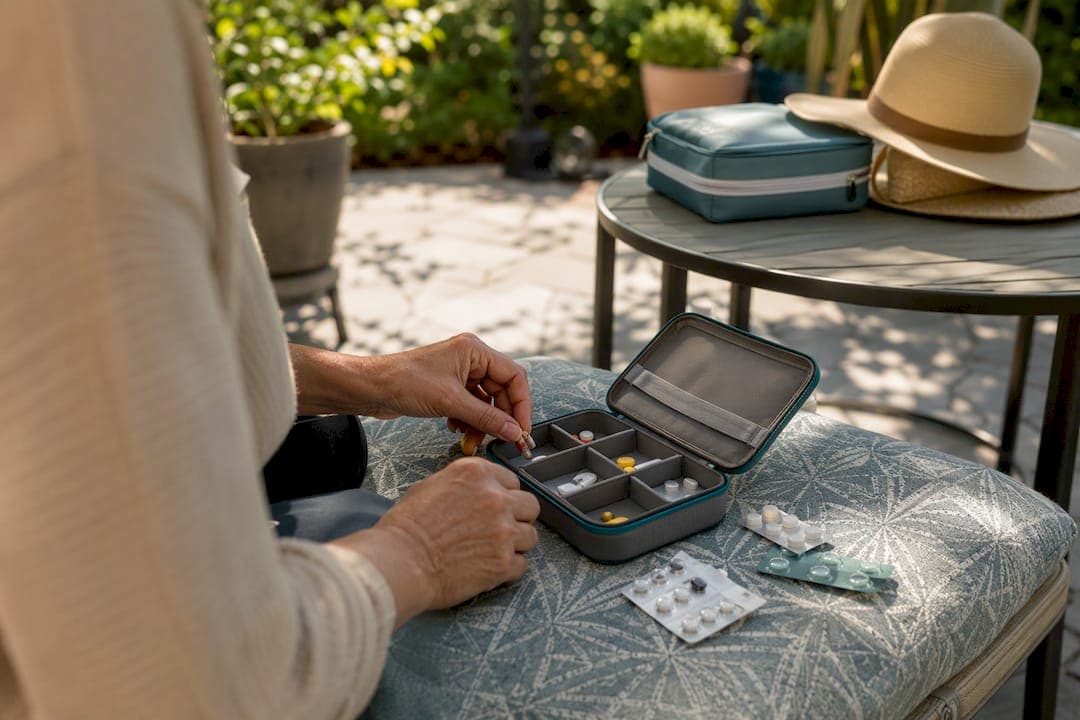
A travel medication checklist keeps doses correct and stops gaps or double-dosing when someone you care for is away from home. Get three things right first: book a clinical review well before departure, pack every medicine in original labelled containers inside hand luggage, and build a dosing plan based on elapsed hours since the last dose rather than local clock time. The Daily Dose Tracker turns this into a working system rather than a memory test.
Do this now:
- Book a GP, specialist or travel clinic appointment well before travel if the trip allows it
- Pack a full travel supply of medicines in hand luggage, in their original packaging
- Set alarms based on hours elapsed since the last dose, not the destination's clock time
Key Takeaways
Maintaining correct dosing while travelling depends on early clinical review, hand-luggage packing with original labels, and elapsed-hours dosing rather than clock-time guesswork.
| Point | Details |
|---|---|
| Book early | Arrange a clinical review four to six weeks before travel to sort prescriptions, vaccines and dosing changes. |
| Pack smart | Keep medicines in original labelled containers in hand luggage, with extra supply for delays. |
| Track by elapsed hours | Base dosing on hours since the last dose, not local clock time, especially for insulin and anti-epileptics. |
| Carry documentation | A doctor's letter on clinic letterhead speeds up security checks and emergency treatment abroad. |
| Use a shared digital plan | The Daily Dose Tracker turns the checklist into schedules, alarms and household sharing that work offline. |
This article is general information, not a substitute for advice from a qualified doctor. Consult a qualified healthcare professional about your own circumstances before acting on anything here.
Table of Contents
- Travel medication checklist: what to do, in order
- How do you adjust dosing schedules across time zones?
- What documents and packing rules keep medicines safe in transit?
- Running the checklist through The Daily Dose Tracker while travelling
- Who should you see before you go, and what would postpone travel?
- Do travel vaccines or altitude affect existing medicines?
- What if a dose is missed, doubled, or a medical emergency happens abroad?
- Why professional consultation still beats a generic checklist
- The gap between having a plan and using one
- How The Daily Dose Tracker turns this checklist into daily practice
- Sources
Travel medication checklist: what to do, in order
Start preparing as early as you reasonably can. Preparing well before travel gives enough runway to sort prescriptions, adjust dosing schedules and get a doctor's letter written and signed, according to CDC travel health guidance. If the trip is routine and short, a shorter lead time may suffice, but leaving too little time increases risks.
- Build a master medication list. Record the generic name, dose, timing, reason for taking it, and any allergies, for every medicine the person takes. This document does more work than any single item you pack.
- Sort prescriptions and refills. Contact the prescriber or pharmacy for enough supply to cover the trip plus a buffer, and ask about refill options if the trip runs long.
- Get a doctor's letter for controlled medicines or devices. Insulin pens, injectables and anything classed as a controlled substance need documentation, ideally on clinic letterhead.
- Pack extra supply and protect it. Add several days beyond the planned length of the trip to cover delays, and keep temperature-sensitive items in an insulated pouch.
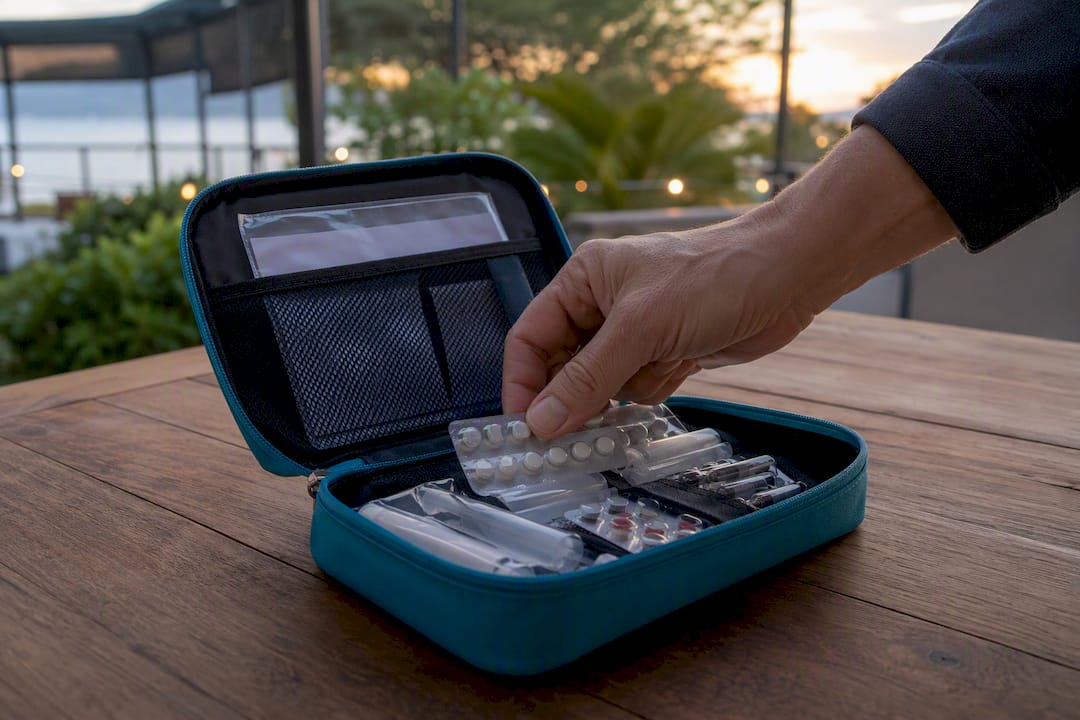
- Prepare dose packs and a backup plan. Ask a pharmacy about blister packs or multi-dose organisers, and decide in advance what happens if a device (an insulin pen, an inhaler) fails or is lost.
Pharmacies increasingly offer multi-dose packaging built specifically for this kind of disruption, and it reduces the risk of double-dosing when a carer is administering medicines in an unfamiliar routine, per Medical News Today's travel medicine guidance. For anyone managing several conditions at once, a prescription management guide for multiple health conditions is worth reading alongside this checklist.
Pro Tip: Photograph the master medication list and every prescription label before you leave. A lost phone is recoverable through cloud backup; a lost paper list at 30,000 feet is not.
How do you adjust dosing schedules across time zones?
The safest method is elapsed hours since the last dose, not the local clock. If a medicine is due every 12 hours and the last dose was taken at 8am home time, the next dose is due 12 hours later by the watch, regardless of what the destination clock says. Switching straight to local time on arrival risks compressing or stretching the interval between doses, which matters far more for some drugs than others.
- Once-daily medicines usually tolerate a few hours' drift either way; shift gradually towards local time over two or three days.
- Twice-daily medicines need tighter management, especially across long-haul crossings of six hours or more.
- Insulin, anti-epileptics and immunosuppressants need a specific plan from the prescriber. These are the drugs where a missed or doubled dose has real clinical consequences.
For a short-haul hop of one to three time zones, most people can simply keep dosing on elapsed hours until the next scheduled event and let the small drift resolve naturally. Long-haul travel across seven or eight zones is different: clinicians often set out a written plan covering the flight day and the first 48 hours after landing, with exact elapsed-hour timings rather than clock times. Mental arithmetic is the single biggest cause of dosing errors on the move, and a written or digital record beats memory every time, according to WebMD's travel medication guidance. Write down the exact time of the last dose before you board, and let an alarm do the counting.
What documents and packing rules keep medicines safe in transit?
Carry medicines in your hand luggage, not in checked baggage. Checked bags go missing, get delayed, and sit in unpressurised, temperature-uncontrolled holds. The CDC Yellow Book advises that anyone managing a chronic condition should keep medicines with the traveller, in original labelled containers, with enough supply to cover the whole trip plus some extra for delays.
A doctor's letter should include:
- The prescribing clinic's letterhead and contact details
- Every medicine, its dose, and the medical reason for it
- An emergency contact number for the prescribing team
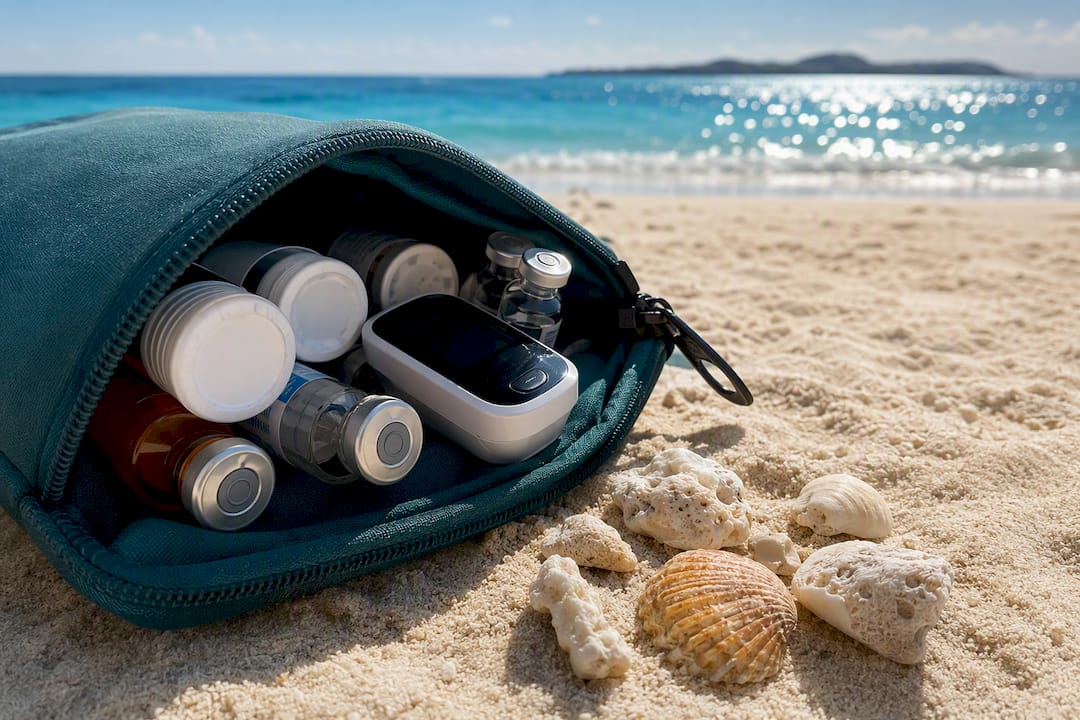
Original packaging matters at security checkpoints and customs. An unlabelled pill organiser invites questions a printed label answers instantly. For anything temperature-sensitive, insulin, certain biologics, some patches, use an insulated carrier with cold packs and never leave it in a car, a glove compartment or checked luggage, where heat or cold can degrade the active ingredient within hours. Syringes, pens and spare needles are generally permitted through security with the accompanying prescription or doctor's letter, but check the specific carrier and airport rules before travel. A medication summary referral letter template gives a practical starting format for the letter itself.
Running the checklist through The Daily Dose Tracker while travelling
A checklist on paper is a good start. A checklist that fires alarms, checks interactions and shares itself with another carer automatically is what actually holds up on day three of a trip when everyone is tired and the schedule has slipped.
- Build a travel schedule before departure. Log the exact time of the last pre-flight dose, then let the platform calculate elapsed-hours timings for the days ahead.
- Run an interaction check before you go. Any new travel medicine, an antimalarial, a motion sickness tablet, gets checked against the existing regimen automatically.
- Turn on refill predictions. These flag a supply gap before it becomes an emergency abroad, rather than after.
- Share the plan. Household members or a professional care team can see the same schedule in real time, so a missed alarm on one device doesn't mean a missed dose.
- Prepare for patchy signal. Export the medication list as a document before you leave home turf, and rely on local device notifications rather than a constant connection.
Pro Tip: Set up household sharing at least a week before departure and test it, not on the morning of the flight. A second person seeing the same alarms is the difference between a missed dose being caught in minutes rather than hours.
The platform runs under UK GDPR standards, and accessibility settings, larger fonts, dark mode, are there for carers managing a schedule on a small phone screen in poor light. A family medication safety guide covers the sharing side of this in more depth.
Who should you see before you go, and what would postpone travel?
Book the GP, specialist or a travel clinic four to six weeks before departure where the trip allows it, following CDC advice on pre-travel review. That appointment should confirm any dosing changes needed for the destination, check whether planned vaccines interact with existing medicines, and set out a plan for medicines timed around a procedure day if one falls during the trip.
Some situations are genuine red flags rather than inconveniences to work around:
- A condition that has been unstable or recently adjusted
- A recent adverse reaction to any current medicine
- Inability to secure the full supply of an essential medicine before departure
Where any of these apply, that's a conversation for the clinician, not a workaround for the carer. Before departure, set up emergency contact details inside the medication plan, including local care instructions relevant to the destination, so anyone treating the patient abroad has the full picture immediately. An emergency contacts guide for medication plans walks through how to structure this properly.
Do travel vaccines or altitude affect existing medicines?
Vaccines and altitude both interact with certain medicines, and neither interaction is obvious from the outside. Some travel vaccines are live and carry specific guidance for people on immunosuppressants, so the sequencing of vaccine and medicine can matter as much as the vaccine itself. Altitude changes affect blood oxygen and clotting in ways that matter for people on anticoagulants, certain heart medicines and some respiratory treatments; a destination above 2,500 metres is a different conversation to a beach holiday at sea level.
This is exactly the territory a travel health specialist is trained to navigate, because the interaction depends on the specific medicine, the specific vaccine, and the specific altitude profile of the trip. Raise both questions at the same pre-travel appointment rather than treating vaccines and dosing as separate errands, since a clinician reviewing one in isolation from the other can miss a real interaction. If the itinerary includes a rapid ascent, a stopover at altitude, or a multi-country trip with different vaccine requirements at each leg, say so explicitly when booking the appointment so the clinic has time to research the specific combination rather than giving generic advice on the day.
What if a dose is missed, doubled, or a medical emergency happens abroad?
A missed or doubled dose abroad needs a calm, specific response rather than a guess. For most medicines, the safe move is to take the missed dose as soon as it's noticed unless it's nearly time for the next one, in which case skip it and resume the normal schedule. Never double up to compensate without checking first. Insulin, anti-epileptics and blood thinners are the exceptions where guessing carries real risk, and the doctor's letter carried for the trip should specify what to do for that particular medicine.
For a genuine medical emergency, having the master medication list and doctor's letter to hand means a foreign clinician can act immediately rather than waiting on a translated history. Keep a copy of the local emergency number for the destination alongside the usual home contacts, and make sure whoever is travelling with the patient, or a household member reachable by phone, has access to the same information. If a device fails (a lost insulin pen, a damaged inhaler), the doctor's letter also serves as proof of prescription for a local pharmacist trying to source a replacement, which speeds things up considerably compared with explaining the situation from scratch.
Why professional consultation still beats a generic checklist
No checklist replaces a clinician who knows the person's specific history, current medicines and the destination's particular risks. A travel health specialist consulted four to six weeks before departure can catch combinations a general list never will, an antimalarial that interacts with an existing prescription, a vaccine timing conflict, a destination-specific restriction on a controlled medicine.
This matters most for anyone managing multiple conditions or a recently changed regimen, where the margin for error is smaller. Booking that appointment early, and bringing the master medication list to it, gives the specialist something concrete to work from rather than a verbal summary reconstructed from memory. A chronic condition medication checklist covers how to prepare for that consultation in more detail.
The gap between having a plan and using one
Most carers I've seen fail at this don't fail through carelessness. They fail because they trusted memory over a written record, or converted time zones in their head at 2am and got it wrong. The fix isn't more willpower, it's redundancy: printed list, digital record, tested alarms, before departure, not during it.
— Prasant
How The Daily Dose Tracker turns this checklist into daily practice
Every task on this checklist maps to something inside the platform rather than sitting as a separate to-do. The master medication list becomes a schedule with dose, timing and reason attached. The elapsed-hours dosing plan becomes an alarm that fires on schedule regardless of which country the phone thinks it's in. Interaction checks run automatically when a new travel medicine gets added, and refill predictions flag a supply gap while there's still time to act on it.
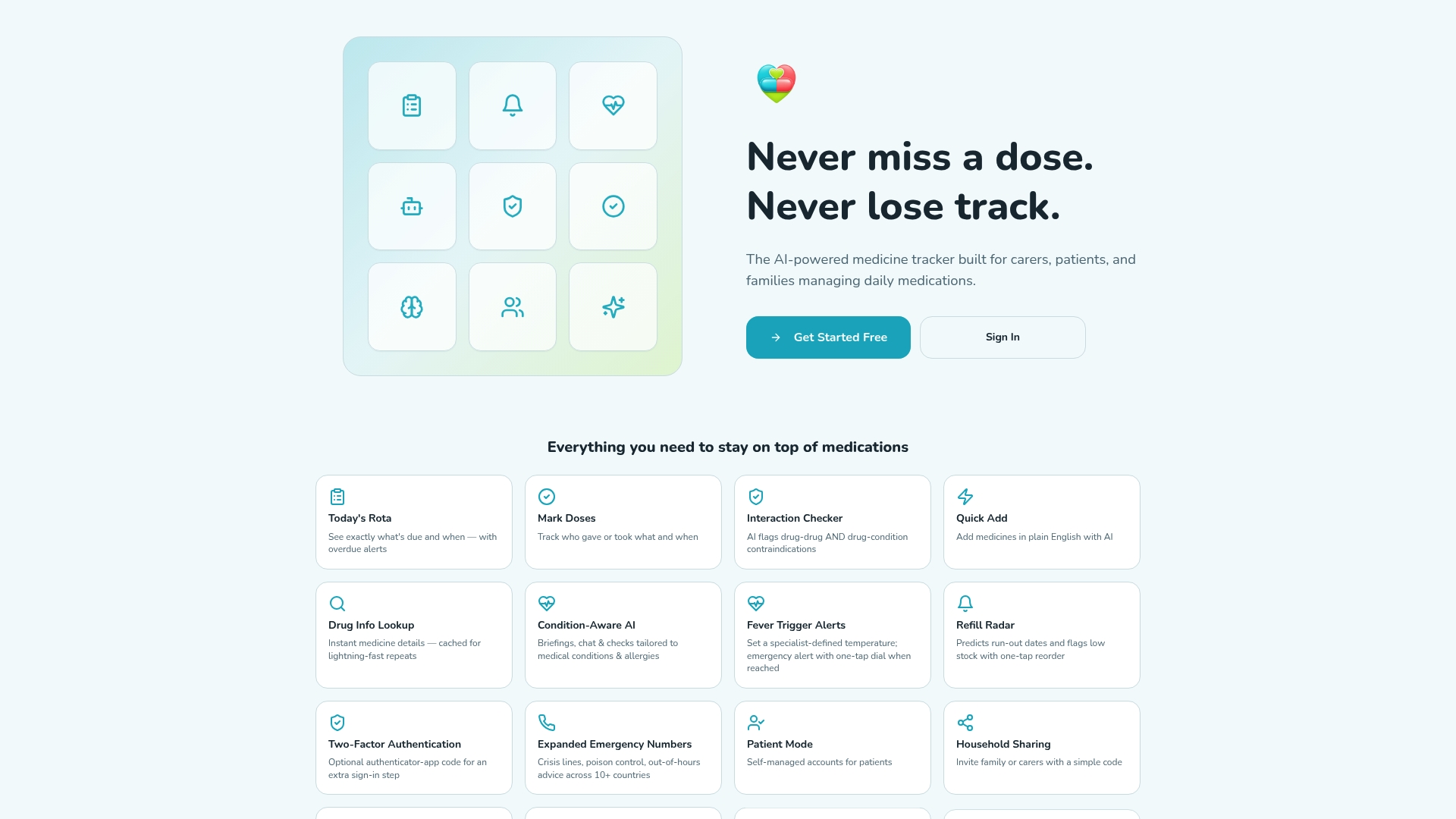
Household sharing means a second carer or a professional care team sees the same live schedule, so one missed notification doesn't mean one missed dose. The core scheduling and logging tools are free to use, with advanced features, refill predictions, multi-patient management, appointment tracking, available on the paid Individual and Pro tiers, and the whole platform runs to UK GDPR standards. Set up the travel schedule at The Daily Dose Tracker before the next trip, log the pre-departure dose, and let the alarms take over from there.
Sources
- Traveling Abroad with Medicine | Travelers' Health | CDC
- Travelers with Chronic Illnesses - CDC Yellow Book, 2026 edition - NCBI Bookshelf
- Traveling with medication: Travel basics and more | Medical News Today
- How to manage medications while you travel | WebMD