

A properly prepared medication summary attached to a referral must list reconciled current medications, allergies and intolerances, and the source and date of reconciliation so the receiving team can act safely without delay. Per LOINC 56445, a medication summary is a point-in-time snapshot of currently prescribed medications and should include allergy status.
Every medication summary referral letter must contain:
- Full patient identifiers (name, date of birth, NHS number)
- Reconciled medication list with dose, route, frequency and indication
- Allergies and adverse drug reactions (state "none known" explicitly if applicable)
- Source(s) of the medication information and date/time of verification
- Last prescriber name and date of last medication review
- Preparer name, role and contact details
Immediate next step: attach the summary as a clearly named PDF to the NHS e-RS referral record, or send via the agreed secure NHS channel, and note the consent basis for sharing.
Key takeaways
A complete medication summary referral letter requires a reconciled medication list with dose, route, frequency and indication, documented allergy status, the source and date of reconciliation, and the preparer's contact details, all attached securely to the NHS e-RS referral.
| Point | Details |
|---|---|
| Reconciled medication list | Include dose, route, frequency, indication and last review date for every medicine. |
| Allergy documentation | Always state allergy status explicitly; "no known drug allergies" is a required entry, not a blank. |
| Source and date of reconciliation | Record where the information came from and when it was verified, per PRSB and TRAQS guidance. |
| High-risk medicine flags | Bold-label anticoagulants, insulin, opioids and antipsychotics; include the most recent monitoring value inline. |
| Thedailydosetracker | Produces a UK GDPR-compliant, auditable PDF export with timestamp and source trail for immediate attachment to referrals. |
This article is general information, not a substitute for advice from a qualified doctor. Consult a qualified healthcare professional about your own circumstances before acting on anything here.
Table of Contents
- Who should prepare the medication summary, and when?
- What does the medication summary checklist include?
- How to format and send the medication summary securely in the UK
- How to export a medication summary from a digital tool
- Quality checks to perform before sending
- Copy-and-use templates: short and detailed examples
- When to flag an urgent medication review alongside the referral
- What experienced practitioners actually do differently
- Thedailydosetracker makes medication summary exports faster and auditable
- Sources
Who should prepare the medication summary, and when?
Primary responsibility sits with the referring clinician or their delegated colleague. A community pharmacist or carer may produce an export when formally delegated, but a clinician must sign off the final document. For carers collecting medication history, a structured approach to patient medication history makes that delegation safer.
The Alberta Health Services MedRec process frames this cleanly: generate the list, reconcile discrepancies, then share the updated list with the team and patient. That three-step model applies equally at the point of referral, at hospital discharge, and at any change of care setting.
Timing guidance:
- Prepare the summary at the point of referral, before submission
- Prepare or update it whenever medication changes have occurred in the prior 72 hours
- For high-risk medicines (anticoagulants, insulin, opioids), update immediately regardless of the 72-hour window
- Routine referrals: target completion within one working day of the decision to refer
- Urgent referrals: complete and attach before or simultaneously with the referral submission; phone the receiving team to confirm receipt
What does the medication summary checklist include?
The PRSB Clinical Referral Information Standard lists medications and medical devices as a required section in referral records and recommends including sources and the date of verification. TRAQS ideal referral letter guidance confirms that current and relevant medications are core items receiving clinicians expect to find.
Use the table below as your medication list template. Copy the column headers directly into your referral document.
| Field | What to record |
|---|---|
| Medication name and formulation | Generic name preferred; include brand if critical (e.g. modified-release) |
| Dose | Numeric dose with unit (e.g. 5 mg) |
| Route | Oral, subcutaneous, topical, inhaled, etc. |
| Frequency | e.g. once daily, twice daily, PRN |
| Indication | Brief clinical reason (e.g. atrial fibrillation) |
| Prescriber / source | GP, hospital, patient report, pharmacy |
| Last review date | Date of most recent clinical review |
| Recent change? | Started/stopped/changed in last 7 days: yes/no |
| Monitoring required | e.g. INR, renal function, blood glucose |
| PRN instructions | Trigger, maximum dose, frequency limit |
After the medication table, add a clearly labelled allergy section. Never leave it blank; "no known drug allergies" is a clinically meaningful statement.
Document your reconciliation sources explicitly. ISMP Canada recommends sharing the reconciled list with community pharmacists and the patient's circle of care, including complete medication details and allergy status. ASHP guidance adds that a thorough patient interview plus verification from at least one additional source is the foundation of safe reconciliation.
Pro Tip: Flag high-risk medicines (anticoagulants, insulin, opioids, antipsychotics) with a bold label in the medication table. Add the most recent relevant monitoring value inline, for example "Warfarin 3 mg oral once daily — INR 2.4 on 14 May 2026." This prevents the receiving team from having to chase results before acting.
For polypharmacy cases, guidance on managing prescriptions for multiple health conditions covers how to prioritise and present a complex medication list without losing clarity.
How to format and send the medication summary securely in the UK
NHS e-RS guidance advises that referral clinical content should be appropriate but not excessive, and that where local pro-formas exist, referrers should complete and attach them. Check the service detail page before submitting.
Practical formatting rules:
- Use a single, clearly labelled PDF; avoid multiple attachments where one will do
- Filename convention:
SURNAME_Firstname_DOB-YYYYMMDD_medlist_YYYYMMDD.pdf(e.g.Smith_Jane_DOB-19650312_medlist_20260601.pdf) - Attach the PDF to the e-RS referral record; if the service pro-forma requires it, paste the medication table into the referral body as well
- Include a one-line consent and GDPR statement in the document footer, for example: "Medication information shared with consent of the patient/carer for the purpose of clinical care under UK GDPR Article 9(2)(h)."
- State the source(s) of the medication information in the footer alongside the consent line
Pro Tip: Put the preparer's name, role, and direct contact number on the first page. Receiving teams frequently need rapid clarification on a dose or a recent change, and a named contact halves the time spent on that call.
How to export a medication summary from a digital tool
A step-by-step workflow for generating an auditable export:
- Open the patient profile in your medication management tool and confirm you are viewing the correct patient record.
- Select "export medication summary" or the equivalent export function.
- Choose fields to include: all current medications, allergies, recent changes, audit trail, and any monitoring notes.
- Export as PDF and verify the filename matches your local naming convention before saving.
- Open the exported PDF and run the verification checklist below before attaching it to the referral.
Verification checklist after export:
- Confirm every dose, route and frequency matches the current clinical record
- Check that over-the-counter medicines and supplements are included (patients often omit these)
- Verify allergy status is present and accurate
- Confirm the source of each medication entry is stated
- Add the preparer's signature, role and date before sending
Thedailydosetracker produces a portable medication summary export that includes a full audit trail and is compliant with UK GDPR. Its household sharing and multi-patient features mean a carer can maintain a living medication record and generate a current export at the point of referral without starting from scratch. For more on why digital logs reduce transcription errors, see why digital medication logs are safer.
When a carer exports on behalf of a clinician, document the delegated authority explicitly in the export notes and record the chain of custody: who requested the export, who produced it, and who reviewed it before submission.
Quality checks to perform before sending
A two-minute pre-send check prevents the most common, clinically significant omissions:
- Confirm patient identifiers match the referral (name, DOB, NHS number)
- Cross-check the medication list against at least one other source (GP record, pharmacy label, discharge summary)
- Verify allergies are documented; "none known" is acceptable, a blank field is not
- Confirm high-risk medicines are flagged and relevant monitoring values are included
- Check that every medication entry has a dose, route and frequency (missing any one of these is a clinical risk)
- Confirm the preparer's name, role, contact details and preparation date are on the document
Common errors to avoid:
- Incomplete entries: dose recorded but route and frequency missing
- Omission of over-the-counter medicines, supplements and herbal products
- Blank allergy field with no explicit "none known" statement
- No source or date of reconciliation recorded
- Sending an outdated list without noting the date of last review
If you discover a discrepancy after the referral has been sent, contact the receiving team directly by phone, send a corrected medication summary via secure route, and document the correction in the patient record with the date and time. Guidance on reducing medication errors in elderly home care covers escalation steps for high-risk situations.
Copy-and-use templates: short and detailed examples
Short template (routine referrals)
MEDICATION SUMMARY — REFERRAL ATTACHMENT
Patient: [Full name] | DOB: [DD/MM/YYYY] | NHS No: [000 000 0000]
GP Practice: [Name] | Date prepared: [DD/MM/YYYY]
Preparer: [Name, role, contact number]

CURRENT MEDICATIONS
[Use medication table fields above — one row per medicine]

ALLERGIES / ADRs: [List or state "No known drug allergies"]

SOURCE OF INFORMATION: [GP record / patient report / pharmacy / discharge summary]
Date/time of reconciliation: [DD/MM/YYYY HH:MM]

GDPR statement: Information shared with patient consent for clinical care purposes.
Use this for routine, single-condition referrals where the medication list is straightforward and no recent changes have occurred.
Detailed template (complex or urgent referrals)
All fields from the short template, plus:
RECONCILIATION NOTES
Sources used: [List all sources checked]
Discrepancies identified: [Yes/No — if yes, describe and state resolution]
Medicines started/stopped/changed in last 7 days: [List with dates and reason]

HIGH-RISK MEDICINES
[Bold flag for anticoagulants, insulin, opioids, antipsychotics]
Relevant monitoring: [e.g. INR 2.4 on 14/05/2026; eGFR 48 on 01/06/2026]

SUPPORTING DOCUMENTS ATTACHED: [Lab report / discharge summary — list filenames]
Use the detailed template for patients on high-risk medicines, those with recent medication changes, or any urgent referral where the receiving team must act on medication information immediately. Attach supporting lab reports and name them in the document.
Filename example: Smith_Jane_DOB-19650312_medlist_20260601_detailed.pdf
When to flag an urgent medication review alongside the referral
Some clinical situations require more than a well-prepared summary. They require a phone call to the receiving team and simultaneous escalation.
Red flags that trigger urgent action:
- INR out of therapeutic range with active bleeding or thrombotic risk
- Recurrent hypoglycaemia or suspected insulin dosing error
- Suspected overdose or toxicity (e.g. digoxin, lithium, methotrexate)
- Abrupt cessation of a critical medicine (anticoagulant, antiepileptic, corticosteroid)
- New severe allergic reaction following a recently prescribed medicine
- Unexplained acute deterioration within 48 hours of a medication change
When any of these apply, include a bold line at the top of the referral: URGENT MEDICATION REVIEW REQUIRED. Phone the receiving team before or immediately after submitting the referral. Send the medication summary by secure route simultaneously; do not wait for the e-RS system to process the attachment.
Clinical examples: anticoagulant-related bleeding in a patient on warfarin, insulin dosing errors in frail older adults with renal impairment, suspected digoxin toxicity presenting with bradycardia and nausea.
What experienced practitioners actually do differently
The formal guidance tells you what to include. What it does not tell you is how to make the document usable under pressure.
Keep the medication table compact and machine-readable. Consistent spelling of drug names and standard abbreviations (od, bd, tds, prn) mean the receiving pharmacist can scan the list in seconds rather than deciphering freehand variations. One inconsistency in a 12-item list is enough to cause a clarifying call.
Use a consistent filename convention every time. A team that receives dozens of referrals a week will file and retrieve your document faster, and you will spend less time on the phone explaining which attachment to open.
For carers: keep a living export on the household device and update it after every medication change. When a referral is needed urgently, a current copy is ready to attach immediately. Thedailydosetracker supports exactly this workflow, with real-time updates and an exportable audit trail that shows when each entry was last reviewed.
Thedailydosetracker makes medication summary exports faster and auditable
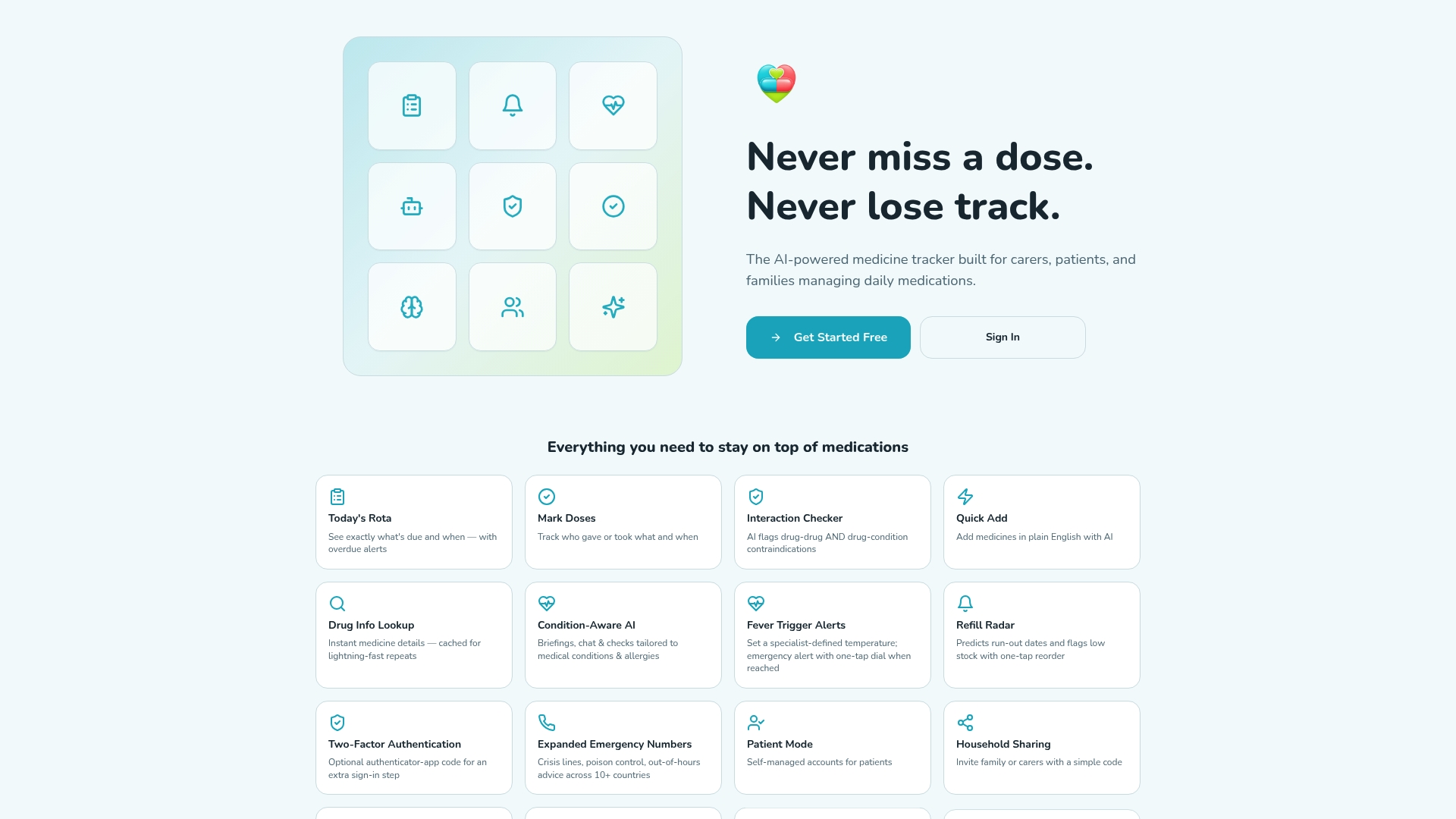
Thedailydosetracker gives referrers and carers a single place to maintain an accurate, up-to-date medication record and generate a formatted export at the point of referral. The platform's audit trail records who added or changed each entry and when, satisfying PRSB expectations for source and date of reconciliation without additional paperwork. Household sharing means a carer and a clinician can work from the same live record, and multi-patient management keeps complex cases organised. Every export is UK GDPR-compliant.
Practical benefits for referrers and carers:
- Formatted PDF export ready to attach to e-RS in seconds
- Audit trail included automatically, with preparer and timestamp
- Allergy and drug interaction checks built in
- Multi-patient and household sharing for care teams and family carers
Start managing medication records and producing referral-ready exports at Thedailydosetracker.
Sources
- Clinical Referral Information Standard - PRSB
- Referrer best practice guidelines - NHS e‑Referral Service
- TRAQS – Ideal referral letter contents
- LOINC 56445 — Medication summary Document
- Primary care medication reconciliation guide - ISMP Canada
- Medication reconciliation guidance document for pharmacists - ASHP
- MedRec quick reference guide - Alberta Health Services