

Keeping a symptom log makes medication reviews safer, faster, and more precise. That single habit gives your GP or pharmacist something they rarely have: a reliable, timestamped record of what your body actually did between appointments, rather than a best-guess reconstruction under time pressure. The NHS medicines-optimisation framework emphasises using patient-reported information to inform prescribing decisions, and clinical evidence consistently shows that organised symptom logs improve consultation efficiency and help clinicians avoid unnecessary tests or interventions.
Before your next review, do two things:
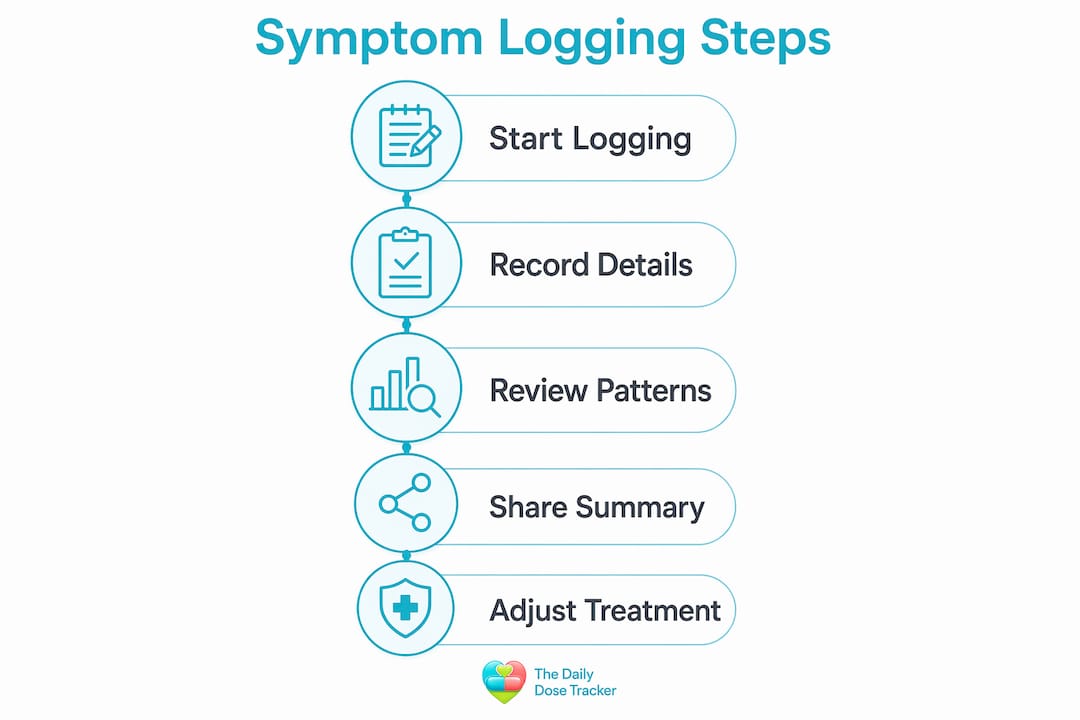
- Start a two-week log today. Record the date, time, symptom name, severity on a 0–10 scale, and whether the symptom appeared before or after a dose.
- Prepare a one-page summary. Pull out the top three patterns, flag any suspected drug-related problems, and bring it to the appointment in print or on your phone.
That summary alone changes the dynamic of the consultation. Clinicians who receive structured, pre-synthesised patient data are more likely to invest time in accurate treatment planning rather than spending the appointment reconstructing a timeline from memory, making solo & group practice software for Canadian therapists an ideal tool for managing patient-provided symptom data.
Table of Contents
- Why symptom logs make medication reviews safer and more useful
- Exactly what to record: a practical symptom-log template you can start today
- How clinicians use symptom logs during a medication review
- Ways to keep a log: paper, apps and the features that matter in the UK
- How to prepare your symptom log for a GP or pharmacist medication review
- When to start logging and how long to keep a record before a review
- Privacy, sharing and UK data considerations
- How Thedailydosetracker supports symptom-augmented medication reviews
- Key takeaways
- A carer's perspective on fitting logging into real life
- Thedailydosetracker: a practical tool for your next medication review
- Useful sources and further reading
Why symptom logs make medication reviews safer and more useful
A medication review without a symptom log is a bit like a car service where the mechanic only hears what you remember to mention in the first two minutes. The log fills the gap between what you recall and what actually happened.

Reducing recall bias is the most immediate benefit. Clinicians use precise timestamps and intensity ratings to correlate symptoms with dosing schedules, which turns a vague "I felt off last week" into "severity 7/10, onset 90 minutes after the evening dose, resolved by morning." That specificity makes dose-timing adjustments or reductions actionable rather than speculative.
The concrete clinical benefits of symptom documentation include:
- Detecting adverse drug reactions (ADRs). Adverse-effect reporting within symptom logs is frequently the most actionable element for medication reviews because it directly points to drug-related problems clinicians can address.
- Revealing non-adherence. Missed doses recorded honestly in a log explain symptom patterns that would otherwise prompt unnecessary investigations.
- Showing trends in effectiveness. A log covering several weeks of a new antihypertensive tells a clinician whether blood pressure symptoms are improving, stable, or worsening, without relying on a single in-clinic reading.
- Supporting deprescribing decisions. When a log shows that a symptom predates a recently added medicine, it gives the prescriber grounds to consider stopping or reducing that medicine rather than adding another.
In oncology, where patient-reported symptom monitoring has been studied most rigorously, structured reporting has been associated with better symptom control and fewer emergency visits in some studies, though the evidence base is strongest in that specific population. For general practice, the gains are more modest but still meaningful: better shared decision-making, fewer wasted appointments, and a clearer picture of whether a medicine is doing what it should.
Exactly what to record: a practical symptom-log template you can start today
The fields below cover everything a clinician needs to interpret a symptom in the context of your medicines. You do not need to fill every column for every entry; fill what is relevant.
| Field | What to record | Example entry |
|---|---|---|
| Date and time | Exact date; time of day | 14 June, morning |
| Symptom | Plain description, one symptom per row | Dizziness |
| Severity (0–10) | 0 = none, 10 = worst imaginable | 6 |
| Relation to dose | Before dose / within 2 hrs after / 2–6 hrs after / unrelated | Within 2 hrs after morning dose |
| Current medicine and dose | Name and dose as on the packet | Amlodipine 5 mg |
| Missed doses | Yes / No; if yes, which dose | No |
| Suspected trigger or context | Food, activity, stress, alcohol, other | Stood up quickly after breakfast |
| Photo attached | Yes / No | No |
| Notes | Anything else relevant | Symptom resolved after sitting for 10 minutes |
A second row might read: 14 June, 20:30 / Ankle swelling / 4 / Unrelated to dose timing / Amlodipine 5 mg / No / Sedentary day / Yes (photo attached) / Swelling present since afternoon.
Those two rows tell a clinician that dizziness is likely postural and dose-related, while ankle swelling is a known side effect of amlodipine that warrants review. Without the timing data, both symptoms might be attributed to the underlying condition.
Pro Tip: Before your appointment, scan your log for recurring patterns and write one sentence per pattern at the top of your summary sheet. For example: "Dizziness, severity 5–7, consistently within two hours of the morning dose, three times in two weeks." Clinicians can act on a sentence like that immediately; they cannot act on two weeks of raw daily entries during a ten-minute appointment.
Adding contextual fields, such as diet, activity, and missed doses, alongside symptoms helps clinicians distinguish drug side effects from external triggers, which in turn reduces unnecessary medication changes. This is especially useful when tracking symptoms alongside medication intake over several weeks.
How clinicians use symptom logs during a medication review
Understanding how a GP or pharmacist actually reads your log helps you structure it so the right information is visible immediately.
The typical workflow runs in four stages. Before the appointment, if you have shared your log digitally or handed it in early, the clinician can review it and arrive with specific questions rather than starting from scratch. During the appointment, the log replaces the open-ended "how have you been?" with a focused history-taking session: the clinician moves straight to the entries flagged as severe or frequent. They then correlate those entries with your medication timing and doses, looking for patterns such as symptoms that cluster after a specific dose or that disappeared when a medicine was paused.
From that correlation, decisions follow: adjust the dose, switch the medicine, order a blood test to rule out a non-drug cause, or stop a medicine that is no longer needed. Prepared symptom logs change the consultation dynamic into a collaborative dialogue and encourage clinicians to invest more time in accurate treatment planning.
The biggest practical gain is in detecting drug-related problems (DRPs) that would otherwise go unnoticed. A patient who mentions "occasional stomach upset" verbally gives a clinician very little to work with. The same patient who shows a log entry reading "nausea, severity 6, every morning within 30 minutes of taking ibuprofen, six days in a row" gives the clinician a clear DRP to address.
Patient-held medication records that combine medication lists with space for reported problems, including missed doses and adverse effects, also support medication reconciliation across care settings. This matters particularly after a hospital discharge, when medicines may have changed and discrepancies between hospital and GP records are common.
Ways to keep a log: paper, apps and the features that matter in the UK
Three broad approaches exist, each with genuine trade-offs.

| Method | Pros | Cons | Best for |
|---|---|---|---|
| Paper record or spreadsheet | No technology required; easy to hand to a clinician; no privacy concerns about third-party apps | Hard to search or visualise trends; no reminders; photos require separate attachment | Patients who prefer low-tech or have limited smartphone access |
| Basic symptom-tracker app | Reminders; searchable entries; some export options | May lack medication fields; data may be stored on overseas servers; GDPR compliance varies | Patients already using a health app who want a simple upgrade |
| Integrated medication-plus-symptom platform | Links symptoms directly to doses; visual trend charts; export/print; household sharing; GDPR-compliant options available in the UK | Requires setup time; ongoing use of a device | Carers managing complex or multi-medicine regimens; patients with long-term conditions |
When choosing an app for UK use, prioritise these features:
- Export and print. A log that cannot leave the app is not useful in a consultation.
- Sharing controls. You should be able to choose exactly what you share and with whom.
- Data visualisation. Charts showing symptom frequency or severity over time are far easier for a clinician to interpret than a list of raw entries.
- Reminders. Consistent logging depends on being prompted at the right moment.
- Offline access. Connectivity in clinics and rural areas is not guaranteed.
- GDPR compliance and UK data storage. Health data is sensitive; check where it is stored and who can access it.
- Photo attachment. Rashes, swelling, and other visible symptoms are far better documented with a photograph than a text description.
Electronic health tools that support symptom reporting have been shown in multiple studies, including randomised controlled trials, to prompt positive medication changes and improve symptoms, particularly when the tool integrates well with clinical workflows. The key word is integration: a log that cannot be exported or summarised quickly creates a barrier rather than removing one.
For carers managing children's medicines, the logging considerations differ somewhat from adult regimens; a parent's guide to child medication tracking covers those specific needs in more detail.
How to prepare your symptom log for a GP or pharmacist medication review
Raw daily entries are the raw material; the one-page summary is the finished product. Here is how to turn one into the other before an appointment.
- Verify your current medication list. Check that every medicine, dose, and frequency in your log matches what is on your repeat prescription. Discrepancies are worth flagging immediately.
- Highlight suspected drug-related problems. Go through your entries and mark any symptom that appears consistently after a dose, worsens over time, or matches a known side effect listed on the medicine's patient information leaflet.
- Extract the top three patterns. Choose the three most frequent or most severe symptom-dose relationships and write one sentence each. These become the opening of your summary.
- Add a short timeline. Note when each medicine was started or changed, and when symptoms first appeared. A simple list of dates is enough.
- Write two or three questions for the clinician. For example: "Could the ankle swelling be caused by amlodipine?" or "Is it safe to take ibuprofen alongside my current medicines?"
- Decide what to share and what to keep private. You are not obliged to hand over your entire log. Share the summary and the specific entries that are relevant; keep personal notes private if you prefer.
For the handover itself, a printed one-page summary is the most universally accessible format. If you are sharing digitally, use a secure method: NHSmail if your GP practice supports it, or hand a printed copy directly to the clinician. Reviewing a complete medication history alongside your symptom summary gives the clinician the fullest possible picture.
When to start logging and how long to keep a record before a review
Timing matters. A two-day log captures almost nothing useful; a six-month unstructured diary is too much to interpret in a short appointment.
Suggested durations by situation:
- New medicine: 2–4 weeks of focused daily logging to detect early adverse effects or changes in symptom control.
- Dose change: 4–12 weeks, depending on how quickly the medicine reaches a steady state in the body.
- Long-term condition or complex regimen: Ongoing logging with a monthly summary prepared before each scheduled review.
Common triggers that should prompt you to start or intensify logging:
- A new side effect appears, particularly one that is severe or affects daily life.
- Symptom severity increases without an obvious non-drug explanation.
- Discharge from hospital, where medicines may have been added, stopped, or changed.
- Starting or stopping any medicine, including over-the-counter medicines and supplements.
- Age 65 or older, or taking five or more medicines simultaneously (polypharmacy), where the risk of drug-related problems rises.
For frequency, daily entries are ideal during the first weeks of a new medicine. After that, logging every time a symptom occurs, plus a brief daily note of missed doses, is usually sufficient. If a symptom is severe, worsening rapidly, or accompanied by signs such as chest pain, difficulty breathing, or a severe rash, do not wait for a scheduled review: contact your GP or call 111.
Privacy, sharing and UK data considerations
Personal health data, including symptom logs, is protected under UK GDPR. You control who sees it. No clinician, pharmacist, or app provider can share your health information without your consent, and you have the right to request deletion of your data from any digital service.
Practical steps for safe sharing:
- Choose your export format carefully. A PDF is readable by any clinician; a proprietary app file may not be. Always export to a standard format before a consultation.
- Remove unrelated identifiers if needed. If your log contains personal notes unrelated to the medicines being reviewed, consider editing or printing only the relevant rows.
- Confirm secure transmission. Hand a printed copy directly to the clinician, or ask whether your GP practice accepts documents via NHSmail. Avoid sending health data by standard email or unsecured messaging apps.
- Check your app's privacy settings. Before using any digital logging tool, read its privacy policy and confirm it complies with UK GDPR. Check where data is stored: UK or EU-based servers offer stronger protections than servers in other jurisdictions.
NHS medication reviews are free. You do not need to pay for a private appointment to have your medicines reviewed, and clinicians can accept patient-held records to support medication reconciliation. Digital medication logs that are GDPR-compliant and exportable are increasingly accepted as a legitimate part of the consultation record.
Remote symptom monitoring integrated into electronic health records can improve patient-provider communication and detect otherwise hidden problems, though many benefits in that setting remain supported mainly by qualitative evidence. The practical implication for most UK patients is straightforward: a well-prepared exported summary, handed to a clinician in person, achieves most of the same gains without requiring any EHR integration.
How Thedailydosetracker supports symptom-augmented medication reviews
Consider a carer managing medicines for an elderly parent taking six daily medicines across three different conditions. Keeping a paper log is possible, but correlating symptoms with specific doses across a complex regimen is time-consuming and error-prone. Thedailydosetracker is designed for exactly this situation.
The platform allows the carer to log each dose as it is given, then add a symptom entry directly linked to that dose record. If the parent develops ankle swelling three hours after the afternoon amlodipine dose, the carer logs the symptom, rates it on the 0–10 scale, and attaches a photograph. Over two weeks, the platform's visual trend charts show the pattern clearly: swelling appears consistently on days when the afternoon dose is taken on time, and is absent on the two days it was delayed.
Before the GP appointment, the carer exports a one-page PDF summary showing the top symptom patterns, the medication timeline, and the attached photographs. The GP receives a structured, interpretable record rather than a verbal account, and the appointment focuses on the decision: whether to reduce the amlodipine dose or switch to an alternative.
Features that matter specifically for medication reviews:
- Household sharing and multi-patient management, so a carer can manage logs for more than one person without mixing records.
- Export and print, producing a clean PDF ready to hand to a clinician.
- Visual trend charts, which surface patterns that are invisible in raw daily entries.
- Reminders, which support consistent logging at the times that matter most.
- Multi-device access via a progressive web app, so the log is available on a phone, tablet, or computer.
Thedailydosetracker complies with UK GDPR, and its security and data-protection controls give carers and patients confidence that sensitive health information is handled appropriately.
Pro Tip: Use the photo attachment feature for any visible symptom, particularly rashes, swelling, or skin changes. A photograph dated and timestamped within the app is far more persuasive in a consultation than a verbal description, and it removes any ambiguity about severity or appearance.
Key takeaways
A structured symptom log, shared as a one-page summary at a medication review, is the single most practical step patients and carers can take to improve the safety and efficiency of their medicines management.
| Point | Details |
|---|---|
| Start logging immediately | Begin a two-week log for any new medicine, recording date, time, severity, and dose timing. |
| Record the right fields | Include suspected triggers, missed doses, and photos of visible symptoms alongside severity ratings. |
| Prepare a one-page summary | Extract the top three patterns and two or three questions before every medication review appointment. |
| Share securely | Use print or NHSmail; check that any app you use is UK GDPR-compliant before sharing health data. |
| Thedailydosetracker | Supports symptom-linked dose logging, visual trend charts, photo attachments, and GDPR-compliant export for UK carers and patients. |
A carer's perspective on fitting logging into real life
The advice to "keep a daily log" sounds straightforward until you are managing medicines for someone who resists taking them, has three different conditions, and needs support with personal care as well. The logging does not always happen at the ideal moment.
What actually works is tying the log entry to the medication round itself. The moment you hand over the tablets is the moment you note whether the previous dose caused any problems. It takes thirty seconds if the entry is simple, and it means you never have to reconstruct the previous day from memory.
Photographing visible symptoms, such as a rash or swollen ankle, is one of the highest-value habits a carer can build. A photograph taken on a phone and uploaded immediately is timestamped automatically, which removes any dispute about when the symptom appeared. It also means you do not have to describe a rash to a GP who cannot see it.
Recording missed doses honestly is harder than it sounds. There is a natural reluctance to document that a dose was skipped, particularly if the carer feels responsible. But a missed dose recorded in the log is information; a missed dose omitted from the log is a gap that leads to the wrong clinical decision. Clinicians are not there to judge adherence; they need the data to make safe prescribing choices.
When asking for a structured medication review, be specific. "I'd like a structured medication review" is a recognised NHS process. You are entitled to request one, and bringing a prepared symptom log to that appointment signals to the clinician that you are ready to engage with the process properly. The emotional labour of caring is real, and a well-prepared log is one of the few tools that makes the appointment feel less like a battle for time and more like a genuine conversation.
Thedailydosetracker: a practical tool for your next medication review
Logging symptoms on paper is a perfectly valid starting point, and nothing in this guide requires a specific app. But if you are managing a complex regimen, caring for someone with multiple conditions, or simply want a log that is easy to export and share, Thedailydosetracker removes most of the friction.
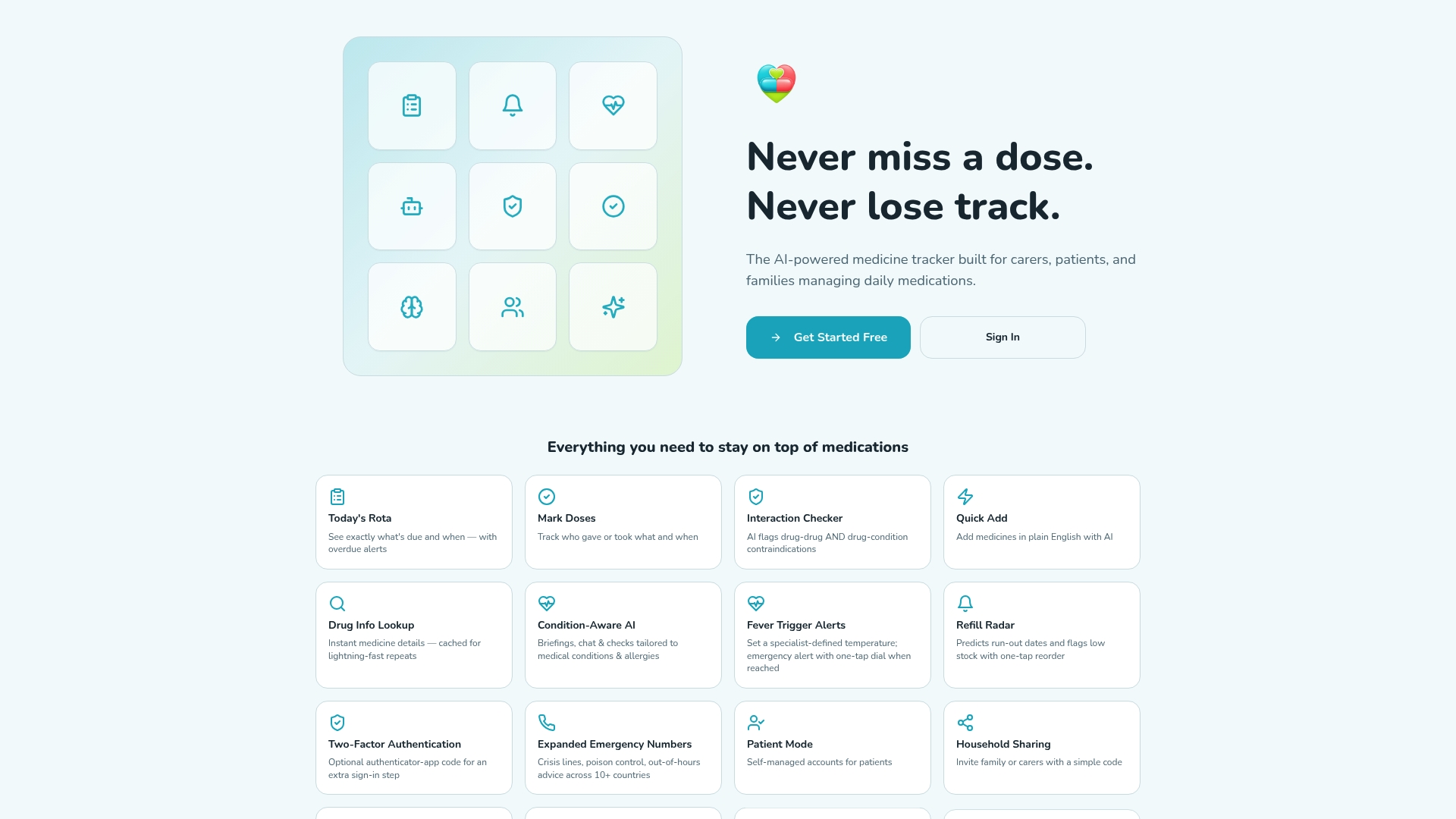
The platform links symptom entries directly to dose records, generates visual trend charts, and produces a clean exportable PDF that a GP or pharmacist can read in under two minutes. It supports household sharing, so a carer and a patient can both contribute to the same record without confusion. It works across devices, complies with UK GDPR, and includes reminders to keep logging consistent. There is no need to reconstruct a timeline from memory before an appointment; the summary is already there.
Visit Thedailydosetracker's pricing page to see the available plans, including a free option for carers and families getting started. If data security is your primary concern, the security and compliance page sets out exactly how your health data is protected.
Useful sources and further reading
The following sources informed this guide and are worth bookmarking for further reading:
- JMIR: Electronic health tools for patient self-monitoring and adverse-effect reporting — a review of studies examining how eHealth tools affect symptom reporting and medication changes.
- BMJ Open: Impact of patient-held medication records on medication management — evidence on how patient-held records support medication reconciliation across care settings.
- MDPI: Additional value of patient-reported symptom monitoring in cancer care — systematic review of symptom monitoring outcomes; strongest evidence base in oncology, with broader implications for structured reporting.
- AAFP: How symptom logs improve clinical efficiency — practical clinical perspective on how organised patient histories reduce unnecessary investigations.
- Newgate Medical Group: Structured medication review guidance — UK-based guidance on what a structured medication review involves and how to prepare.
- PMC: Remote symptom monitoring integrated into electronic health records — systematic review of EHR-integrated symptom monitoring and its limitations.
- Thedailydosetracker blog: Medication review process explained for patients and carers — plain-English guide to the types of medication review and what to expect.
- Thedailydosetracker blog: Medication history for carers — practical guidance on compiling and maintaining accurate medication histories.
This article provides general information for patients and carers and does not constitute medical or pharmaceutical advice. Always confirm your current medicines and any concerns about side effects with your GP, pharmacist, or a qualified healthcare professional.