

A patient medication history is a complete, verified record of every medicine a person currently takes or has recently taken, including prescription drugs, over-the-counter products, vitamins, herbal remedies, and relevant lifestyle factors. In clinical practice, the gold standard method for compiling this record is the Best Possible Medication History (BPMH), which cross-checks information from at least two reliable sources. For carers and families managing elderly or complex patients, understanding what a patient medication history contains and how it is gathered is the first step towards preventing serious medication errors.
What is a patient medication history and what does it include?
A patient medication history is a structured clinical record covering every medicine a person takes, how they take it, and any previous reactions to medicines. It goes well beyond a simple prescription list. The British Geriatrics Society identifies medication history as a core component of the Comprehensive Geriatric Assessment (CGA), reflecting how central it is to safe care for older adults.
The BPMH process, described in detail by BMJ Open Quality, requires at least two reliable information sources to confirm accuracy. That might mean combining a patient interview with pharmacy dispensing records, or cross-referencing GP notes with a carer's written list. Using a single source leaves too much room for error.
A thorough medication history covers the following categories:
- Prescription medicines: name, dose, frequency, route of administration, and the condition being treated
- Over-the-counter medicines: painkillers, antacids, antihistamines, and similar products bought without a prescription
- Vitamins and supplements: including vitamin D, fish oil, iron, and any other nutritional products
- Herbal and traditional remedies: St John's Wort, for example, interacts with several prescription medicines
- Cannabis and recreational drugs: relevant to drug interactions and clinical decision-making
- Previous adverse drug reactions and allergies: including the nature of the reaction, not just the drug name
- Immunisation history: particularly relevant for elderly patients and those with complex conditions
- Lifestyle factors: alcohol consumption, smoking status, and recreational drug use
Pro Tip: Ask your pharmacist for a printed dispensing history. It lists every medicine dispensed over a set period and serves as a reliable second source during a BPMH interview.
Why is medication history accuracy critical for elderly patients?
Incomplete or inaccurate medication histories cause direct, measurable harm. 1 in 5 unplanned hospital admissions in people aged 65 and over are caused by adverse drug reactions. That figure rises sharply with polypharmacy: patients taking 10 or more medicines are 300 times more likely to be admitted than those on fewer medicines. These are not rare edge cases. They represent a predictable, preventable pattern.
The scale of preventability makes this especially important. Between 27% and 75% of adverse drug events are preventable with accurate medication histories and proper clinical review. That wide range reflects variation across care settings, but even the lower figure represents a substantial reduction in harm.
"Two-thirds of unplanned hospital admissions from adverse drug reactions in elderly patients are preventable through proactive medication optimisation, including Structured Medication Reviews." — British Geriatrics Society
Structured Medication Reviews (SMRs) depend entirely on having an accurate medication history as their starting point. Without one, a clinician cannot identify which medicines are causing side effects, which are no longer needed, or which are interacting dangerously. For families managing prescriptions for multiple health conditions, this matters enormously.
One of the most underappreciated risks is the prescribing cascade. This occurs when a clinician prescribes a new medicine to treat what appears to be a new symptom, without realising the symptom is actually a side effect of an existing medicine. Accurate medication histories prevent prescribing cascades by giving the prescriber a full picture before any new drug is added. For elderly patients already on complex regimens, a single missed medicine in the history can trigger a cascade that compounds over months.
Lifestyle factors add another layer of complexity. Healthcare providers must ask elderly patients about alcohol, smoking, and recreational drug use, and must not make assumptions based on age. Alcohol interacts with anticoagulants, sedatives, and antidiabetic medicines. Omitting this information from a medication history produces an incomplete and potentially dangerous clinical picture.
How can patients and carers gather and maintain accurate medication records?
Patients and carers are the most reliable source of real-world medication information. A clinician sees a patient for minutes; a carer observes them daily. That direct knowledge is irreplaceable during a medication history interview. The challenge is translating it into a format that is clinically useful.
Follow these steps to prepare for a medication history interview and maintain accurate patient medication records:
- Gather every medicine in the home. Bring all prescription bottles, blister packs, over-the-counter products, vitamins, and herbal supplements to the appointment. Do not filter out anything that seems minor.
- Be honest about how medicines are actually taken. Patients frequently differ in how they take medicines compared to the prescribed regimen. If a dose is skipped regularly, halved, or taken at a different time, say so. Discrepancies cause clinical misjudgements.
- Bring pharmacy contact details. The pharmacist can confirm dispensing history and flag any recent changes. This is the second source required for a valid BPMH.
- Ask for a printed, updated medication list after every appointment. An updated printed list gives patients and carers a reliable reference to check at home and report any discrepancies at the next visit.
- Record any side effects or reactions. Note the medicine name, the reaction, and when it occurred. This information is as important as the medicine list itself.
- Update the record after every prescription change. A medication history that is three months out of date is not a medication history. It is a hazard.
Patient-held medication records are most effective when they are integrated into clinical workflows rather than kept as static lists. A record that travels with the patient to every appointment, and that clinicians actively consult and update, functions as a genuine communication tool. Carers managing complex schedules benefit from medication schedule best practices that turn a paper list into a living document.
Pro Tip: Keep a single running document on your phone or a notebook that lists every medicine, dose, and time taken. Update it the same day any change is made. This becomes your most valuable asset at any clinical appointment.

What is medication reconciliation and how does it relate to medication history?
Medication reconciliation is the formal clinical process of comparing a patient's current medication list against new prescriptions or orders at every point of care transition. It applies when a patient is admitted to hospital, transferred between wards, or discharged home. The goal is to identify and resolve any discrepancies before they cause harm.
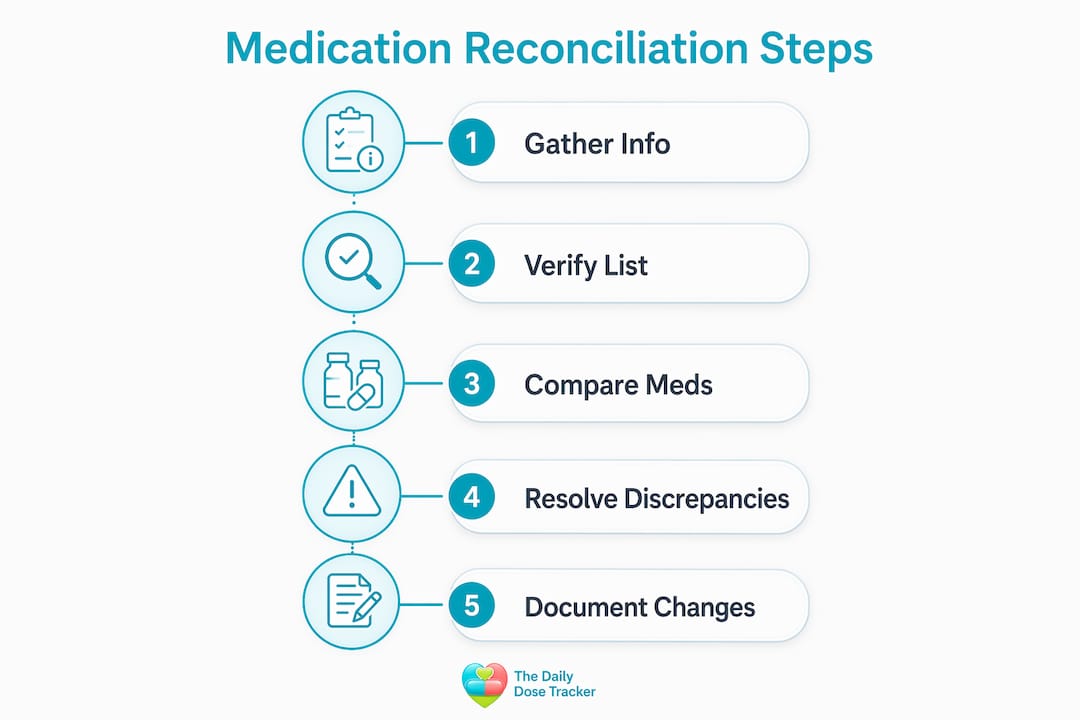
An accurate patient medication history is the foundation of medication reconciliation. Without a verified list of what a patient was taking before admission, reconciliation cannot function. Electronic health records, GP systems, and pharmacy records all contribute, but none of these sources is complete on its own. The BPMH interview fills the gaps.
The table below clarifies how medication history, reconciliation, and medication review relate to each other:
| Process | When it happens | Primary purpose |
|---|---|---|
| Medication history | At any clinical contact | Record all current and recent medicines accurately |
| Medication reconciliation | At care transitions (admission, discharge, transfer) | Identify and resolve discrepancies between medicine lists |
| Medication review | Scheduled clinical appointment | Assess whether current medicines are still appropriate |
Each process depends on the one before it. A medication review conducted without an accurate history produces unreliable conclusions. Reconciliation without a verified history misses discrepancies. For families supporting elderly relatives through hospital admissions, understanding this chain helps them contribute at the right moment. Guidance on reducing medication errors in elderly home care explains how these processes connect in a home care context.
The NHS and organisations such as the British Geriatrics Society both recognise medication reconciliation as a patient safety priority. Errors at care transitions are among the most common and most preventable causes of medication harm.
Key takeaways
A complete, verified medication history is the single most effective tool for preventing adverse drug events in elderly and complex patients.
| Point | Details |
|---|---|
| Definition of BPMH | The Best Possible Medication History requires at least two reliable sources to verify accuracy. |
| Elderly admission risk | 1 in 5 unplanned admissions in over-65s are caused by adverse drug reactions. |
| Preventability | Between 27% and 75% of adverse drug events are preventable with accurate medication histories. |
| Patient and carer role | Bringing all medicines and reporting actual use, not just prescribed use, is critical for safety. |
| Reconciliation link | Medication reconciliation at care transitions depends entirely on an accurate prior medication history. |
The detail that gets left out most often
The most common failure I see in medication histories is not a missing prescription. It is the gap between what a medicine label says and what the patient actually does. A carer tells me their relative takes ramipril 5mg once daily. The label confirms it. But the patient has been splitting the tablet for months because it makes them dizzy. That half-dose changes the clinical picture entirely.
Clinicians are trained to ask about adherence, but the question is often framed in a way that invites a reassuring answer. Patients want to be seen as cooperative. Carers want to appear on top of things. The result is a history that looks complete but contains a quiet inaccuracy at its centre.
My advice to carers is direct: write down what actually happens, not what should happen. If your relative skips the evening dose three times a week, write that down. If they take an extra painkiller on bad days, write that down. A clinician who knows the truth can adjust the plan. A clinician working from a polished but inaccurate history cannot.
Digital tools are changing this. Platforms that log doses in real time, flag missed doses, and generate reports for clinical appointments give carers something concrete to share. That shift from memory to data is where the real safety improvement lies.
— Prasant
How Thedailydosetracker supports accurate medication management
Keeping a medication history up to date is straightforward in theory and genuinely difficult in practice, especially when you are caring for someone with multiple conditions and a changing prescription list. Thedailydosetracker is built for exactly this situation.
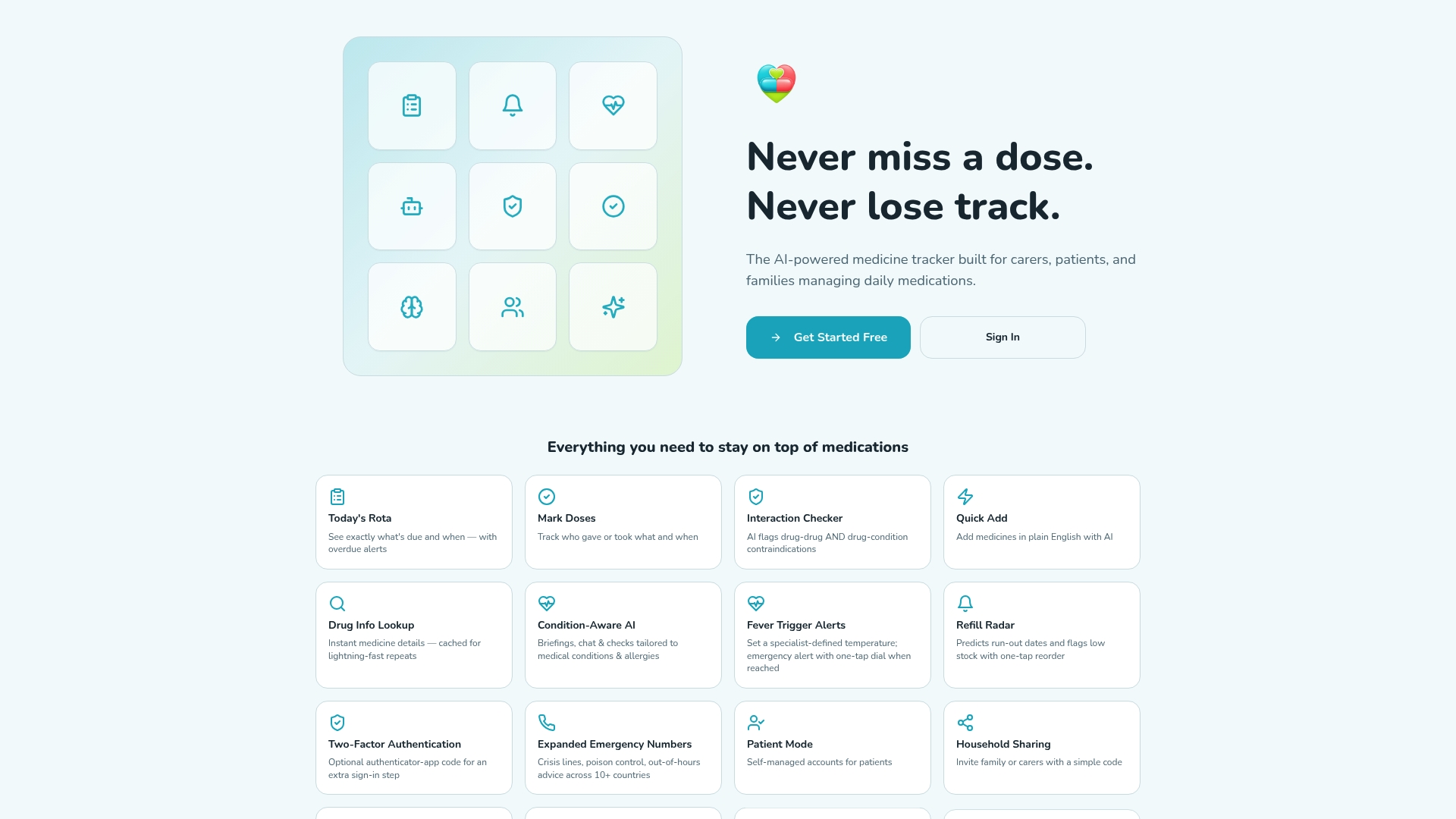
The platform lets carers and families log every medicine, record doses in real time, and generate a clear medication summary that travels to every appointment. AI-powered drug interaction checks flag potential problems before they reach a clinician. Refill predictions and missed-dose alerts mean the record stays current without relying on memory. For families managing elderly relatives or complex patients, the free app turns a static list into a living, shareable record. View pricing and plan options to find the right fit for your household.
FAQ
What does a patient medication history include?
A patient medication history includes all prescription medicines, over-the-counter products, vitamins, herbal remedies, previous adverse drug reactions, allergies, immunisation history, and lifestyle factors such as alcohol and smoking. Each medicine should be recorded with its dose, frequency, and the condition it treats.
Why is medication history important for elderly patients?
1 in 5 unplanned hospital admissions in people aged 65 and over are caused by adverse drug reactions. An accurate medication history enables clinicians to identify dangerous interactions, conduct Structured Medication Reviews, and prevent prescribing cascades before harm occurs.
What is the Best Possible Medication History (BPMH)?
The BPMH is the gold standard method for compiling a medication history. It requires information from at least two reliable sources, such as a patient interview combined with pharmacy dispensing records, to verify accuracy and reduce the risk of omissions.
How does medication reconciliation differ from a medication history?
A medication history records all current and recent medicines at any clinical contact. Medication reconciliation is a specific safety process that compares that history against new prescriptions at points of care transition, such as hospital admission or discharge, to identify and resolve discrepancies.
How can carers help maintain accurate medication records?
Carers should bring all medicines, including supplements and over-the-counter products, to every appointment, report how medicines are actually taken rather than how they are prescribed, and request a printed updated list after each visit. Digital tools that log doses in real time provide the most reliable ongoing record.