

Medication timing is the single most controllable factor determining whether a drug works, causes harm, or fails entirely in an older adult. For family members and caregivers, understanding why medication timing matters for elderly patients is not a clinical nicety. It is the difference between a prescription that protects and one that puts someone at risk. Incorrect timing reduces effectiveness and raises side effects by disrupting steady drug levels and conflicting with the body's own rhythms. Ageing changes how the body absorbs, processes, and responds to medicines, which makes the stakes of getting timing right considerably higher than for younger adults.
Why medication timing matters differently in elderly patients
The formal term for studying how timing affects drug action is chronopharmacology. It examines how the body's circadian rhythms, the 24-hour biological cycles governing sleep, hormone release, and organ function, alter the way medicines behave at different points in the day. For older adults, this matters more than most people realise.
Ageing produces a set of physiological changes that directly affect what pharmacologists call pharmacokinetics: how a drug is absorbed, distributed, metabolised, and excreted. Several of these changes work against consistent medication performance:
- Slower gastric emptying reduces the speed at which oral medicines reach the small intestine, delaying absorption and shifting peak drug concentration to a later window than the prescriber may have intended.
- Reduced liver function means the liver clears drugs more slowly, raising the risk of accumulation when doses are taken too close together or at times that coincide with other metabolic demands.
- Declining kidney function is present in the majority of adults over 75, even when blood tests appear normal, and it extends the effective half-life of renally cleared drugs such as metformin and many antibiotics.
- Disrupted circadian rhythms are a direct consequence of ageing. Ageing disrupts circadian patterns, increasing risk for metabolic and cardiovascular diseases and altering how cardiometabolic medications perform across the day.
The practical implication is straightforward. A blood pressure tablet taken at the wrong time of day in a 78-year-old may produce a different peak concentration, a different duration of action, and a different side-effect profile than the same tablet taken at the prescribed time. The drug has not changed. The body's response to its timing has.
What do prescription timing instructions actually mean?
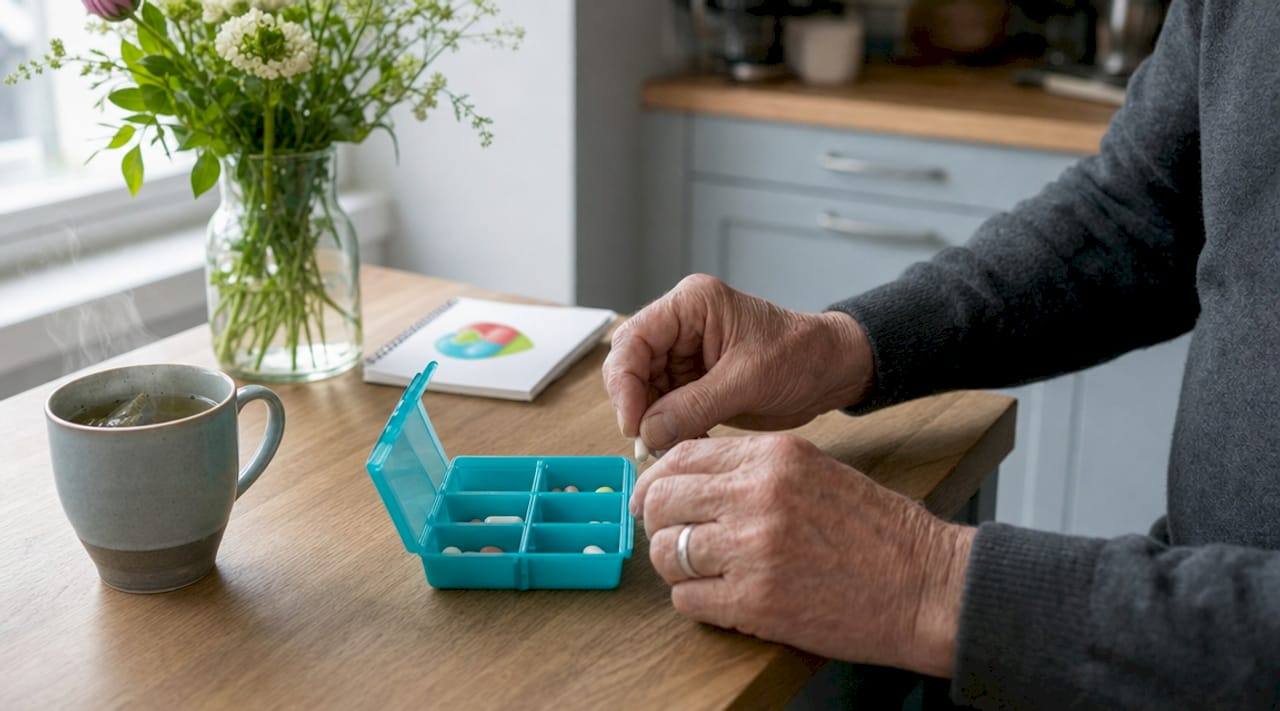
Prescription labels use shorthand that caregivers often interpret loosely, and that looseness creates real risk. Understanding these instructions precisely is one of the most practical things you can do for someone in your care.
The instruction "take with food" does not mean "take whenever you eat something." Taking medication during or right after meals improves absorption for some drugs and reduces stomach irritation for others. NSAIDs such as ibuprofen and oral diabetes medicines such as metformin fall into this category. Taking them on an empty stomach does not just cause discomfort. It can produce nausea severe enough to stop the person taking the medicine at all.
"Take on an empty stomach" is equally specific. Levothyroxine, the most commonly prescribed thyroid medication in the UK, must be taken 30 to 60 minutes before breakfast. Food, coffee, and even calcium-containing drinks interfere with its absorption. A person who takes their thyroid medicine with their morning tea is likely receiving a fraction of the intended dose every single day, without anyone realising why their thyroid levels remain unstable.
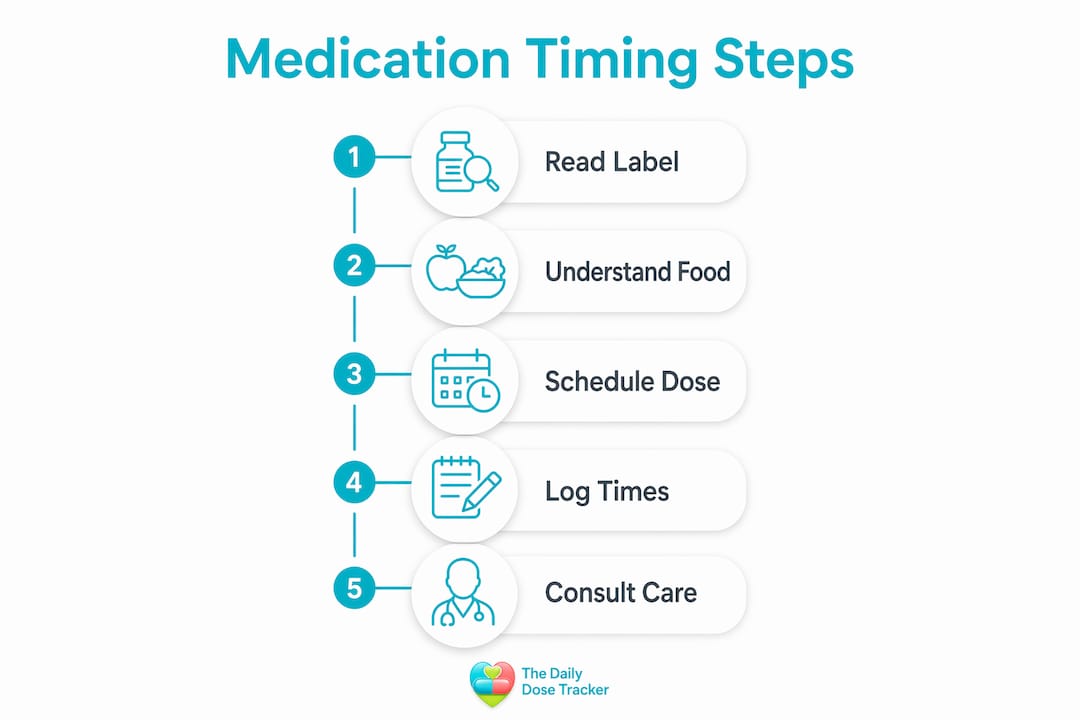
The following sequence illustrates how to read timing instructions correctly:
- Identify the interval. Does the label say "twice daily," "every 12 hours," or "morning and evening"? These are not interchangeable. "Every 12 hours" requires consistent spacing. "Twice daily" allows more flexibility but still benefits from routine.
- Identify the food relationship. "With food," "before food," "after food," and "without regard to meals" each carry distinct clinical meaning. Ask the pharmacist to clarify if the label is ambiguous.
- Identify any time-of-day specifics. Statins such as simvastatin are traditionally taken at night because cholesterol synthesis peaks in the early hours. Some antihypertensives are prescribed at bedtime. The 2026 BedMed-Frail trial found that bedtime antihypertensive dosing reduced all-cause unplanned hospitalisations in frail older adults compared with morning dosing, with a hazard ratio of 0.74. That is a meaningful reduction, and it came from a timing change alone.
- Identify any interactions with other medicines. Two drugs taken at the same time may compete for absorption. A pharmacist can map out a safe schedule when multiple medicines are involved.
Pro Tip: Document both the timing instruction and its clinical reason in a written or digital medication log. Knowing that levothyroxine must be taken before breakfast because food blocks absorption helps caregivers troubleshoot missed doses far more confidently than a label instruction alone.
Consistent dosing intervals matter more than hitting an exact clock time for most chronic medicines. This is genuinely reassuring for caregivers. A blood pressure tablet taken at 8:15 am instead of 8:00 am is not a problem. A blood pressure tablet taken at noon when it should have been taken at 8:00 am may be.
How do care transitions create medication timing errors?
Hospital discharge is the single highest-risk moment for medication timing errors in older adults. When a person moves from a hospital ward to home, or from home to a care facility, the format of medication instructions changes entirely. Ward schedules use nursing shift times. Discharge letters use clock times. Community pharmacies use label shorthand. Each translation introduces the possibility of error.
Care transitions introduce timing errors because instructions often change format, and pharmacist-led reconciliation that includes explicit timing details, not just medication listing, is what reduces those errors. This distinction matters. A reconciliation process that confirms the correct drug and dose but fails to confirm the correct timing and food relationship is incomplete.
The evidence for structured reconciliation is striking. The MERITS study, a multidisciplinary medication reconciliation service for older adults after surgery, found that medication discrepancies fell from 62.0% to 2.8% at admission, and drug-related problems dropped from 32.4% to 14.8% after discharge. Pharmacist interventions were accepted by clinical teams at a rate above 96%. These numbers demonstrate that the problem is solvable, and that pharmacist involvement is the mechanism that solves it.
| Risk point | What goes wrong | How to address it |
|---|---|---|
| Hospital discharge | Timing instructions change format from ward schedule to clock time | Request a pharmacist-reviewed discharge summary with explicit timing notes |
| Care home admission | New staff unfamiliar with individual timing needs | Provide a written medication schedule with food and interval details |
| GP medication review | Timing changes made without caregiver notification | Ask for written confirmation of any timing changes at every review |
| Carer handover | Verbal timing instructions passed between family members | Keep a shared digital or written log updated after every dose |
Pro Tip: At every care transition, ask the discharging team one specific question: "Has the timing of each medication been confirmed, including its relationship to food and other drugs?" This single question prompts a check that is often skipped.
Practical strategies for caregivers managing medication timing
Consistency is the foundation of good medication management for older adults. A medication schedule for seniors that anchors doses to fixed daily events, meals, waking, and bedtime, is more reliable than one based on clock-watching alone.
The following approaches make a measurable difference in practice:
- Anchor doses to meals. Morning medicines taken with breakfast, lunchtime medicines taken with the midday meal, and evening medicines taken with supper create automatic triggers that reduce the chance of a forgotten dose.
- Use a weekly pill organiser. Filling a pill organiser once a week makes it immediately visible whether a dose has been taken, removing the uncertainty that leads to accidental double-dosing.
- Separate medicines that interact. If a pharmacist has advised that two medicines should not be taken simultaneously, build a gap into the daily routine. A 30-minute gap between levothyroxine and a calcium supplement, for example, is easy to manage once it becomes habit.
- Know what to do when a dose is missed. For most medicines, the guidance is to take the missed dose as soon as you remember, unless it is close to the time of the next dose. Never double up without checking with a pharmacist first.
- Track doses in real time. Behavioural supports improve adherence by 25 to 59% in older adults, with significant reductions in cardiovascular events. Digital tools that log doses and send reminders sit squarely within this category of support.
Technology has made real-time medication tracking accessible for family caregivers. Thedailydosetracker offers dose logging, real-time alerts for due or overdue medicines, drug interaction checks, and multi-patient management across devices. For caregivers managing complex regimens across multiple conditions, having a medicine management app that flags timing conflicts and missed doses removes a significant cognitive burden.
My view on what caregivers consistently get wrong
Prasant's perspective
After working closely with families navigating elderly care, the pattern I see most often is not negligence. It is a misunderstanding of what "consistent timing" actually requires. Most caregivers know that medicines should be taken regularly. Far fewer understand that the interval between doses, and the relationship of each dose to food, sleep, and other medicines, is where the real clinical risk lives.
The second thing I see is over-reliance on memory. A 78-year-old managing eight daily medicines, or a family carer managing them on their behalf, cannot be expected to hold all of that information accurately in their head. The caregivers who do this well are the ones who have externalised the system. They use a written schedule, a pill organiser, or a digital tracker. They do not rely on remembering.
What I find genuinely underappreciated is the role of the pharmacist in all of this. Most families treat the pharmacist as the person who dispenses the prescription. The pharmacist is actually the most accessible clinical expert on medication timing, interactions, and food relationships available to you. A 10-minute conversation at the pharmacy counter, or a formal medicines use review, can resolve timing questions that have been causing problems for months.
The families who manage elderly medication timing well share one characteristic: they treat it as a system, not a task. They document, they communicate with the care team, and they use tools that do the tracking for them. That shift in approach, from reactive to systematic, is where the real improvement in safety and outcomes happens.
— Prasant
How Thedailydosetracker supports medication timing for carers
Managing a complex medication schedule for an elderly relative is demanding, and the margin for error is narrow. Thedailydosetracker is built specifically for this situation.
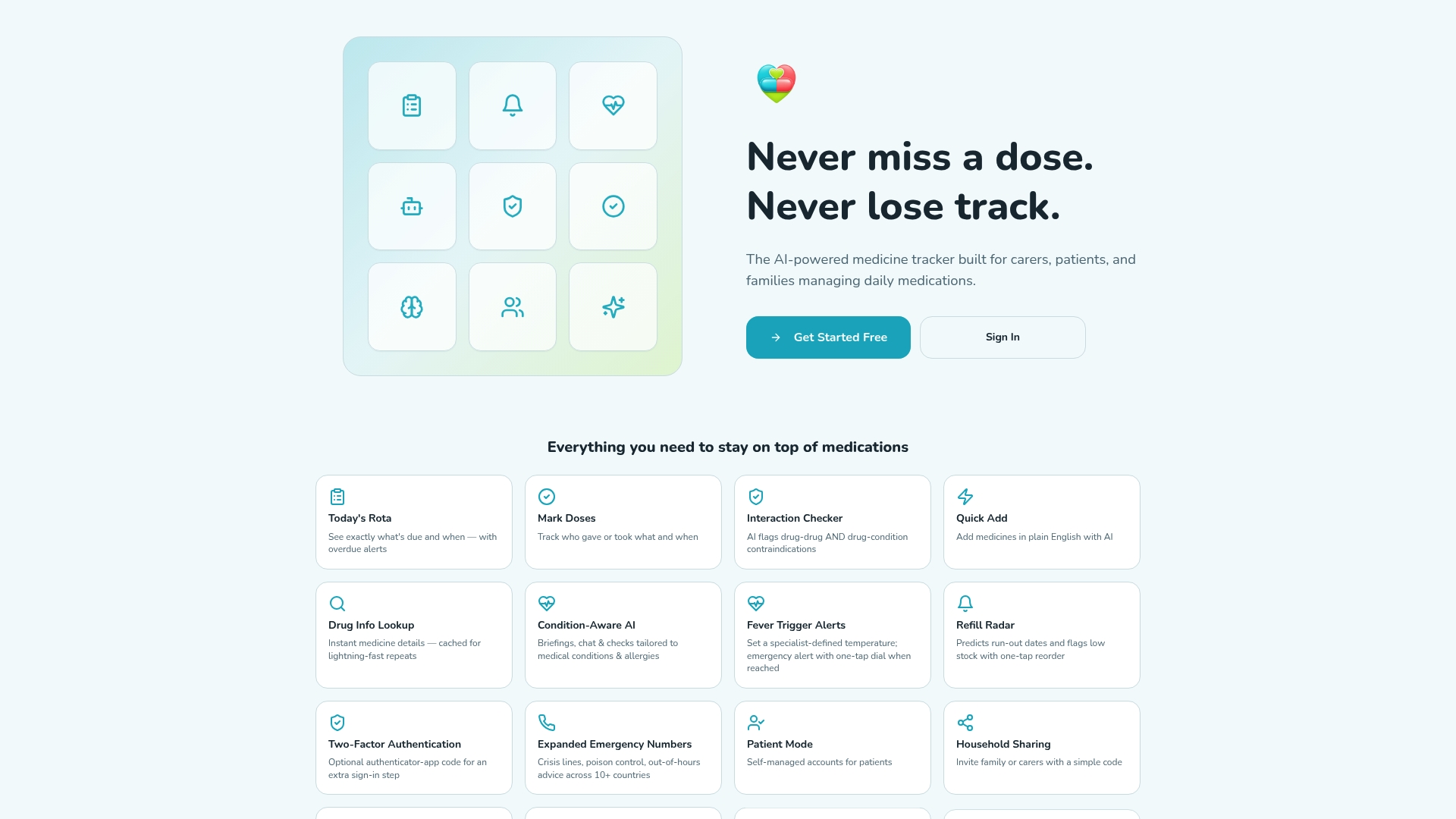
The platform allows caregivers to build detailed medication schedules that include timing instructions, food relationships, and dosing intervals. Real-time alerts notify carers when a dose is due or overdue, and the drug interaction checker flags conflicts before they become problems. For families managing care across multiple people or locations, the multi-patient and household-sharing features keep everyone informed. Start managing medication timing with confidence at Thedailydosetracker, a free tool designed for carers and families who need more than a reminder app.
Key takeaways
Medication timing in elderly care is a clinical discipline, not a scheduling preference. Getting it right requires understanding physiology, following label instructions precisely, and building systems that survive care transitions.
| Point | Details |
|---|---|
| Ageing changes drug response | Slower metabolism and disrupted circadian rhythms alter how and when medicines work in older adults. |
| Label instructions are precise | "With food," "before food," and "every 12 hours" each carry distinct clinical meaning that affects absorption and safety. |
| Care transitions are high risk | Medication discrepancies at hospital discharge can be reduced from 62% to under 3% with pharmacist-led reconciliation. |
| Intervals matter more than clock time | Consistent spacing between doses is more important than hitting an exact time for most chronic medicines. |
| Systems outperform memory | Digital tracking tools and written schedules reduce timing errors and improve adherence by up to 59% in older adults. |
FAQ
Why does medication timing matter more for elderly patients?
Ageing slows metabolism, reduces liver and kidney function, and disrupts circadian rhythms, all of which alter how drugs are absorbed and cleared. These changes mean that the same dose taken at the wrong time can produce a different and potentially harmful effect in an older adult compared with a younger person.
What does "take with food" mean on a prescription label?
It means taking the medicine during or immediately after a meal to improve absorption or reduce stomach irritation. For drugs such as metformin or NSAIDs, taking them on an empty stomach increases the risk of nausea and gastrointestinal side effects.
How do I prevent timing errors when my relative comes home from hospital?
Ask the discharging team for a pharmacist-reviewed medication summary that includes explicit timing instructions and food relationships for every medicine. A written schedule, confirmed by a pharmacist, is the most reliable way to prevent the format changes that cause errors at discharge.
Is it harmful if a dose is taken slightly late?
For most chronic medicines, a dose taken 15 to 30 minutes late is not clinically significant. What matters is maintaining the correct interval between doses. If a dose is missed entirely, check with a pharmacist before doubling up, as the guidance varies by medicine.
Can a digital app really help with medication timing for elderly patients?
Behavioural supports including digital reminders improve adherence by 25 to 59% in older adults, with measurable reductions in cardiovascular events. An app that logs doses, sends real-time alerts, and checks for drug interactions provides the kind of systematic support that memory alone cannot reliably deliver.