
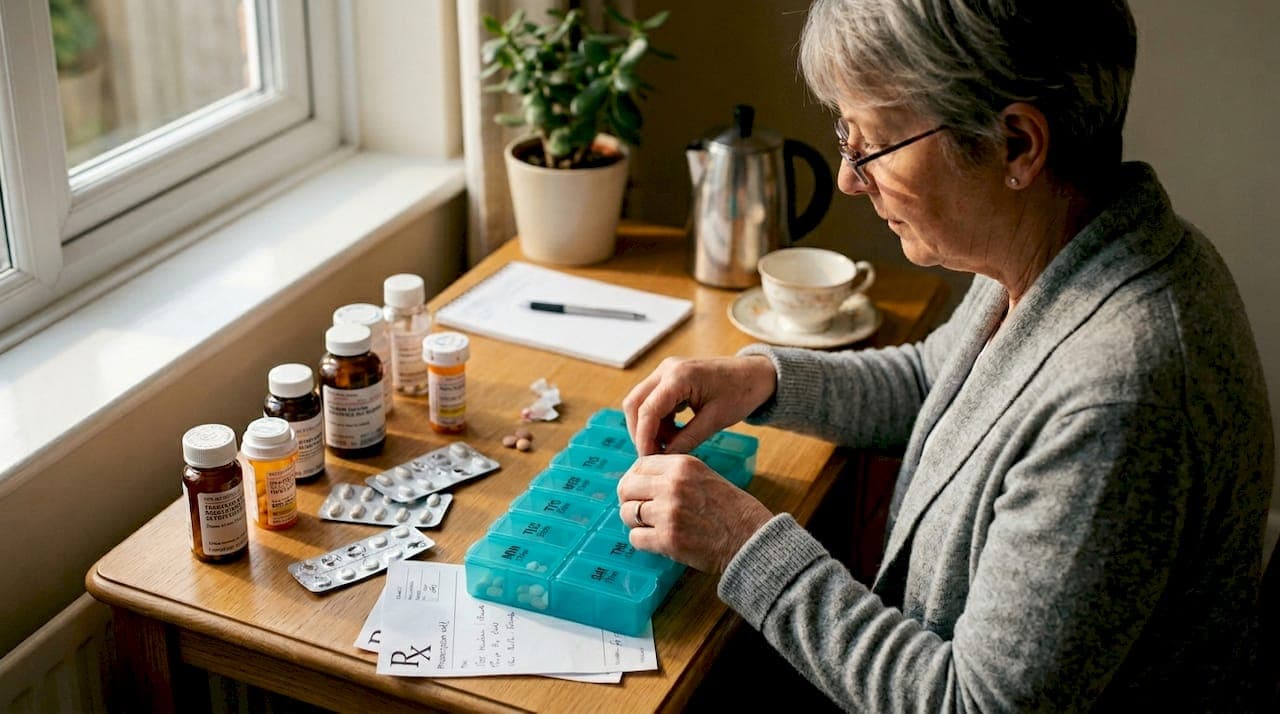
Managing a loved one's medication might look straightforward from the outside. In reality, nonadherence affects up to 58% of patients on long-term regimens, and the consequences range from avoidable hospital admissions to life-threatening emergencies. For family carers juggling multiple prescriptions, changing doses, and differing formulations, the emotional and clinical burden is enormous. This guide cuts through the confusion, offering practical frameworks, honest comparisons of available tools, and expert-backed advice so you can manage complex medication schedules with greater confidence and safety.
Table of Contents
- Why complex medication schedules matter for carers and patients
- What makes a medication schedule complex?
- Tools and methods for managing complex medication schedules
- Common pitfalls and best practices for carers
- How technology is changing medication management
- What most carers and experts miss about complex medication schedules
- Make medication management easier with the right support
- Frequently asked questions
Key Takeaways
| Point | Details |
|---|---|
| Polypharmacy is common | Managing five or more medicines is common in older adults and significantly increases complexity. |
| Technology boosts adherence | Digital apps and reminder systems offer up to 30 percent improvement in medication adherence. |
| Safety needs systems | Implementing clear routines, documentation, and double-checks prevents most common errors. |
| Simplification reduces risk | Deprescribing and regular review can dramatically lower the burden and risk of medication schedules. |
Why complex medication schedules matter for carers and patients
When a loved one reaches the point of managing five or more daily medications, the situation has a clinical name: polypharmacy. It is far more common than most families realise. Polypharmacy affects 35 to 39% of older adults, while hyperpolypharmacy, defined as ten or more concurrent medications, affects between 12 and 18%. Both are strongly associated with higher healthcare costs, increased fall risk, and a greater likelihood of harmful drug interactions.
The hospital statistics are equally sobering. Older adults discharged with five or more prescriptions face significantly higher risks of emergency department visits and re-hospitalisation within 30 days. Many of those readmissions trace back to something as preventable as a missed dose, a duplicated tablet, or a misunderstood instruction.
- Polypharmacy raises the likelihood of adverse drug reactions exponentially with each additional medicine added
- Cognitive decline in elderly patients means they may not recognise or report side effects reliably
- Carers often manage these schedules without formal training, relying on memory or handwritten notes
- Schedule changes after hospital discharge are a particularly high-risk period
Beyond the clinical risks, there is the emotional weight. Carers frequently describe a persistent background anxiety: the nagging worry that they have forgotten something, given the wrong tablet, or missed a critical timing window. That stress is not irrational. It reflects the genuine complexity of what they are being asked to manage, often alone and without adequate support.
"The burden of managing multiple medications falls disproportionately on informal carers, many of whom receive little guidance and no formal training." — NHS Specialist Pharmacy Service
What makes a medication schedule complex?
Not every multi-medication routine is equally difficult. Complexity arises from a specific combination of factors, and recognising them is the first step towards managing them safely.

Dosing frequency is one of the biggest contributors. A patient taking one tablet daily is manageable. A patient taking different doses in the morning, at midday, with food in the evening, and at bedtime, across six different medicines, is a logistical challenge. Variable timing, where doses must be spaced precisely or taken relative to meals, adds another layer of difficulty.
Formulation matters too. Tablets, capsules, patches, liquids, inhalers, and injections each carry different instructions, storage requirements, and risks. A carer managing both an insulin injection and a fentanyl patch alongside oral tablets needs to track very different types of administration.
Sudden changes are perhaps the highest-risk moment. When a GP adjusts a dose, adds a new prescription, or discontinues a medicine after a hospital stay, the transition period is when errors cluster. NHS guidance on managing medicines safely emphasises that process clarity and staff training are essential during these transitions, even in clinical settings, let alone at home.
| Complexity factor | Lower risk | Higher risk |
|---|---|---|
| Number of medicines | 1 to 4 | 5 or more |
| Dosing frequency | Once daily | Multiple times, variable timing |
| Formulation types | Tablets only | Mixed (patches, injections, liquids) |
| Recent changes | Stable regimen | Post-discharge or recent adjustment |
| Patient cognition | Fully independent | Moderate to severe impairment |
Pro Tip: Keep a dedicated notebook or digital log specifically for recording any changes to the regimen, including the date, what changed, who authorised it, and why. This single habit prevents the most common source of confusion during handovers between carers.
- Always read the updated prescription label after any change, even if the medicine looks identical
- Check whether a new medicine interacts with existing ones before the first dose
- Confirm timing instructions with the prescriber if anything is ambiguous
Tools and methods for managing complex medication schedules
There is no single tool that suits every family. The right approach depends on the level of complexity, the patient's cognitive ability, and how many carers are involved in the routine.
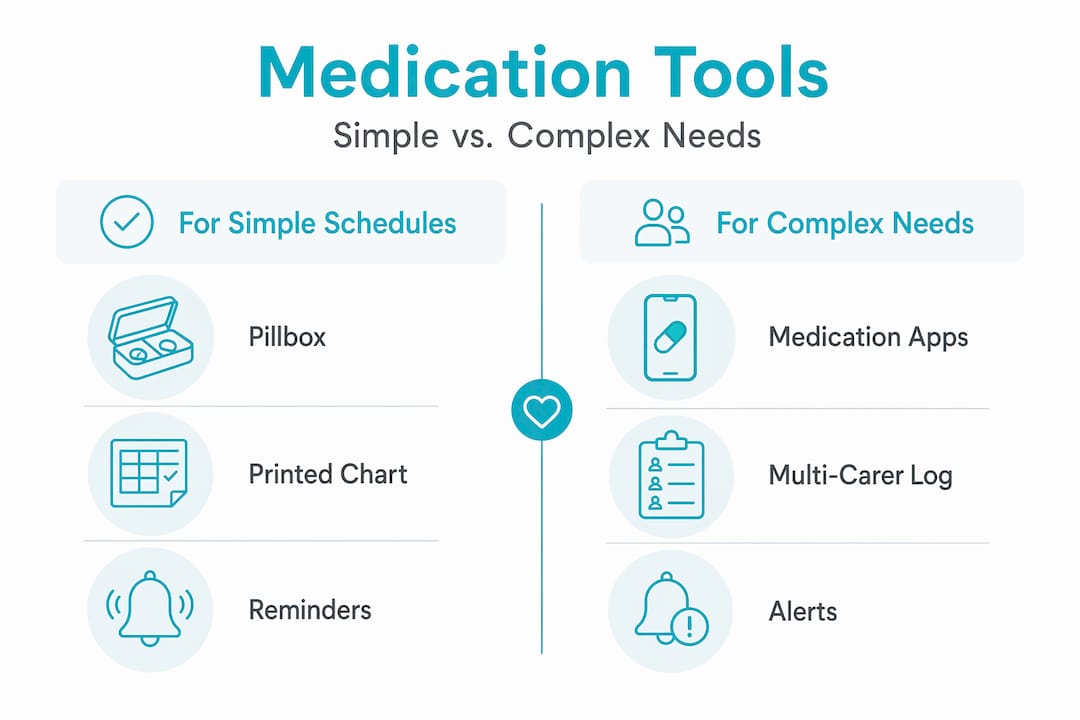
Pillboxes are the most familiar option. They work well for simple, stable regimens and patients who can self-manage with minimal oversight. Their limitation is obvious: they provide no alert, no log, and no way to confirm a dose was actually taken rather than simply removed from the box.
Reminder apps move the needle significantly. Digital apps like Medisafe show 20 to 30% adherence gains over standard methods, and the Medisafe app with counselling has demonstrated measurable improvements in blood pressure control among elderly hypertensive patients. That is a meaningful clinical outcome, not just a convenience metric.
When evaluating any digital tool, look for these core features:
- Real-time alerts for due and overdue doses
- A dose log that records what was taken and when
- Drug interaction checking built into the platform
- Multi-user or household sharing so several carers can coordinate
- Integration with emergency contacts or healthcare providers
- Secure data storage that complies with UK GDPR
| Method | Best for | Limitations |
|---|---|---|
| Pillbox | Simple, stable regimens | No alerts, no confirmation |
| Phone reminders | Single carer, low complexity | No log, no interaction checks |
| Dedicated medicine app | Complex regimens, multiple carers | Requires consistent use |
| Professional blister packs | High-risk patients, dispensed by pharmacy | Less flexible, requires pharmacy setup |
You can explore app adherence resources to compare what different platforms offer before committing to one. For families managing genuinely complex cases, a mobile medicine tracker that combines logging, alerts, and interaction checks in one place is almost always more effective than any single-method approach.
Pro Tip: Combining methods works better than relying on one alone. Use a pillbox to organise the week's supply, a dedicated app to send alerts and log doses, and a shared household view so every carer is working from the same information.
Common pitfalls and best practices for carers
Even experienced carers fall into predictable traps. Knowing what they are makes them far easier to avoid.
Missed doses are the most common error, but duplicated doses are arguably more dangerous. When two carers share responsibility without a shared log, it is easy for one to give a tablet not knowing the other already did. This is especially risky with medicines like blood thinners or insulin, where a double dose can be life-threatening.
Mixing up pills is another frequent problem, particularly when multiple medicines look similar or are stored together. Colour coding storage containers, labelling clearly, and keeping medicines in their original packaging wherever possible all reduce this risk significantly.
Missed schedule changes are the silent danger. A GP may update a prescription, but if that update is not communicated clearly to every carer involved, the old routine continues. This is why documentation is not optional. It is a safety-critical practice.
- Always use a shared log that every carer can access and update in real time
- Review the full medication list at every GP or pharmacy appointment
- Never assume a medicine is still correct just because it has been prescribed before
- Report any unexpected symptoms immediately and link them to recent medication changes
NHS recommendations for safe medication administration consistently highlight double-checking, clear role assignment, and ongoing training as the foundations of safe practice. These principles apply just as much in a home setting as in a clinical one.
"Safe medication administration is not about memory. It is about systems, documentation, and shared accountability." — NHS Specialist Pharmacy Service
Using secure medication tracking tools ensures that dose logs are protected, accessible to authorised carers, and available to share with healthcare professionals when needed.
How technology is changing medication management
The landscape for medication management technology has shifted considerably in recent years. What was once a choice between a pillbox and a phone alarm is now a far richer set of options.
Leading digital platforms now offer features that were previously only available in clinical settings:
- Automated interaction checks that flag dangerous combinations before a dose is given
- Condition-specific guidance tailored to diagnoses like diabetes, heart failure, or Parkinson's disease
- Refill predictions that alert carers before a medicine runs out
- Symptom logging linked directly to the medication timeline, helping clinicians spot patterns
- Emergency contact integration so a carer can escalate concerns instantly
- Multi-device synchronisation allowing seamless handover between family members or professional carers
The data on outcomes is encouraging. Digital tools show 20 to 30% improvement in adherence over standard methods in elderly populations, and that figure rises when the technology is paired with active carer engagement rather than used passively.
The trend is also moving towards team-based care. Rather than one carer carrying all the responsibility, modern platforms allow GPs, pharmacists, community nurses, and family members to share a unified view of a patient's medication status. That kind of joined-up approach is where the greatest safety gains are found.
The Daily Dose Tracker app reflects this direction, bringing together AI-powered insights, real-time alerts, multi-patient management, and household sharing in a single platform designed specifically for the complexity that family carers face every day.
What most carers and experts miss about complex medication schedules
Here is an uncomfortable truth: the search for the perfect tool can actually distract from the most important safety lever available to carers, which is simplification.
Technology is genuinely valuable. But no app can compensate for a regimen that has grown unnecessarily complex over years of accumulated prescriptions. Deprescribing, the structured process of reducing or stopping medicines that are no longer needed or are causing more harm than benefit, is one of the most evidence-backed interventions available. Yet it remains underused, partly because carers and patients fear that removing a medicine means giving up on treatment.
The families who manage complex regimens most successfully tend to share a few habits that have nothing to do with which app they use. They review the full medication list with a pharmacist at least once a year. They ask the GP directly: "Does my loved one still need all of these?" They involve the patient in every decision, even when cognitive decline makes that conversation harder. And they document everything, not because they distrust themselves, but because they understand that memory is fallible and systems are not.
There is also a human dimension that technology cannot replace. A carer who knows their patient's rhythms, who notices that they seem more confused than usual after a new prescription, or who spots that they are consistently refusing a particular tablet, is providing a layer of safety monitoring that no algorithm can replicate. The best outcomes we see come from combining that human attentiveness with the structural support that good digital tools provide.
The practical wisdom here is straightforward: before adding another tool to your routine, ask whether the regimen itself could be simplified. Work with the prescribing team. Push for a medication review. And then use technology to support a leaner, safer routine rather than to manage an unnecessarily complex one.
Make medication management easier with the right support
Managing a complex medication schedule is one of the most demanding responsibilities a family carer can take on. The good news is that you do not have to rely on memory and handwritten notes alone.
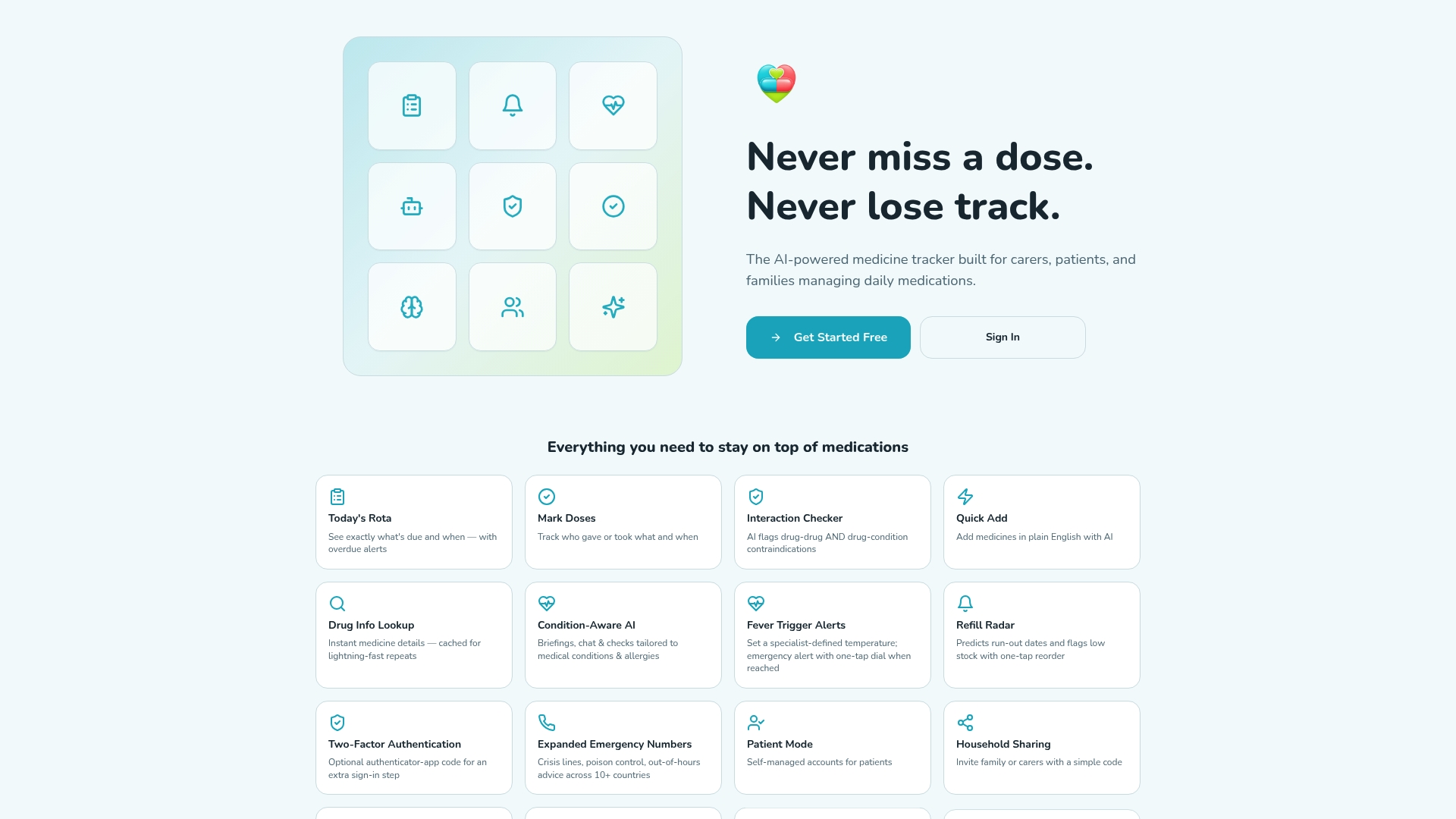
The Daily Dose Tracker is built specifically for carers managing exactly this kind of complexity. It combines real-time dose alerts, drug interaction checks, multi-carer household sharing, and AI-powered insights in one secure, easy-to-use platform. You can log doses, track symptoms, schedule appointments, and share information with healthcare professionals, all from any device. Explore important medication links to see how the platform connects with wider healthcare resources, and find out how we secure your medicine data to the highest UK GDPR standards. Taking the next step towards safer medication management starts here.
Frequently asked questions
How can I reduce the complexity of my loved one's medication schedule?
Ask a GP or pharmacist about deprescribing and simplification. Reducing unnecessary medications is a proven approach to lower risk and make regimens more manageable.
Which digital tools are best for tracking complex medication routines?
Dedicated medicine apps that offer reminders, dose logs, and interaction alerts are the most effective option. The Medisafe app with counselling has demonstrated improved adherence and blood pressure control in elderly patients.
What are the main risks of polypharmacy for elderly patients?
Polypharmacy significantly increases the risk of hospitalisation, adverse drug reactions, and drug interactions. Polypharmacy affects 35 to 39% of older adults and is directly linked to higher healthcare costs.
How effective are reminder packaging and pillboxes?
Reminder packaging modestly improves adherence on its own, but digital apps show 20 to 30% adherence gains when used consistently, particularly when combined with structured routines.
How can family carers prevent common medication errors?
Double-check every dose, document all changes immediately, and use a shared digital log so every carer is working from the same information. NHS guidance consistently identifies double-checking and clear role assignment as the most effective safeguards.