

Care home medication management is the structured process that ensures every resident receives the correct medicine, at the correct dose, at the correct time, administered by trained staff under clear clinical oversight. For families placing a loved one in residential care, understanding this process is not optional. It is the foundation of informed advocacy. The formal term used by clinicians and regulators is medicines management, and it covers everything from the initial prescription through to ongoing monitoring and review. Knowing how this cycle works, where the safeguards sit, and what questions to ask gives you real power to protect someone you care about.
What are the core steps in care home medication management?
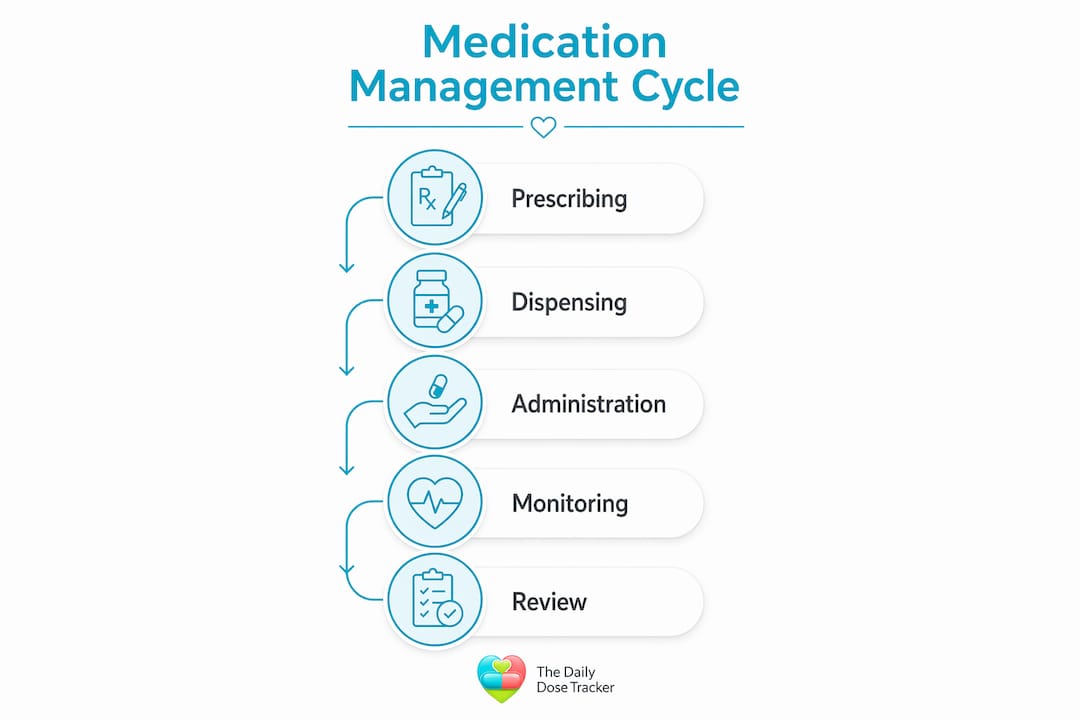
Medication management is a cycle, not a single event. It begins with a licensed physician prescribing medicines based on a resident's clinical needs and ends with careful monitoring for therapeutic effect and side effects. Between those two points, several critical steps occur.
1. Prescribing. A GP or specialist prescribes based on clinical guidelines. In the UK, tools such as the Beers Criteria help identify medicines that carry elevated risks for older adults. Pharmacists apply the Beers Criteria to flag over 30 drug classes that older adults should avoid or use only with close monitoring. This is not bureaucracy. It is a practical filter against harm.
2. Dispensing. Medicines are prepared and supplied, typically by a community pharmacy contracted to the care home. Unit-dose or blister packs are standard because they reduce handling errors and make it immediately visible if a dose has been missed.
3. Administration. Trained staff follow the "five rights" principle: right resident, right medicine, right dose, right route, right time. Every administration is recorded on a Medication Administration Record (MAR), which is the legal document of what was given, when, and by whom.

4. Monitoring. Staff observe residents for therapeutic response and adverse reactions. Blood pressure checks, blood glucose readings, and behavioural observations all feed into this ongoing assessment.
5. Review. Pharmacists conduct monthly medication regimen reviews in nursing homes, checking for interactions, duplications, and medicines that are no longer clinically justified. Regular medication log documentation supports these reviews by providing an accurate record of what was administered and when.
Pro Tip: Ask the care home how often a pharmacist reviews your relative's full medication list. Monthly reviews are best practice. If the answer is "when the GP requests it," that is worth following up.
How do care homes safely manage medications during transitions of care?
Transitions of care represent the highest-risk moments in any resident's medication journey. When a person moves between hospital and a care home, or between wards, their medication list is vulnerable to discrepancies. Over 50% of post-discharge medication lists contain at least one discrepancy. That figure means a missed dose, a duplicated drug, or a dangerous interaction is more likely than not unless active steps are taken.
Medication reconciliation is the formal process that addresses this. It involves a clinician comparing the medicines a resident was taking before admission with those prescribed on arrival, resolving any differences before the first dose is given. The process requires communication between the sending team, the receiving team, and ideally the resident or their family.
Key safeguards during transitions include:
- A complete and up-to-date medicines list travelling with the resident at every transfer
- A named clinician responsible for reconciliation at the receiving end
- Family members confirming the accuracy of the medicines list, particularly for over-the-counter drugs and supplements that hospital records often miss
- Written documentation of any changes made and the clinical reason for each change
Technology is changing this area significantly. Electronic medication chart adoption reduces transcription errors and creates an auditable trail that paper records cannot match. The eNRMC (Electronic National Residential Medication Chart) is now mandated for residential homes in several jurisdictions, and its adoption is accelerating across the UK and Australia.
| Risk factor | Mitigation strategy |
|---|---|
| Incomplete medicines list at discharge | Reconciliation meeting before first dose |
| Verbal-only handover between teams | Written documentation with clinical rationale |
| Over-the-counter medicines omitted | Family confirmation of full medicines list |
| Transcription errors on paper charts | Electronic medication chart (eNRMC) |
Pro Tip: Do not assume a hospital discharge summary is complete. Request a reconciliation meeting at every admission, discharge, or transfer. Families who ask for this meeting actively reduce the risk of a harmful discrepancy.
What policies and staff competencies underpin medication safety?
Effective medicines management in care homes does not rest on individual goodwill. It rests on governance. A current, practical medicines policy is the backbone of safe practice, and it must reflect what staff actually do, not what a template document says they should do.
A well-constructed medicines policy covers:
- Receiving, labelling, and storing medicines correctly
- Clear definitions of who may administer versus who may only assist
- MAR record completion standards
- Procedures for refused, omitted, or wasted doses
- Escalation routes when a clinical concern arises
- Audit schedules and how findings feed back into practice
The distinction between administration and assistance matters more than most families realise. Medication assistance, such as opening a blister pack or providing a verbal reminder, can be carried out by trained but unlicensed staff. Medication administration, such as giving a controlled drug or managing a patch, requires a licensed professional or a certified care aide. Knowing which category applies to your relative's medicines tells you what qualifications the person handing them over should hold.
Staff training is not a one-off event. Competency-based training and reassessment after incidents or policy changes are recognised best practice. Ask the care home when staff last completed a medicines competency assessment and whether refresher training is triggered by incident reports. Incident reporting and regular audits are how a care home learns from near-misses before they become serious errors. A home that cannot show you its audit schedule is a home that is not actively managing its risks.
How are polypharmacy, refusals, and PRN medications managed?
Three scenarios create the most complexity in day-to-day medicines management for elderly residents: polypharmacy, medication refusal, and PRN (as needed) medicines.
Polypharmacy is defined by the WHO as taking five or more medicines simultaneously. Polypharmacy increases the risk of drug interactions and adverse events, and it is extremely common in care home residents, many of whom have multiple long-term conditions. The response is not simply to reduce the number of medicines but to review each one for continued clinical justification. A pharmacist-led deprescribing review, conducted at least annually, is the standard approach.
Medication refusal is legally and ethically complex, particularly for residents with dementia or other cognitive impairments. A resident with capacity has the right to refuse any medicine. Where capacity is in question, the care home must follow the Mental Capacity Act 2005 framework, document the decision-making process, and involve the family or a legal representative. Covert administration of medicines, where a drug is hidden in food or drink, requires a formal best-interests decision and must never be used as a default convenience measure.
PRN medicines require written protocols that specify the target symptom, the minimum interval between doses, the maximum daily dose, and the criteria for escalating to a clinician. Without these protocols, PRN medicines risk misuse, particularly psychoactive drugs used to manage agitation. Chemical restraint, where sedating medicines are used to control behaviour rather than treat a clinical condition, is a safeguarding concern. Families should ask whether PRN protocols exist for every as-needed medicine their relative is prescribed.
| Scenario | Key risk | Safeguard |
|---|---|---|
| Polypharmacy (5+ medicines) | Drug interactions, adverse events | Annual pharmacist deprescribing review |
| Medication refusal | Untreated condition or legal breach | Mental Capacity Act assessment, documented |
| PRN medicines | Overuse, chemical restraint | Written protocol with symptom criteria |
For families managing complex regimens at home or supplementing care home oversight, a carer's guide to complex schedules provides practical frameworks for tracking multiple medicines across different administration times.
Key takeaways
Safe care home medication management requires a complete cycle of prescribing, dispensing, administration, monitoring, and review, supported by governance, trained staff, and active family involvement.
| Point | Details |
|---|---|
| Medication management is a cycle | It spans prescribing to monitoring and requires multidisciplinary input at every stage. |
| Transitions carry the highest risk | Over 50% of post-discharge medication lists contain discrepancies; request reconciliation at every transfer. |
| Policy and training underpin safety | A current medicines policy and documented competency assessments are non-negotiable governance standards. |
| Polypharmacy demands active review | Five or more medicines requires at least annual pharmacist-led deprescribing review to reduce interaction risks. |
| PRN protocols prevent misuse | Every as-needed medicine must have a written protocol specifying symptoms, dosing limits, and escalation criteria. |
What families often miss about medicines oversight
The families I speak with most frequently are surprised to learn that medication errors in care homes are rarely caused by a single careless act. Systemic failures come from patterns of transcription and documentation errors, not isolated incidents. That changes how you should think about oversight.
Rather than looking for one bad moment, look for the systems. Ask whether the MAR records are completed in real time or retrospectively. Ask whether the medicines policy was last reviewed within the past 12 months. Ask what happens when a dose is refused or omitted. These questions reveal whether a care home has a genuine safety culture or a paper-thin compliance posture.
I have also found that families underestimate their own role during care transitions. Most assume that a hospital discharge summary is a complete and accurate handover. It rarely is. Proactively attending a reconciliation meeting, bringing a written list of every medicine including supplements and over-the-counter products, and confirming that list matches what the care home has on record is one of the most protective things a family member can do. It takes 20 minutes and it can prevent a serious adverse event.
The other thing worth saying plainly: do not be deterred by clinical language. You do not need a medical degree to ask "What is this medicine for?" or "When was my relative's full medicines list last reviewed by a pharmacist?" Those are reasonable questions. Any care home worth its registration should answer them without hesitation.
— Prasant
Track your relative's medicines with Thedailydosetracker
Managing medicines for an elderly relative, whether they live in a care home or at home, requires more than memory and goodwill. Thedailydosetracker is a free digital platform built specifically for carers and families who need a reliable, secure way to track medication schedules, log doses, and receive real-time alerts for missed or overdue medicines.
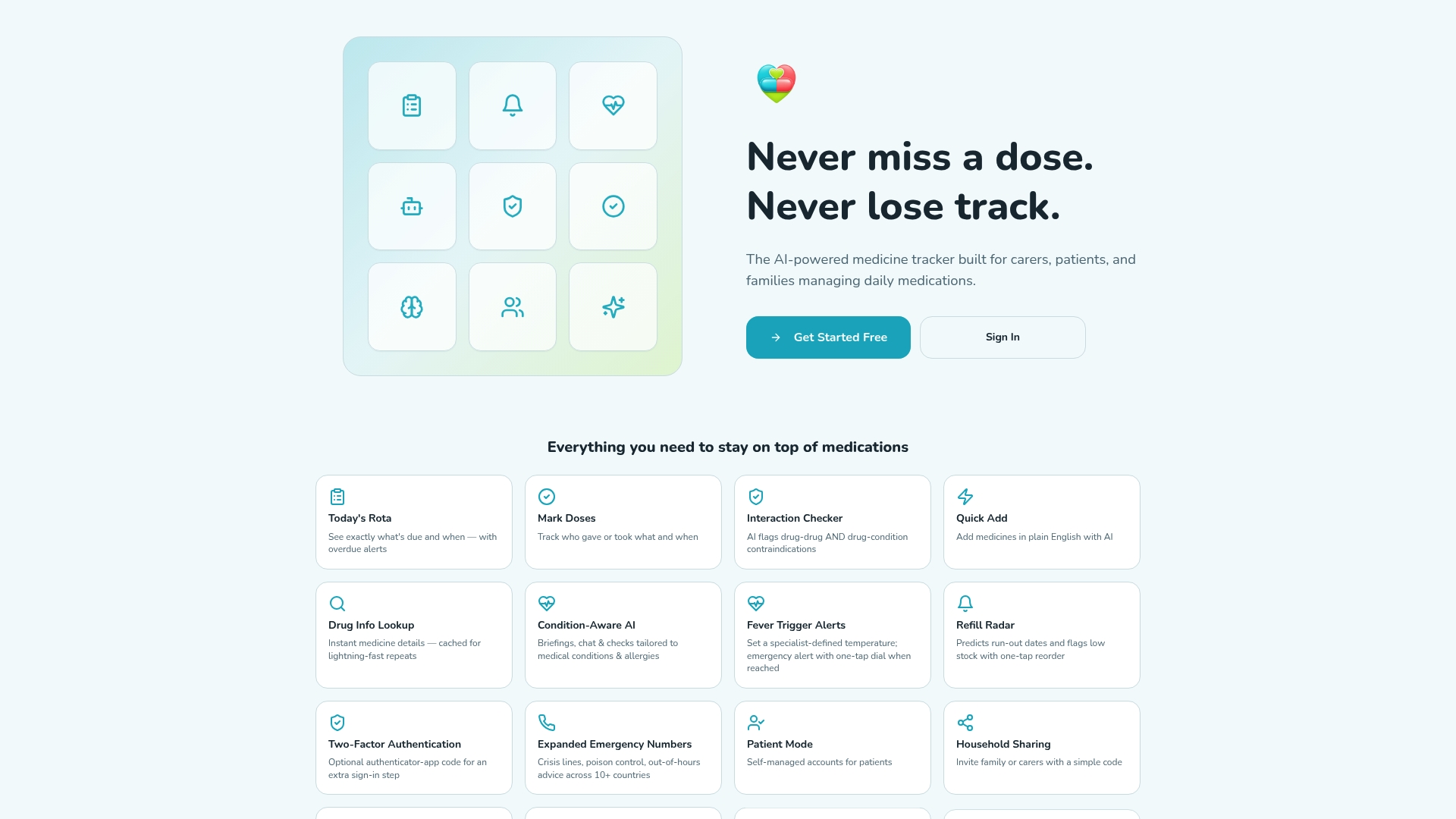
The platform includes drug interaction checks, condition-specific guidance, and refill predictions, all compliant with UK GDPR standards. It supports multi-patient management, making it practical for families overseeing care for more than one person. Whether you are coordinating with a care home team or managing medicines independently, start with Thedailydosetracker to reduce errors and stay informed. You can also explore the platform's security and privacy details before signing up.
FAQ
What does medication management in care homes involve?
Medication management in care homes covers the full process from prescribing and dispensing through to administration, monitoring, and regular review. It involves trained staff, pharmacist oversight, MAR records, and governance policies that together protect residents from errors and adverse effects.
How often should a pharmacist review a care home resident's medicines?
Pharmacists should conduct monthly medication regimen reviews in nursing homes, applying tools like the Beers Criteria to identify inappropriate or unnecessary medicines. Families can request confirmation that these reviews are taking place and ask to see the outcomes.
What is medication reconciliation and why does it matter?
Medication reconciliation is the process of comparing a resident's medicines before and after a care transition to identify and resolve discrepancies. It matters because more than half of post-discharge medication lists contain at least one error that could cause harm if left uncorrected.
What questions should I ask a care home about medication safety?
Ask when the medicines policy was last reviewed, how staff competency in medicines administration is assessed, what the protocol is for refused or omitted doses, and how often a pharmacist reviews your relative's full medicines list. An elderly medication management checklist can help you structure these conversations.
What is polypharmacy and how is it managed in care homes?
Polypharmacy means taking five or more medicines simultaneously and is associated with higher risks of drug interactions and adverse events. Care homes should conduct at least annual pharmacist-led reviews to assess whether each medicine remains clinically justified, a process known as deprescribing.