
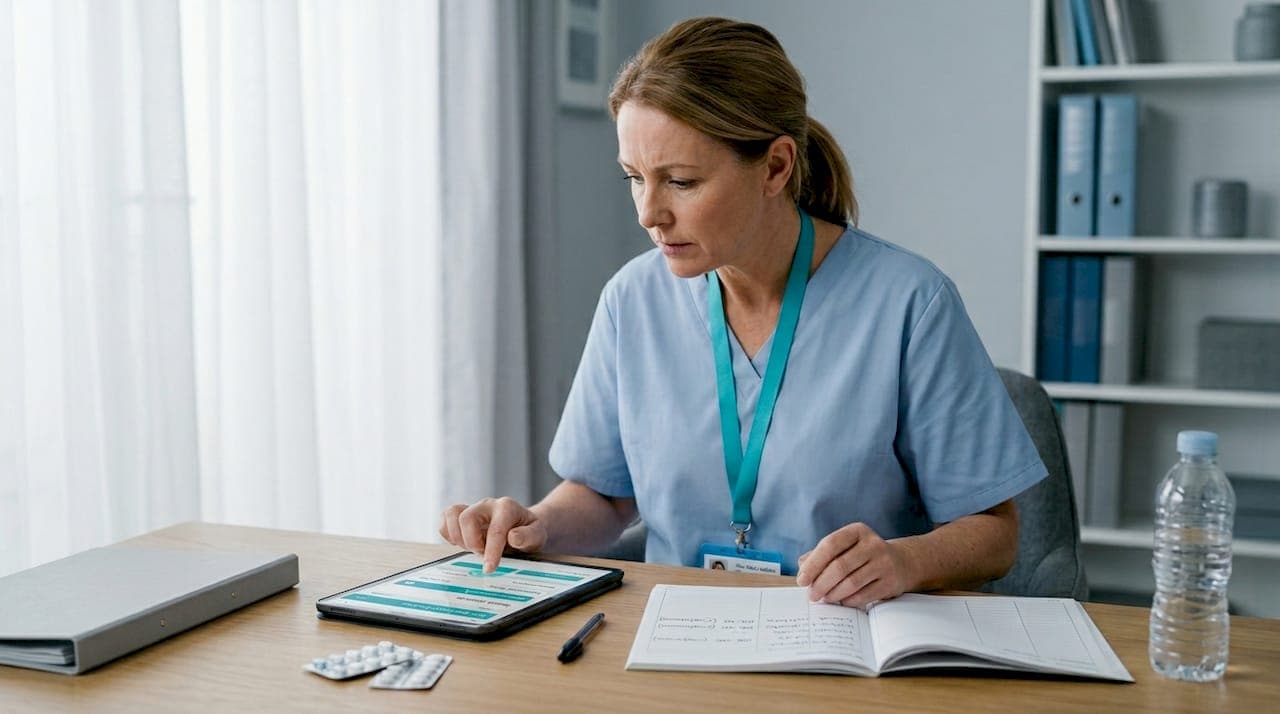
Picture this: a district nurse arrives for an evening visit, scans the paper medication sheet left by the morning carer, and notices a gap. Three doses of a blood-pressure medication are simply missing from the record. Was the medicine given and not logged, or not given at all? That moment of uncertainty is not rare. Nurses and home care providers maintain shift-by-shift logs precisely because accountability and continuity depend on it. This guide walks you through how to prepare, log, verify, and troubleshoot medication records so that every clinical decision is grounded in accurate, shared data.
Table of Contents
- Understanding the problem: why medication discrepancies matter
- Preparation: what you need to start medication logging
- How to log medications: step-by-step process
- Verification and reconciliation: making logs actionable for decisions
- Troubleshooting and common pitfalls in medication logging
- Our perspective: what really drives effective medication logging
- Get started with smarter medication logging
- Frequently asked questions
Key Takeaways
| Point | Details |
|---|---|
| Accurate logs boost safety | Comprehensive medication records help clinicians spot errors, prevent overdoses, and reduce hospital readmissions. |
| Digital tools outperform paper | Digital medication logging tools offer better accuracy, easier sharing, and stronger reminders for families and providers. |
| Routine reconciliation is essential | Regularly comparing logs with prescriptions drastically lowers the risk of discrepancies, especially for elderly or complex patients. |
| Engage the whole care network | Involving all carers—formal and informal—makes medication records more complete and reliable for clinical decisions. |
Understanding the problem: why medication discrepancies matter
A medication discrepancy is any difference between what a patient is actually taking and what is documented in their official record. It sounds administrative, but the clinical consequences are serious. A missed antiepileptic, a duplicated anticoagulant, or an undocumented over-the-counter supplement can each trigger a cascade of harm ranging from preventable hospital admission to life-threatening drug interactions.
The populations most at risk are those you work with every day. Elderly patients managing five or more medicines, people with dementia who cannot reliably self-report, and anyone moving between care settings face the greatest exposure. Research shows that 88% of elderly patients had at least one medication discrepancy after hospital discharge, with the primary cause being undocumented current medications. That figure is striking. It means the default outcome, without deliberate logging, is error rather than accuracy.
The impact extends beyond patient safety. Carers who discover a discrepancy mid-shift face enormous stress and uncertainty. GPs making prescribing decisions without a reliable medication list risk compounding existing problems. And for families already stretched thin by caregiving responsibilities, the emotional burden of a preventable medication incident is profound.
"Medication discrepancies are not edge cases. They are the expected outcome of fragmented, undocumented care."
Using digital tools for reducing discrepancies shifts the default from error-prone to error-resistant, but only when logging is consistent, shared, and acted upon.
Key risk factors that increase discrepancy rates:
- Polypharmacy (five or more regular medicines)
- Recent hospital discharge or care transition
- Multiple prescribers involved in one patient's care
- Informal carers who are not integrated into the clinical record
- Cognitive impairment that limits self-reporting
Preparation: what you need to start medication logging
Understanding the problem points us to better preparation. Before you log a single dose, you need the right information assembled in one place. Gaps in your baseline data will undermine every entry that follows.
Start by compiling a complete medicines list. This means every prescribed medicine, every over-the-counter product, every vitamin or supplement, and any medicines taken on an "as needed" basis. Include the drug name (both generic and brand if relevant), dose, frequency, route of administration, and the prescribing clinician. This list is your foundation.
What to gather before you start:
- Full current medicines list verified against the most recent prescription
- Known allergies and adverse drug reactions, clearly flagged
- Contact details for the prescribing GP and any specialist teams
- The patient's weight and relevant diagnoses (for dose-checking purposes)
- Emergency contact information for family members or key carers
Once you have the baseline, choose your logging method. The evidence increasingly favours digital tools. Structured EHR documentation is prioritised over paper for both accuracy and the ability to generate reminders, flags, and audit trails. Paper logs are better than nothing, but they cannot alert you to a missed dose at 2am, check for drug interactions automatically, or be shared instantly with a GP across town.
Digital apps vs paper logs: a practical comparison
| Feature | Digital log | Paper log |
|---|---|---|
| Real-time alerts for missed doses | Yes | No |
| Automatic drug interaction checks | Yes | No |
| Accessible to multiple carers simultaneously | Yes | Limited |
| Audit trail with timestamps | Yes | Difficult |
| Legibility | Always clear | Varies |
| Cost | Low to moderate | Very low |
| Backup and data security | Cloud-based | Risk of loss |
| Integration with clinical records | Possible | Rarely |
Explore the important app links for guidance on setting up a shared digital log, and review the platform's log security standards before entering patient data.
Pro Tip: Ask every member of the care team, including informal family carers, to confirm which medicines they personally administer. Overlapping responsibilities without clear documentation are a leading cause of duplicate dosing.
How to log medications: step-by-step process
With your tools assembled, it is time to actually log medication. The goal is a record that any member of the care team can pick up and trust completely, even if they have never met the patient before.
Step-by-step daily logging routine:
- Confirm patient identity before every administration using at least two identifiers (full name and date of birth as a minimum). This is not bureaucratic box-ticking; it prevents administration to the wrong person in shared care settings.
- Perform a pre-administration check. Review the current prescription, check for known allergies, and confirm the dose against the medicines list. Note any relevant observations such as blood pressure before an antihypertensive or blood glucose before insulin.
- Record the medicine name, dose, route, and exact time of administration immediately after giving it. Never log in advance. An entry made before administration creates a false record if the dose is subsequently not given.
- Document the outcome. Did the patient swallow the tablet? Was there any immediate reaction? Was the dose refused? All of this is clinically relevant.
- Log missed or delayed doses with a reason. "Patient asleep," "medicine not available," or "patient refused" are all valid entries. A blank is not.
- Flag any concerns immediately in the log and notify the responsible clinician. Safe administration guidelines include pre-assessments, scanning barcodes where possible, and formal incident reporting for near-misses.
What to record for each dose:
| Field | Example entry |
|---|---|
| Medicine name | Amlodipine 5mg tablet |
| Route | Oral |
| Scheduled time | 08:00 |
| Actual time given | 08:15 |
| Administered by | J. Smith (registered nurse) |
| Patient response | Swallowed without difficulty |
| Observations | BP 138/82 pre-dose |
| Missed dose reason | N/A |
Pro Tip: Set up your digital logging tool to require a mandatory "reason" field for any dose logged outside its scheduled window. This single change dramatically reduces unexplained gaps in the record.
Visit the logging tips section for practical templates and field-by-field guidance tailored to home care and clinical settings.
Verification and reconciliation: making logs actionable for decisions
Accurate logging can save lives, but only if logs are used for proactive verification and reconciliation. A log that sits in a drawer or a folder no one opens is no better than no log at all.

Medication reconciliation is the formal process of comparing a patient's current medicines list against prescriptions, discharge summaries, and clinical records to identify and resolve discrepancies. It should happen at every care transition: hospital admission, discharge, GP review, and whenever a new carer joins the team.
Steps for a structured reconciliation review:
- Pull the current log and the most recent prescription together side by side.
- Check every medicine on the prescription against the log. Is it being given at the right dose and time?
- Check every medicine in the log against the prescription. Is anything being given that is not currently prescribed?
- Review for duplicates, especially where brand and generic names may be causing confusion.
- Identify any medicines that have been started informally (by a family member, for example) and are not in the official record.
- Document every discrepancy found and escalate to the prescribing clinician or pharmacist.
The evidence for this process is strong. Reconciliation interventions, predominantly pharmacist-led, have raised reconciliation rates from as low as 13% to as high as 87%, with corresponding reductions in prescribing errors.
Who should be involved in reconciliation:
- The patient (where cognitive capacity allows)
- Family carers who administer medicines at home
- The key nurse or care coordinator
- The GP or prescribing clinician
- A pharmacist for complex regimens
"Reconciliation is not a one-off event at discharge. It is a continuous discipline that every shift handover and every GP appointment should reinforce."
Use the adherence tracking features within your digital platform to generate a reconciliation-ready summary before any clinical appointment or care transition.
Troubleshooting and common pitfalls in medication logging
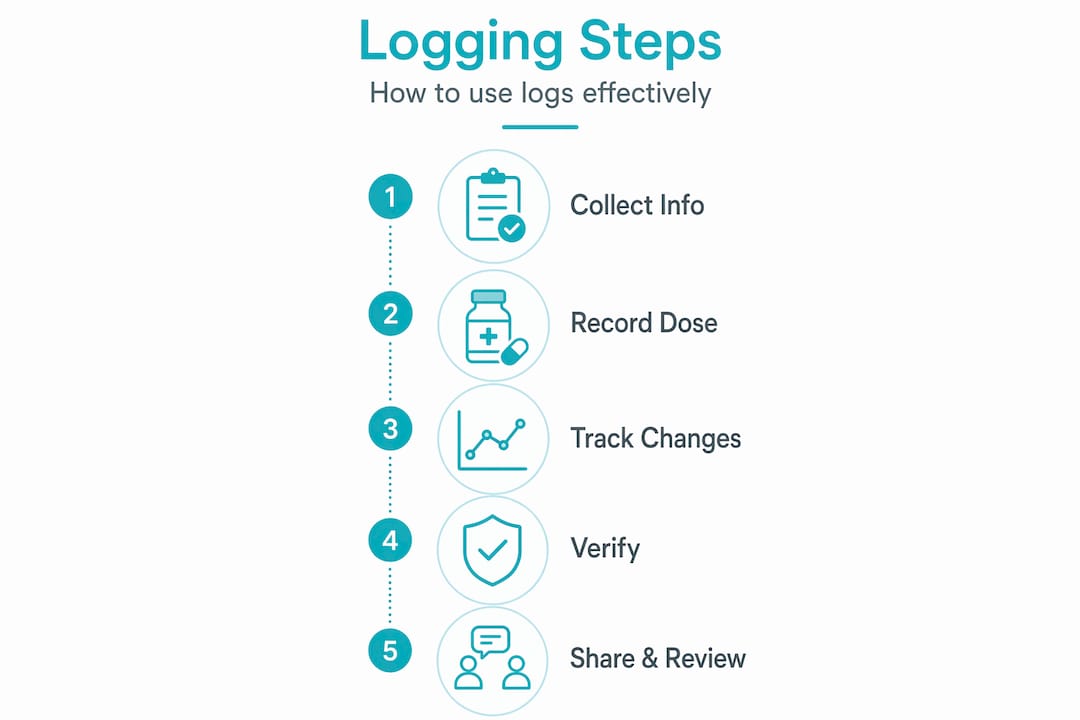
To finish the main guide, let us look at the issues that commonly derail even well-designed medication logs and how to overcome them.
Missed entries are the most frequent problem. A carer is interrupted mid-task, intends to log later, and forgets. The fix is to make logging immediate and frictionless. A digital tool that takes three taps to record a dose is more likely to be used consistently than a paper form requiring a pen search and a trip to another room.
Alarm fatigue is a real risk with digital tools. When every missed dose triggers an alert, carers quickly learn to dismiss notifications without reading them. Set alerts selectively: prioritise high-risk medicines such as anticoagulants, insulin, and antiepileptics, and reduce or silence alerts for low-risk supplements. Review your notification settings monthly.
Informal carers being left out of the loop is a particularly serious pitfall. Research into caregiver networks, especially in dementia care, shows that unreported medication changes and self-weaning are common when family members are not formally integrated into the logging system. A daughter who quietly halves her mother's sedative because she thinks it is "too strong" creates a clinical risk that no professional will detect unless she is part of the log.
Practical fixes for common logging pitfalls:
- Assign a named person responsible for each administration window, not just a general "family" or "carer" label
- Use a shared digital platform so all carers log into the same record in real time
- Schedule a brief weekly log review with all active carers present
- Create a simple escalation path: who to call, and when, if a discrepancy is found
- Keep a "changes" section in the log where any informal adjustments can be noted without blame
"The most dangerous medication error is the one nobody knows about. Build a culture where logging gaps are raised, not hidden."
Our perspective: what really drives effective medication logging
Having covered the technical how-to, let us step back and reflect on what actually works in the real world, and what consistently does not.
Most medication log failures are not technical. They are cultural. A log that is maintained by one dedicated nurse but ignored by the rest of the team at handover is not a shared record; it is one person's diary. A paper form that is completed perfectly but then filed away before the GP appointment is a missed opportunity. The log only creates value when it is used, questioned, and updated by everyone involved in care.
We see a pattern in settings where medication safety genuinely improves. The log is digital, accessible on any device, and updated in real time. Every stakeholder, from the consultant to the family member who visits on Sunday afternoons, has a role in the record. Discrepancies are treated as learning opportunities rather than blame triggers. And crucially, the log feeds directly into clinical decisions: it is open on the screen during the GP call, referenced at the pharmacy, and reviewed at every care team meeting.
The uncomfortable truth is that many organisations invest in logging tools but not in logging culture. A sophisticated platform left to one enthusiastic nurse will underperform a simple shared spreadsheet that the whole team owns. The technology matters, but the team habits matter more.
Explore the caregiver network resources to see how a shared digital platform can shift logging from a solitary task to a genuine team discipline. The difference in outcomes is not marginal. It is the difference between a record that prevents harm and one that merely documents it after the fact.
Get started with smarter medication logging
Bringing everything in this guide into daily practice is far easier with the right digital foundation. The Daily Dose Tracker is built specifically for family carers, nurses, and clinical teams managing complex medication regimens. It combines real-time dose logging, drug interaction checks, missed-dose alerts, and multi-carer access in a single progressive web app that works across all devices.
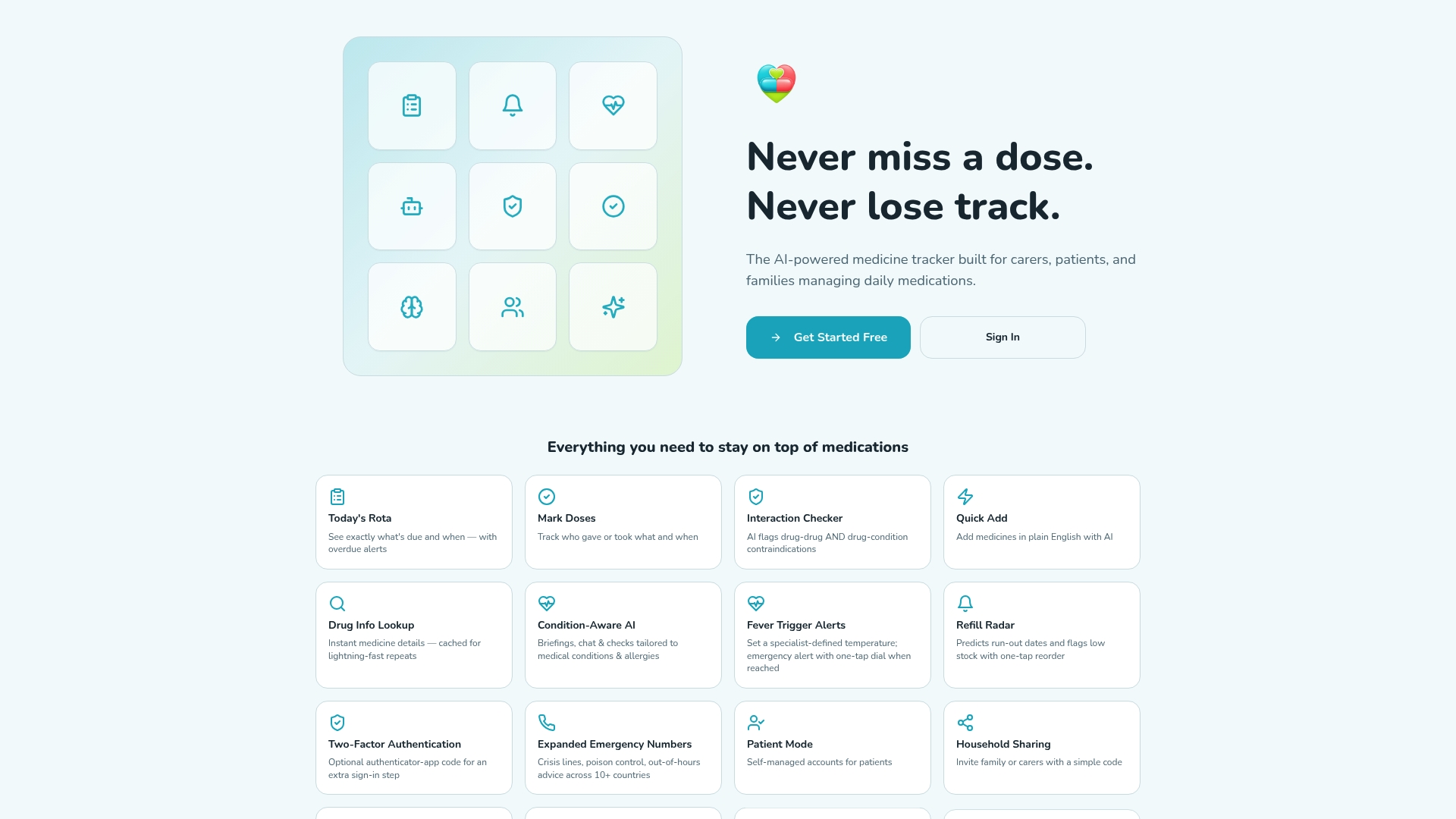
Whether you are coordinating care for an elderly parent at home or managing medication records across a professional caseload, the platform removes the friction that causes logging to break down. Shared access means every carer works from the same live record. AI-powered insights flag patterns that human review might miss. And full UK GDPR compliance means patient data is handled with the security it deserves. To find the right plan for your situation, see pricing options and get started today.
Frequently asked questions
What should be included in a medication log for clinical decision making?
A medication log should record drug name, dose, time, route, any reactions, missed or changed doses, and who administered each dose. Nurses and home care providers track all of these fields to maintain accountability and clinical continuity.
How do medication logs reduce errors during care transitions?
Logs provide an up-to-date list to reconcile against prescriptions, preventing omissions or duplications after hospital discharge. Reconciliation interventions raised reconciliation rates from 13 to 51 per cent up to 82 to 87 per cent and reduced prescribing errors significantly.
Are digital logs safer than paper medication records?
Digital logs are generally safer because they are easier to update, share in real time, and check automatically for errors or interactions. Digital tools are prioritised over paper records for accuracy and the ability to generate reminders and audit trails.
Who should have access to medication logs for the best clinical decisions?
Everyone directly involved in medication management, including family, nurses, doctors, and pharmacists, should be able to read and contribute to the log. Caregiver network involvement in shared platforms reduces errors and improves adherence across the care team.
What if a medication is missing from the log?
Raise it with the care team immediately, as missing entries are a leading cause of clinical decision errors. Research confirms that 88% of elderly patients had post-discharge discrepancies primarily because current medications were undocumented.