
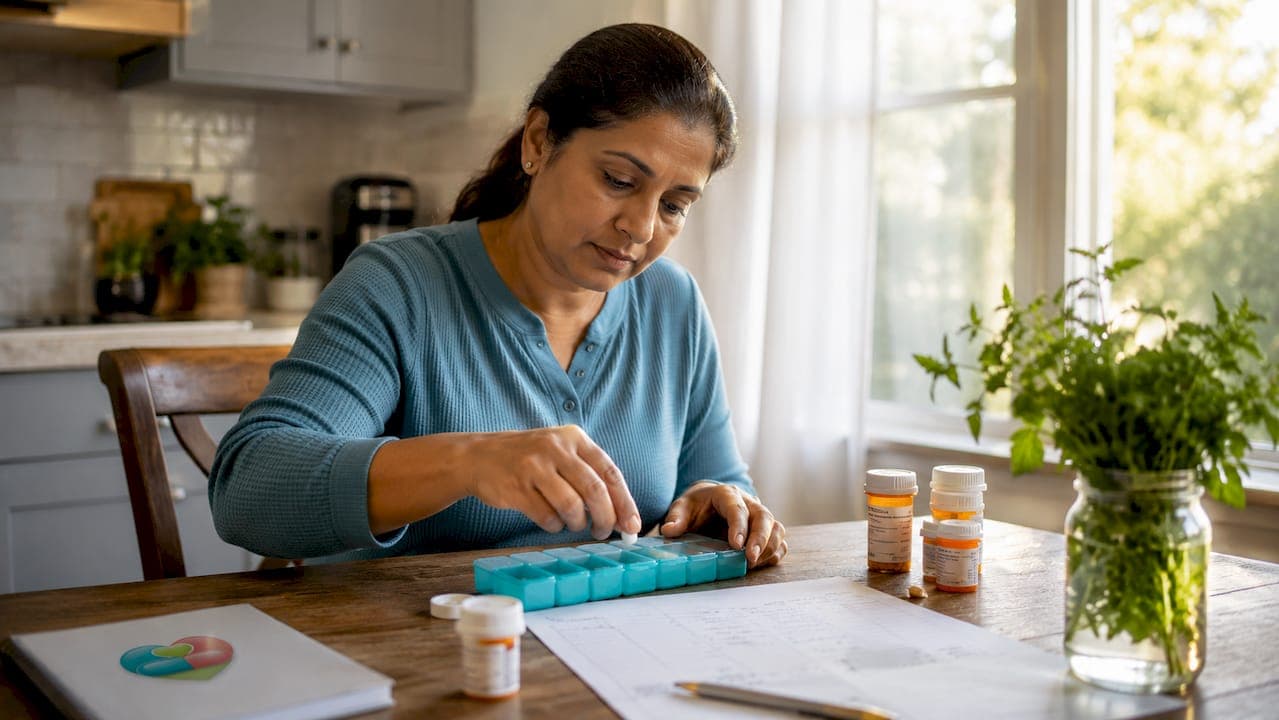
The role of carer in medication management is to support safe, accurate administration of prescribed medicines by following instructions, organising regimens, and communicating with healthcare providers, without independently altering any treatment. This is formally known as medication support, and it sits at the heart of safe home care for elderly or complex patients. Informal carers perform a wide range of medication-related tasks but require training and guidance to do so safely. Getting this role right protects the person in your care and protects you.
What is the role of carer in medication management?
The carer's role in medication management covers organisation, administration, documentation, and communication. It does not include clinical decision-making. That boundary is the single most important thing a family carer can understand.

Carers need strong organisation and advocacy skills, including keeping detailed medication lists and engaging doctors and pharmacists to understand expected effects and any changes. A medication list should record the drug name, dosage, prescriber, and reason for each medicine. Without this, errors multiply quickly, especially when a person takes five or more medicines daily.
The supportive role of carers also includes recognising side effects and reporting them promptly. It does not include deciding whether to reduce a dose or stop a medicine. That distinction keeps patients safe and keeps carers within their legal and ethical remit.
Which tasks are carers responsible for, and which are not?
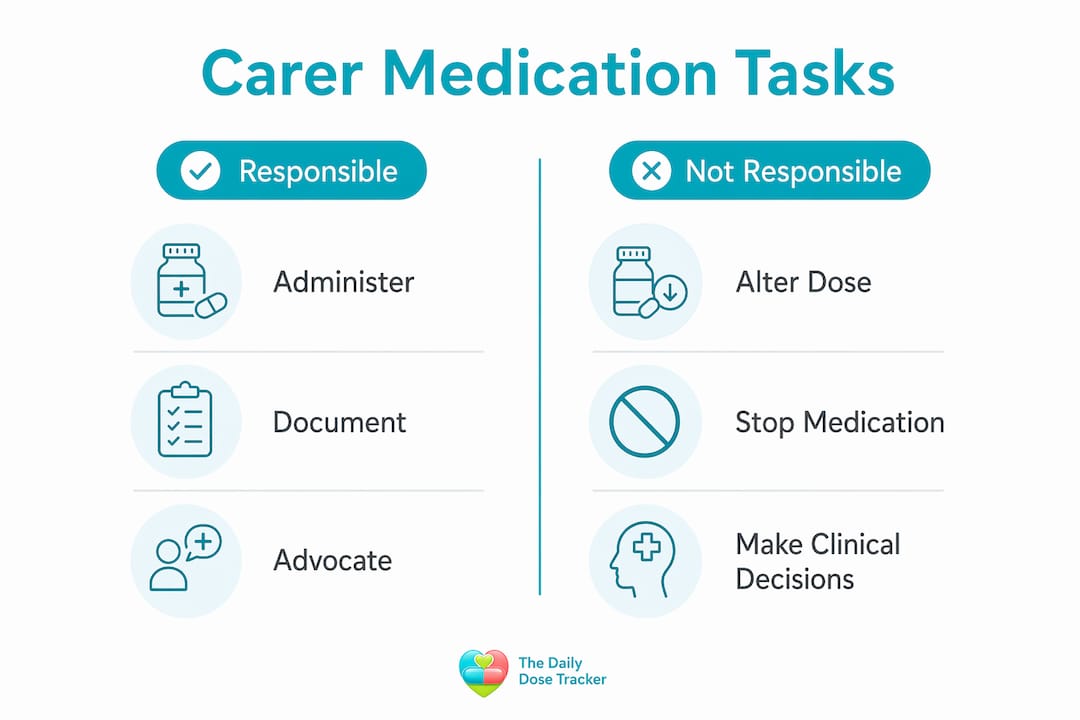
Carer responsibilities in medication fall into two clear categories: what you must do and what you must never do alone.
What carers are responsible for:
- Administering medicines at the correct time and in the correct form (tablet, liquid, patch)
- Recording each dose on a medication administration record or care plan
- Organising pill organisers or blister packs in advance
- Observing for side effects and reporting them to a GP or pharmacist
- Collecting prescriptions and managing refills before supplies run out
- Following the written care plan precisely as instructed
What falls outside a carer's remit:
- Changing a dose, even if the person says they feel better or worse
- Stopping a medicine without clinician approval
- Making clinical judgements about whether a medicine is working
- Substituting one medicine for another without professional guidance
Acting beyond role boundaries by changing or stopping medication without clinician input increases risk and is strongly discouraged. Accurate recording and escalation, rather than independent decision-making, is the central safety principle.
A written care plan is your reference document. If an instruction is unclear, contact the prescriber or pharmacist before acting. Never guess.
Pro Tip: Keep a printed copy of the care plan in the same place as the medicines. If a healthcare professional visits, they can review it immediately without delay.
How can carers organise and track medication administration effectively?
Effective medication supervision by carers depends on consistent systems, not memory. Memory fails under stress, fatigue, and the complexity of managing multiple conditions.
Build and maintain a medication list
Every carer should maintain an up-to-date written or digital medication list. Include the drug name, generic and brand name, dose, frequency, prescriber, and reason for use. Update it after every GP or hospital appointment. This list becomes critical during emergencies when you may not be present to explain the regimen yourself.
Use the six rights framework
Medication Administration Records (MARs) are legal documents used by care professionals to record administration and ensure compliance with the six rights approach. The six rights are: right patient, right medication, right dose, right route, right time, and right to refuse. Applying this framework before every administration catches errors before they happen.
Step-by-step administration routine
- Check the medication list and confirm the medicine, dose, and time
- Check the MAR to confirm the dose has not already been given
- Prepare the medicine exactly as instructed (do not crush tablets unless prescribed)
- Administer and observe the person taking it
- Record the dose on the MAR immediately, including any refusal
- Store remaining medicines correctly (cool, dry, away from children)
Tools that reduce errors
| Tool | Best use |
|---|---|
| Pill organiser (7-day) | Daily sorting for simple regimens |
| Blister pack (dispensed by pharmacy) | Complex or high-risk regimens |
| Phone alarm or app reminder | Time-sensitive medicines |
| Digital tracking app | Multi-patient or multi-medicine logging |
| Written MAR chart | Legal record for formal care settings |
For carers managing complex medication schedules, a digital app that logs doses and sends alerts reduces the cognitive load significantly. Thedailydosetracker offers real-time dose alerts, drug interaction checks, and refill predictions in one place.
Pro Tip: Ask your pharmacist to dispense medicines in a monitored dosage system (blister pack). This removes the daily sorting step entirely and reduces the risk of missed or double doses.
What role do carers play during hospital discharge?
Hospital discharge is one of the highest-risk moments in a patient's care. Medicines are frequently changed, added, or stopped during a hospital stay, and the person returning home may not remember or fully understand what has changed.
Family carers play a critical role at hospital discharge by relaying medication information, yet they are often insufficiently involved in discharge discussions. This gap directly impairs safe management at home.
Carers should take the following steps at every hospital discharge:
- Ask to be present during the discharge conversation with the ward pharmacist or nurse
- Request a written discharge summary that lists every medicine, including new ones and any that have been stopped
- Clarify the purpose, dose, and schedule of each new medicine before leaving the ward
- Ask specifically what to do if a dose is missed or a side effect appears
- Contact the GP within 48 hours to confirm the new regimen is on the patient's records
Carers should proactively clarify medication instructions during discharge to ensure safe continuation at home. Asking clearly about purposes, schedules, and actions if doses are missed is not overstepping. It is your responsibility.
Once home, document any new symptoms or behavioural changes in writing. If something concerns you, contact the GP or NHS 111 the same day. Do not wait to see if it resolves.
How should carers collaborate with healthcare professionals?
Carers' role in chronic illness care depends heavily on the quality of their relationships with GPs, pharmacists, and specialists. A carer who communicates well with the healthcare team is a safety asset. One who stays silent is a risk.
Meaningful conversations between carers and community pharmacists improve medication management and safety. Pharmacists can review the full regimen, explain brand and generic differences, and advise on side effect thresholds. Most community pharmacies offer a medicines use review or new medicine service at no cost.
Practical steps for effective collaboration:
- Book a medicines review with the GP or pharmacist every six months, or after any hospital admission
- Bring the medication list to every appointment and ask for it to be checked
- Report any observed side effects or changes in behaviour, appetite, or sleep
- Ask the pharmacist whether any medicines interact with each other or with over-the-counter products
- Request written information on any new medicine, including what to monitor
Medication safety improves when carers combine organisation tools with advocacy in clinical appointments. Advocacy here means asking questions, not accepting vague answers, and following up in writing if needed. You are the person who sees the patient every day. That observation is clinically valuable.
For carers managing prescriptions across multiple conditions, keeping a single consolidated record and sharing it at every appointment prevents duplication and dangerous interactions.
Key takeaways
The carer's role in medication management is to administer, document, and escalate, never to make clinical decisions independently.
| Point | Details |
|---|---|
| Stay within your remit | Administer and record medicines as instructed; never change doses or stop medicines without clinician approval. |
| Use a MAR and medication list | Written records protect the patient and protect you if a question arises about what was given. |
| Act at hospital discharge | Request a written discharge summary and clarify every medicine change before leaving the ward. |
| Build pharmacist relationships | Regular medicines reviews with a community pharmacist catch interactions and errors before they cause harm. |
| Use tools to reduce errors | Pill organisers, blister packs, and digital apps reduce reliance on memory and lower the risk of missed doses. |
What I have learned from watching carers manage medicines
Family carers are often handed a bag of medicines at a hospital door and expected to manage them without adequate explanation. I have seen this create genuine harm, not from negligence, but from a lack of clear guidance on what the role actually requires.
The most common mistake is not a missed dose. It is a carer who quietly adjusts a medicine because the person says it is not working, without telling anyone. That decision, made with the best intentions, can mask a serious deterioration or cause a dangerous interaction. Following instructions carefully and reporting concerns, rather than making clinical changes, is carer best practice. It sounds simple. It is harder than it looks when you are tired and the person in your care is distressed.
The carers who manage this role well share two habits. They write everything down, and they ask questions without embarrassment. A pharmacist will never think less of you for asking what a medicine does. A GP will not dismiss you for reporting a change in behaviour. These conversations are the mechanism by which safe care happens at home.
The emotional and cognitive load of medication management is real and significant. If you are managing medicines for someone with dementia, Parkinson's disease, or heart failure, you are doing clinical-level work without clinical-level support. Seek out carer training through organisations like Carers UK or your local NHS trust. Use every tool available to you. And recognise that asking for help is part of doing the job well.
— Prasant
Thedailydosetracker: built to support carers like you
Managing medicines for an elderly or complex patient involves dozens of decisions every week. Thedailydosetracker is a free digital platform designed specifically for carers and families who need a reliable system for tracking doses, scheduling reminders, and logging administration records.
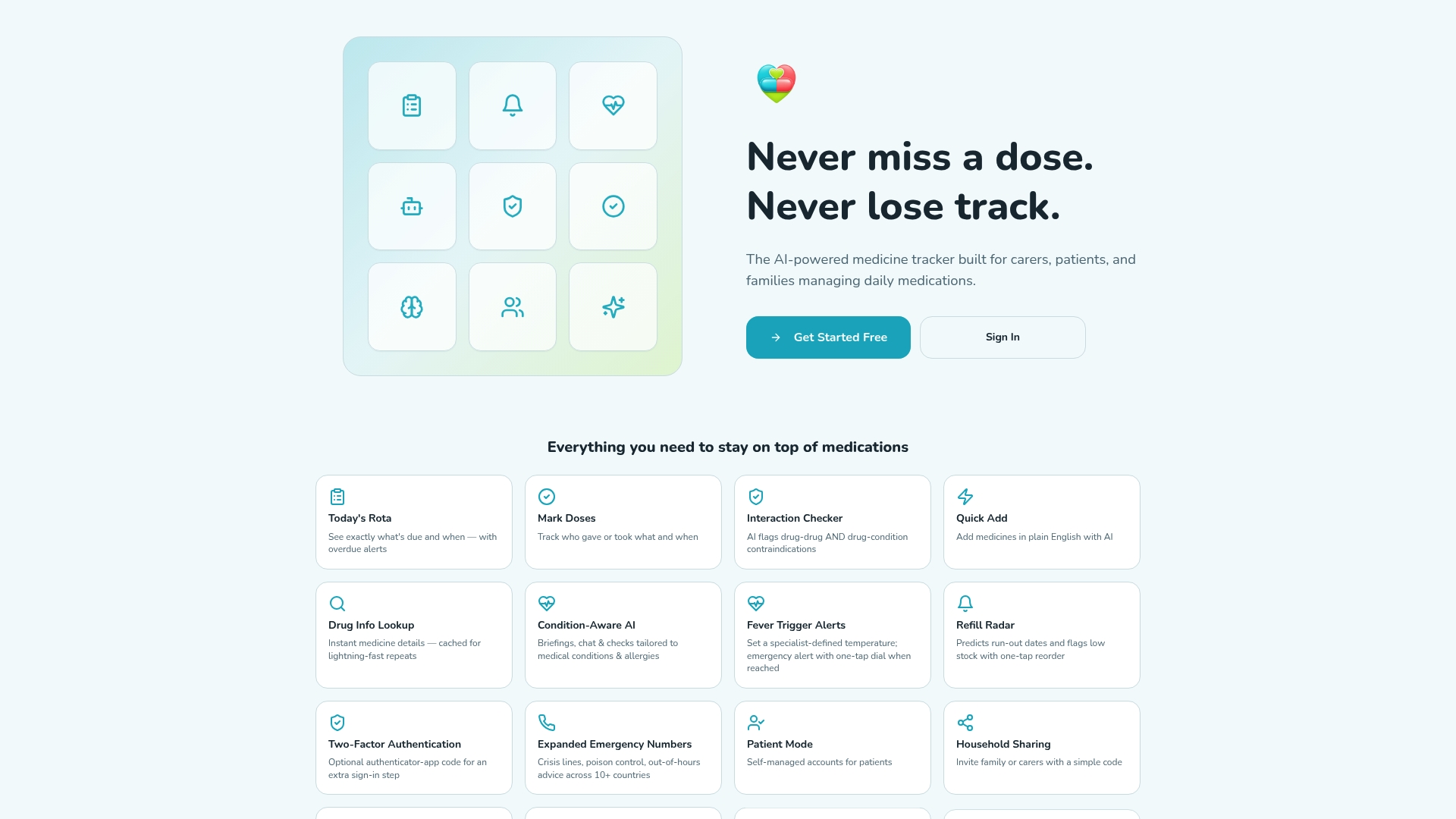
The platform includes real-time alerts for due and overdue doses, drug interaction checks, refill predictions, and multi-patient management across shared households. It complies with UK GDPR standards and works across devices as a progressive web app. For carers who want a clear, auditable record of every dose given, Thedailydosetracker removes the guesswork from daily medicine management. Start tracking medicines for free and see how it fits your care routine.
FAQ
What is a carer's main responsibility in medication management?
A carer's main responsibility is to administer medicines as prescribed, record each dose accurately, and report any concerns to a healthcare professional. Carers must follow written care plans precisely and must not make clinical decisions such as altering doses independently.
Can a carer stop or change a medicine if the patient asks?
No. Stopping or changing a medicine without clinician approval is outside a carer's remit and increases patient risk. The correct response is to contact the GP or pharmacist and report the concern.
What is a Medication Administration Record (MAR)?
A MAR is a legal document used to record every medicine given to a patient, including the dose, time, and any refusal. MARs support the six rights approach to safe administration and provide an auditable record for healthcare professionals.
How should carers handle medication changes after a hospital stay?
Carers should request a written discharge summary, attend the discharge conversation where possible, and clarify every medicine change with the ward pharmacist before leaving. Proactive clarification at discharge prevents errors in the critical first days at home.
How often should a carer review medicines with a pharmacist?
A medicines review with a community pharmacist is recommended every six months, or after any hospital admission or significant change in health. Regular pharmacist conversations help identify interactions, clarify side effects, and confirm the regimen remains appropriate.