

The single most effective step you can take today is to combine a formal medication review with clinician-aligned medication schedule software that logs doses, tracks PRN use, and exports a complete medication history for your GP or pharmacist. Software alone will not fix a regimen that needs clinical rationalisation first, but together they reduce errors, cut missed doses, and give clinicians the real-world data they need to make better decisions.
Three actions to take now:
- Request a medication review from your GP or community pharmacist, specifically asking for a review of dosing frequency and whether any medicines can be consolidated or stopped.
- Export or write up a best possible medication history (BPMH) that includes every prescription medicine, over-the-counter product, and supplement, with doses and timings.
- Install your chosen dose scheduling software, enter the BPMH, enable caregiver sharing, and run a test alert before the first real dose is due.
Table of Contents
- What counts as a complex medication regimen?
- Why regimen complexity puts patients at real risk
- The clinical approach: medication review and regimen simplification
- Non-digital aids you will still encounter: pill organisers and MCAs
- What medication schedule software must do for complex regimens
- Why Thedailydosetracker is the recommended UK solution
- How to set up a safe, clinician-aligned schedule in software
- How to monitor effectiveness and the red flags that need clinical review
- Key takeaways
- The gap between what software promises and what actually works
- Thedailydosetracker: built for the complexity you are actually managing
- Authoritative UK and peer-reviewed sources to share with clinicians
What counts as a complex medication regimen?
The Specialist Pharmacy Service (SPS) defines a regimen as clinically complex when it involves three or more regular medicines, multiple daily dosing windows, PRN (as-needed) components, or special administration instructions such as taking a medicine on an empty stomach or at a specific interval from another drug. A useful working rule: if you are managing three or more regular medicines, or if doses are spread across more than two windows per day, the regimen qualifies.
The validated research tool for measuring this is the Medication Regimen Complexity Index (MRCI), which scores a regimen by counting dosage forms, dosing frequency, and special instructions. Clinicians use it in research and increasingly in practice to flag patients who need closer support.
Common examples of complex medication regimens include:
- An older person with heart failure, type 2 diabetes, and osteoporosis taking eight or more medicines across four daily windows, some with food restrictions.
- A younger patient managing an autoimmune condition alongside depression and asthma, with a mix of daily, twice-daily, and PRN inhalers.
- A family carer coordinating medicines for two or three household members simultaneously, each with different schedules, refill dates, and prescribers.
For a fuller explanation of what a regimen involves, the complete guide to medication regimens covers the terminology in plain language.
Why regimen complexity puts patients at real risk
Complexity is not just inconvenient. Research in clinically complex older adults consistently shows that adherence falls as dosing frequency rises, and that once-daily regimens outperform multi-dose regimens across multiple studies. The practical consequence: every extra dosing window you add to a schedule increases the probability that a dose will be missed, delayed, or doubled.
Adherence drops as dosing frequency rises. Studies in adults on complex regimens show that once-daily schedules produce better adherence than multi-dose regimens, and that around half of adults on three or more medicines make at least one dosing error.
A study of adults managing complex regimens found that roughly 20% scheduled dosing five or more times per day, and approximately half made at least one dosing error. Those errors were not random: they clustered around PRN medicines and medicines with special timing instructions, precisely the components that standard pill boxes and memory alone handle worst.
The groups most vulnerable to complexity-driven harm include:
- Older adults with cognitive impairment or early dementia, where working memory cannot reliably track multiple windows.
- Patients with low health literacy or language discordance, who may misread labels or misunderstand interval instructions.
- Carers managing medicines for someone else, where the cognitive load falls on a person who may also be fatigued or dealing with their own health needs.
The cognitive burden matters as much as the pharmacological risk. When a regimen demands active mental effort to execute correctly every day, fatigue and distraction become clinical hazards.
The clinical approach: medication review and regimen simplification
Software helps most when the regimen has already been clinically rationalised. That means starting with a medication review, not an app.

A structured medication review, carried out by a GP or pharmacist, examines every medicine for continued need, correct dose, and potential interactions. The RACGP simplification framework describes practical strategies including consolidating dosing times, switching to long-acting formulations, and using combination products where clinically appropriate. The MRS GRACE framework and similar tools have reduced administration frequency in trials without harming outcomes.
Deprescribing, stopping or reducing medicines that are no longer needed or are causing harm, is a core part of this process. It is not a failure of treatment; it is good clinical practice. For carers managing polypharmacy, understanding that some medicines can be safely stopped is often the most useful thing a review produces.
How to request and prepare for a medication review:
- Contact your GP surgery or community pharmacist and ask specifically for a "structured medication review" or a "medicines use review." NHS pharmacists can conduct these without a GP referral in many cases.
- Prepare your BPMH before the appointment. List every medicine, dose, frequency, prescriber, and the reason it was started, including OTCs and supplements. Apps that export this list as a PDF save significant time.
- Note any medicines that feel burdensome, confusing, or that you suspect are causing side effects. Clinicians cannot deprescribe what they do not know is a problem.
- Ask specifically whether any medicines can be consolidated to fewer daily windows, switched to a once-daily formulation, or stopped entirely.
Realistic timeline: a GP review appointment typically takes 20–30 minutes. Changes to a regimen may take several weeks to implement safely, particularly for medicines requiring gradual dose reduction.
Pro Tip: Bring a printed or exported medication list from your app to every appointment. Clinicians consistently report that a complete, accurate list, including supplements and OTCs, leads to faster and more productive reviews than relying on GP records alone, which frequently miss self-purchased medicines.
Simplification is not always possible. Some regimens are complex because the clinical situation demands it, and consolidating doses may not be pharmacokinetically safe for every combination. Your clinician will assess compatibility before making changes.
Non-digital aids you will still encounter: pill organisers and MCAs
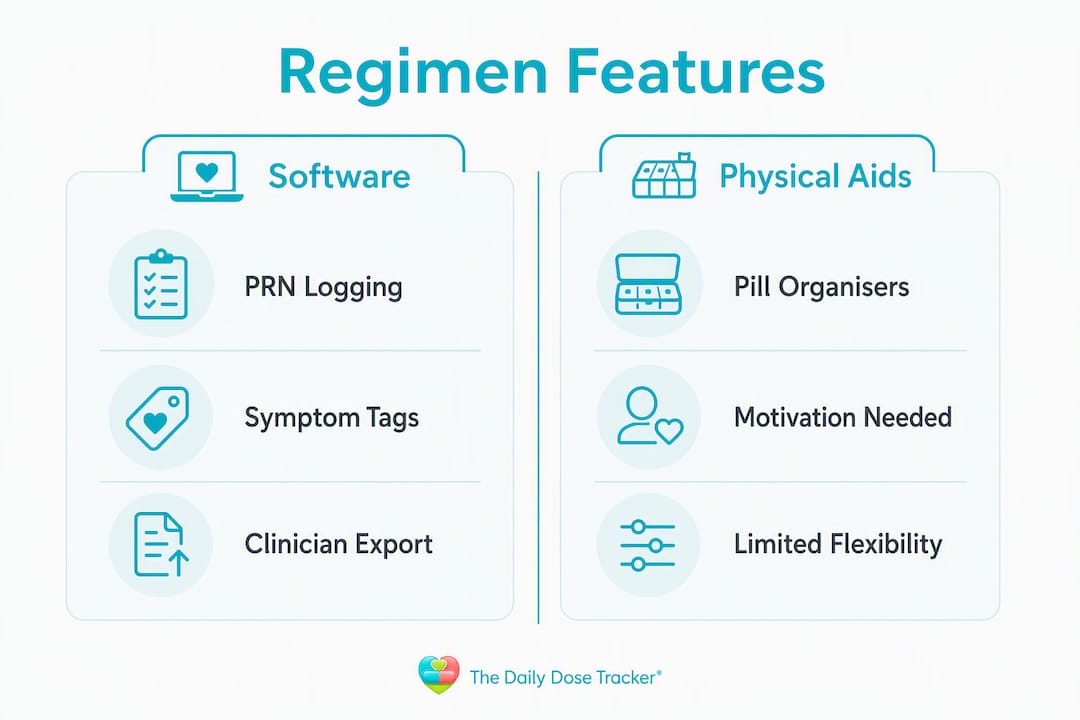
Physical aids remain widely used in UK community and residential care, and they are worth understanding before you layer software on top.
| Aid | Best suited to | Limitations |
|---|---|---|
| Weekly pill box (7-day) | Stable regimens, motivated self-managing adults | No alert function; does not handle PRN, inhalers, or liquids |
| Blister pack (pharmacy-prepared) | Older adults, carers needing visual confirmation | Inflexible when regimen changes; pharmacist repack needed |
| Multi-compartment compliance aid (MCA) | Residential care, complex stable regimens | Inappropriate for frequently changing regimens; unsuitable for some formulations |
| Dose administration aid (DAA) | Community patients with stable polypharmacy | Benefits in community settings are mixed; does not address intentional non-adherence |
DAAs and MCAs work well when a regimen is stable and the patient is motivated. They become a liability when medicines change frequently, because the pack must be remade each time, creating a window where the wrong version is in use. Inhalers, patches, and liquids cannot go into a blister pack at all.
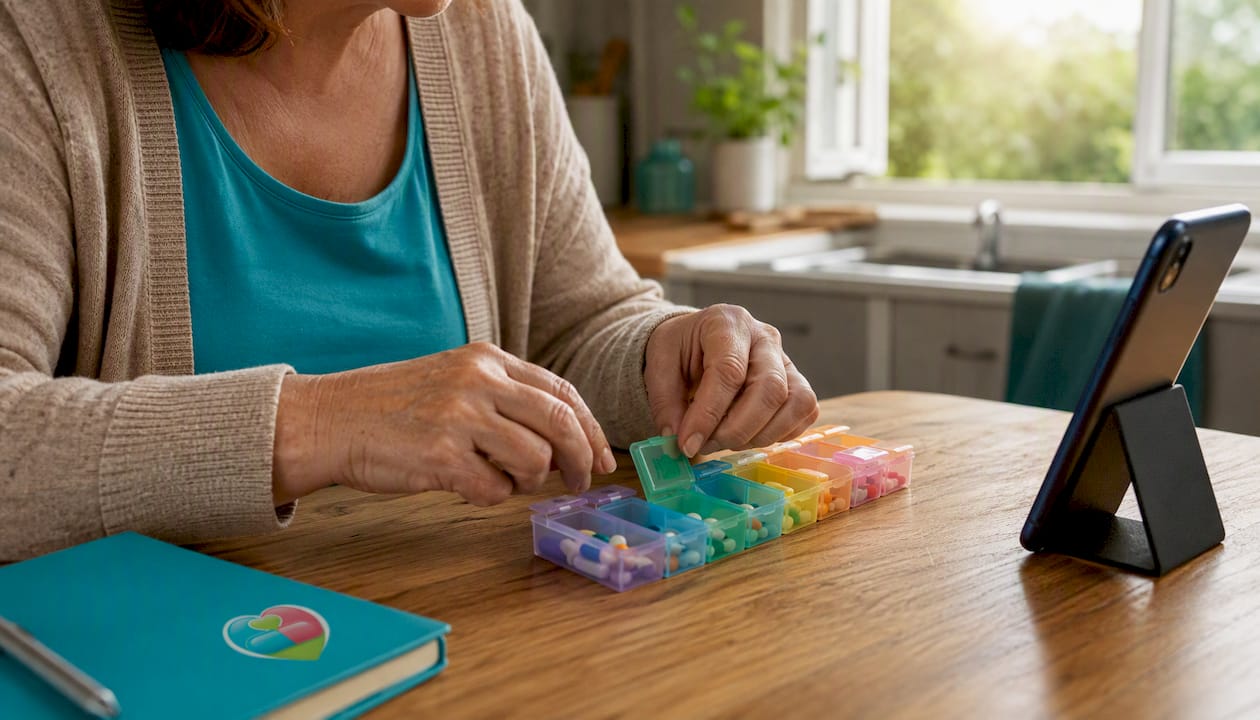
A pill organiser and software complement each other well in practice. The organiser provides a physical prompt and a visual check that the day's medicines are present; the software provides timed alerts, logs the confirmation, and flags missed doses to a carer or clinician. Neither replaces the other entirely.
What medication schedule software must do for complex regimens
Not every medication app is built for complexity. A simple reminder app that sends a notification and does nothing else will not support a patient on eight medicines with PRN components and a carer who needs to monitor remotely.
Must-have features for complex regimen management:
- Multi-dose scheduling with configurable windows, not just fixed alarm times, so doses can be tied to meals and daily routines.
- PRN logging with symptom tags, so as-needed medicines are recorded with the reason they were taken, creating a pattern clinicians can act on.
- Exportable medication history (BPMH) in a format a GP or pharmacist can read, ideally PDF or CSV.
- Caregiver sharing, allowing a family member or professional carer to view the schedule, receive alerts, and confirm doses remotely.
- Refill alerts based on remaining supply, not just calendar dates.
- Interaction checks that flag potential drug-drug or drug-food conflicts at the point of entry.
Logging PRN use alongside symptom context creates a feedback loop that helps clinicians avoid over-medication and identify patterns that would otherwise be invisible between appointments.
Nice-to-have features that add genuine value:
- AI-driven suggestions for consolidating dosing windows, based on the medicines entered.
- Automated cumulative-dose limits for PRN medicines (for example, a 24-hour paracetamol cap), which addresses a frequently overlooked safety gap.
- Multi-patient dashboard for carers managing more than one person.
- Integration with NHS App or GP records, where available.
| Feature | Why it matters for complex regimens |
|---|---|
| PRN logging + symptom tags | Captures real-world use patterns for clinician review |
| BPMH export | Replaces unreliable patient recall at appointments |
| Caregiver sharing | Distributes monitoring load; enables remote oversight |
| Interaction checks | Catches new conflicts when medicines are added |
| Cumulative PRN dose limits | Prevents inadvertent overdose of as-needed medicines |
| Refill predictions | Avoids gaps in supply for critical medicines |
Privacy matters here too. Any app storing medication data for UK patients must comply with UK GDPR. Check that the provider states its data storage location, has a published privacy policy, and does not sell health data to third parties.
Why Thedailydosetracker is the recommended UK solution
Thedailydosetracker maps directly onto the must-have checklist above. It supports multi-patient management from a single account, which matters for carers coordinating medicines for more than one person. PRN medicines can be logged with symptom tags, and the platform applies cumulative-dose logic to flag when a PRN limit is approaching. Medication history can be exported for GP and pharmacist appointments, giving clinicians the BPMH they need rather than a verbal summary.
Feature mapping against the must-have checklist:
- Multi-dose scheduling with configurable windows: included.
- PRN logging with symptom tags: included.
- Exportable medication history (BPMH): included.
- Caregiver sharing and household management: included.
- Refill predictions: included.
- Drug interaction checks and condition-specific guidance: included.
- UK GDPR compliance: confirmed.
A practical example: a carer supporting a family member with dementia sets up the schedule in Thedailydosetracker, entering all eight medicines with their dosing windows tied to breakfast, lunch, and bedtime. PRN pain relief is logged each time it is used, with a symptom tag. Before the quarterly pharmacist review, the carer exports the medication history and the PRN log as a PDF. The pharmacist can see that the PRN medicine has been used daily for three weeks, which prompts a conversation about whether a regular low dose would be more appropriate. That conversation would not have happened without the log.
| Need | Generic approach | Thedailydosetracker |
|---|---|---|
| Track PRN with context | Paper diary or memory | Symptom-tagged digital log with cumulative limits |
| Share schedule with carer | Printed list | Live household sharing with remote alerts |
| Prepare for review | Verbal recall | Exportable BPMH (PDF/CSV) |
| Monitor multiple patients | Separate apps or paper | Single multi-patient dashboard |
The platform runs as a progressive web app, meaning it works on any device without a separate download, which removes a common barrier for older carers or patients who are not confident with app stores.
How to set up a safe, clinician-aligned schedule in software
Setup done carelessly creates new risks. Done carefully, it takes about 30–45 minutes and produces a schedule that a clinician can verify.
- Prepare your BPMH first. List every medicine, including OTCs and supplements, with the dose, frequency, prescriber, and the reason it was started. Use the patient medication history guide as a template.
- Enter medicines one at a time. Do not rush. Check the dose and frequency against the current prescription label, not memory.
- Set dosing windows, not alarm times. Tie each window to an anchor habit: breakfast, midday meal, evening meal, bedtime. Consolidating to anchor habits improves adherence because the cue is already part of the day.
- Mark PRN medicines separately. Tag each one with the condition it treats so logs are meaningful when exported.
- Enable caregiver sharing. Add the relevant household members or professional carers and confirm they can see the schedule and receive alerts.
- Run a test alert. Trigger a test notification on every device that will receive alerts before the first real dose is due. Silent or delayed alerts are a common setup failure.
- Export the medication list and share it with your GP or pharmacist. Ask them to confirm the entries are correct and flag anything missing.
Safety reminders to build into your routine:
- Always confirm a dose in the app after taking it, not before. Pre-confirmation creates false records.
- If you travel across time zones, adjust dosing windows manually and note the change in the diary.
- If a device is lost or replaced, revoke access immediately and re-verify alerts on the new device.
- Double-check interaction alerts when any new medicine is added, including OTCs.
The medication review preparation guide explains what a clinician will expect to see in an exported list and how to present it clearly.
How to monitor effectiveness and the red flags that need clinical review
Setting up software is not a one-time task. Effective monitoring means reviewing the data regularly and knowing when a pattern requires clinical attention.
Weekly and monthly checks:
- Review the adherence report: are doses being confirmed consistently, or are certain windows regularly missed?
- Check PRN usage rates: is an as-needed medicine being used more frequently than expected?
- Review the symptom diary for patterns linked to specific medicines or dosing times.
- Confirm refill alerts are triggering with enough lead time to order repeat prescriptions.
- For PRN medicines with cumulative limits, check the 7-day and 30-day totals.
Symptom logs linked to medication timing give clinicians the kind of longitudinal data that a 10-minute GP appointment cannot generate from memory alone.
Red flags that need prompt clinical contact:
- A sudden increase in PRN use over 5–7 days, which may indicate undertreated pain, anxiety, or a new clinical problem.
- Frequent missed doses in a previously reliable window, which may signal a side effect, swallowing difficulty, or cognitive change.
- New symptoms appearing consistently after a specific dose, suggesting a drug reaction or interaction.
- Falls, confusion, or changes in mobility or cognition, which are common presentations of medication-related harm in older adults.
- Any medicine running out significantly faster or slower than the refill prediction suggests.
When you contact your GP or pharmacist, bring the exported log. A clinician who can see two weeks of PRN use, missed doses, and symptom entries can make a far more targeted decision than one working from a verbal summary. That is precisely what the SPS guidance on complex regimen adherence recommends: digital diaries and exportable histories move clinicians from generic advice to personalised, data-informed adjustments.
Key takeaways
Medication schedule software for complex regimens works best when it is set up after a clinical medication review, configured with a complete BPMH, and used to generate exportable logs that carers and clinicians review together.
| Point | Details |
|---|---|
| Start with a medication review | Request a structured review from your GP or pharmacist before configuring any software. |
| Build a complete BPMH | Include every prescription, OTC, and supplement; export it for every clinical appointment. |
| PRN logging is a safety feature | Symptom-tagged PRN records reveal patterns that prevent over-medication and inform deprescribing. |
| Monitor weekly, not just at setup | Check adherence reports, PRN rates, and symptom diary entries on a regular cycle. |
| Thedailydosetracker covers the full checklist | PRN logging, BPMH export, caregiver sharing, multi-patient management, and UK GDPR compliance in one platform. |
The gap between what software promises and what actually works
There is a tendency in health technology to treat the app as the solution. Download it, enter your medicines, and the problem is solved. The evidence does not support that framing.
Research in clinically complex older adults makes the point plainly: software alerts alone are insufficient for complex patients. Success requires caregiver workflows, test alerts, and clinician sign-off after a short trial period to confirm that safety and adherence have actually improved. The technology is a scaffold, not a cure.
What I find consistently underestimated is the value of the PRN log. Most carers focus on scheduled medicines because those are the ones with clear times and obvious consequences for missing them. PRN medicines feel optional by definition. But a patient taking as-needed pain relief every day for three weeks has a clinical problem that needs addressing, and without a log, that pattern is invisible. The symptom tag is what turns a log entry into a clinical signal.
The other thing worth saying plainly: a complex regimen that has not been reviewed by a clinician is a regimen that probably contains medicines that could be stopped, consolidated, or switched. Software makes a complex regimen manageable. A medication review makes it simpler. The combination is what actually reduces harm.
Thedailydosetracker: built for the complexity you are actually managing
Managing eight medicines across four daily windows, with PRN components and a carer who needs to monitor remotely, is not a problem a basic reminder app was designed to solve. Thedailydosetracker handles exactly that: multi-patient scheduling, PRN logging with symptom tags, cumulative dose limits, caregiver sharing, and a BPMH export your pharmacist can read at the next review.
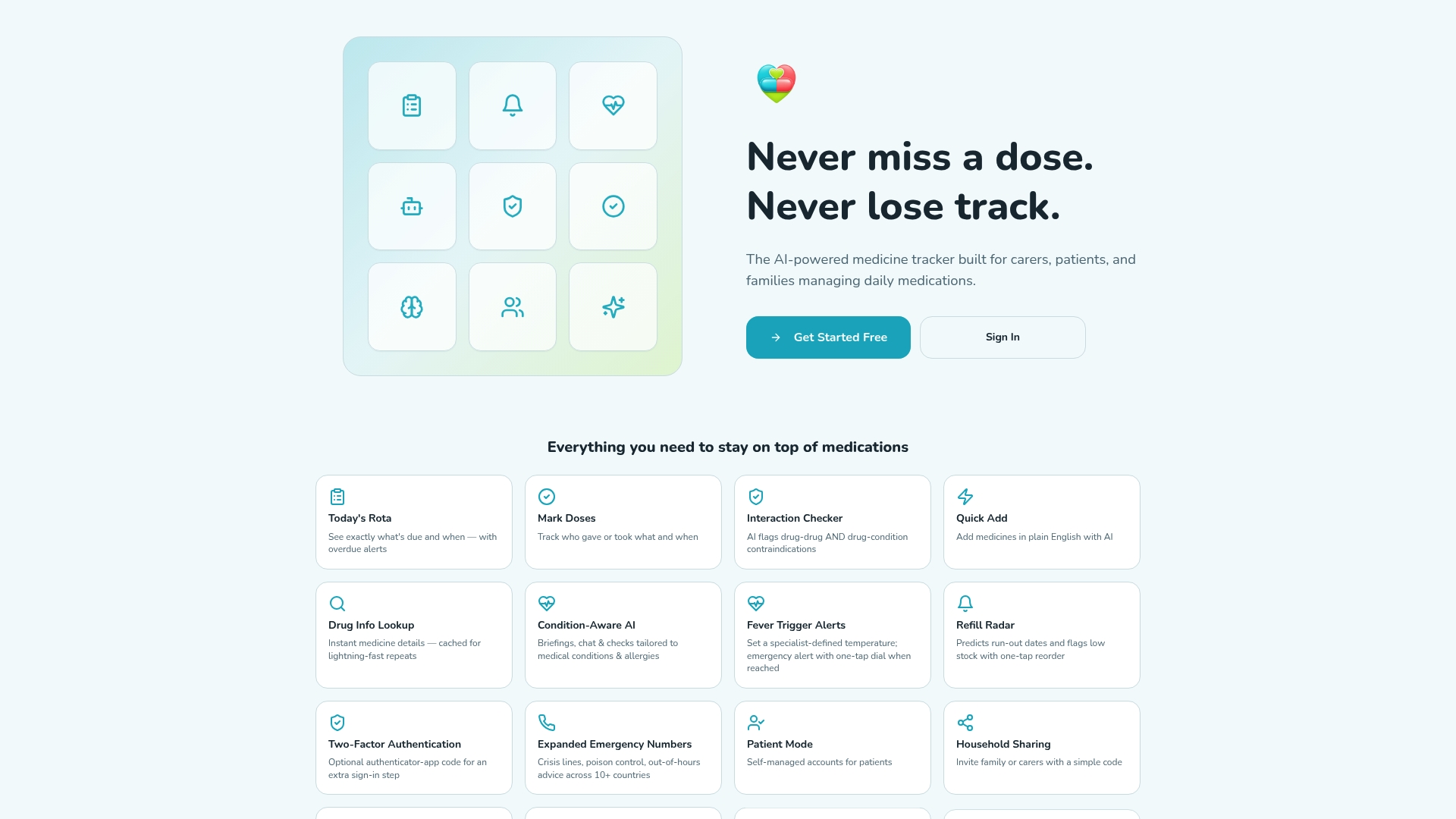
The freemium plan covers core scheduling and alerts at no cost. The Individual and Pro tiers unlock advanced AI insights, multi-patient management, appointment scheduling, and full diary and export functionality. A practical way to start: enter one patient's medicines, log one week of doses including any PRN use, then export the history and take it to your next pharmacist appointment. That single conversation often produces more regimen improvements than months of solo management.
Start your free trial and see how much clearer a complex regimen looks when the data is in one place.
Authoritative UK and peer-reviewed sources to share with clinicians
Bring this list, alongside your exported BPMH, to your next medication review appointment.
- Complex medication regimens: supporting adherence (Specialist Pharmacy Service / SPS) — NHS-hosted guidance on defining complexity, supporting adherence, and the role of medication review. The starting point for any UK clinician.
- An automated strategy to calculate medication regimen complexity (PMC) — Explains the MRCI scoring system; useful if your clinician wants a structured complexity measure.
- Managing medications in clinically complex elders (PMC) — Evidence on adherence, dosing frequency, and the limits of technology-only interventions in older adults.
- Medication dosing schedules, knowledge and dosing errors in adults on complex regimens — Real-world data on how often dosing errors occur and where they cluster in complex schedules.
- Student pharmacists and the Universal Medication Schedule (PMC) — Research on standardising dosing to four daily intervals to reduce over-scheduling and improve understanding.
- MedMinify: an advice-giving system for simplifying medication regimens (PMC) — Early clinical informatics work on automated simplification advice; useful background for clinicians interested in digital decision support.
Bring a printed or exported copy of your medication history from Thedailydosetracker alongside these sources. A clinician who can see your actual regimen alongside the evidence for simplification is far better placed to act on it.
This article provides general information for educational purposes. It is not a substitute for professional medical advice. Always confirm medication changes with your GP, pharmacist, or a qualified healthcare professional.