

A medication regimen is defined as a structured, personalised clinical plan detailing the drug, dosage, frequency, duration, and route of administration for a patient's treatment. Clinicians also refer to this as a drug regimen or medicine schedule. The plan balances a drug's therapeutic window, keeping doses high enough to work but low enough to avoid toxicity. Getting this balance right is the foundation of safe, effective prescribing. For patients, caregivers, and healthcare professionals alike, understanding what a medication regimen involves is the first step towards better health outcomes.
What is a medication regimen and what does it involve?
A medication regimen specifies five core components: the drug itself, the dose, how often it is taken, how long the course lasts, and the route of administration. Each component carries clinical weight. A dose that is too low fails to treat the condition; a dose that is too high causes harm. The route of administration, whether oral, inhaled, injected, or topical, affects how quickly the drug reaches its target and how the body processes it.
Regimens fall into four broad categories:
- Acute courses treat short-term conditions. A seven-day antibiotic course for a bacterial infection is a typical example.
- Chronic management regimens control long-term conditions such as type 2 diabetes, hypertension, or asthma. These regimens often involve multiple medicines taken indefinitely.
- Preventive regimens reduce the risk of disease. Daily low-dose aspirin or statins for cardiovascular prevention are well-known examples.
- Symptomatic regimens manage symptoms without curing the underlying cause, such as paracetamol for pain relief.
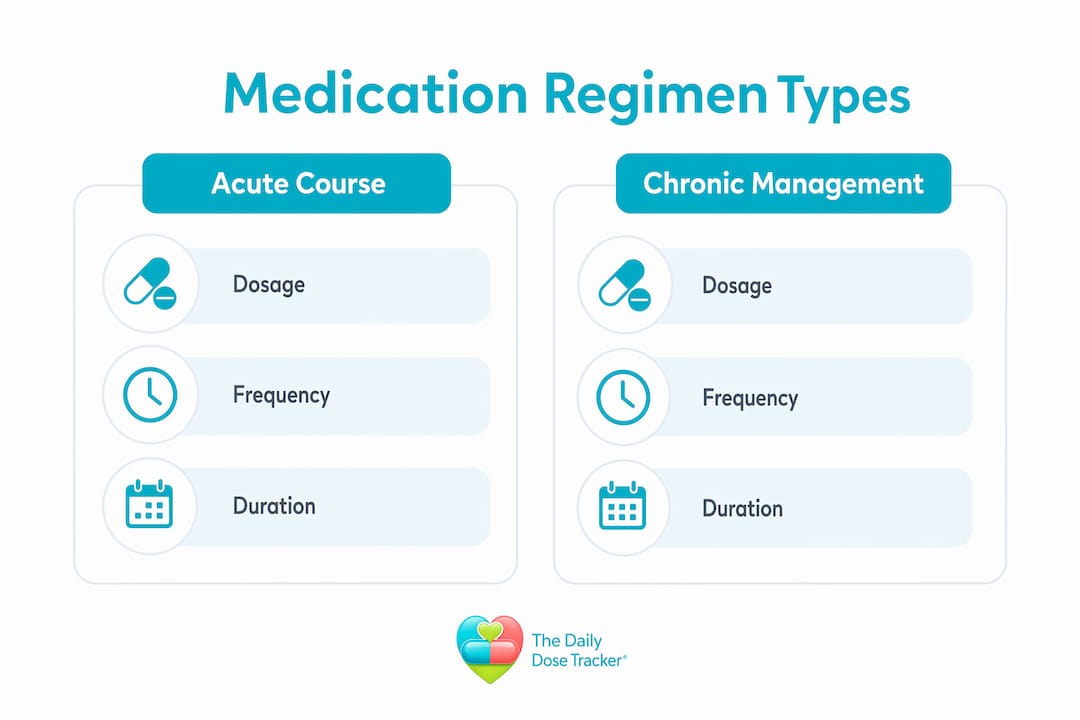
The table below shows how each core component differs across regimen types.
| Component | Acute course | Chronic management | Preventive |
|---|---|---|---|
| Dosage | Fixed, often higher | Titrated over time | Usually low and stable |
| Frequency | Multiple times daily | Once or twice daily | Often once daily |
| Duration | Days to weeks | Indefinite | Indefinite or seasonal |
| Route | Commonly oral | Oral, inhaled, or injected | Oral |
Injectable therapies such as insulin for type 1 diabetes illustrate how route and frequency interact. Patients may inject multiple times daily, with doses adjusted based on blood glucose readings. This level of complexity is why a personalised medication schedule requires ongoing clinical review, not just an initial prescription.

Pro Tip: Keep a written or digital record of every component of your regimen, including the exact dose and timing. This record is invaluable when speaking to any new clinician or attending an emergency department.
Why does adherence to a medication regimen matter?
Adherence is defined as the degree to which a patient takes medicines as prescribed. Clinicians also use the terms "compliance" and "concordance," though concordance carries a broader meaning: it refers to a shared agreement between patient and clinician about the regimen, rather than simple rule-following.
Only about 50% of patients adhere properly to their prescribed regimens. That figure means half of all prescriptions are not being taken as intended, which has serious consequences for public health. Non-adherence contributes to up to 125,000 cardiovascular deaths annually and drives significant hospital admissions.
The most common barriers to adherence include:
- Forgetfulness. This is the single most frequently reported reason for missed doses.
- Fear of side effects. Patients may stop a medicine after reading a leaflet or experiencing mild symptoms.
- Regimen complexity. Taking five or more medicines at different times of day creates confusion and fatigue.
- Emotional resistance. Patients often skip doses because the medicine reminds them of a chronic illness they are not ready to accept.
- Practical barriers. Cost, difficulty opening packaging, and swallowing problems all reduce adherence.
Older adults, children, and people with cognitive impairment face the greatest challenges. For elderly patients, polypharmacy, meaning the concurrent use of multiple medicines, compounds the problem significantly. A practical guide to adherence in elderly patients outlines specific strategies for this group.
Clinicians face a communication challenge too. Patients seldom volunteer adherence barriers unless directly asked. A simple question such as "When did you last take this medicine?" can uncover hidden non-adherence that would otherwise go undetected.
Pro Tip: If you are a caregiver, ask the patient to describe their routine for taking each medicine rather than asking whether they take it. Specific questions reveal far more than yes-or-no ones.
How do healthcare professionals personalise and optimise medication regimens?
The 2026 Scottish Government Polypharmacy Guidance redefines medication regimens as dynamic, person-centred partnerships that prioritise patient priorities and sustainability. This marks a significant shift from the older model of prescribing as a one-way clinical decision. The guidance covers the period 2026–2029 and applies across NHS Scotland, though its principles are widely adopted across the UK.
The guidance introduces a 7-step polypharmacy review process that clinicians use to assess and adjust complex regimens. The steps are:
- Identify all medicines the patient is currently taking, including over-the-counter and herbal products.
- Assess the clinical indication for each medicine.
- Evaluate the benefit-to-risk balance for each drug.
- Identify medicines that may be causing harm or are no longer needed.
- Agree on a revised regimen with the patient, reflecting their priorities.
- Implement changes and communicate them clearly to all members of the care team.
- Re-evaluate the regimen at regular intervals.
This process distinguishes between appropriate polypharmacy, where multiple medicines are genuinely needed, and inappropriate polypharmacy, where the burden outweighs the benefit. Reducing inappropriate polypharmacy improves patient safety and, as the guidance notes, reduces the carbon footprint associated with avoidable hospital admissions.
Pharmacists play a central role in this process. Pharmacists detect early refill patterns that indicate a patient is collecting medicines too early or too late, both of which signal adherence problems. They can then suggest simplified dosing schedules or alternative formulations. For a detailed look at how this review works in practice, the medication review process explained for patients and carers is a useful resource.
Pro Tip: Ask your GP or pharmacist to review your full medicine list at least once a year. A structured review often identifies medicines that can be stopped or consolidated, reducing the daily burden considerably.
What are the best practices for managing a medication regimen?
Effective medication management starts with an accurate, up-to-date medicine list. Every patient and caregiver should maintain a record that includes the medicine name, dose, frequency, and the reason it was prescribed. This list should be shared with every clinician involved in the patient's care, including dentists and pharmacists.
Practical strategies that consistently improve adherence include:
- Consolidate dose times. Taking all once-daily medicines at the same time each morning reduces the number of separate decisions a patient must make.
- Use long-acting formulations. Switching to once-daily or long-acting formulations reduces dose frequency and simplifies the regimen. This is one of the most effective structural changes a clinician can make.
- Use a single pharmacy. Collecting all prescriptions from one pharmacy makes it easier to spot interactions and track refills.
- Set up reminders. Digital reminders, whether through a phone alarm or a dedicated platform, significantly reduce missed doses. The role of reminders in patient health is well established in clinical literature.
- Use pill organisers. Weekly pill boxes help patients and carers confirm at a glance whether a dose has been taken.
Communication with healthcare professionals is equally important. Patients should report side effects promptly rather than stopping a medicine without guidance. Many side effects are manageable or resolve within days. Stopping a medicine abruptly, particularly for conditions such as hypertension or epilepsy, can cause serious harm.
Caregivers need to tailor their support to the individual. Caregiver approaches should reflect the patient's age, cognitive ability, and regimen complexity rather than relying solely on reminders or supervision. A caregiver supporting a person with dementia, for example, requires a different strategy from one supporting a teenager with asthma. Guidance on managing family medications covers these differences in practical detail.
Never adjust a dose or stop a medicine without speaking to a clinician first. Self-modification of a regimen is one of the most common causes of preventable harm.
Key takeaways
A medication regimen requires five defined components, consistent adherence, and regular clinical review to deliver safe, effective treatment outcomes.
| Point | Details |
|---|---|
| Five core components | Every regimen specifies drug, dose, frequency, duration, and route of administration. |
| Adherence is critical | Around 50% of patients do not take medicines as prescribed, contributing to serious harm. |
| Concordance over compliance | The 2026 polypharmacy guidance prioritises shared decision-making between patient and clinician. |
| Simplification improves outcomes | Reducing dose frequency and using long-acting formulations are the most effective adherence strategies. |
| Caregivers need tailored approaches | Support strategies must reflect the patient's age, cognition, and regimen complexity. |
Why I think we are still getting medication regimens wrong
After years of working with patients and care teams, the pattern I see most often is this: clinicians prescribe carefully, but the conversation stops at the pharmacy counter. The regimen is correct on paper. The patient nods. Then, three months later, the condition has not improved, and nobody has asked why.
The 2026 polypharmacy guidance is a genuine step forward because it names this problem directly. Concordance, the idea that a regimen must be agreed upon rather than handed down, is not a soft concept. It is a clinical necessity. A patient who does not understand why they are taking a medicine, or who fears what it represents, will not take it reliably. No reminder app changes that without an honest conversation first.
Pharmacists are, in my view, the most underused resource in this space. They see patients regularly, without appointments, and they notice when a prescription is collected two weeks late. That observation is clinical intelligence. It should trigger a conversation, not just a refill.
Technology has real value here, but only when it supports a regimen that the patient has already agreed to. A digital platform that logs doses, flags interactions, and alerts carers to missed medicines removes friction from a process that is already difficult. Thedailydosetracker does exactly this, and I think tools like it will become standard in complex care within the next few years.
The uncomfortable truth is that the best medication regimen in the world fails if the patient does not take it. Simplicity, communication, and trust are not optional extras. They are the treatment.
— Prasant
How Thedailydosetracker supports your medication regimen
Managing a complex medication regimen across multiple patients or family members is genuinely difficult. Thedailydosetracker is built for exactly this situation.
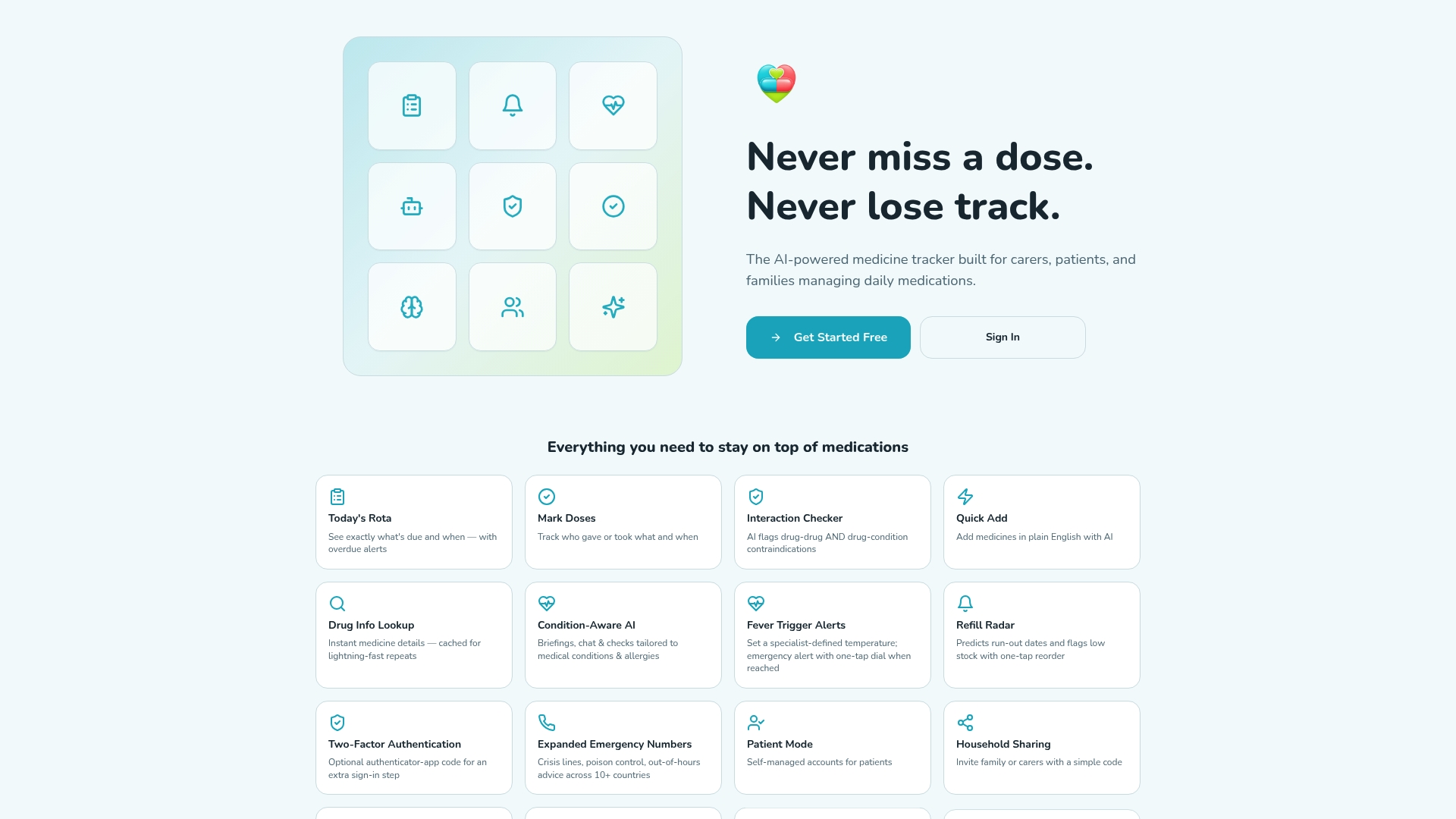
The platform lets patients, carers, and healthcare professionals create detailed medication schedules, log every dose, and receive real-time alerts for due or overdue medicines. AI-powered drug interaction checks and refill predictions add a layer of clinical safety that paper lists and pill boxes cannot provide. The platform complies with UK GDPR standards and supports multi-patient management across devices. Whether you are caring for an elderly parent or managing your own chronic condition, start tracking your medicines securely and without cost.
FAQ
What is a medication regimen in simple terms?
A medication regimen is a structured plan that specifies which medicine to take, at what dose, how often, for how long, and by which route. It is designed to treat or manage a health condition safely and effectively.
What are the most common types of medication regimens?
The four main types are acute courses for short-term illness, chronic management regimens for ongoing conditions, preventive regimens to reduce disease risk, and symptomatic regimens to manage specific symptoms.
Why do so many patients not follow their medication regimen?
Around 50% of patients do not adhere to their prescribed regimen. The most common reasons are forgetfulness, fear of side effects, regimen complexity, and emotional resistance to acknowledging a chronic illness.
How can caregivers help someone stick to their medication routine?
Caregivers should tailor support to the patient's age, cognition, and regimen complexity. Practical tools such as pill organisers, digital reminders, and a single pharmacy service all reduce the risk of missed doses.
What does concordance mean in medication management?
Concordance means that the patient and clinician have reached a shared agreement about the regimen, with the patient's priorities and concerns fully considered. The 2026 Scottish Government Polypharmacy Guidance identifies concordance as central to effective, person-centred prescribing.