

Managing family medications is defined as the process of ensuring every medicine is taken correctly, safely, and on time by all members of a household. For caregivers looking after elderly relatives, this is rarely straightforward. Polypharmacy, coordination failures between specialists, and challenges in medication adherence combine to create real risks. Medicare Part D data shows patients receiving prescriptions from up to 15 different providers yearly, which dramatically increases the chance of harmful drug interactions. The common challenges managing family medications presents are serious, but they are manageable with the right knowledge and tools.
1. What are the most common challenges managing family medications?
Medication management in family settings fails most often because no single person has the full picture. Specialists prescribe independently, pharmacies dispense without cross-checking, and caregivers are left to piece it all together. The result is a system where errors are almost inevitable without active coordination.
The core challenges caregivers face include:
- Polypharmacy. Fragmented specialist care is the primary driver. When a cardiologist, a rheumatologist, and a GP each prescribe without seeing the full list, dangerous overlaps occur.
- Medication adherence difficulties. Cognitive impairment, treatment burden, and fragmented care all reduce the likelihood that an elderly relative takes medicines correctly. These are systemic problems, not personal failings.
- Low health literacy. Patients with lower literacy levels are less likely to identify and manage medication complexity effectively. This means dosage instructions, interaction warnings, and label changes go unnoticed.
- Coordination failures. Caregivers, pharmacies, and healthcare providers often operate in silos. Without a shared record, the same information gets repeated, misunderstood, or missed entirely.
- Physical limitations. Poor vision, hearing loss, and reduced dexterity all interfere with safe medication handling at home. An elderly person who cannot read a label or open a childproof cap faces a genuine safety risk every day.
2. How to coordinate complex medication regimens effectively
The foundation of good coordination is a single, up-to-date master medication list. This list should include every medicine, the prescribing doctor, the dose, the timing, and the reason for each drug. Without it, caregivers are working blind.

Medication reconciliation after hospital discharge
Hospital discharge is the highest-risk moment for medication errors. New prescriptions are frequently added without stopping conflicting legacy medicines unless someone actively reconciles the full list. Caregivers should request a written discharge medication summary and compare it line by line against the existing list before the first post-discharge dose is given.
Pill organisers versus smart dispensers
A weekly pill organiser is a dispensing tool, not a safety net. A pill organiser does not confirm whether a dose was actually taken, flag missed refills, or alert anyone to interactions. Smart dispensers and digital logs provide that layer of verification. The table below shows where each approach succeeds and where it falls short.
| Feature | Weekly pill organiser | Smart dispenser or digital log |
|---|---|---|
| Dose dispensing | Yes | Yes |
| Confirms dose taken | No | Yes |
| Refill alerts | No | Yes |
| Interaction checks | No | Yes |
| Shared family access | No | Yes |
| Cost | Low | Moderate to high |
Pro Tip: Ask your pharmacist to fill the pill organiser for you each week. This reduces dispensing errors and gives the pharmacist a natural opportunity to spot any new interactions.
Engaging pharmacists and digital tools
Pharmacists who see all prescriptions filled at their pharmacy are uniquely placed to identify duplicated drugs and dangerous interactions across multiple specialists. Medication Therapy Management (MTM) sessions offer a structured review that can simplify a complex regimen significantly. Thedailydosetracker supports this process by giving caregivers a centralised, shareable medication record that can be brought to any appointment or MTM session.
3. What strategies improve medication adherence among elderly relatives?
Medication adherence involves complex psychological and system factors. Simple reminders alone are insufficient. Strong family support and proactive communication with healthcare teams are what actually move the needle.
The following strategies are grounded in current evidence and practical caregiving experience:
- Build a family support system. Assign one family member as the primary medication coordinator. That person attends appointments, asks questions, and keeps the master list current. Shared responsibility without a clear lead creates gaps.
- Communicate assertively with healthcare professionals. Bring the full medication list to every appointment. Ask directly whether each drug is still needed. Doctors respond to specific, prepared questions far better than vague concerns.
- Address cognitive impairment with structured reminders. Thedailydosetracker sends real-time alerts for due and overdue doses. This removes the burden of memory from an elderly relative who may already be struggling.
- Simplify regimens through MTM. A pharmacist-led MTM session can identify medicines that can be stopped, combined, or switched to once-daily formulations. Fewer doses mean fewer missed doses.
- Use plain language for all education. Low health literacy is a critical barrier. Providers should use jargon-free communication, and caregivers should reinforce this at home with simple written instructions and large-print labels.
- Track adherence, not just dispensing. Logging whether a dose was taken, not just whether it was prepared, is the only reliable measure of adherence. Digital logs make this visible to the whole care team.
Pro Tip: Keep a printed one-page medication summary in your relative's wallet or bag. In an emergency, paramedics and A&E staff can act faster with an accurate list in hand.
4. What physical and psychological barriers affect safe medication management?
Physical changes that come with age directly affect a person's ability to manage medications safely at home. These are not minor inconveniences. They are genuine safety risks that require practical adaptations.
Common physical barriers include:
- Poor vision. Standard prescription labels are often too small to read safely. Large-print labels and magnifying glasses reduce dispensing errors.
- Hearing loss. Verbal instructions from a GP or pharmacist may be missed or misunderstood. Written summaries and follow-up calls help close this gap.
- Tremors and arthritis. Opening blister packs and childproof bottles is genuinely difficult for many elderly people. Non-childproof caps and pre-filled dosette boxes are practical solutions.
- Reduced dexterity. Splitting tablets or measuring liquid medicines becomes hazardous when fine motor control declines.
Psychological barriers are equally significant. Negative beliefs and emotional distress around medications reduce adherence when left unaddressed. An elderly relative who believes a medicine is unnecessary, or who fears side effects, will find ways to avoid taking it. Caregivers who respond with frustration typically make the resistance worse. A calm, curious approach works better. Ask what specifically worries them, then bring those concerns to the prescribing doctor with a written note. Giving the person a sense of control over their own care reduces anxiety and increases cooperation.
Supporting patient self-administration where it is safe to do so also preserves dignity and independence, both of which matter enormously to elderly people. Supervision does not have to mean taking over.
Key takeaways
Managing family medications safely requires active coordination, not passive dispensing. Caregivers who treat themselves as the central coordinator, rather than a passive helper, prevent the most serious errors.
| Point | Details |
|---|---|
| Polypharmacy is a coordination problem | Multiple specialists prescribing independently is the leading cause of harmful drug interactions in elderly patients. |
| Pill organisers are not enough | They confirm dispensing, not ingestion. Use digital logs or smart dispensers to verify doses are actually taken. |
| Pharmacists are underused allies | MTM sessions can simplify complex regimens and catch interactions that no single prescriber sees. |
| Psychological barriers need empathy | Medication refusal driven by fear or negative beliefs requires calm dialogue, not pressure. |
| Technology supports, not replaces, human care | Tools like Thedailydosetracker centralise records and send alerts, but family coordination remains the foundation. |
Prasant's take on what caregivers get wrong
The biggest mistake I see caregivers make is treating medication management as a task to complete rather than a system to maintain. They fill the pill organiser on Sunday, feel satisfied, and consider the job done. The problem is that a full pill organiser tells you nothing about whether those medicines were actually taken, whether a new prescription conflicts with an existing one, or whether a refill is running low.
The second mistake is underusing pharmacists. Most caregivers see the pharmacist as the person who hands over the bag. In reality, a pharmacist who knows your relative's full medication history is one of the most valuable people in your care team. Book an MTM session. Bring the complete list. Ask directly whether anything can be stopped or simplified. You will almost always leave with fewer medicines and more confidence.
Technology genuinely helps here, but only when it is used to support human judgement, not replace it. An app that sends reminders and logs doses is useful. An app that replaces a conversation with a GP is dangerous. The role of a carer in medication management is to coordinate, advocate, and verify. No app does that for you. The best ones simply make it easier.
— Prasant
How Thedailydosetracker supports caregivers managing family medications
Keeping track of every medicine across multiple conditions and prescribers is genuinely difficult. Thedailydosetracker is built specifically for caregivers in that position.
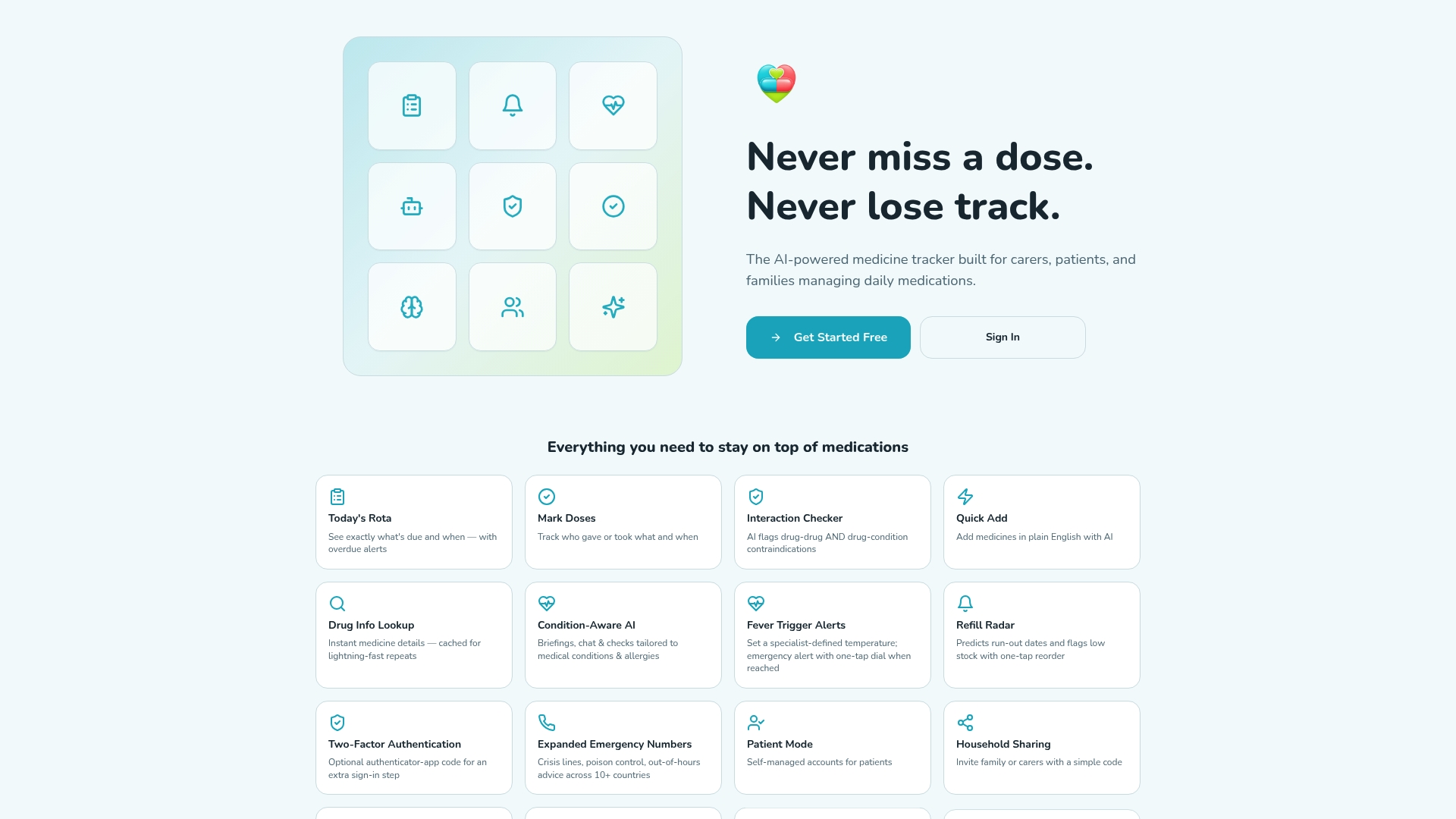
The platform gives your whole family a shared, real-time medication record. Automated reminders alert you when a dose is due or overdue. Refill predictions mean you never run out unexpectedly. Built-in drug interaction checks flag potential problems before they reach a pharmacist or GP. All of this is available through a free medicine app designed for carers and families, compliant with UK GDPR, and accessible across all your devices. If you are managing prescriptions for an elderly relative, Thedailydosetracker gives you the visibility and confidence to do it safely.
FAQ
What is polypharmacy and why does it affect elderly patients most?
Polypharmacy is defined as the concurrent use of multiple medicines, typically five or more, and it affects elderly patients most because they are more likely to see multiple specialists who prescribe independently. Medicare Part D data shows patients receiving prescriptions from up to 15 different providers yearly, creating significant interaction risks.
How do I create a master medication list for my relative?
A master medication list should include every medicine by name, the dose, the timing, the prescribing doctor, and the reason for each drug. Bring this list to every appointment and update it immediately after any prescription change. Thedailydosetracker allows you to maintain and share this list digitally across your care team.
What should I do when my relative comes home from hospital?
Request a written discharge medication summary and compare it against your existing list before giving any dose. New prescriptions are frequently added without stopping conflicting legacy medicines, so active reconciliation at discharge is critical. Contact the GP or ward pharmacist if anything is unclear.
How can I improve medication adherence in an elderly relative with memory problems?
Structured reminders, supervised administration, and a simplified regimen are the most effective combination. Family support and proactive healthcare communication significantly improve adherence rates in older adults with cognitive difficulties. A pharmacist-led MTM session can also reduce the number of daily doses required.
When should I involve a pharmacist in my relative's medication management?
Involve a pharmacist whenever your relative starts a new medicine, returns from hospital, or takes five or more medicines regularly. Pharmacists reviewing the full prescription list can identify duplicated drugs and dangerous interactions that individual prescribers may miss. Ask specifically for a Medication Therapy Management review.