
For carers managing daily doses at home, Thedailydosetracker is the clearest starting point: it combines custom scheduling, a timestamped dose log, multi-patient household sharing, drug interaction checks, and UK GDPR-compliant data handling in a single progressive web app.
The core reasons it fits carers well:
- Scheduling and reminders — custom dose times with real-time alerts for due or overdue medicines, reducing the cognitive load that MEMORABLE research identifies as one of the heaviest burdens on family carers
- Dose log and audit trail — every administration is timestamped and exportable, so you can share an accurate medication history with a GP or pharmacist at a structured medication review
- Multi-patient sharing and carer access — separate profiles for each person in the household, with role-based permissions for paid carers or community nurses
- Interaction checks and refill alerts — AI-backed drug interaction and condition-specific guidance, plus refill predictions before a medicine runs out
The free tier covers core features. Advanced AI tools, notifications, diary entries, appointment management and multi-patient support sit behind paid Individual and Pro monthly subscriptions.
Table of Contents
- What should you look for in a medication tracking app?
- How Thedailydosetracker maps to what carers actually need
- How to set up and use Thedailydosetracker as a carer
- Privacy, safety and NHS-relevant checks for UK carers
- Practical scenarios and quick tips for carers
- Key takeaways
- Why pairing an app with simple routines matters more than the technology itself
- Try Thedailydosetracker free today
- Useful sources and further reading
What should you look for in a medication tracking app?
The phrase "medication administration record apps nurses" often surfaces clinical eMAR systems built for hospital wards. What carers and community teams actually need is different: a consumer-grade tool that fits home routines, protects health data, and makes it easy to share records with clinicians. These are the criteria that matter.
Scheduling and reliable reminders. A single push notification is not enough. NHS Specialist Pharmacy Service guidance recommends linking reminders to existing daily triggers, such as meals or a morning routine, and using multiple cue types to avoid alarm fatigue. Look for apps that let you set more than one reminder mode.
An immutable dose log. Every recorded dose should carry a timestamp that cannot be edited after the fact. This is what turns a reminder app into a genuine medication administration record — and it is what a pharmacist or GP needs to trust the history you bring them.
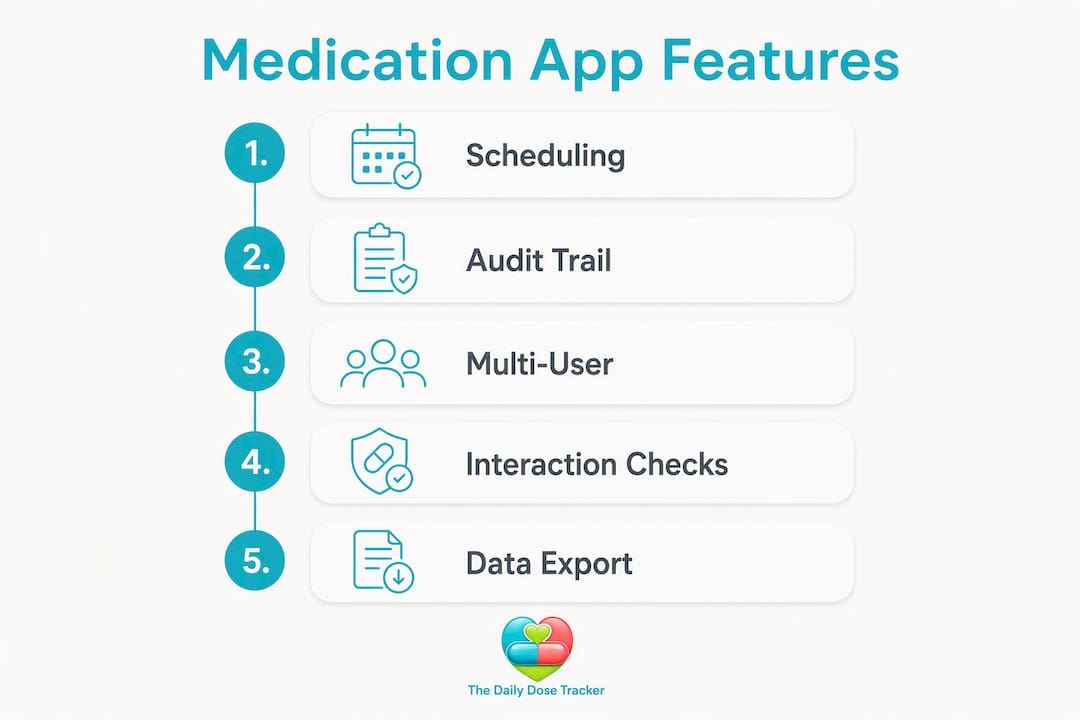
Multi-user access with clear permissions. If two or more people share caring responsibilities, the app must let each carer log independently without overwriting each other's entries. Role-based access, where a community nurse can view but not edit a profile, is the gold standard.
Interaction checks and escalation. An app that flags a potential drug interaction before a dose is taken is genuinely useful. One that also integrates emergency contact details closes the loop when something goes wrong.
Data export and clinician sharing. Can you produce a PDF or structured export to bring to a GP appointment? If not, the app is a private diary rather than a clinical communication tool.
Red flags to avoid: no audit trail or editable dose history; no export or share function; vague or absent privacy policy; no multi-user access; no refill or escalation features.
How Thedailydosetracker maps to what carers actually need
Systematic review evidence from BMJ Open confirms that family carers handle prescription management, preparation, administration, monitoring and tracking — often without adequate support. Thedailydosetracker is built around exactly that workload.
Scheduling and alarm fatigue. The platform lets you create custom schedules per medicine, per patient, with push and SMS alerts. Crucially, you can set multiple reminder triggers rather than relying on a single notification. Research on managing polypharmacy at home found that tools work best when they fit existing habits rather than imposing new ones.
Dose logging and audit trail. Each recorded dose captures the time, the medicine, the dose, and any notes you add. Exports carry timestamps, making them usable at a structured medication review or a pharmacist consultation. The MEMORABLE synthesis specifically recommends personalised, co-produced records that carers and clinicians can use as a shared reference.
Multi-patient and household sharing. You can manage separate profiles for each person in the household. A paid carer or community nurse can be granted view or edit access without seeing other profiles. This matters most during handovers, where a clear, shared log prevents duplication or missed doses.
Clinical safety features. Drug interaction checks and condition-specific guidance are available within the platform. These are decision-support tools, not a substitute for GP or pharmacist advice, but they give carers an early warning before a dose is taken. Refill predictions flag when a medicine is likely to run out, reducing the risk of an unplanned gap.
Device access and accessibility. Thedailydosetracker runs as a progressive web app, so it works on any smartphone, tablet or desktop without a separate download. Accessibility controls include dark mode and adjustable font sizes.
Pro Tip: Anchor each medicine reminder to a fixed daily activity, such as breakfast or a morning routine, rather than a standalone alarm. Linking reminders to established routines is one of the most reliable ways to improve adherence without adding cognitive burden.
How to set up and use Thedailydosetracker as a carer
Getting started takes under 20 minutes if you have the medication list to hand.
- Create an account at thedailydosetracker.com and select your plan (free tier is sufficient to start).
- Add each patient or household member as a separate profile. Give each profile a clear name so logs stay distinct.
- Enter each medicine with the correct dose, frequency, and schedule. Use the condition-specific guidance feature to flag any relevant health context.
- Set reminders using at least two cue types — for example, a push notification and a link to a mealtime. This is where the elderly medication management checklist can help you structure the setup.
- Invite shared carers or community nurses and assign permissions. A community nurse typically needs view access to the log; a co-carer may need edit access.
- Record each dose as it is given. If a dose is missed, log it as missed with a note rather than skipping the entry — the audit trail needs to reflect what actually happened.
- Log side effects or observations using the symptom diary. These entries are timestamped and included in exports.
- Export the medication history before any GP appointment or pharmacist review. The export includes the full timestamped log and can be shared digitally or printed.
Common issues: if notifications stop arriving, check that browser or app permissions have not been revoked. Duplicate entries usually result from two carers logging the same dose — agree in advance who logs each administration. Permission problems are almost always resolved by the account holder re-sending the invitation.
Privacy, safety and NHS-relevant checks for UK carers
Health data is among the most sensitive personal data under UK GDPR. Before committing to any medication tracking app, confirm these points.
- Data controller and retention policy — who holds your data, for how long, and can you delete or export it on request?
- Encryption — data should be encrypted both at rest and in transit (look for HTTPS and a clear security statement)
- Authentication — two-factor authentication and session timeouts reduce the risk of unauthorised access
- Role-based access — carers and nurses should only see what they need; no single login should expose all household profiles to everyone
On the clinical side, a NIHR-reviewed pooled analysis of nine studies covering 1,159 patients found that app users were roughly twice as likely to report taking medicines as prescribed. The evidence is promising, but the same review notes that measurement methods varied, so apps should support rather than replace clinical oversight.
Thedailydosetracker complies with UK GDPR. For any app you assess, ask whether the privacy policy names a UK data controller and specifies retention periods. If it does not, that is a meaningful gap.
When to escalate: if a drug interaction alert appears, contact the prescribing GP or pharmacist before giving the dose. If a person shows signs of an adverse reaction, call 999. An app log is evidence, not a substitute for clinical judgement.
Practical scenarios and quick tips for carers
One person, multiple daily doses. Structure the schedule by time of day rather than medicine name. Group morning, midday, evening and bedtime doses into separate reminder blocks. Set refill alerts at least two weeks before the expected run-out date to allow for GP processing time.
Two or more people on different regimens. Keep profiles strictly separate and use different colour labels if the app supports them. Never enter medicines for person B while viewing person A's profile. The common challenges managing family medications guide covers the most frequent mix-up scenarios in detail.
Community nurse handovers. Grant the nurse view-only access to the relevant profile. Before each handover, export the previous 48 hours of the dose log and share it digitally. The nurse should check the log against their own records and flag any discrepancy immediately rather than at the end of a shift.
Quick tips: update the medication list within 24 hours of any GP change; never delete a dose entry, mark it as missed instead; and review the refill predictions weekly rather than waiting for an alert.
Key takeaways
A medication tracking app only reduces carer burden when it combines a reliable audit trail, multi-user access, and export options that clinicians can actually use.
| Point | Details |
|---|---|
| Recommended app | Thedailydosetracker covers scheduling, logging, interaction checks and UK GDPR compliance in one progressive web app. |
| Top selection criteria | Prioritise an immutable timestamped log, multi-user permissions, data export, and multiple reminder modes. |
| Immediate setup action | Add each patient as a separate profile, enter medicines with schedules, and set at least two reminder types before going live. |
| Privacy reminder | Confirm the app names a UK data controller, encrypts data in transit and at rest, and allows full data export or deletion on request. |
| When to involve a clinician | Bring an exported medication history to every structured medication review, and contact a GP or pharmacist before acting on any interaction alert. |
Why pairing an app with simple routines matters more than the technology itself
The research on medication management at home keeps returning to the same finding: the tools that work are the ones that fit around what people already do, not the ones that demand new habits. MEMORABLE's five burden types, including fragmentation and exclusion, describe exactly what happens when carers are handed a system that does not talk to their daily life. An app that sends a single notification at an arbitrary time and then goes silent is not solving that problem.
What actually shifts behaviour is anchoring a reminder to something that already happens: a kettle boiling, a morning wash, a television programme. The technology is the scaffold; the routine is the structure. Carers who build the app into an existing sequence report far less friction than those who treat it as a separate task. That is not an argument against digital tools. It is an argument for choosing one that is flexible enough to meet you where your day already is.
Try Thedailydosetracker free today
Managing medicines for someone you care about is demanding enough without an app that adds complexity. Thedailydosetracker gives you a free core tier that covers scheduling, dose logging and basic reminders from day one, with no time limit. Upgrading to Individual or Pro unlocks AI-powered interaction checks, multi-patient profiles, refill predictions, appointment management and the full audit trail export that GPs and pharmacists can use directly.
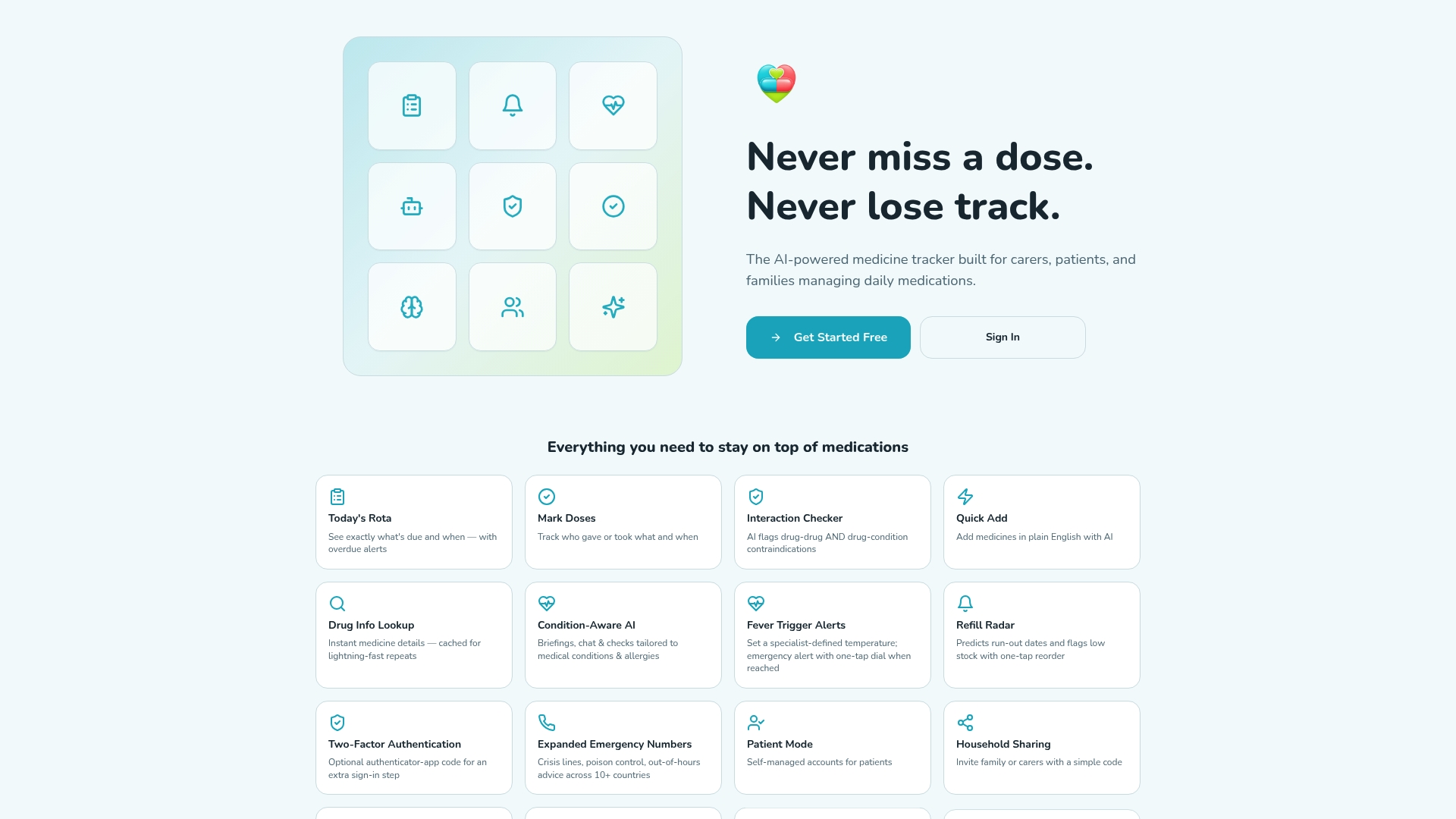
The platform runs as a progressive web app, so there is nothing to install. It works on any device your household already uses, and accessibility controls mean it is usable for carers and patients across a wide range of needs. Support materials and setup guides are available on the Thedailydosetracker blog for carers who want a step-by-step walkthrough before they begin.
Start managing medications safely with the free plan, and upgrade only when you need the advanced features.
Useful sources and further reading
The claims in this article draw on the following research and guidance. Each is worth reading if you want to go deeper on the evidence.
| Source | What it covers |
|---|---|
| NIHR: Apps to help patients take medication on time | Pooled analysis of nine studies on reminder app effectiveness and the need for consistent evaluation methods |
| MEMORABLE realist synthesis (NCBI) | Five-stage framework for medication management in older people; recommends personalised, co-produced records |
| MEMORABLE eprint (White Rose) | Detailed burden-type framework identifying fragmentation, exclusion and ambiguity as key targets for intervention |
| BMJ Open: Role of informal carers in medication management | Systematic review of carers' physical and cognitive roles; highlights need for multi-user tools and clearer professional communication |
| NHS SPS: Reminding to take medicines | Pharmacy safety guidance on redundant cues, routine-linked reminders and reducing alarm fatigue |
| Polypharmacy at home: qualitative study (White Rose) | Qualitative interviews on how carers and patients manage polypharmacy; emphasises fitting tools to existing routines |
| Thedailydosetracker: what is a medication administration record? | Plain-English explanation of the consumer-focused meaning of a medication record, distinct from clinical eMAR systems |
| Thedailydosetracker: reducing medication errors in elderly home care | Practical guidance on preventing errors at home and when to involve a clinician |
Sharing your audit trail with a clinician: export the full timestamped log from Thedailydosetracker's history screen as a PDF or structured file. Bring it to any structured medication review, GP appointment or pharmacist consultation. The export includes medicine names, doses, scheduled times, actual administration times and any notes or missed-dose entries.
This article provides general information for carers and patients. It is not medical or legal advice. Confirm current guidance with your GP, pharmacist or the relevant NHS service before making changes to any medication regimen.