

A medication administration record (MAR) is the official, legal document used to track every medicine administered to a patient, creating a complete and verifiable history of their treatment. In clinical settings, the MAR is the primary tool for ensuring medication safety, professional accountability, and regulatory compliance. The Care Quality Commission (CQC) mandates specific standards for what these records must contain, and NICE guidelines reinforce those requirements across adult social care and NHS settings. For healthcare professionals, family carers, and patients alike, understanding the MAR is not optional. It is the foundation of safe medication management.
What is a medication administration record and what does it contain?
A medication administration record is a structured document that captures every detail of a patient's medicine administration in one place. MARs serve as a formal audit trail showing what was given, when, and by whom, and they are reviewed during regulatory inspections. That audit function is what makes them legally significant, not just administratively useful.
The CQC specifies mandatory details that every MAR must include:
- Patient identifiers: full name, date of birth, and NHS number
- Medication details: drug name, formulation (tablet, liquid, patch), strength, dose, and route of administration (oral, topical, subcutaneous)
- Timing: scheduled administration times and the actual date and time given
- Administrator record: signature or initials of the person who gave the medicine
- Allergies and reactions: any known sensitivities that affect prescribing decisions
- Special instructions: for example, "take with food" or "monitor blood pressure after dose"
- Refusals and omissions: a record of any dose the patient declined or that was missed, with a reason code
NICE guidelines recommend that monitoring requirements are also documented, so staff know when to check blood glucose, blood pressure, or other parameters after administration. This level of detail transforms the MAR from a simple checklist into a clinical communication tool.
| MAR element | Why it matters |
|---|---|
| Patient identifiers | Prevents wrong-patient errors at the point of administration |
| Medication name and strength | Eliminates ambiguity between similar drug names or doses |
| Route and timing | Confirms the correct method and schedule were followed |
| Administrator signature | Establishes professional accountability for each dose |
| Refusals and omissions | Maintains a complete record even when medicine is not given |

Why is a medication administration record crucial in healthcare and caregiving?
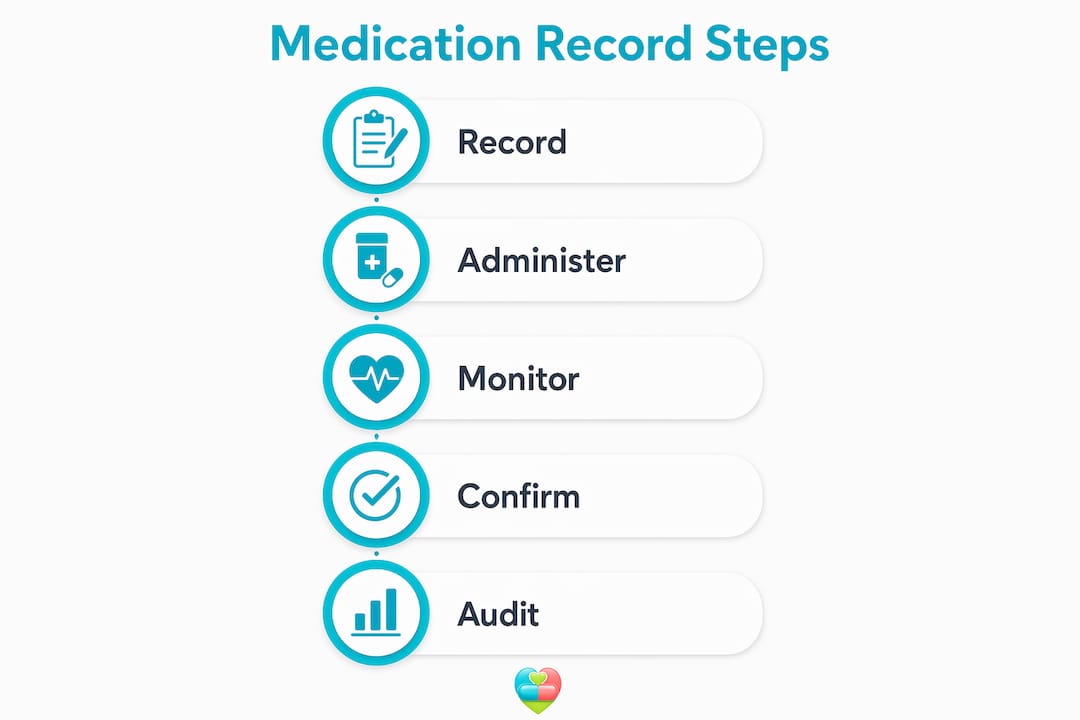
The MAR is the single most reliable safeguard against medication errors in both clinical and home care settings. Accurate MARs help prevent missed doses, duplications, and medication errors by giving every carer real-time, clear information about what has already been administered. Without that shared record, a patient receiving care across multiple shifts is at serious risk of receiving a double dose or missing a critical medicine entirely.
The legal weight of the MAR is equally significant. As a permanent part of the patient's medical record, it protects healthcare professionals from liability when questions arise about what was given and when. CQC Regulation 12 requires providers to deliver safe care and treatment, and Regulation 17 requires good governance, including accurate record-keeping. A poorly maintained MAR is not just a clinical risk. It is a regulatory failure.
"The primary purpose of an MAR is ensuring accountability and safe care. Accurate record-keeping protects both patients from harm and healthcare workers from liability." — Care Quality Commission
The operational value of MARs extends to handovers and multi-disciplinary communication. When a district nurse visits a patient at home, the MAR tells her immediately what the morning carer administered and whether any dose was refused. That continuity is impossible without a shared, accurate record.
The four core functions of a well-maintained MAR are:
- Safety assurance: confirms the right medicine, dose, and route were used at the right time
- Legal accountability: documents professional responsibility for every administration decision
- Communication tool: enables consistent care across shifts, teams, and care settings
- Audit and inspection evidence: demonstrates compliance with CQC and NICE standards during formal reviews
What are the different formats of medication administration records?
MARs exist in two primary formats: paper-based and electronic. Each has distinct characteristics that affect how care teams use them in practice.
Paper MARs are pre-printed charts, typically issued monthly by a dispensing pharmacy alongside a patient's medicines. They are familiar, require no technology, and work in any care environment. The drawbacks are significant, though. Handwritten entries can be illegible, charts can be misfiled, and there is no automatic alert when a dose is overdue.
Electronic MARs (eMARs) offer improved accuracy, real-time updates, and better integration with wider healthcare IT systems. A carer records a dose on a tablet or smartphone, and the record updates instantly across all authorised devices. That real-time visibility is particularly valuable in residential care homes where multiple staff members administer medicines across a 24-hour period.
Pro Tip: If your care setting is transitioning from paper to electronic MARs, run both systems in parallel for at least four weeks. This gives staff time to build confidence with the digital format without creating gaps in the paper record.
Digital records also reduce transcription errors. When a pharmacist uploads a prescription directly into an eMAR system, there is no manual copying of drug names, doses, or frequencies. That single step removes one of the most common sources of error in medication management. For carers managing complex patients at home, digital medication logs offer the same accuracy benefits that hospital eMARs provide in clinical settings.
Security and confidentiality requirements apply equally to both formats. Electronic records must comply with UK GDPR, and access should be restricted to authorised personnel only.
How should you accurately use and maintain a medication administration record?
Accurate MAR completion requires discipline, training, and a clear process at every administration. The record must be completed immediately after giving a medicine, not at the end of a shift. Retrospective entries introduce errors and undermine the legal integrity of the document.
Care workers must use MARs only if they have been trained and assessed as competent, and any changes to a patient's medication should be checked by a second trained member of staff. That second-check requirement exists because medication changes are the highest-risk moment in the administration cycle.
Key best practices for maintaining accurate records include:
- Write clearly: use block capitals for handwritten entries and avoid abbreviations that are not universally recognised
- Record immediately: sign or initial the MAR at the point of administration, not later
- Document refusals properly: record refusals and omissions with a reason code rather than leaving the field blank
- Verify before administering: cross-check the MAR against the original prescription before giving any medicine
- Retain records securely: UK guidance recommends keeping adult care records for a minimum of eight years after the period of care ends
Pro Tip: Before each administration round, check the MAR against the patient's current prescription list. Discrepancies between the two documents are a red flag that a medicine change has not been properly updated.
For family carers managing medicines at home, a patient medication history guide provides a practical framework for building and maintaining accurate records outside formal care settings.
What are the common pitfalls in medication administration records?
The most frequent MAR errors are preventable with consistent training and clear processes. Common pitfalls include illegible entries, late recording, unclear abbreviations, and failure to record refusals or missed doses. Each of these creates a gap in the audit trail that can lead to patient harm or a failed inspection.
Multi-compartment compliance aids, such as dosette boxes or blister packs, present a specific documentation challenge. Each individual medicine inside the compliance aid must still be recorded separately on the MAR. Recording only "compliance aid given" is not sufficient and does not meet CQC standards.
The most common MAR pitfalls to watch for are:
- Blank signature fields: an unsigned field is indistinguishable from a missed dose
- Late entries: recording hours after administration makes the time field inaccurate
- Correction fluid: never use correction fluid on a MAR. Draw a single line through the error, initial it, and write the correct entry alongside
- Inconsistent abbreviations: "PO" for oral and "by mouth" used interchangeably on the same chart creates confusion
- Failure to update after prescription changes: an outdated MAR is as dangerous as no MAR at all
Regular internal audits of MARs catch these errors before they become patterns. Carers managing medicines for elderly patients at home can use an elderly medication management checklist to build a structured review process into their routine. Reducing medication errors in elderly home care depends directly on the quality of the records supporting each administration decision.
Key takeaways
A medication administration record is the legal and clinical backbone of safe medicine management, and its accuracy directly determines patient safety outcomes.
| Point | Details |
|---|---|
| MAR definition | An MAR is the official legal document recording every medicine administered to a patient. |
| Mandatory content | CQC requires patient identifiers, drug details, route, timing, and administrator signature on every MAR. |
| Legal and regulatory weight | MARs support CQC Regulation 12 and Regulation 17 compliance and protect staff from liability. |
| Electronic MARs | eMARs reduce transcription errors and provide real-time updates across care teams. |
| Best practice | Complete MARs immediately after administration and document all refusals with a reason code. |
Why accurate MARs matter more than most carers realise
Working with medication records across clinical and home care settings, the pattern I see most often is not deliberate negligence. It is the small, habitual shortcuts that accumulate into serious risk. A signature left until the end of a shift. A refusal recorded as a blank rather than a coded entry. An abbreviation that made sense to the person who wrote it and no one else.
What strikes me most is how the MAR functions as a communication device between people who may never meet. The night carer relies entirely on what the day carer recorded. The district nurse visiting on a Tuesday trusts the entries made by a family member on a Sunday. That chain of trust is only as strong as the weakest entry in the record.
For family carers especially, the MAR can feel like bureaucratic paperwork. It is not. It is the document that tells a paramedic, at 2:00 AM, exactly what medicines your relative has taken and when. That information can be the difference between a correct and an incorrect emergency treatment decision.
Digital tools are making accurate record-keeping genuinely easier, and adoption is accelerating across both residential and home care settings. The technology is not the barrier. The barrier is the habit of treating the MAR as an afterthought rather than the first step in every administration.
— Prasant
How Thedailydosetracker supports better medication record keeping
Managing a medication administration record manually is demanding work, particularly for carers supporting multiple patients or complex medication schedules.
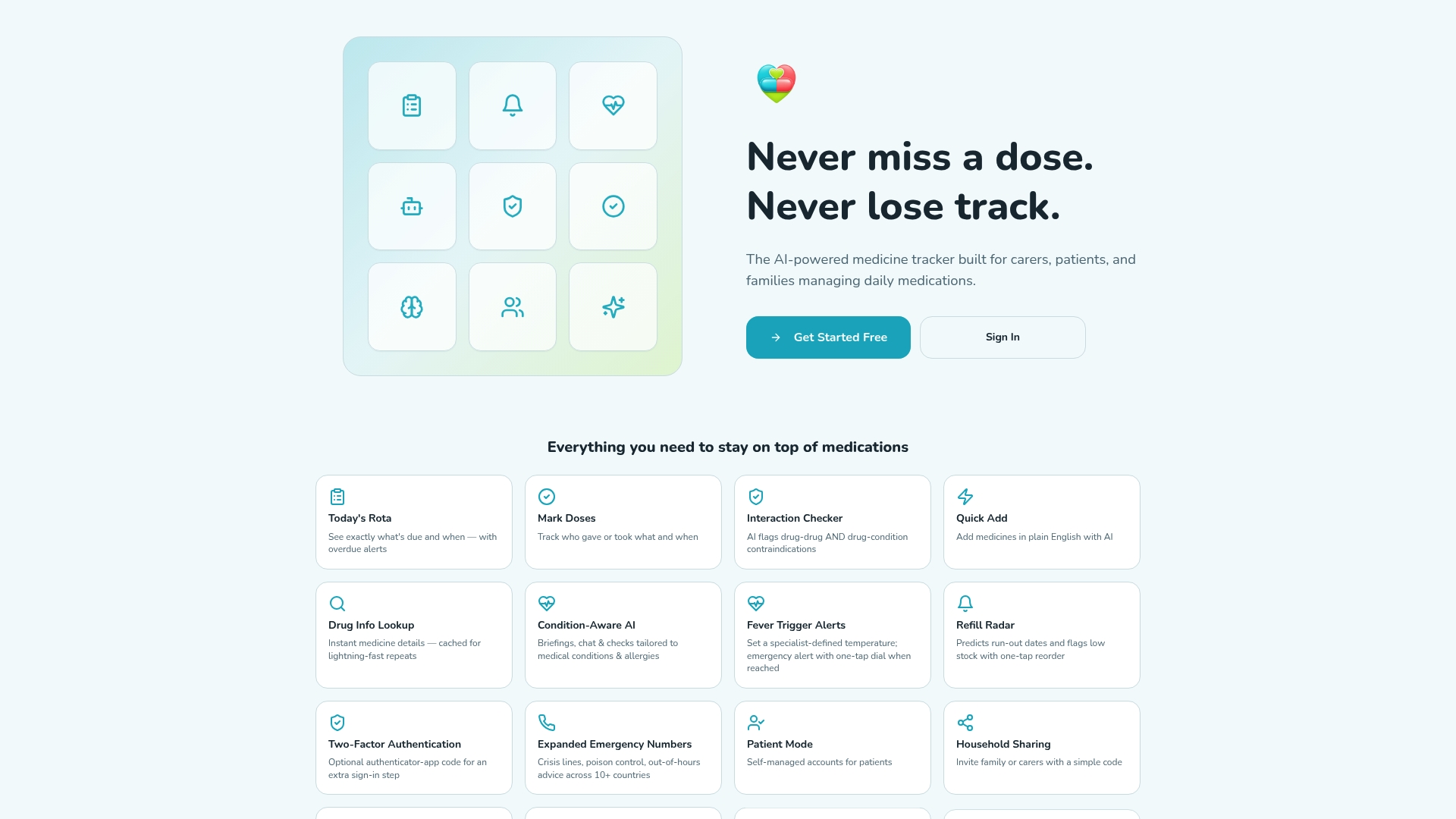
Thedailydosetracker is a digital platform built to support carers, patients, and healthcare professionals in managing daily medication routines with accuracy and confidence. It enables you to log doses in real time, receive alerts for due or overdue medicines, and maintain a clear, auditable record of every administration. Features including drug interaction checks, refill predictions, and multi-patient management make it particularly well suited for families caring for elderly relatives and professional care teams managing complex cases. Visit Thedailydosetracker to see how the platform supports safe, compliant medication management every day.
FAQ
What is a medication administration record used for?
A medication administration record is used to document every medicine given to a patient, including the dose, time, route, and administrator. It serves as a legal document, a safety tool, and a communication record across care teams.
Who is responsible for completing a MAR?
Any trained and assessed care worker or healthcare professional who administers a medicine is responsible for completing the corresponding MAR entry immediately after administration.
What happens if a dose is missed or refused?
Refusals and missed doses must be recorded on the MAR with an appropriate reason code. Leaving the field blank is not acceptable and does not meet CQC standards.
What is the difference between a paper MAR and an eMAR?
A paper MAR is a pre-printed chart completed by hand, while an eMAR is a digital record updated in real time. eMARs reduce transcription errors and allow instant access across authorised devices and care teams.
How long must medication administration records be kept?
UK guidance recommends retaining adult care records, including MARs, for a minimum of eight years after the period of care ends, to support audits, inspections, and any future legal review.