

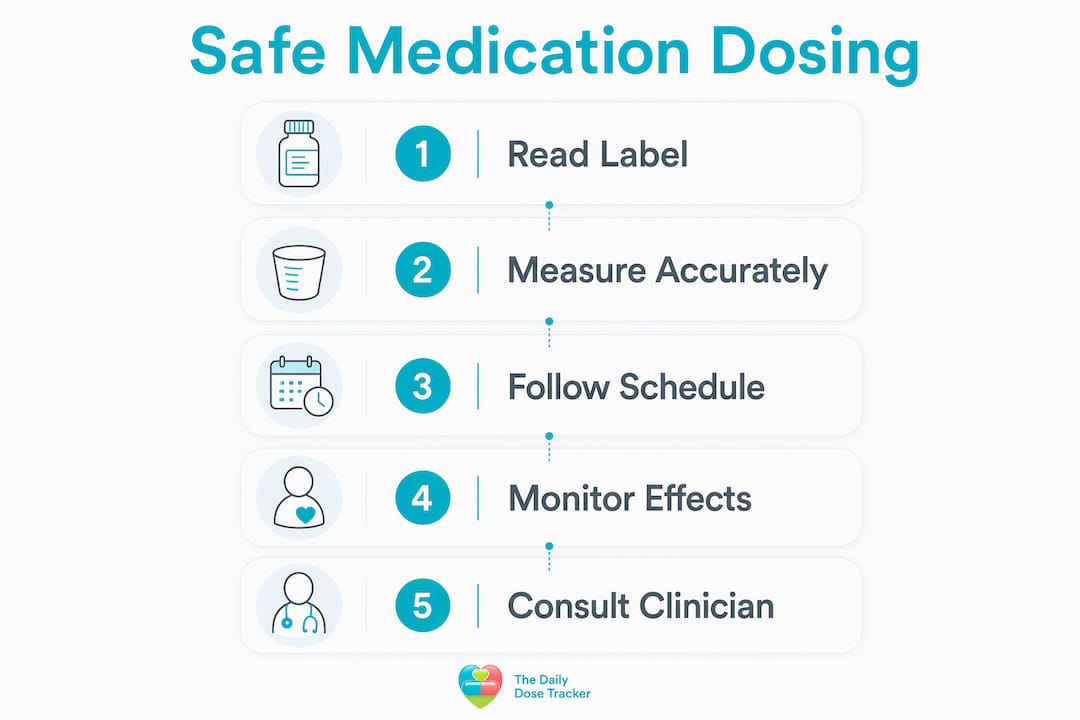
A med dose is the specific amount of a medicine taken at one single time, whether that is 500 mg of paracetamol, 5 mL of an antibiotic suspension, or one puff from an inhaler. The single most important safety rule is straightforward: always follow the dose stated by your prescriber or on the product leaflet, and measure it accurately every time. The NHS, the British National Formulary (BNF), and the Medicines and Healthcare products Regulatory Agency (MHRA) all anchor UK dosing guidance, and Thedailydosetracker is built to help patients and carers put that guidance into daily practice.
- Always use the measuring device that comes with the medicine.
- Never estimate a liquid dose with a kitchen spoon.
- Double-check the dose against the label before every administration.
Pro Tip: For paediatric medicines, use the supplied syringe or dropper rather than a household teaspoon. Kitchen spoons vary widely in volume and can deliver the wrong amount, which matters most when the margin between a safe and unsafe dose is small.
Table of Contents
- What is the difference between a dose and a dosage?
- How to read a prescription label and understand what it says
- Why your correct dose may differ from someone else's
- How paediatric dosing works and why it needs extra care
- How to administer medicines accurately at home
- What to do if you miss a dose or suspect an overdose
- When and how doses are adjusted by a clinician
- Practical tools that help you get the dose right every time
- Key takeaways
- Why clear dosing guidance is the most underrated part of medication safety
- Thedailydosetracker: a practical tool for safer daily dosing
- Useful UK sources for authoritative dosing information
What is the difference between a dose and a dosage?
These two terms are often used interchangeably, but confusing them is a common cause of medication error. Getting them straight takes about thirty seconds and can prevent a serious mistake.
Dose is the amount of a medicine taken at one time. It is a single event: one tablet, one injection, one measured spoonful. Dosage is the full picture: the dose, how often it is taken, and for how long. "500 mg four times a day for seven days" is a dosage; "500 mg" is the dose.

| Written expression | Plain-English meaning |
|---|---|
| 5 mL twice daily | 5 mL in the morning and 5 mL in the evening |
| 1 tablet three times a day | One tablet at breakfast, lunch and dinner |
| 10 mg once daily (OD) | 10 mg taken once every 24 hours |
| Injection every 4 weeks | A single injection administered monthly |
| 2 puffs as required (PRN) | Two inhaler puffs when symptoms occur |
Units matter just as much as numbers. Milligrams (mg), micrograms (mcg), millilitres (mL), and International Units (IU) are not interchangeable, and the same drug can be expressed in different units depending on the formulation. The total daily dose is simply dose multiplied by frequency: 5 mL twice daily equals 10 mL per day. Patients who misread "twice daily" as "twice a week" effectively halve their treatment, while those who take a dose twice in quick succession double it.
Patients frequently confuse dose and dosage, which can cause doubling of daily intake or early cessation of therapy; clear labelling and counselling reduce this risk.
How to read a prescription label and understand what it says
Prescriptions and dispensed medicine labels follow a consistent format in the UK, but the abbreviations can trip people up. Knowing what to look for means you can spot a dispensing error before it reaches the patient.
Common units and abbreviations:
- mg (milligrams), mcg or µg (micrograms), mL (millilitres), IU (International Units)
- OD (once daily), BD (twice daily), TDS (three times daily), QDS (four times daily)
- PRN (as required), AC (before food), PC (after food), nocte (at night)
Note: "µg" is sometimes misread as "mg" on handwritten labels, a tenfold error. The BNF recommends writing "micrograms" in full to avoid this.
Route abbreviations:
- PO (by mouth/oral), IV (intravenous), IM (intramuscular), subcut (subcutaneous), top (topical)
Route is not just a label formality. A dose calculated for oral use is not the same as an intravenous dose for the same drug. Oral morphine and IV morphine, for instance, require very different amounts to achieve the same effect.
What to check on every label:
- Drug name, strength and formulation (tablet, liquid, modified-release capsule)
- Dose and frequency
- Special instructions (with food, on an empty stomach, avoid grapefruit)
- Expiry date
- Whether a measuring device is included for liquids
Pro Tip: If a dose looks unusual or the strength on the dispensed pack does not match what you expected, call your pharmacist before administering it. The BNF online and NHS medicines pages are free to access and give the standard dose range for most common medicines within seconds.
Why your correct dose may differ from someone else's
Standard label doses are derived from dose-finding studies and represent population averages. They are a starting point, not a guarantee of the right amount for every individual. Many standard dosing labels are based on trials that excluded very young, elderly or medically complex patients, which means prescribers often need to adjust doses using clinical judgement rather than simply following the label.
The factors that alter how a drug behaves in your body include:
- Age: Neonates, children and older adults process drugs differently due to changes in metabolism and kidney function. Explore how medication timing matters for elderly patients for a deeper look at age-related dosing.
- Renal function: — Drugs cleared by the kidneys accumulate when the kidneys are not working well. Prescribers check estimated glomerular filtration rate (eGFR) and reduce doses accordingly.
- Drug interactions: Co-medications can inhibit or induce liver enzymes, raising or lowering the effective dose of another drug. See the guide to drug interaction screening in nursing for practical examples.
Clinicians will routinely order blood tests, check eGFR, or measure drug levels when prescribing medicines with a narrow safety margin or when any of the above factors apply.
How paediatric dosing works and why it needs extra care
Children are not small adults. Their organ systems are still developing, their body composition differs from adults, and their ability to process drugs changes rapidly with age and weight. Paediatric dosing is primarily weight-based, expressed as milligrams per kilogram (mg/kg), and the calculation must be done carefully every time.

Worked example:
A child weighs 20 kg. The prescribed dose of ibuprofen is 5 mg/kg.
| Step | Calculation |
|---|---|
| Identify weight in kg | 20 kg |
| Multiply by dose per kg | 20 × 5 mg |
| Check against maximum dose | Confirm calculated mg does not exceed the stated maximum |
| Select appropriate formulation | Children's ibuprofen suspension 100 mg/5 mL = 5 mL |
Essential safety steps for paediatric dosing:
- Confirm the child's current weight in kilograms (not estimated from memory).
- Use the mg/kg dose stated by the prescriber or product leaflet.
- Calculate the dose, then cross-check against the maximum stated dose.
- Use the syringe or dropper supplied with the medicine, not a kitchen spoon.
- Check that the formulation is a paediatric one (concentration differs from adult products).
- Never alter a prescribed paediatric dose without speaking to the prescriber first.
Pro Tip: Keep the dosing syringe with the medicine bottle so it is always to hand. Altering a paediatric dose without advice, even by a small amount, carries direct risks. If you are unsure, your pharmacist can confirm the correct volume to draw up.
How to administer medicines accurately at home
Knowing the right dose is half the job. Giving it correctly is the other half.
Measuring liquid medicines:
- Shake the bottle if instructed.
- Draw the liquid into the supplied oral syringe.
- Hold the syringe at eye level and read the mL mark at the bottom of the meniscus (the curved surface of the liquid).
- Administer all of the drawn volume; do not leave any in the syringe.
Tablets and capsules:
- Only split a tablet if it is scored and your pharmacist has confirmed it is safe to do so.
- Never crush, chew or split modified-release (MR), extended-release (XL) or enteric-coated tablets. Doing so destroys the release mechanism and can deliver the full dose at once.
- Capsule contents should not be emptied unless the prescriber or pharmacist has specifically approved it.
Pro Tip: If swallowing tablets is difficult, ask your pharmacist whether a liquid formulation exists. Never assume crushing is safe without checking first.
Inhalers: Technique directly affects how much drug reaches the lungs. Poor technique with a pressurised metered-dose inhaler (pMDI) can mean a fraction of the labelled dose is actually inhaled. Ask your pharmacist or GP practice nurse to check your technique at least once a year.
Food and timing interactions:
- Some medicines must be taken with food to reduce stomach irritation (e.g. ibuprofen).
- Others require an empty stomach for full absorption (e.g. some thyroid medicines and bisphosphonates).
- Grapefruit and grapefruit juice inhibit an enzyme that metabolises several drugs, raising blood levels significantly. The NHS medicines pages list which drugs are affected.
- Calcium-rich foods and dairy can bind to some antibiotics (e.g. tetracyclines) and reduce absorption.
What to do if you miss a dose or suspect an overdose
Missed doses:
Missing a single dose happens. The general rule is to take it as soon as you remember, unless it is nearly time for the next one, in which case skip the missed dose and continue as normal. Never double the next dose without specific advice from a pharmacist or prescriber, as this can push the drug to toxic levels. The correct action varies by medicine class, so when in doubt, call your pharmacist.
Frequent missed doses are a different matter. They suggest the regimen may need review, and managing missed doses in elderly patients carries particular risks for conditions like heart failure or epilepsy.
Signs of overdose or toxicity to watch for:
- Sedatives/opioids: Extreme drowsiness, slow or shallow breathing, pinpoint pupils, unresponsiveness
- Paracetamol: Nausea, vomiting, abdominal pain (symptoms may be mild initially but liver damage can develop over 24–72 hours)
- Stimulants/decongestants: Racing heart, chest pain, agitation, high blood pressure
UK escalation steps:
- If the person is conscious and symptoms are mild: call your pharmacist or NHS 111 (online or by phone) for urgent non-emergency advice.
- If the person is unconscious, not breathing normally, or has severe symptoms: call 999 immediately.
- Bring the medicine container, the label, and any remaining tablets or liquid to the clinician or emergency team.
- Be ready to state: the person's age and weight, the medicine name and strength, the amount taken, and when it was taken.
Paracetamol overdose is one of the most common causes of acute liver failure in the UK. Early treatment is highly effective; delayed presentation is not. If you suspect a paracetamol overdose, do not wait for symptoms to worsen before calling 999.
When and how doses are adjusted by a clinician
Dose adjustment is not a sign that something has gone wrong. It is a normal part of managing medicines for real patients whose bodies change over time.
Common triggers for dose adjustment:
- Declining eGFR (kidney function), which slows clearance of renally excreted drugs
- Hepatic impairment, which reduces metabolism of many medicines
- Significant weight change (gain or loss)
- New interacting medicine added to the regimen
- Pregnancy or breastfeeding
- Adverse effects or lack of therapeutic response
Monitoring methods clinicians use:
- Blood tests for drug levels (e.g. digoxin, lithium, vancomycin, aminoglycosides)
- Liver function tests and renal function panels
- INR monitoring for warfarin
- Symptom diaries and patient-reported outcomes
- Seizure frequency logs for antiepileptics
Therapeutic drug monitoring and ongoing symptom tracking are particularly important for medicines with narrow safety margins and for patients whose renal or hepatic function is changing. The goal, as the clinical literature frames it, is the greatest therapeutic effect with the fewest side effects.
Pro Tip: If you have not had a medication review in the past year and you take three or more regular medicines, ask your GP or pharmacist for one. Bring a current list of all medicines, including over-the-counter products and supplements, and note any symptoms that have changed since the dose was last set. See also the guide to managing prescriptions for multiple health conditions for practical preparation tips.
Practical tools that help you get the dose right every time
Getting the dose right once is straightforward. Getting it right every day, for multiple medicines, across a household of people with different schedules, is where errors creep in.
Low-tech aids that work:
- Weekly pill organisers (Sunday-to-Saturday) with AM/PM compartments
- Labelled medicine pots for carers managing multiple patients
- Printed dosing charts pinned near the medicine storage area
- A simple paper log noting time and dose given, particularly useful for PRN medicines
Structured reminder systems and trackers reduce missed doses and support adherence when combined with professional advice and correct dosing information. The evidence for this is consistent: the problem is rarely knowledge, it is the daily execution of a complex routine.
Digital tools:
A dedicated medication management platform goes further than a phone alarm. Thedailydosetracker allows carers and patients to build custom medication schedules, log each dose as it is given, and receive real-time alerts for due or overdue doses. The platform includes drug interaction checks, condition-specific guidance, and household sharing so that multiple carers can see the same patient's record. For families managing family medications across multiple conditions, that shared visibility alone reduces the risk of double-dosing.
| Tool type | Best for | Limitation |
|---|---|---|
| Weekly pill organiser | Simple, stable regimens | No alert if dose is missed |
| Printed dosing chart | Carers managing children or elderly patients | Requires manual updating |
| Phone alarm | Single-medicine reminders | No dose logging or interaction checks |
| Digital tracker (e.g. Thedailydosetracker) | Complex regimens, multiple patients, shared care | Requires a device and initial setup |
Pro Tip: Combine a digital tracker with a pharmacist counselling session when starting a new medicine. The tracker handles the reminders and logs; the pharmacist confirms the correct dose and flags interactions. Together, they cover both the human and the logistical side of safe dosing.
Key takeaways
A medication dose is the specific amount taken at one time, and the single most important safety rule is to follow the prescriber's instructions and measure every dose accurately using the correct device.
| Point | Details |
|---|---|
| Dose vs dosage | Dose is the amount at one time; dosage includes frequency and duration. Confusing them can double or halve daily intake. |
| Read the label carefully | Check strength, formulation, units, frequency, route and any food or timing instructions before every administration. |
| Paediatric doses need weight-based calculation | Use mg/kg, confirm the child's current weight, and always use the supplied measuring device, never a kitchen spoon. |
| Missed doses and overdose | Skip a missed dose if the next one is near; never double up without advice. Call NHS 111 for urgent guidance or 999 for life-threatening symptoms. |
| Thedailydosetracker | Supports daily dosing with custom schedules, real-time alerts, drug interaction checks and household sharing for safer medication management. |
Why clear dosing guidance is the most underrated part of medication safety
Most medication errors do not happen in hospitals. They happen at home, at the kitchen table, at 11 PM when a carer is tired and cannot remember whether the evening dose was given. The clinical literature on dosing is thorough and well-organised; the gap is between that literature and the person actually holding the medicine bottle.
What strikes me about the dose-versus-dosage confusion is how predictable it is. Patients are handed a label that says "take one tablet twice daily" and a leaflet that says "the recommended dosage is 500 mg per day." Those two sentences describe the same thing, but they use different frames, and a significant number of patients read them as two separate instructions. Clear labelling and pharmacist counselling reduce this risk, but neither is consistently delivered at the point of dispensing.
The other underappreciated issue is paediatric dosing at home. Parents are often sent away with a liquid medicine, a weight-based instruction, and no syringe. The assumption that they will find a suitable measuring device is optimistic. The evidence is clear: household teaspoons are unreliable, and the consequences of getting a paediatric dose wrong are more serious precisely because children have less physiological reserve to absorb the error.
Digital tools like Thedailydosetracker do not replace clinical judgement, and they should not try to. What they do is remove the logistical failures: the forgotten dose, the double-dose, the carer who did not know the morning dose had already been given. That is a narrower claim than "AI will fix medication safety," but it is a defensible one, and it is where the real-world benefit sits.
Thedailydosetracker: a practical tool for safer daily dosing
Keeping track of a complex medication regimen is genuinely difficult, particularly when more than one person is involved in a patient's care. Thedailydosetracker was built for exactly that situation.
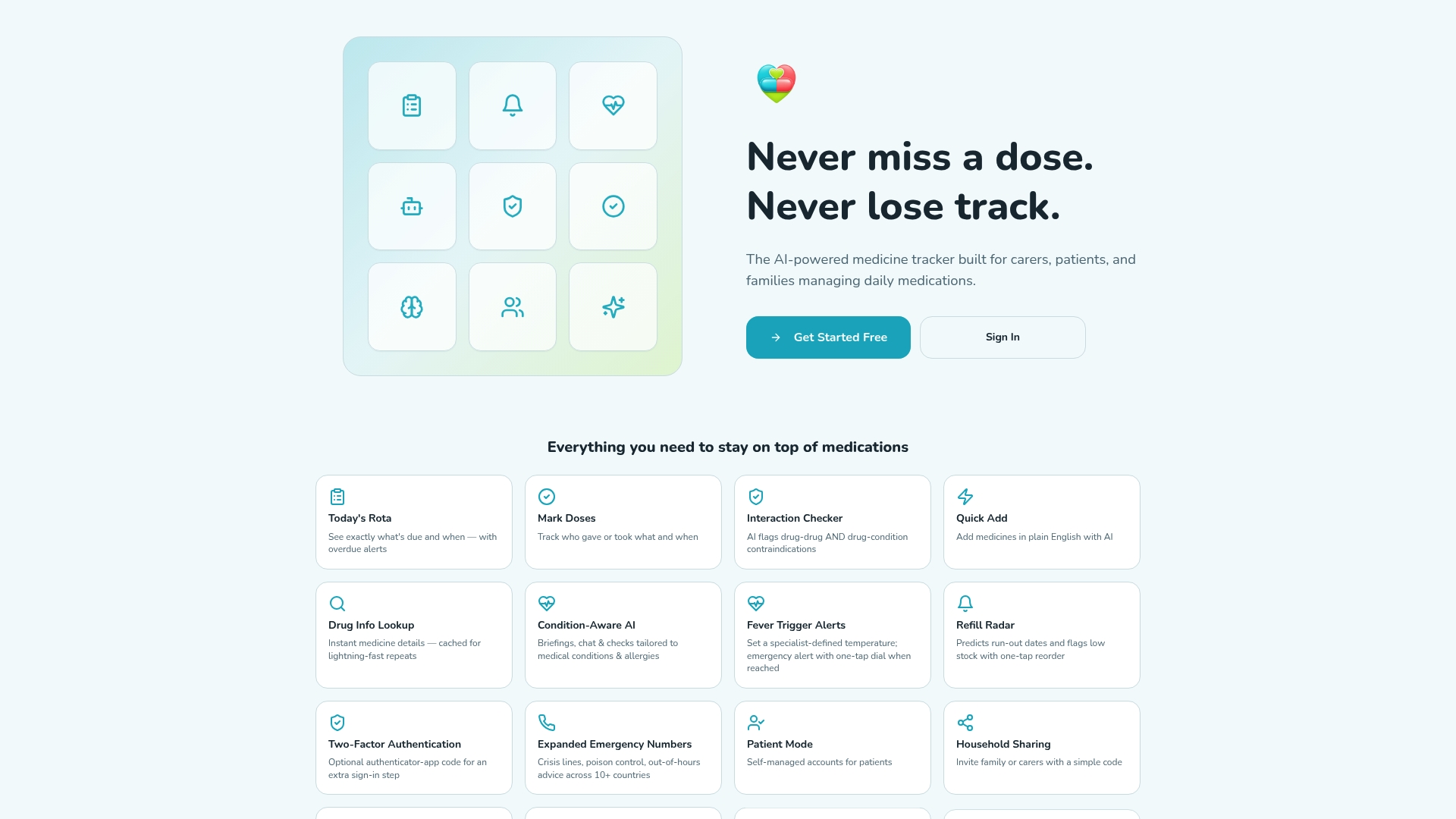
The platform lets you build custom medication schedules, log each dose as it is given, and receive real-time alerts before a dose is due or overdue. Drug interaction checks run automatically, so a new medicine added to the schedule is screened against everything already on the list. Household sharing means two carers looking after the same person see the same record, which removes the single biggest cause of accidental double-dosing. Medication history can be exported for GP or pharmacist appointments, and emergency contact integration means the right person is notified if something goes wrong.
Thedailydosetracker complies with UK GDPR, so patient data is handled to the standard UK residents expect. A free tier covers core scheduling and reminders; advanced features including multi-patient management, AI-based insights and appointment scheduling are available on paid Individual and Pro plans.
See the plans and start free to find the option that fits your household or care team.
Useful UK sources for authoritative dosing information
When you need to verify a dose, these are the sources that carry the most authority in the UK:
-
British National Formulary (BNF): The primary clinical reference for prescribers, pharmacists and nurses in the UK. Covers doses, indications, contraindications, interactions and monitoring for virtually every licensed medicine. Free to access online. Use this when you need the standard dose range for a specific drug or want to check an interaction.
-
NHS medicines pages (NHS.uk): Patient-facing guidance on common medicines, written in plain English. Covers how to take a medicine, what to do if you miss a dose, and when to seek help. The first stop for patients and carers who need a straightforward answer.
-
MHRA (Medicines and Healthcare products Regulatory Agency): The UK regulator for medicines and medical devices. Publishes safety updates, drug alerts and guidance on licensed indications. Relevant when you want to check whether a medicine has a current safety warning or a recent licence change.
A note on authority: the prescriber's instruction and the Summary of Product Characteristics (SPC) for the specific licensed product are the final authority for any individual dose. The BNF and NHS pages give standard ranges; your prescriber applies those ranges to your specific circumstances.
This article provides general information about medication dosing and is not a substitute for professional medical advice. Always confirm dosing with your prescriber, pharmacist, or the product's Summary of Product Characteristics before making any change to a medicine regimen.