

A shared care medication protocol (SCP) is a formal clinical agreement that transfers day-to-day prescribing and agreed monitoring from a hospital specialist to a GP once a patient is clinically stable. NHS England defines SCPs as clinically focused documents that support safe, effective shared care for specified medicines using standardised templates. Three facts matter immediately:
- The specialist initiates the request and sends the full protocol to the GP.
- The GP must accept in writing for each individual patient before prescribing responsibility moves.
- The specialist remains clinically responsible until that written acceptance is received and logged.
The Area Prescribing Committee (APC) traffic-light system governs which medicines are suitable for shared care locally. Thedailydosetracker is a digital platform that carers and patients can use to manage the monitoring schedules, dose logs, and communications that an SCP requires day to day.
Table of Contents
- What does a shared care protocol actually cover?
- How does the NHS set up a shared care arrangement?
- Who is responsible at each stage?
- Which medicines are suitable for shared care?
- What are your responsibilities as a patient or carer?
- How can a medication app support shared care?
- What should you do when things go wrong?
- Timeline and costs: what to expect
- Key takeaways
- The part most carers only learn the hard way
- Thedailydosetracker: built for the tasks an SCP puts on carers
- Useful sources
What does a shared care protocol actually cover?
An SCP is medicine-specific and disease-specific, not a blanket permission to transfer all prescribing. Each agreement typically sets out:
- Diagnosis and indication — the confirmed condition and why this medicine is appropriate.
- Initiation and stabilisation requirements — what the specialist must complete before requesting transfer.
- Prescribing split — which doses or formulations the GP will prescribe and which remain with the specialist.
- Monitoring schedule — frequency of blood tests, thresholds that trigger a return to specialist care, and who performs each test.
- Baseline results — pre-transfer test values the GP needs to continue monitoring safely.
- Contact details — named specialist or team, referral route back, and out-of-hours advice line.
- What to do if monitoring is missed or an adverse effect occurs — explicit escalation instructions.
High-risk "red" medicines rarely transfer. Complex monitoring that requires specialist equipment or interpretation stays with the hospital team. The SCP covers only what primary care can safely manage.
How does the NHS set up a shared care arrangement?
- Specialist stabilises the patient — the minimum recommended period is 4–6 weeks on the medicine before any transfer request is made.
- Specialist sends the full SCP and a request letter — this must include treatment history, baseline test results, the monitoring schedule, and specialist contact details.
- GP reviews and replies in writing — using acceptance or decline templates, assessed for each patient individually. Local guidance recommends the specialist continues prescribing until written acceptance is confirmed.
- Transfer of prescribing is logged — commencement is recorded in primary care notes, with a clear route back to specialist care documented.
Pro Tip: Ask the specialist's secretary to confirm the GP has received the SCP request letter. Then contact your GP practice directly to request written confirmation of acceptance before the specialist stops prescribing. Never assume the handover has happened.
Who is responsible at each stage?
The prescriber who signs the prescription holds clinical responsibility for that prescription. Until the GP gives written acceptance, the specialist remains responsible, full stop.
Specialist responsibilities:
- Initiate and stabilise treatment.
- Send complete clinical information and the SCP to the GP.
- Continue prescribing during the transfer window.
- Retain responsibility for any monitoring that requires specialist input.
GP/primary care prescriber responsibilities (once accepted):
- Issue routine prescriptions.
- Arrange and review local monitoring (e.g. blood tests).
- Refer back to the specialist if results fall outside agreed thresholds.
Patient/carer responsibilities:
- Attend all monitoring appointments.
- Report new side effects promptly to the GP or specialist.
- Keep an up-to-date copy of the SCP.
Clinical responsibility does not transfer automatically. Each patient requires a formal written acceptance from the GP before prescribing responsibility moves. A national or regional SCP is not an automatic pass — the GP assesses suitability case by case and retains the right to decline. If a GP declines, the specialist must continue prescribing and document the refusal.
Which medicines are suitable for shared care?
The APC traffic-light system determines local suitability:
| Traffic light | Meaning | Shared care possible? |
|---|---|---|
| Red | Specialist only; high complexity or risk | No |
| Amber | Shared care appropriate with agreed protocol | Yes, with SCP |
| Green | Suitable for primary care prescribing | Usually, no SCP needed |
Typical amber medicines that move under shared care include oral immunomodulators (such as methotrexate, azathioprine, and hydroxychloroquine for inflammatory conditions), some disease-modifying therapies for neurological conditions, lithium for long-term mental health management, and certain ADHD medicines in stable adults. The North East and North Cumbria ICS publishes a full list of approved SCPs as a useful reference.
- Check your local ICB or Trust shared care pages for the exact traffic-light status of a medicine — national guidance does not automatically override local decisions.
- Download the specific shared care guideline for the medicine, not a generic template.
- Non-medical prescribers such as specialist pharmacists and nurses may sign prescriptions under shared care; confirm which clinician will do so.
What are your responsibilities as a patient or carer?
The primary goal of shared care is patient-centred convenience, keeping stable long-term therapy in the community. That only works if patients and carers hold up their end.
Your typical responsibilities under an SCP:
- Attend all agreed blood tests and monitoring appointments on schedule.
- Bring printed or digital results to every clinical appointment.
- Keep a written or digital copy of the SCP and monitoring schedule.
- Report side effects promptly — do not wait for the next routine appointment.
- Keep medication supplies topped up, particularly during any transfer period.
- Confirm in writing (or by email) that the GP has accepted the SCP before the specialist stops prescribing.
The patient must agree to the arrangement and receive understandable written information about it. Consent is not a formality.
Pro Tip: A carer's medication record that logs every blood test date, result, and GP contact creates an audit trail that protects both the patient and the prescriber if questions arise later.

How can a medication app support shared care?
Communication failures are the most common point of failure in shared care arrangements. A well-chosen app addresses this directly.
Features that genuinely help with an SCP:
- Multi-patient household sharing — one dashboard for a family member managing several people's medicines.
- Documented notes per medicine — log the SCP reference, dose range, and monitoring schedule against each drug.
- Test reminders — calendar alerts for blood tests so nothing slips.
- Audit logs — a timestamped record of who amended a dose or schedule entry.
- Symptom logging — note new symptoms between appointments so the GP or specialist has a clear timeline.
Privacy matters. Any app used to store or share clinical documents must comply with UK GDPR. Thedailydosetracker is built to UK GDPR standards, supports secure document workflows for long-term care, and keeps household medication records accessible across devices without compromising patient confidentiality.
Thedailydosetracker supports multi-patient management, real-time dose alerts, drug interaction checks, and appointment scheduling — all relevant to the day-to-day tasks an SCP places on carers. For families managing elderly relatives remotely, the shared household view is particularly useful.
What should you do when things go wrong?
- Missed monitoring blood test: Contact the GP practice the same day to rebook. Inform the specialist if the test is significantly overdue — some medicines require suspension until results are available.
- New or worrying side effect: Contact the GP or specialist immediately. Do not wait. For serious reactions, call 111 or attend urgent care and bring the SCP document.
- GP declines shared care: The specialist must continue prescribing. Ask the GP for written reasons. The specialist can request a review or explore whether another practice in the area will accept.
- Prescription gap during transfer: The specialist should supply at least 28 days' medication to cover administrative delays. If a gap appears, contact the specialist's team directly for an emergency supply.
- Moving GP practice or region: Notify the specialist before moving. The new GP must receive the full SCP and issue a fresh written acceptance — the previous practice's acceptance does not transfer automatically.
Document every contact: date, who you spoke to, and what was agreed. That record is your protection.
Timeline and costs: what to expect
| Stage | Typical timeframe |
|---|---|
| Minimum stabilisation before transfer request | 4–6 weeks |
| Minimum interim medicine supply during transfer | 28 days |
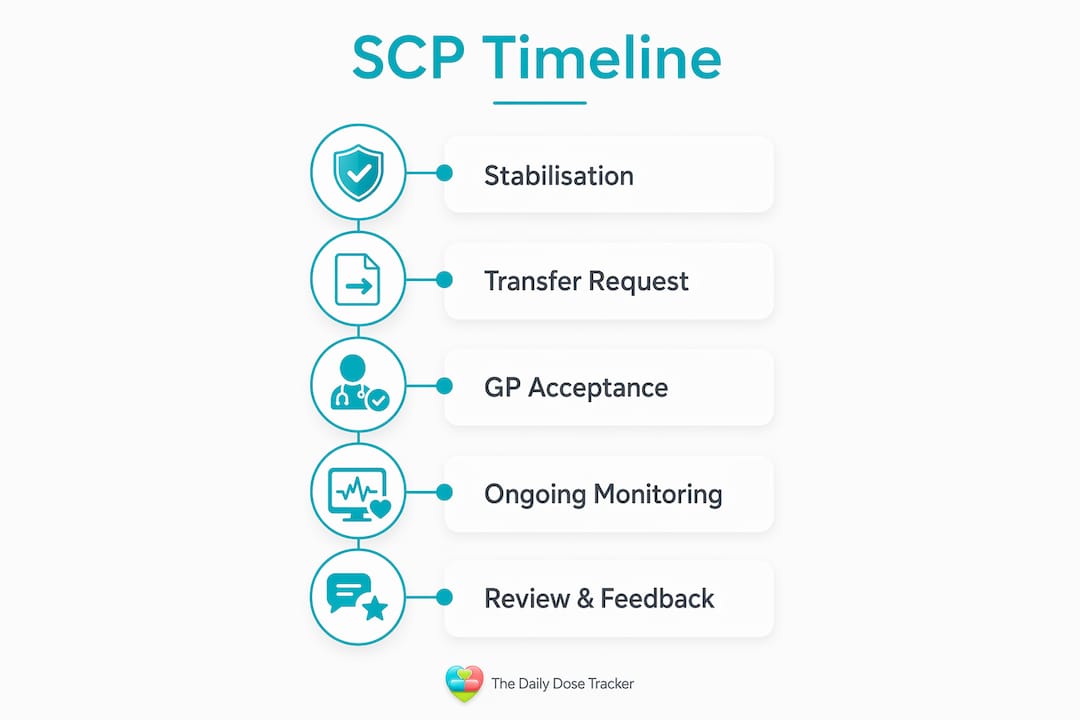
Shared care is a service arrangement, not a separate fee. Medicines prescribed by a GP under an SCP are subject to standard NHS prescription charges (or exemptions) in the usual way. Monitoring blood tests arranged through primary care are an NHS service. Some locally commissioned monitoring services may vary by ICB area.
Key takeaways
A shared care medication protocol only works when written GP acceptance is confirmed before the specialist stops prescribing — everything else depends on that single documented step.
| Point | Details |
|---|---|
| Written GP acceptance is non-negotiable | Responsibility does not transfer until the GP confirms acceptance in writing for each patient. |
| Stabilisation comes first | Specialists should stabilise a patient for at least 4–6 weeks before requesting a transfer. |
| 28-day supply covers the gap | Specialists should provide at least 28 days' medication to prevent a prescription gap during transfer. |
| Carers must keep records | Log every blood test, result, and GP contact — this protects the patient if questions arise. |
| Thedailydosetracker supports SCP tasks | Multi-patient scheduling, test reminders, and audit logs help carers manage shared care day to day. |
The part most carers only learn the hard way
The paperwork around shared care looks straightforward on a flowchart. In practice, the gap between "the specialist sent the letter" and "the GP has formally accepted" is where things quietly fall apart. Carers often discover this only when a prescription runs out.
The advice most guides skip: treat written GP acceptance as a task you own, not one you wait for. Chase it. Get it in an email or a letter. Log the date. Then confirm the specialist knows the GP has accepted before the next prescription is due. That sequence, done once, prevents the most common shared care crisis.
Keeping a single shared medication timeline — one document or app view that shows the SCP reference, the monitoring schedule, and the next test date — also removes the ambiguity that causes missed appointments. Carers who do this consistently report far fewer panicked calls to specialist secretaries. Related guides worth reading: medication schedule best practices for carers and common challenges managing family medications.
Thedailydosetracker: built for the tasks an SCP puts on carers
Managing a shared care arrangement means tracking blood test dates, logging doses, chasing GP letters, and keeping records that three different clinicians might need at short notice. Thedailydosetracker handles the daily layer of that work.
The platform supports multi-patient household schedules, real-time dose alerts, drug interaction checks, and symptom logging — all in one place, compliant with UK GDPR. You can attach notes for each medicine, set reminders for monitoring appointments, and maintain an audit log of every schedule change. It does not replace clinical responsibility; prescribers retain that. What it does is give carers a clear, organised record so nothing falls through the gap between specialist and GP. Start managing shared care schedules with Thedailydosetracker today.
This article is general information, not medical or legal advice. Always confirm the current shared care arrangements for your medicine with your GP, specialist, or local ICB.
Useful sources
- NHS England shared care protocols page — standardised SCP templates and national guidance.
- NHS England: responsibility for prescribing between primary and secondary care — the definitive statement on clinical responsibility and GP rights to decline.
- NHS England regional medicines optimisation and shared care — APC traffic-light guidance and regional SCP lists.
- All Wales shared care framework — detailed framework covering written acceptance, stabilisation periods, and communication requirements.
- NTAG shared care guidelines (North East and North Cumbria ICS) — approved medicine-specific SCPs with request and agreement letter templates.
- Your local ICB or Trust shared care pages — search "[your ICB name] shared care formulary" to find the traffic-light status and specific SCP for your medicine.