

Refill management in caregiving is the proactive system a carer uses to track, request and secure repeat prescriptions so doses are never missed. Three actions you can take right now: check how many tablets remain on the current bottle or patient portal; note the next due date and set a reorder lead time of at least five to seven days; and nominate one pharmacy for all prescriptions. The rest of this guide walks through NHS repeat prescriptions, the Electronic Prescription Service (EPS), a month-by-month checklist and tools including Thedailydosetracker.
- Check remaining supply on every current bottle or via your GP's online portal today.
- Set a reorder lead time of 5–7 days before a 30-day supply runs out, per Healthline's step-by-step refill guidance.
- Nominate one pharmacy for all prescriptions to consolidate records and reduce the risk of missed interactions.
Nearly two-thirds of carers report frustration with refilling prescriptions and administering medication. That figure alone tells you this is not a minor admin task.
Key takeaways
Refill management in caregiving is a structured, repeatable system: build it once, maintain it weekly, and rebuild it after every care transition.
Table of Contents
- Why refill management matters more than most carers realise
- How repeat prescriptions and the NHS Electronic Prescription Service work
- A monthly refill-management checklist you can print and follow
- Which tools actually help you keep refills on track?
- Common refill problems and exactly what to do about them
- Safety checks every carer must carry out at each refill
- Treat refill management as a small project, not a one-off task
- Thedailydosetracker takes the admin out of refill management
- Sources
Why refill management matters more than most carers realise
A missed dose is rarely just an inconvenience. For someone on blood pressure medication, anticoagulants, or antidepressants, a gap of even two or three days can destabilise a condition that took months to control. Abrupt interruptions to certain medicines, such as corticosteroids or some antiepileptics, carry genuine withdrawal risks. When a prescription changes after a hospital discharge, the risk compounds: the old supply may still be in the cupboard while the new dose sits uncollected at the pharmacy.
Carer stress is the less-discussed side of this. Managing prescriptions for multiple health conditions across several prescribers, each with different reorder windows, is genuinely exhausting. A reliable system does not just protect the person being cared for. It reduces the invisible mental load that accumulates when you are the only one keeping track.
Poor refill management is one of the most common, and most preventable, causes of avoidable hospital admissions among older adults on long-term medication. A structured repeat-prescription routine is not optional for complex patients — it is a safety intervention.
Drug interactions are another underappreciated risk. When prescriptions are spread across multiple pharmacies, no single pharmacist has the full picture. A new antibiotic prescribed by a GP can interact with a heart medication dispensed elsewhere, and nobody flags it.
How repeat prescriptions and the NHS Electronic Prescription Service work
Understanding the system is half the battle. In England, most long-term medications are issued as NHS repeat prescriptions: the GP authorises a set number of issues, and the patient or carer requests each one without needing a new clinical appointment. A refill extends that existing authorisation. A renewal is different — it is a brand-new prescription that requires a clinical review and cannot be dispensed until the prescriber issues it. Knowing which you need saves a wasted trip.
The Electronic Prescription Service (EPS) lets GPs send prescriptions electronically to a nominated pharmacy, cutting out the paper slip entirely. As a carer, you nominate a pharmacy once (in person or via the NHS App), and subsequent prescriptions route there automatically. You or the person you care for can still collect in person, or many pharmacies offer home delivery.
Practical ordering channels:
- NHS App — request a repeat prescription directly; the app shows which items are due and tracks the request status.
- GP practice online portal (such as SystmOnline or Patient Access) — similar functionality, useful if the person you care for is already registered.
- Phone — slower but reliable; ask the receptionist to confirm the expected ready date.
- Pharmacy-initiated requests — some community pharmacies will request the repeat on your behalf if you are enrolled in their managed repeat service.
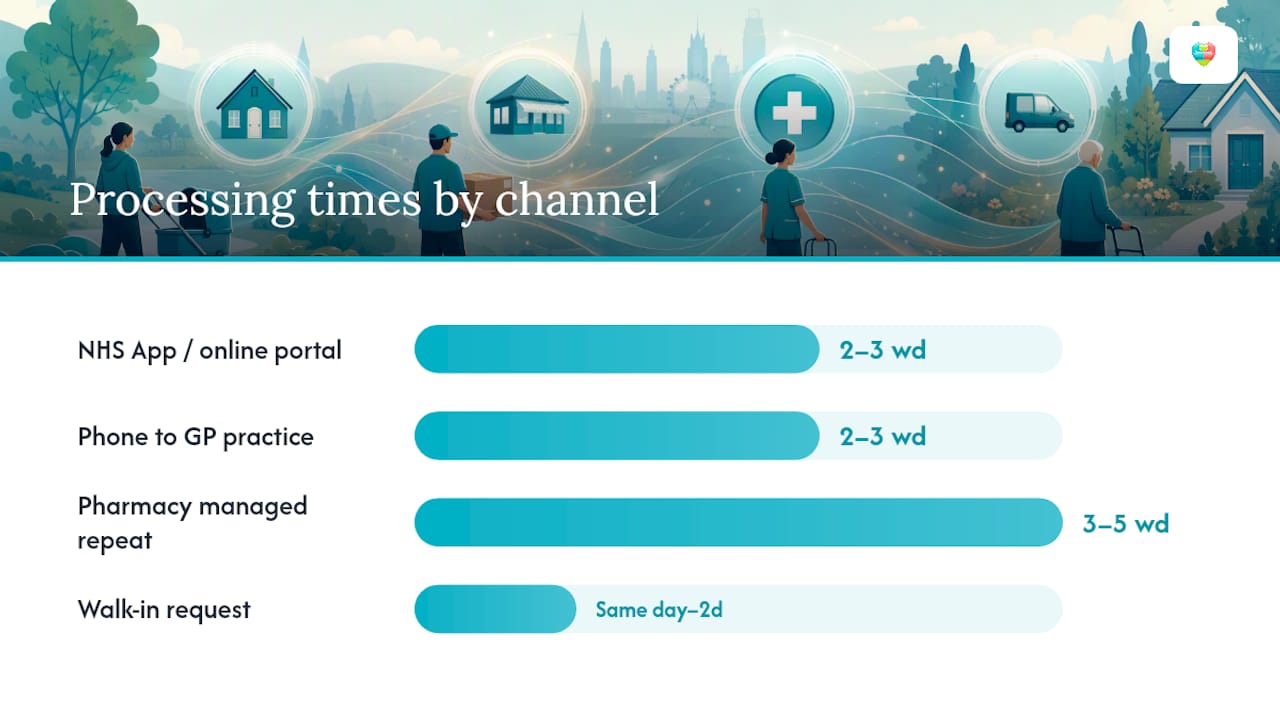
| Ordering channel | Typical processing time | Best for |
|---|---|---|
| NHS App / online portal | 2–3 working days | Tech-confident carers; routine repeats |
| Phone to GP practice | 2–3 working days | Those without online access |
| Pharmacy managed repeat | 3–5 working days | Carers who want the pharmacy to initiate |
| Walk-in request | Same day to 2 days | Urgent or last-minute requests |
Reorder lead time: for a 28-day or 30-day supply, request 5–7 days before you run out. For 90-day supplies, reorder at the 75-day mark. Prescription charges apply in England. Scotland, Wales, and Northern Ireland have their own rules, so check your devolved nation's current guidance before assuming a charge applies.
A monthly refill-management checklist you can print and follow
A prescription refill checklist that tracks medication name, dose, remaining refills and prescriber reduces last-minute panics and prevents missed doses. Here is a sequential monthly routine:
-
Build and maintain a Master Medication List. Record every medicine: name, strength, dose frequency, prescriber, pharmacy and number of refills remaining. Keep a printed copy on the fridge and a digital copy in your phone. For a detailed template, the medication history guide for carers is a good starting point.
-
On day 1 of each month, count remaining tablets. Do this physically, not from memory. Note the count next to each item on your Master Medication List.
-
Calculate your reorder date. For a 28-day supply, if you have 10 days' worth left, request today. If you have 14 days left, set a reminder for day 7. The rule: never let supply drop below a 7-day buffer.
-
Submit repeat prescription requests. Use the NHS App, your GP's online portal, or the pharmacy managed repeat service. Note the submission date and expected ready date.
-
Confirm the prescription is ready before travelling. A quick phone call or app check saves a wasted journey, particularly for carers travelling any distance.
-
Collect or confirm delivery. If using home delivery, confirm dispatch and expected arrival. Keep the delivery confirmation.
-
Check the dispensed label against your Master Medication List. Verify drug name, strength, and quantity. If anything differs from the previous supply, query it with the pharmacist before administering.
-
Update your refill count. Mark the new supply date and recalculate the next reorder date.
-
File or shred old packaging safely. Medicines should not go in household waste; return unused supplies to the pharmacy.
Pro Tip: Ask your pharmacist about med-synchronisation ('med-sync'). This aligns all repeat prescriptions to a single collection or delivery date each month, cutting multiple trips down to one. Most community pharmacies in the UK offer this as a free service if you ask.
Which tools actually help you keep refills on track?
The best system is the one you will use consistently. Here is an honest look at the options.

Low-tech options
A paper Master Medication List kept physically accessible, such as on the fridge, is non-negotiable as an emergency backup. Digital systems fail; carers get ill; a visiting paramedic needs to see the list immediately. A shared family calendar or group text thread works well for simple regimens with one or two medicines, but it breaks down quickly when managing five or more items across different prescribers.
Pill organisers (weekly or monthly) give a visual check of whether a dose has been taken, but they do not track refill status or flag interactions. They are a dose-administration aid, not a refill-management system.
Pharmacy services
Using a single community pharmacist is one of the highest-impact changes a carer can make. A pharmacist who holds the full medication record can spot interactions, flag therapeutic duplication, and proactively request repeats. Ask specifically:
- "Can you set up a managed repeat service for all of these prescriptions?"
- "Can you align the refill dates so everything is ready on the same day?"
- "Do you offer home delivery, and how far in advance do you need the request?"
Automatic refill programmes, med-synchronisation and virtual medical-assistant workflows can proactively manage renewals and prior authorisations to reduce carer workload. These are not futuristic options; most high-street pharmacies in the UK offer the basics today.
Digital platforms
A digital platform adds a layer that paper and pharmacy services cannot: a timestamped adherence log. For carers managing polypharmacy in an ageing parent, having a factual record of what was taken and when is useful at every GP or hospital appointment. Thedailydosetracker provides dose logging, refill predictions, drug interaction checks, multi-patient support and household sharing across devices. For older adults less comfortable with technology, the paper Master Medication List remains the fallback; the digital platform sits alongside it rather than replacing it. Thedailydosetracker complies with UK GDPR and includes accessibility options such as dark mode and adjustable font sizes.
Common refill problems and exactly what to do about them
Even a well-run system hits snags. Here are the most frequent ones and the steps to resolve them quickly.
No refills remaining on the prescription
This means the GP's authorised number of issues is exhausted and a renewal is needed. Contact the GP practice directly, not the pharmacy. Have the medication name, strength and dose ready. Ask for an urgent renewal if the patient has fewer than three days' supply left; most practices have a process for this.
Pharmacy stock shortage
Ask the pharmacist whether a neighbouring branch has stock, or whether a generic equivalent is available. If neither works, ask for a partial supply to cover a few days while the full order arrives. Contact the GP only if no equivalent is available and a clinical decision is needed.
Label or dose change after hospital discharge
This is the highest-risk scenario. Many refill problems occur after care transitions, and an immediate reconciliation of the medication list is the priority. Do not assume the community pharmacy has been notified. Bring the discharge summary to the pharmacist and ask them to update the record. Rebuild your Master Medication List from scratch using the discharge paperwork.
Phone prompts for calling the GP or pharmacist:
- "I'm calling about [patient name], date of birth [DOB]. Their prescription for [medicine name, strength] has run out of refills. They have [X] days' supply left. Can you issue an urgent renewal today?"
- "The label on this prescription shows [new dose], but the previous supply was [old dose]. Can you confirm this change is intentional before I administer it?"
- "The pharmacy doesn't have this in stock. Can you tell me the nearest branch that does, or whether a generic is appropriate?"
Safety checks every carer must carry out at each refill
Collecting a prescription is not the end of the task. Before administering any newly dispensed medicine, run through this checklist:
- Drug name and strength — confirm it matches the Master Medication List exactly.
- Expiry date — check the batch expiry on the box, not just the dispensing label.
- Storage requirements — some medicines require refrigeration; confirm on collection if you are unsure.
- Interactions — if any new medicine has been added since the last refill, ask the pharmacist to run an interaction check. For a broader overview of family medication safety, the linked guide covers storage and interaction risks in detail.
- Condition or symptom changes — if the person you care for has had new symptoms, a hospital admission, or a change in swallowing ability since the last refill, tell the pharmacist before they dispense.
When to contact the pharmacist immediately: dose changes, swallowing difficulties, alternative formulations needed, or any discrepancy between the label and the previous supply.
When to contact the GP: the condition appears destabilised, you suspect the medicine is no longer appropriate, or you cannot reach the pharmacist and the issue is clinical.
Authorised collection: any person may collect a prescription on behalf of a patient in England unless it is a controlled drug, which requires the patient or an authorised representative to collect in person. Check your GP practice's policy for controlled drugs, as requirements vary. Keep a brief written record of who collected each prescription and when — a simple note in your Master Medication List is sufficient.
Treat refill management as a small project, not a one-off task
The carers who manage medication reliably over months and years are not the ones with the best memory. They are the ones who built a system and then stopped relying on memory at all.
The project-management framing matters here. Assign one lead carer as the single point of accountability for medication. Keep one source of truth — whether that is a paper list on the fridge, a shared digital document, or a platform like Thedailydosetracker. Set a single weekly check-in, perhaps Sunday evening, to scan supply levels and upcoming reorder dates. That check-in takes five minutes when the system is working; it takes an hour of panic when it is not.
The most common failure point is a care transition. After any hospital discharge, new diagnosis, or change of prescriber, rebuild the medication list and refill plan from scratch. Do not assume the community pharmacy has been updated. Do not assume the discharge summary matches what the GP now has on file. Reconcile everything within 48 hours of the transition, and treat it as a new project start rather than a continuation of the old one.
Pro Tip: After every hospital discharge or significant medication change, take the discharge summary to your nominated pharmacist and ask them to reconcile it against their records. This single step catches the majority of post-discharge medication errors before they reach the patient.
Thedailydosetracker takes the admin out of refill management
Keeping a paper list, chasing the GP, and remembering five different reorder dates is a significant workload. Thedailydosetracker is built to carry most of that for you.
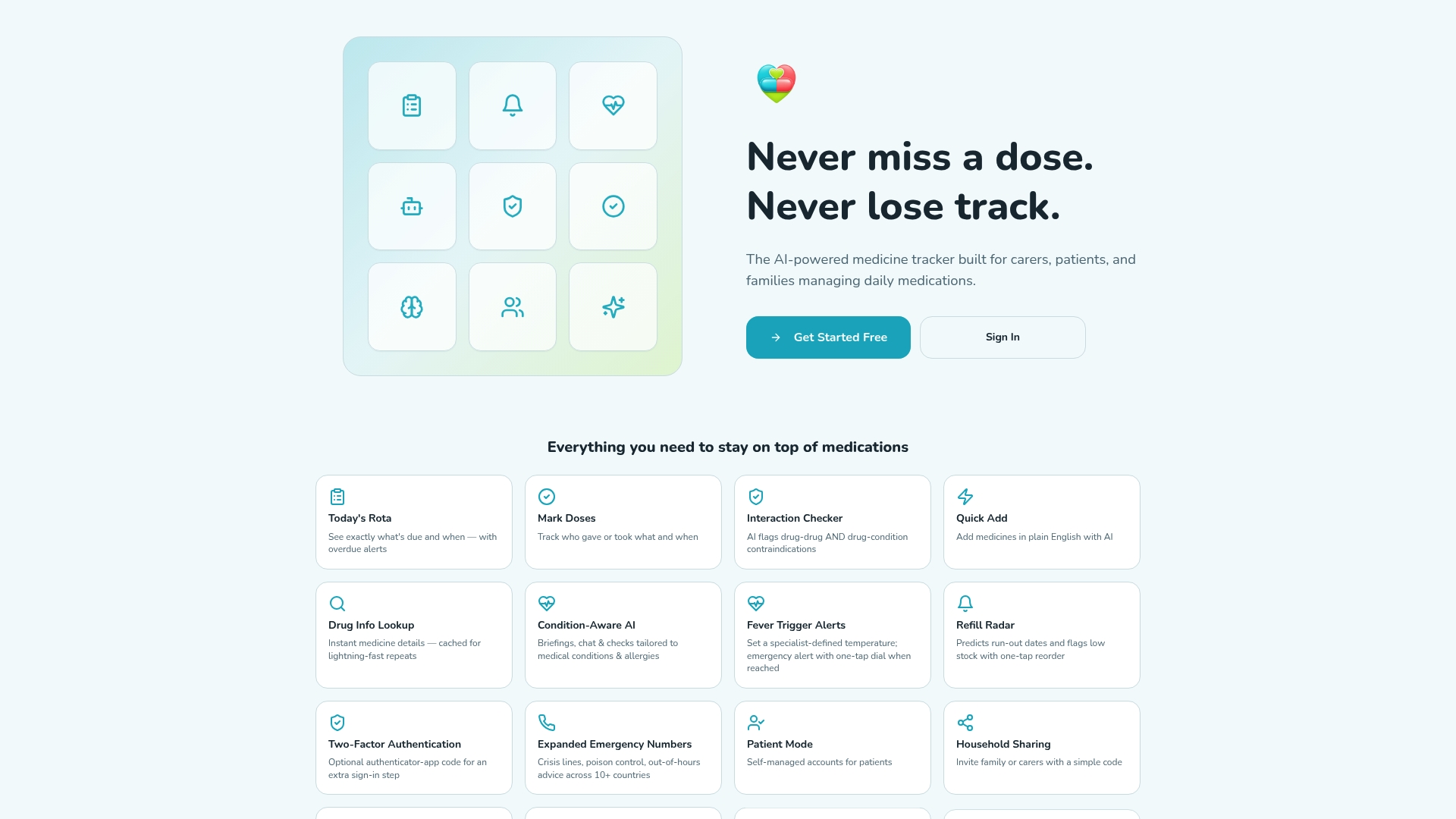
The platform maps directly to the checklist above: refill predictions flag when a supply is running low before you notice; real-time dose alerts confirm what has and has not been taken; drug interaction checks run automatically when a new medicine is added; and multi-patient household sharing means one carer can manage prescriptions for several family members from a single dashboard. The medication history export gives you a clean, timestamped record to bring to any GP or hospital appointment, replacing the guesswork that often follows a care transition.
Thedailydosetracker complies with UK GDPR, works across any device as a progressive web app, and includes accessibility options designed for older adults. A free tier covers the core features; the Individual and Pro subscriptions unlock advanced AI tools, appointment management and multi-patient support. Start with the free tier at Thedailydosetracker and see how much of the monthly checklist it handles automatically.
Sources
- NHS
- Tips for caregivers managing medication | Express Scripts® Pharmacy
- How to Refill a Drug Prescription Step by Step | Healthline
- All About Prescription Renewals, Refills and Expired Medicine | Geisinger
- Prescription Refill Checklist for Caregivers Made Easy | SeniorsProTalk
- Medication Management & Refills: A Practical, No-Panic Medical Guide | CareVMA Health
Prescription charge rules differ across England, Scotland, Wales and Northern Ireland. Check your devolved nation's current guidance before assuming a charge applies.
This article provides general information for carers and is not a substitute for advice from a qualified pharmacist, GP or other healthcare professional. Always confirm current NHS processes and clinical decisions with your prescriber or pharmacist.