

Medicines support for ageing in place means any help that enables a person to take and manage their medicines safely at home, ranging from a simple reminder to full administration by a trained carer. If you are just starting out, take these three steps today: 1) write a master medicines list covering every prescribed, over-the-counter and complementary product; 2) inform the GP and pharmacist that you are now involved in the person's care; 3) request a medication review or a social-care needs assessment if the regimen is complex.
- Create a master medicines list — include drug name, dose, frequency, prescriber and what it is for.
- Notify the GP and pharmacist — ask to be recorded as the named carer and request copies of repeat prescriptions.
- Request a review or assessment — ask the GP for a Structured Medication Review (SMR) or contact the local authority for a social-care needs assessment.
Table of Contents
- Why poor medicines management puts independence at risk
- The range of medicines support: from reminders to full administration
- Who can give medicines support in the UK, and what the rules say
- How to arrange medicines support: assessments, funding and realistic timescales
- Everyday tools and routines that reduce errors straight away
- How a digital tool fits into medicines support at home
- What a Structured Medication Review covers and when to ask for one
- A daily safety checklist and the red flags that need urgent action
- Key takeaways
- The part of medicines support most carers get wrong
- Thedailydosetracker: a practical digital option for carers
- Useful sources for carers
Why poor medicines management puts independence at risk
Ageing changes how the body handles drugs. Kidney and liver function decline, body composition shifts, and the stomach absorbs medicines more slowly. The practical result is that a dose that was safe at 60 may cause toxicity at 80, and side effects can appear at lower doses than prescribers expect.
Polypharmacy compounds this. Older adults managing multiple long-term conditions often take multiple medicines daily, and each additional drug raises the probability of an interaction. Non-adherence rates for prescribed medicines are substantial, meaning a significant share of doses are simply not taken as intended. The consequences range from uncontrolled blood pressure to preventable falls.
Hospital admissions tell the clearest story. Medicines-related admissions account for a notable proportion of all hospital admissions, many of which are avoidable. For a person who wants to remain at home, a preventable admission is not just a health event; it is often the trigger for a permanent move into residential care.
The range of medicines support: from reminders to full administration
Not every older person needs the same level of help. Understanding the spectrum lets you match support to actual need rather than defaulting to the most intensive option.
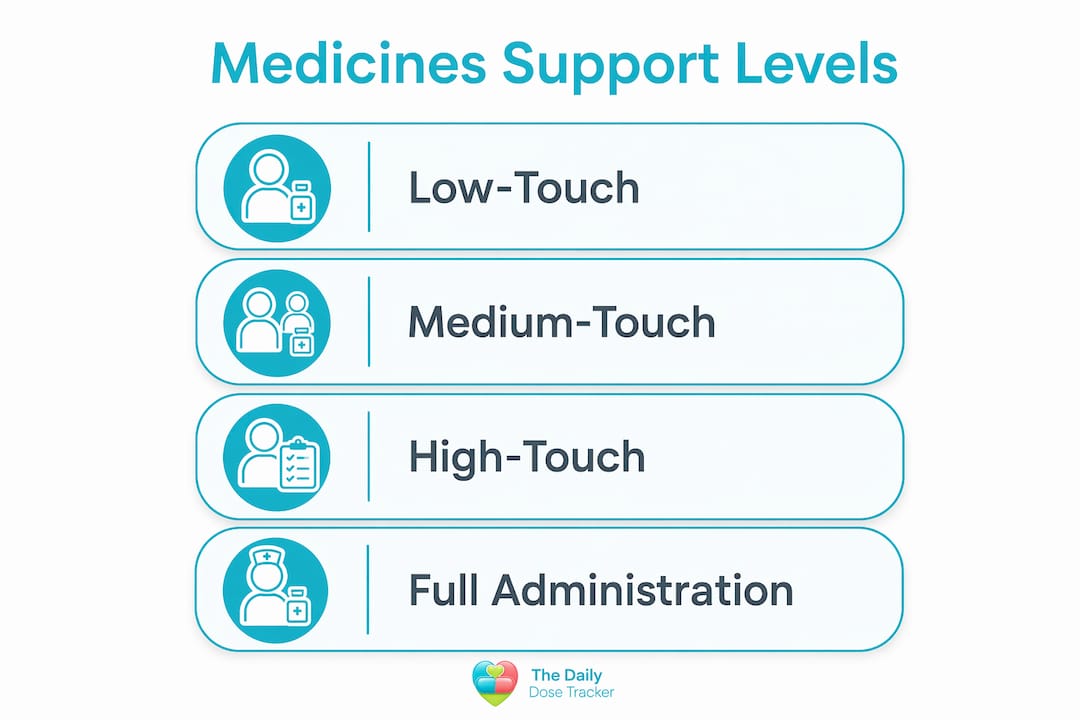
Low-touch support suits people who are largely capable but occasionally forget. This includes verbal reminders, printed dosing schedules, phone alarms, and simple pill organisers. The person retains full control; the carer's role is a prompt, not a handover.

Medium-touch support introduces physical compliance aids. Dosette boxes (weekly pill organisers divided by day and time) and monitored dosage systems (MDS, also called blister packs) are dispensed by the pharmacy with medicines pre-sorted. Domiciliary pharmacy services take this further: a pharmacist or technician visits the home, reconciles what the person is actually taking against GP records, and can identify discrepancies that a remote review would miss. An Exeter cluster pharmacy evaluation found that this approach reduced patients' medication-related harm risk from 76% at referral to 21% at final contact.
High-touch support involves a care worker or nurse administering medicines directly, either under a delegated care plan or as a clinical task. This requires formal training, a written care plan, and documented consent.
| Support level | Who delivers it | Typical aids | Key consideration |
|---|---|---|---|
| Low-touch | Self, family carer | Pill organiser, printed schedule, phone alarm | Preserves independence; relies on memory |
| Medium-touch | Pharmacist, pharmacy technician, trained carer | Dosette box, blister pack, MDS, domiciliary pharmacy visit | Reduces sorting errors; pharmacist involvement adds clinical check |
| High-touch | Domiciliary care worker, community nurse | Delegated care plan, administration record | Requires formal training, written consent and documented care plan |
Blister packs reduce sorting errors but remove the person's ability to self-manage if their condition changes. A domiciliary pharmacy visit, by contrast, adds a clinical layer that a pre-packed box cannot replicate. The right choice depends on the person's cognitive capacity, dexterity, and how stable their regimen is. For more on supporting self-administration, the principle is always to use the least restrictive option that keeps the person safe.
Who can give medicines support in the UK, and what the rules say
The short answer is: the person themselves, a family carer, a trained domiciliary care worker, a community nurse, or a pharmacist. Each role carries different responsibilities and different legal exposure.
Family carers have no formal registration requirement to prompt or assist with medicines, but they do need the person's consent. If the person lacks mental capacity, decisions must follow the Mental Capacity Act 2005 and be made in their best interests, documented in writing.
Domiciliary care workers can administer medicines only when this is written into their care plan, they have received specific training, and their employer's policy permits it. Delegation is not automatic; it requires a named clinical professional (usually a community nurse or GP) to assess and sign off the task.
Community nurses and pharmacists can administer and advise on medicines as part of their registered scope of practice.
NICE NG67 sets the framework for all of this:
The practical implication for carers: if a care agency is involved, ask to see the written care plan and confirm that medicines administration is explicitly listed. If it is not, the care worker is not authorised to give medicines, regardless of what has been verbally agreed.
How to arrange medicines support: assessments, funding and realistic timescales
Getting formal support in place involves several parallel tracks. Here is the sequence most carers follow.
- Tell the GP that you are now involved in the person's care. Ask to be added as a named carer on the GP record and request a Structured Medication Review if the person takes multiple medicines or has recently been discharged from hospital.
- Contact the local authority to request a social-care needs assessment. This is free and is the gateway to council-funded domiciliary care, including medicines support. Means-testing applies to the cost of care, not to the assessment itself.
- Speak to the community pharmacist. Many pharmacies offer a New Medicines Service, a Medicines Use Review (where still available), or can arrange blister-pack dispensing. Ask specifically about domiciliary pharmacy visits if the person is housebound.
- Request an SMR from the GP or clinical pharmacist. An SMR follows a structured seven-step process and typically requires a minimum of 30 minutes, sometimes face-to-face in the home for people with complex needs.
| Step | Who to contact | Typical timescale |
|---|---|---|
| GP notification and carer registration | GP surgery | Same week |
| Pharmacy blister-pack or MDS set-up | Community pharmacist | 1–2 weeks |
| Social-care needs assessment | Local authority adult social care | 4 weeks (varies by area) |
| Structured Medication Review | GP or clinical pharmacist | 4–8 weeks from referral |
| Domiciliary pharmacy visit (if eligible) | GP referral to pharmacy team | 2 weeks |
Funding for domiciliary care (including medicines support delivered by a care worker) is means-tested by the local authority. People with assets above the upper capital limit (currently £23,250 in England) typically fund their own care, though the assessment and care planning remain free. NHS-commissioned services such as SMRs and community nursing carry no direct charge.
Everyday tools and routines that reduce errors straight away
Organisation is the single biggest lever a carer controls directly. A few low-cost changes make a measurable difference before any formal support is in place.
Master medicines list. Keep one document — paper or digital — that lists every medicine by name, dose, frequency, prescriber and purpose. Include over-the-counter products and supplements. Clinicians cannot reliably hold a complete list during transitions of care, so this list travels with the person to every appointment and any hospital visit.
Dosing schedule. Map each medicine to a fixed time and, where possible, link it to a daily anchor (breakfast, the evening news, bedtime). Write it out and stick it somewhere visible. Consistency reduces the "did I take it?" uncertainty that leads to double-dosing.
Storage. Medicines should be stored at room temperature away from direct sunlight unless the label specifies refrigeration. Keep them out of reach of children and visitors. Do not store medicines in the bathroom; humidity degrades many tablets. Dispose of unwanted or expired medicines by returning them to any community pharmacy, never in household waste.
Documenting doses. A simple paper log or a digital tracker records when each dose was taken. This matters most when multiple carers are involved; without a shared record, doses get missed or repeated. Reducing medication errors in elderly home care often comes down to this single habit.
Pro Tip: Link each medicine time to a specific daily activity rather than a clock time. If breakfast is at 8 AM, "morning medicines with breakfast" is more reliable than "8 AM medicines" because it survives the days when routines shift. This cuts the cognitive load for carers significantly.
How a digital tool fits into medicines support at home

A well-chosen digital tool does not replace the GP, pharmacist or care plan. What it does is fill the coordination gap that paper systems and verbal handovers leave open.
NICE highlights communication failures between GP, pharmacy and carers as a key risk during transitions of care. A shared digital record addresses this directly: every carer in the household sees the same schedule, the same dose log, and the same alerts.
When evaluating any digital tool for medicines support, check for:
- Multi-patient or household sharing — can more than one person's medicines be managed in the same account?
- Real-time dose alerts — does it notify carers when a dose is due or overdue, not just log it after the fact?
- Drug interaction checks — does it flag potential interactions when a new medicine is added?
- Audit log — can you export a medicines history for a GP or pharmacist to review?
- Accessibility — does it support larger text, high contrast or screen readers for older users?
- UK GDPR compliance — is the organisation registered as a data controller with the ICO? Can you export or delete your data on request? Is consent clearly documented?
What a digital tool cannot do: prescribe, adjust doses, replace a clinical assessment, or substitute for a pharmacist's medicines reconciliation visit. Use it alongside professional input, not instead of it.
Thedailydosetracker is built specifically for this role. It offers medication scheduling and dose logging, multi-patient household sharing, real-time alerts, drug interaction checks, refill predictions, and emergency contact integration, all within a UK GDPR-compliant progressive web app. Accessibility controls including dark mode and adjustable font sizes make it usable for older adults directly, not just their carers.
What a Structured Medication Review covers and when to ask for one
An SMR is not a routine prescription check. It is a clinical conversation, usually led by a GP or clinical pharmacist, that looks at every medicine the person takes, why they are taking it, whether it is still working, and whether the burden of the regimen outweighs the benefit.
NICE NG5 frames medicines optimisation as person-centred: the goal is outcomes that matter to the individual, not simply adherence to a prescribing protocol. Deprescribing — stopping medicines that are no longer needed or are causing harm — is a legitimate and often welcome outcome of a good review.
Priority groups for an SMR include people taking ten or more medicines, those with frailty, people recently discharged from hospital, and those whose condition or circumstances have changed significantly. If the person you care for fits any of these, ask the GP explicitly.
Questions worth bringing to an SMR:
- Which medicines are most important to continue, and which could be stopped or reduced?
- Are any of these medicines causing the symptoms we are managing separately (falls, confusion, constipation)?
- Is the current regimen as simple as it can be — once-daily options where available?
- What should we do if a dose is missed?
- How will we know if a medicine is working or causing harm?
For complex regimens, a polypharmacy management guide can help you prepare for this conversation.
A daily safety checklist and the red flags that need urgent action
Daily checks (the "six rights")
- Right person — confirm you are giving medicines to the correct individual, especially in households with multiple people.
- Right medicine — read the label every time; packaging looks similar across different drugs.
- Right dose — check the prescribed amount, not just the number of tablets.
- Right time — follow the schedule; some medicines must be taken with food, others on an empty stomach.
- Right route — tablets, patches, drops and inhalers are not interchangeable.
- Right to refuse — a person with capacity can decline any medicine at any time; record this and inform the GP.
If a dose is missed
Do not double up unless the prescriber or pharmacist has explicitly said this is safe for that specific medicine. For most medicines, skip the missed dose and continue at the next scheduled time. When in doubt, call the pharmacy.
Red flags — contact the GP, pharmacist or 999 immediately
- Sudden confusion, agitation or unusual drowsiness after a new medicine or dose change
- A fall, especially if it follows a new prescription or dose increase
- Difficulty breathing, chest tightness or a new rash
- Signs of bleeding (unusual bruising, blood in urine or stools) in someone on anticoagulants
- Vomiting or inability to keep medicines down for more than 24 hours
- Suspected double-dosing of a high-risk medicine (insulin, warfarin, digoxin, opioids)
An elderly medication management checklist can help you build this into a daily routine.
Key takeaways
Safe medicines support for ageing in place requires a master medicines list, a formal review, and a consistent daily routine backed by the right level of professional involvement.
| Point | Details |
|---|---|
| Start with three actions | Create a master medicines list, notify the GP and pharmacist, and request a review or social-care assessment. |
| Know the support spectrum | Match the level of help to actual need: low-touch reminders, medium-touch compliance aids, or high-touch delegated administration. |
| Request an SMR proactively | People on multiple medicines or with frailty are priority candidates; an SMR can reduce harm and simplify the regimen. |
| Fragmented communication is the main risk | A shared record — paper or digital — that travels with the person reduces errors during transitions of care. |
| Thedailydosetracker | Offers UK GDPR-compliant scheduling, multi-patient sharing, dose alerts and interaction checks as a practical digital layer alongside professional care. |
The part of medicines support most carers get wrong
There is a tendency, entirely understandable, to treat medicines management as a compliance problem. The goal becomes: make sure every tablet is taken, on time, every day. That framing is not wrong, but it is incomplete, and it leads carers into a pattern that quietly undermines the person's independence.
NICE's medicines optimisation framework makes the point plainly: the aim is outcomes that matter to the individual, not adherence for its own sake. A person who refuses a medicine that makes them feel nauseous is not being difficult; they are exercising a legitimate preference. A carer who overrides that preference, however well-intentioned, is not providing support — they are removing agency.
The mistake I see most often is carers taking over the entire medicines routine the moment it becomes complicated, rather than adapting the system so the person can still participate. A dosette box filled by the pharmacist, combined with a shared digital log, often lets the person self-administer with minimal oversight. That is a better outcome than full carer administration, even if it looks less tidy. The habit worth building is this: before you do something for the person, ask whether a small adjustment to the system would let them do it themselves.
Thedailydosetracker: a practical digital option for carers
Managing medicines for someone at home means coordinating schedules, tracking doses, spotting interactions and keeping records that a GP or pharmacist can actually use. Thedailydosetracker is built for exactly that workload.
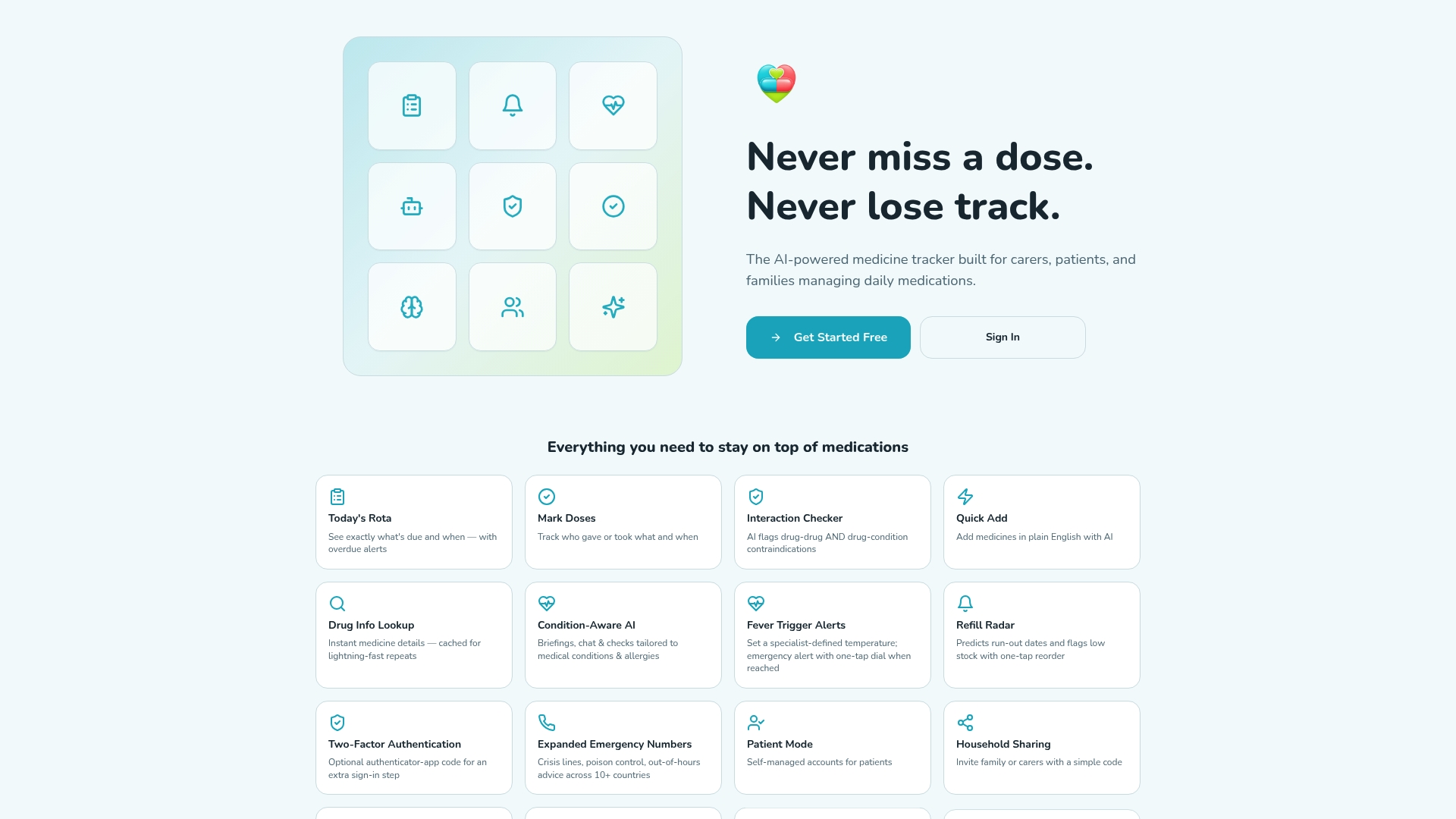
The platform gives carers shared medication schedules, real-time dose alerts, drug interaction checks, refill predictions and emergency contact integration in one place. Multi-patient household support means you can manage medicines for more than one person without switching accounts. Every dose is logged with a timestamp, creating an audit trail you can export for any clinical appointment. It complies with UK GDPR: your data stays yours, with clear consent controls and the ability to export or delete records on request.
The free tier covers core scheduling and logging. Advanced features including AI-based interaction checks, appointment management and multi-patient support are available on paid Individual and Pro plans. Start with a free account and see whether it fits your routine before committing to anything.
Useful sources for carers
-
NICE NG67 — Managing medicines for adults receiving social care in the community: The definitive UK guidance on assessing medicines support needs, care planning and consent. Read this before any formal assessment meeting.
-
NICE NG5 — Medicines optimisation: Sets out the principles of person-centred medicines use, including shared decision-making and structured review. Useful background for SMR conversations.
-
SMR toolkit (Norfolk and Waveney ICB): Practical NHS guidance on how SMRs are conducted, who is prioritised and what the seven-step review process covers. Helps carers know what to expect and what to ask.
-
Pharmacy at home — The Pharmaceutical Journal: Evidence from a UK domiciliary pharmacy programme showing measurable reductions in medicines-related harm risk. Useful if you are making the case for a home pharmacy visit to a GP or commissioner.
-
Merck Manual — Ageing and medications: Plain-language explanation of how ageing affects drug handling; good for understanding why dose adjustments matter and why a complete medicines list is non-negotiable.
-
NHS.uk — medicines and pharmacy services: The starting point for finding local pharmacy services, understanding repeat prescriptions and accessing NHS guidance on specific medicines.
This article is general information for carers and does not constitute medical or legal advice. Confirm current guidance and individual care decisions with the person's GP, pharmacist or a qualified social-care professional.