
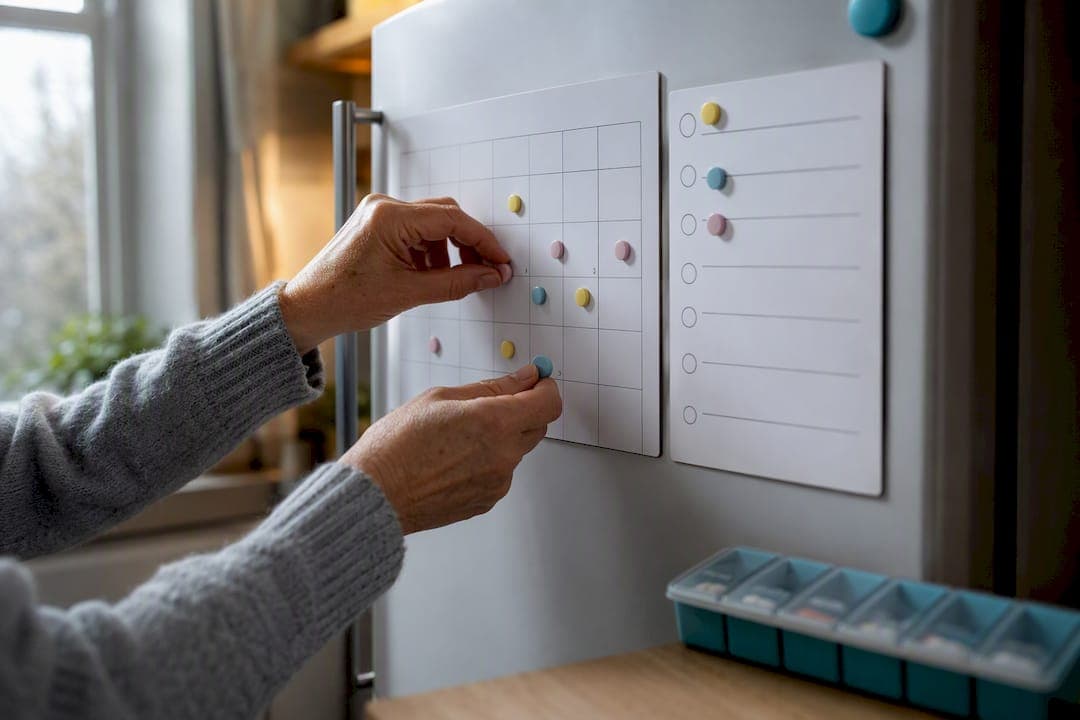
For most acute, post-operative or short-term severe pain, taking medication on a fixed time schedule works better than waiting for pain to build and dosing "as needed" (PRN). Time-scheduled dosing keeps blood levels steadier and reduces pain peaks, though PRN suits mild or intermittent pain. Always follow the prescribed limits on your packaging, check with a pharmacist or GP for kidney, liver or age-related adjustments, and use NHS guidance or a tool to help keep the record straight.
TL;DR:
- Fixed schedules are preferable for severe or post-surgical pain to maintain stable blood levels and reduce peaks, especially in the initial days.
- Building a medication schedule requires checking all active ingredients, avoiding overlap, anchoring doses to routines, and monitoring pain and side effects regularly.
- Paracetamol is best dosed at 500-1,000 mg every 4 to 6 hours with a daily maximum of 4,000 mg, while NSAIDs are taken every 6 to 8 hours with caution for interactions.
- Combining scheduled dosing with PRN medications should follow specific, well-defined instructions to prevent double dosing or missed doses.
- Use digital tools with reminders and interaction checks to support adherence, especially for managing multiple patients and complex medication regimens.
Table of Contents
- Building a pain medication schedule you can actually follow
- How do you build a personalised medication schedule?
- When should you take paracetamol, ibuprofen or opioids?
- Managing PRN and breakthrough pain without losing track
- What are the safe maximum doses and interaction risks?
- Adjusting schedules for older adults, children and complex medical histories
- How medication tracking tools support a safer schedule
- When should you call a clinician or seek urgent help?
- What carers learn about pain schedules that no leaflet tells you
- Try a medication tracking tool to run this schedule without the mental load
- Sources
Building a pain medication schedule you can actually follow
A workable schedule needs two things on paper: a 24-hour calendar for anything you take at fixed times, and a separate checklist for anything you only take when pain flares. Keep both where you can see them, whether that's stuck to the fridge or saved on a phone.
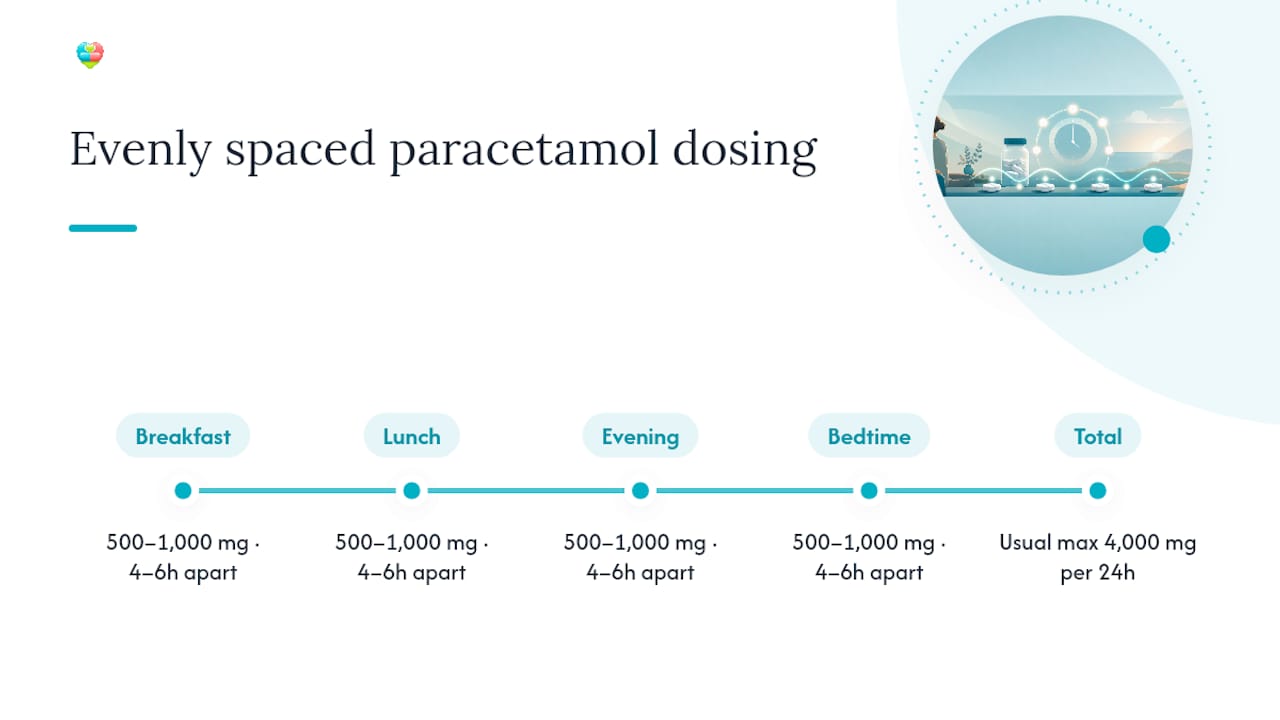
Sample 24-hour time-scheduled calendar (adjust times and doses only with your prescriber's or pharmacist's confirmation):
That spacing keeps paracetamol within its safe interval and under the daily ceiling, covered fully in the safety section below.
PRN checklist for breakthrough or intermittent pain:
- Record the time of the last dose before taking another.
- Confirm the minimum gap required (check the label; commonly 4 to 6 hours for paracetamol or NSAIDs).
- Note the maximum number of doses allowed in 24 hours.
- Score the pain before and roughly an hour after dosing (a simple 0 to 10 scale works fine).
- Log any side effects, however minor: drowsiness, nausea, constipation.
Print both templates or build them into a shared digital log, especially if more than one carer is involved. Bring the printed sheet, or an exported log, to every clinician appointment. It turns a vague "the pain's been bad" into a conversation backed by actual numbers, and that changes how quickly a doctor can adjust the plan.
How do you build a personalised medication schedule?
Every safe schedule starts with an honest inventory, not a template. Here's the sequence that actually works.
- List every medicine and its strength. Include over-the-counter products, herbal remedies and anything a partner or relative has "just given" the patient. This is where duplicate active ingredients hide, most commonly paracetamol tucked inside cold and flu remedies or combination painkillers.
- Check for overlaps. If two products both contain paracetamol, they count towards the same 4,000 mg daily ceiling. A pharmacist can run this check in minutes, and it's worth doing before you build any calendar.
- Decide scheduled versus PRN, with clinician input. Time-scheduled dosing tends to suit the first days after surgery, cancer-related pain, or any period where pain is fairly constant, because it stops levels dipping between doses and prevents the peaks and troughs that let breakthrough pain take hold. PRN suits mild, intermittent pain, such as an occasional headache or a flare that comes and goes.
- Anchor doses to routines. Tie doses to meals, waking, and bedtime rather than arbitrary clock times. It's easier to remember "with breakfast" than "08:15", and it naturally handles the food requirement that ibuprofen and other NSAIDs carry.
- Space multi-daily doses evenly. If a drug is prescribed three or four times a day, spread the doses across the full 24 hours rather than clustering them into waking hours. Tramadol taken four times daily works far better spaced roughly six hours apart than squeezed into a 12-hour window, a point NHS guidance makes explicitly for slow-release and standard formulations alike.
- Set a monitoring routine. Track pain scores, watch for a side-effect pattern, and set a calendar reminder for a scheduled review, typically within a week for any new opioid prescription.
For post-surgical patients, timing analgesia ahead of physiotherapy or planned activity, rather than after pain has already started, reduces breakthrough pain and keeps rehabilitation on track. If a physio session is booked for 10am, a dose at 9am does more good than one taken once the exercise has already become uncomfortable.
Pro Tip: Write the "why" next to each medicine on the schedule, not just the dose, e.g. "for inflammation" or "for nerve pain". When a GP reviews the list, that single word often speeds up the decision on what to change.
When should you take paracetamol, ibuprofen or opioids?
Different analgesic classes behave on different clocks, and mixing up the timing is one of the most common ways schedules fall apart.
Paracetamol is typically dosed at 500 to 1,000 mg every 4 to 6 hours, with a usual adult maximum of 4,000 mg in 24 hours. Four evenly spaced doses across the day, anchored to meals and bedtime, cover most adults without pushing near that ceiling.
Ibuprofen and other NSAIDs usually run every 6 to 8 hours, and over-the-counter strengths commonly cap out around 1,200 mg a day, well below the higher doses a prescriber might allow under supervision. Take NSAIDs with food. They're the better choice for inflammatory pain, such as a swollen joint or post-surgical swelling, whereas paracetamol suits non-inflammatory pain just as effectively without the stomach or kidney load NSAIDs can carry.
Opioids cover a wide range, and the timing differs by drug. Tramadol standard tablets are usually taken three to four times a day, spaced evenly; slow-release versions follow a different schedule entirely and should never be assumed interchangeable with immediate-release tablets. Codeine and stronger opioids generally follow a similar every-4-to-6-hour pattern for immediate-release forms. The Right Decisions guidance from NHS Scotland sets out a stepwise approach: start with the simplest effective option, add or substitute rather than stacking, and treat opioids as a short-course tool for severe pain rather than a long-term default. Most opioid courses for acute pain, including post-surgical pain, are reviewed by a clinician within days because tolerance and side effects build quickly.
A quick reference on onset and spacing: analgesic dosing tables show that oral paracetamol and NSAIDs typically reach effect within 30 to 60 minutes, while some opioids act faster but wear off sooner, which is exactly why dosing intervals matter more for opioids than for slower-clearing drugs.
Adjuvants, things like certain antidepressants or anticonvulsants used for nerve pain, run on entirely separate schedules and dose logic. They're prescribed for a different mechanism of pain, generally taken once or twice daily regardless of pain flares, and should never be treated as a substitute for standard analgesics or adjusted without the prescriber's say. Pharmacists generally match the drug class to the type of pain: NSAIDs for inflammation, paracetamol for general non-inflammatory pain, adjuvants for nerve-related pain. A turmeric supplement or other anti-inflammatory alternative sometimes enters the conversation here too, though the evidence base and dosing logic for supplement-based options differ substantially from licensed medicines and shouldn't be assumed to follow the same schedule.
Managing PRN and breakthrough pain without losing track
PRN dosing works when the instruction is specific, not vague. "Take as needed" isn't a schedule; "take every 4 to 6 hours as needed, up to four times in 24 hours" is.
- Write the exact PRN window and daily maximum on the checklist, not just in memory.
- Log the time of every PRN dose the same way you would a scheduled one; gaps in the log are where accidental double-dosing creeps in.
- Watch the pattern of PRN use over several days. If breakthrough doses are needed more than two or three times daily on a regular basis, that's usually a sign the baseline schedule needs revisiting, not that the PRN dose needs increasing.
- Combining a scheduled baseline (say, regular paracetamol) with a PRN top-up (an NSAID or short-acting opioid) is common and often more effective than either alone, but the combination should come from the prescriber, not guesswork.
Missed doses deserve a firm rule, because this is where most scheduling errors happen. If a dose is missed and it's close to the next one, skip the missed dose rather than doubling up. If it's still well within the normal window, take it as soon as remembered and adjust the next dose time accordingly rather than stacking two doses close together. Never take an extra dose to "catch up." If more than one dose has been missed, or if you're unsure what to do, call the pharmacy or out-of-hours line rather than guessing. This applies equally to opioids, where a missed dose followed by an accidental double dose carries real respiratory risk, so treat that caveat with the same seriousness as any paracetamol overdose warning.
What are the safe maximum doses and interaction risks?
The two most commonly misjudged limits are paracetamol and NSAIDs, largely because both sit on pharmacy shelves without a prescription and feel harmless.
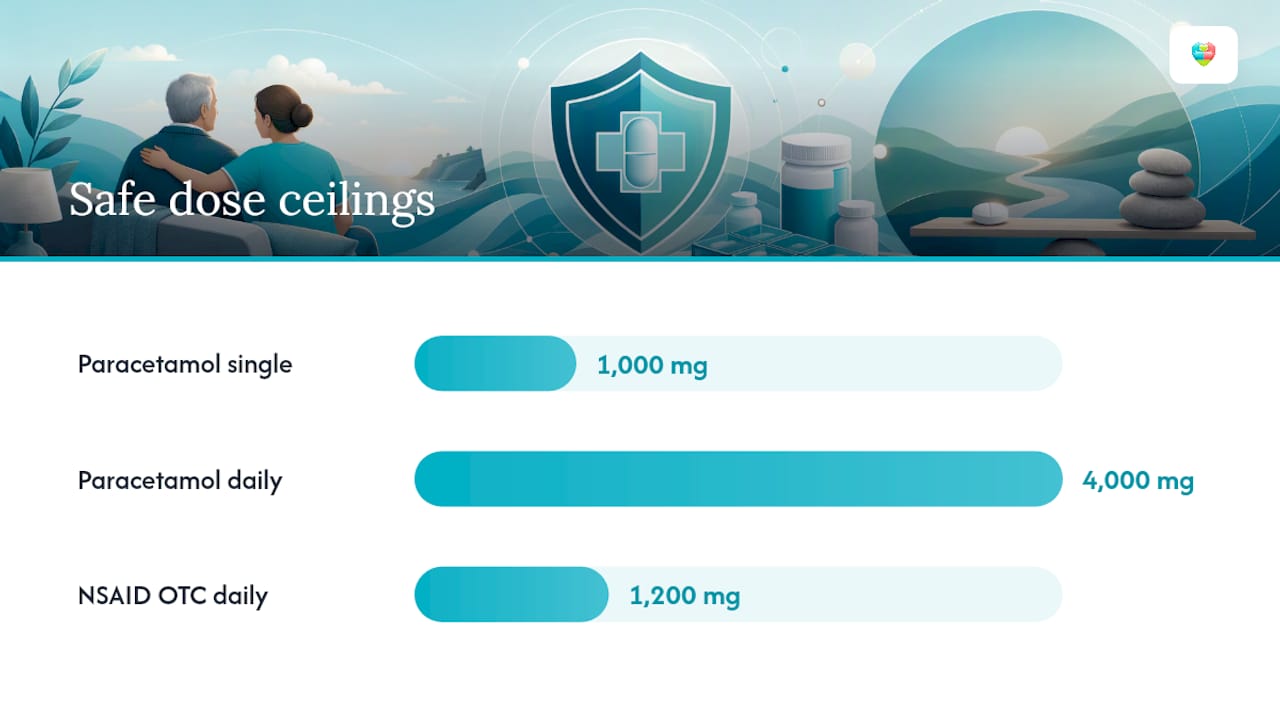
Paracetamol: 500 to 1,000 mg every 4 to 6 hours, with a firm adult ceiling of 4,000 mg in 24 hours. The real danger sits in combination products. Cold and flu remedies, some prescription painkillers, and certain migraine treatments all contain paracetamol, and stacking them on top of a "standalone" paracetamol dose is one of the most common routes to accidental overdose. Always check the active ingredients list, not just the brand name.
Ibuprofen and other NSAIDs: typically dosed every 6 to 8 hours, with over-the-counter products capping at commonly recommended daily doses. Higher doses exist under prescription, but only with clinician oversight, particularly for anyone with a history of stomach ulcers, kidney disease, or heart problems.
The gap between the OTC ceiling (roughly 1,200 mg/day) and prescription-strength NSAID doses is exactly why "just take a couple more" is the wrong instinct. Crossing that line without medical advice is one of the more preventable causes of NSAID-related hospital admissions.
Interactions worth flagging on any schedule:
- Alcohol combined with paracetamol raises the risk of liver damage, and the same caution applies to opioids, where alcohol increases sedation and breathing risk.
- NSAIDs taken alongside blood-thinning medication (warfarin, apixaban and similar) raise bleeding risk substantially and generally need a pharmacist or GP sign-off first.
- Combining two sedating medicines, such as an opioid and certain antihistamines or sleeping tablets, compounds drowsiness and fall risk.
Seek urgent medical help for confusion, unusual drowsiness that's hard to rouse someone from, slow or shallow breathing, swelling of the face or throat, or a rash with breathing difficulty. These are emergencies, not "wait and see" situations, whichever drug class is involved.
Adjusting schedules for older adults, children and complex medical histories
A schedule that suits a fit 40 year old rarely transfers safely to an 85 year old on five other medicines, and pretending otherwise is where most preventable harm creeps in.
- Older adults: start at the lower end of the dose range and increase slowly if needed. Sedation and dizziness raise fall risk substantially in this group, so any new opioid or sedating adjuvant warrants closer early monitoring. Timing adjustments for elderly patients often matter as much as the dose itself.
- Liver or kidney impairment: both organs clear most analgesics, and reduced function means doses can build up faster than expected. Paracetamol and NSAIDs both need dose review in significant impairment; some opioids need dose reduction, others need swapping out entirely. This is a prescriber decision, not one to make from a leaflet.
- Children: dosing is weight-based, not a fraction of the adult dose, and requires the correct paediatric formulation and measuring device. Never split or estimate a portion of an adult tablet for a child.
- Polypharmacy: anyone taking several regular medicines benefits from a formal pharmacist review, ideally before a new painkiller is added, to catch duplicate active ingredients and dangerous combinations before they cause harm. Polypharmacy risks compound quietly, often for months, before anyone notices the pattern.
Pro Tip: If an older relative is on regular medication and a new painkiller gets added after a fall or a hospital visit, ask specifically: "Does this change how the existing doses should be timed?" Half the schedule conflicts carers report start with an add-on drug nobody re-timed against the rest.
How medication tracking tools support a safer schedule
A paper calendar works, but it has limits: nobody gets an alert when a dose is due, and a printed sheet doesn't flag that the new NSAID prescription clashes with the blood thinner already on the list. That's the gap digital tools are built to close.
Look for these capabilities in any tool you consider:
- Schedule templates that handle both time-scheduled and PRN dosing side by side.
- Multi-patient support, useful for a carer managing medication for more than one relative.
- Real-time reminders for doses that are due or overdue.
- Interaction and duplicate-ingredient checks that flag conflicts automatically rather than relying on memory.
- Exportable dose logs to bring, or send, to a clinician review.
Mapping a printed schedule into an app is straightforward: enter each medicine, its dose, its interval, and whether it's scheduled or PRN, then let reminders do the rest. Reminders, interaction alerts, and exportable logs together tend to catch the errors a busy carer misses at 11pm on a hard day. Multi-device access matters too; a household sharing a patient's care benefits from everyone seeing the same up-to-date schedule rather than three different versions on three phones.
A schedule only works if it's followed consistently, and consistency is exactly what breaks down when carers are tired, juggling multiple people's medicines, or relying on memory across shift changes. The tools that help most aren't the ones with the most features. They're the ones that make the next dose obvious without anyone having to think about it.
When should you call a clinician or seek urgent help?
Certain signs mean the schedule isn't working, or something more serious is happening, and neither situation should wait.
- Pain stays uncontrolled despite following the schedule correctly, or PRN doses are being needed noticeably more often than a few days ago.
- Signs of overdose or serious reaction: confusion, marked drowsiness, slow or shallow breathing, yellowing skin or eyes (a paracetamol overdose warning sign), swelling of the face or throat, or a widespread rash. These need emergency care immediately, not a next-day GP call.
- Before the appointment, prepare: the current schedule with exact times and doses, any concern about accidental overdose or missed doses, a list of every other medicine being taken, and, for anyone on opioids beyond a few days, a specific question about tapering and review timing.
What carers learn about pain schedules that no leaflet tells you
Most of the technical guidance above is straightforward once it's written down. What's harder is running it in a real household, on a bad night, with a relative who's in pain and a phone buzzing with something else entirely.
A few things tend to matter more in practice than in theory. Visual labelling, colour-coding morning versus evening doses, or writing the time directly on the box lid, prevents more errors than any app notification, because it catches the moment someone reaches for the wrong bottle without thinking. Anchoring doses to routines rather than clock times survives real life far better; a 2pm alarm gets missed on a chaotic day, but "with lunch" rarely does. And the carers who get the most out of clinician reviews are the ones who show up with a log, not a memory. A GP can adjust a plan in five minutes when they can see the actual pattern of pain scores and PRN use, rather than trying to reconstruct two weeks of "sometimes it was bad" from a tired conversation.
The instinct to be a hero and push through gaps in the schedule, skipping a dose because things seem calmer, doubling up because the last one didn't touch the pain, is understandable and usually wrong. The schedule exists because pain control works better as a steady state than a series of emergencies.
— Prasant
Try a medication tracking tool to run this schedule without the mental load
A medication tracking tool turns everything covered above, the calendar, the PRN checklist, the interaction checks, into one running record instead of scattered notes and half-remembered timings. Such tools may build schedule templates for both time-scheduled and PRN dosing, support multiple patients under one household account, and flag overdue doses or duplicate active ingredients before they become a problem rather than after.
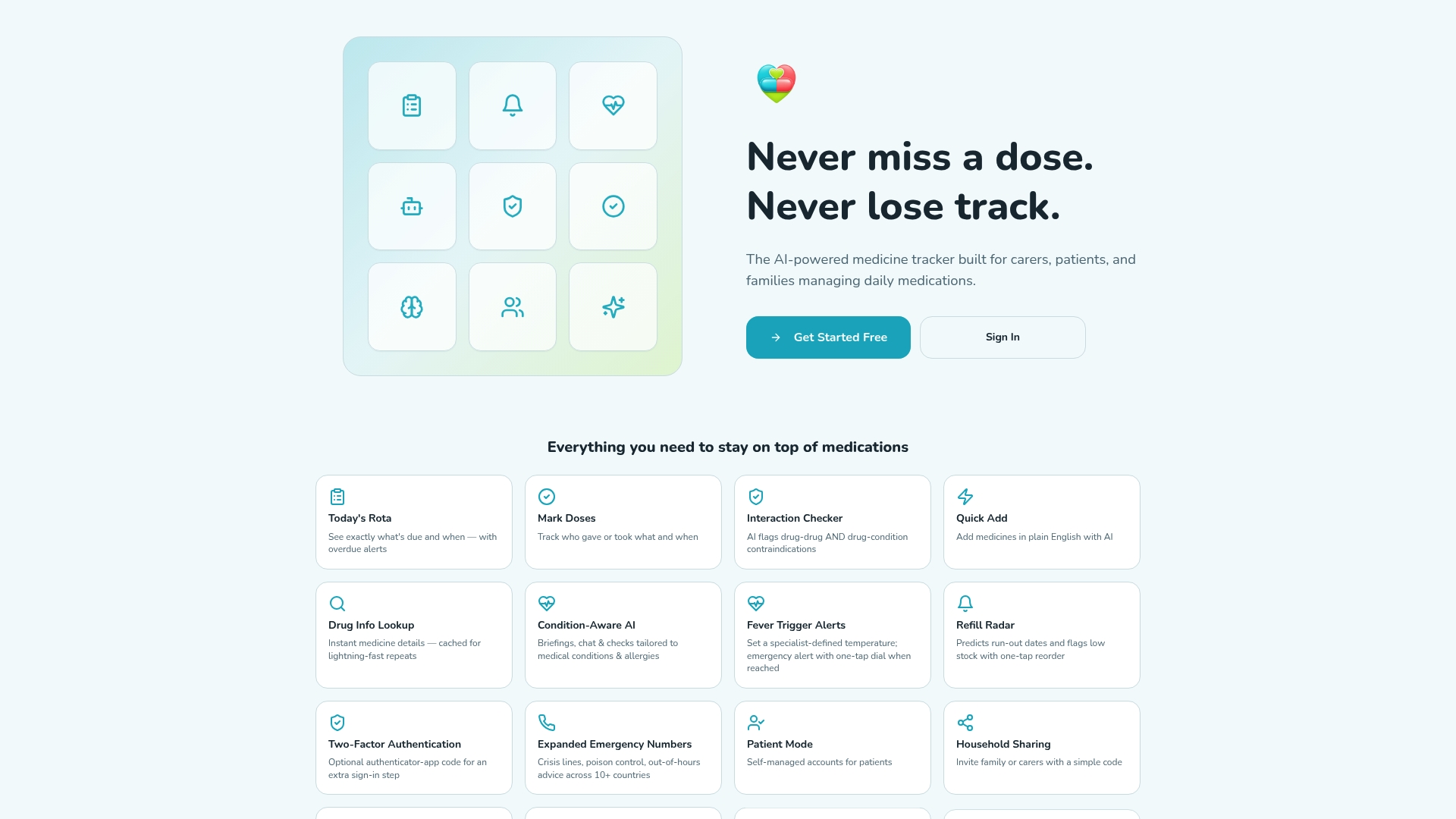
Carers managing more than one relative's medicines, or anyone juggling a scheduled painkiller alongside PRN top-ups, get the most value from the multi-patient view and automatic reminders. Dose logs export cleanly for clinician reviews, so the conversation starts with real data instead of guesswork. The core scheduling and logging features are free to use; advanced tools like AI-based insights, appointment scheduling and household sharing sit on the paid Individual and Pro plans for anyone who needs more. Start with The Daily Dose Tracker and set up the first schedule today.
This article is general information, not a substitute for advice from a qualified doctor. Consult a qualified healthcare professional about your own circumstances before acting on anything here.
Sources
- How and when to take tramadol - NHS
- Time‑Scheduled versus Pain‑Contingent Opioid Dosing in Chronic Opioid Therapy — PMC
- Analgesic onset, duration and typical dosing — NCBI Bookshelf
- Pain medicines after surgery — Mayo Clinic
- Drugs used in acute pain | Right Decisions - NHS Scotland