

Polypharmacy means taking five or more regular medicines at once, and while that's sometimes the right call clinically, it consistently raises the odds of falls, confusion, hospital admission, and dangerous drug interactions. The National Overprescribing Review found that 8.4 million patients regularly take five or more medicines, and estimates roughly 10% of primary care prescriptions are inappropriate. That gap between "appropriate" and "problematic" polypharmacy is the whole story.
Three things to do right now:
- Write a complete medicine list, including over the counter tablets, vitamins and herbal remedies.
- Ask your GP or pharmacist for a structured medication review.
- Never stop a medicine on your own without discussing it first.
The common harms worth knowing about: adverse drug reactions, falls, delirium or new confusion, drug interactions, and needless hospital stays. Research reviewed in StatPearls links higher medicine counts directly to increased frailty, disability, and mortality risk in older adults. None of that is inevitable. It's manageable once someone actually looks at the full list.
Key Takeaways
Polypharmacy becomes dangerous when medicines pile up without regular review, and the fix is a structured medication review paired with careful, monitored deprescribing.
| Point | Details |
|---|---|
| Know the threshold | Five or more regular medicines counts as polypharmacy; ten or more is hyperpolypharmacy and needs closer attention. |
| Distinguish appropriate from inappropriate | Every medicine should have a clear, current reason; anything without one is worth questioning at a review. |
| Watch the high-risk drug classes | Anticholinergics, benzodiazepines, opioids, anticoagulants, hypoglycaemics, and NSAIDs cause the most harm in combination. |
| Book reviews at least annually | Structured reviews using STOPP/START or Beers criteria should happen yearly, or sooner after a hospital stay or major health change. |
| Deprescribe one drug at a time | Change one medicine, then monitor for 2 to 12 weeks depending on the drug, before adjusting another. |
| Keep one shared list | Thedailydosetracker lets carers maintain and export a complete, current medicine list for GP and pharmacist appointments. |
Table of Contents
- What is polypharmacy, and when does it become risky?
- Why do people end up on so many medicines?
- Who is most vulnerable to medicine-related harm?
- What are the real clinical risks of polypharmacy?
- Which medicines and combinations carry the highest risk?
- How do clinicians identify and screen for harmful polypharmacy?
- How does safe deprescribing actually work?
- What can carers and patients do before the next appointment?
- When does a medicine problem become an emergency?
- What I've learned about carers' fear of stopping medicines
- A simpler way to keep the whole picture in view
- Frequently asked questions
- Sources
What is polypharmacy, and when does it become risky?
Clinicians usually define polypharmacy as taking five or more medicines regularly, with "hyperpolypharmacy" used for ten or more. But the number alone tells you little. The real question is whether each drug still earns its place.
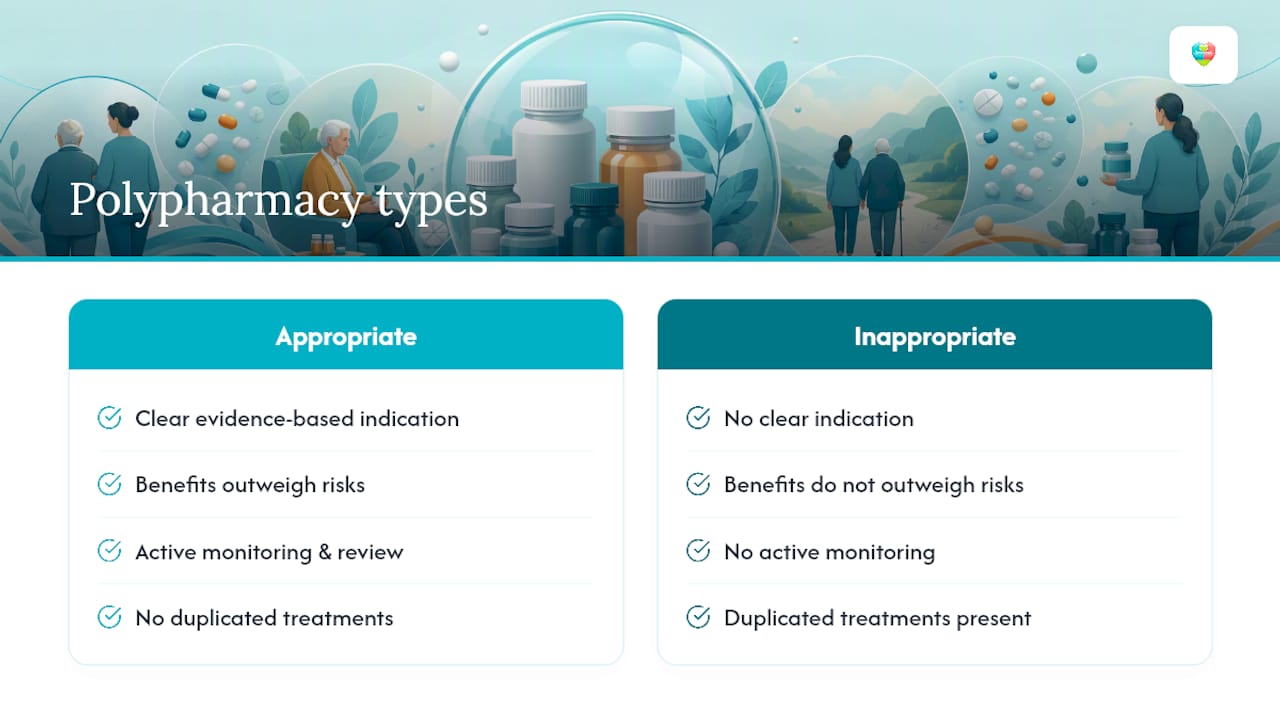
Appropriate polypharmacy happens when every medicine has a clear evidence based reason, the benefits outweigh the risks, and someone is actively monitoring for problems. A person with heart failure, diabetes, and arthritis might genuinely need eight or nine medicines, prescribed thoughtfully and reviewed regularly.
Inappropriate polypharmacy is different: drugs with no clear indication, harmful combinations, duplicated treatments, or medicines added to treat a side effect of another drug rather than a real condition. According to the NHS Specialist Pharmacy Service, a significant share of medicines prescribed in primary care fall into this second, avoidable category.
Here's a concrete illustration of how it happens. A patient starts a calcium channel blocker for blood pressure. It causes ankle swelling. Rather than reviewing the original drug, a clinician prescribes a diuretic to treat the swelling. Now there are two medicines where one might do, and the diuretic brings its own risks of dehydration and falls. This is called a prescribing cascade, and it's one of the most common ways polypharmacy quietly worsens.
Why do people end up on so many medicines?
Polypharmacy rarely happens through one bad decision. It builds up gradually, usually through a mix of these drivers:
- Multiple long-term conditions, each treated by separate single-disease guidelines.
- Several prescribers, GPs, and specialists working without full sight of each other's decisions.
- Repeat prescriptions renewed automatically without a fresh look at whether the drug is still needed.
- Over-the-counter medicines and supplements that never make it onto the official medical record.
- Poor reconciliation when a patient moves between care settings.
That last point deserves particular attention. Hospital discharge and care-home transfers are the moments new medicines get added fastest, and also when existing ones are most likely to be duplicated or forgotten. A discharge summary that doesn't cross-check against the GP's list is how a patient ends up on two different blood thinners by accident.
Who is most vulnerable to medicine-related harm?
Some people carry far more risk than others, and it's worth knowing whether you or someone you look after fits this profile.
- Adults over 65, especially those over 80, whose kidneys and liver process drugs more slowly.
- Care-home residents, who often take more medicines than people of the same age living independently.
- People with dementia or cognitive impairment, who may struggle to report side effects accurately.
- Anyone managing several long-term conditions at once (multimorbidity).
- Patients recently discharged from hospital, where medicine changes are common and reconciliation often slips.
- Anyone collecting prescriptions from more than one GP surgery or pharmacy.
The numbers matter too. Taking five or more medicines raises concern; ten or more (hyperpolypharmacy) raises it sharply. Regularly taking central nervous system drugs such as sedatives or opioids, alongside confusion about dosing schedules, are both strong markers that a review is overdue.
What are the real clinical risks of polypharmacy?
The harms aren't abstract. They show up as specific, often preventable events, and recognising the pattern early makes a genuine difference.
Adverse drug events are unwanted effects from a medicine working as expected, or interacting badly with another. Drug-drug interactions happen when two medicines change how each other work, sometimes dangerously. Drug-disease interactions occur when a medicine that's fine for one condition worsens another the patient also has. Then there's the trio most families actually notice: falls and fractures, delirium or cognitive decline, and hospital admission.
A review referenced in StatPearls puts medicine-related problems behind an estimated 5% to 28% of acute geriatric hospital admissions, a wide range that reflects how differently this gets measured across settings, but the direction is consistent: medicines are a major, and often overlooked, cause of hospital visits in older people.
Symptoms of medicine harm are frequently subtle and get mislabelled as ordinary ageing. Clinicians increasingly recommend a "think medicines first" approach whenever a new symptom appears in an older patient, because fatigue, unsteadiness, and appetite loss are just as likely to be drug effects as new illness.
Two brief examples show how this plays out. First, an adverse drug event: an older woman starts a new antibiotic for a chest infection, which interacts with her regular warfarin and pushes her clotting levels into dangerous territory. She notices unusual bruising a few days later. Second, a prescribing cascade: a man on medication for Parkinson's develops a tremor treated with an antipsychotic, which worsens his Parkinson's symptoms rather than helping. Both cases needed a medicine review, not a new prescription.
Watch for fatigue that doesn't lift, sudden confusion, unsteadiness on the stairs, or a loss of appetite with no obvious cause. Families often chalk these up to "getting older." Sometimes they are exactly that. Often, they're the medicine talking.
Which medicines and combinations carry the highest risk?
Certain drug classes turn up again and again in polypharmacy harm, and recognising them by name is genuinely useful when you're looking at a repeat prescription list.
- Anticholinergics (some antihistamines, bladder medicines, and older antidepressants) can cause confusion, dry mouth, constipation, and cognitive decline, and their effects add up when several are taken together.
- Benzodiazepines raise the risk of sedation, falls, and dependence, particularly in people over 65.
- Opioids bring sedation, constipation, and a sharply increased fall risk, especially at higher doses.
- Anticoagulants (blood thinners) carry a serious bleeding risk that climbs fast when combined with other drugs affecting clotting.
- Hypoglycaemics (insulin, sulfonylureas) can cause dangerous blood sugar drops if doses aren't adjusted as eating or kidney function changes.
- NSAIDs (ibuprofen and similar painkillers) risk stomach bleeding and kidney damage, particularly alongside blood thinners or blood pressure medicines.
One combination stands out for how often it turns up in serious incidents: an opioid taken alongside a benzodiazepine. Both suppress the central nervous system, and together they can slow breathing dangerously, especially in someone who's frail or has reduced lung function. The warning signs are unusual drowsiness, slurred speech, and slow or shallow breathing. Any of those, in someone taking both drug types, deserves urgent attention rather than a wait-and-see approach.
How do clinicians identify and screen for harmful polypharmacy?
Two named tools do most of the heavy lifting in UK and international practice. STOPP/START criteria flag medicines that should potentially be Stopped (drugs likely to cause harm with little benefit) and highlight treatments that should potentially be Started (evidence-based drugs a patient is missing). The Beers criteria, widely used in the US and referenced internationally, lists specific medicines considered potentially inappropriate in older adults.
A structured medication review, the kind NICE guidance recommends, is usually carried out by a GP, a clinical pharmacist, or a specialist nurse. It typically checks:
- Whether each medicine still has a clear, current indication.
- Whether any drugs interact or duplicate each other's effect.
- Whether the patient is actually taking medicines as prescribed.
- Whether over-the-counter products or supplements have been factored in.
As for timing, most guidance points to an annual review as standard practice at minimum, brought forward whenever there's a major health change, a new diagnosis, or a hospital discharge. If you can't remember the last time someone properly went through the full list, that's the signal to book one.
How does safe deprescribing actually work?
Deprescribing is not the same as simply stopping a drug. It's a planned, monitored process, and StatPearls outlines it as one of the core strategies for reducing harmful polypharmacy. Here's the typical sequence:
- Gather the full list. Every prescribed medicine, every over-the-counter product, every supplement, with doses and start dates where possible.
- Identify the highest-risk drugs first. Anticholinergics, benzodiazepines, and opioids usually get prioritised, since they carry the most day-to-day harm.
- Discuss it together. A genuine conversation between clinician and patient (or carer) about what each drug is doing, what stopping it might mean, and what matters most to the patient.
- Change one medicine at a time. Adjusting several drugs simultaneously makes it impossible to tell which change caused which effect.
- Taper gradually where needed, rather than stopping abruptly, and build in a follow-up check.
Monitoring windows vary by drug. Sedatives and blood pressure medicines are often reviewed within 2 to 4 weeks of a change; other drugs may need 8 to 12 weeks to judge the full effect. The goal is simple: fewer symptoms, steadier mood, better sleep, or improved mobility, without new problems appearing.
Pro Tip: Never stop a benzodiazepine, an opioid, or certain blood pressure medicines suddenly. Withdrawal or a rebound of the original condition can be more dangerous than the drug itself. If new symptoms appear during tapering, tell the prescriber immediately rather than waiting for the next scheduled appointment.
A pharmacist is often the most useful person in this process. Many practices now involve pharmacist-led reviews specifically because pharmacists have the time and training to work through complex regimens in detail, something a ten-minute GP appointment rarely allows.
What can carers and patients do before the next appointment?
Preparation makes the review itself far more productive. Before you go in, put together:
- A single list of every medicine, prescribed and over-the-counter, plus any supplements or herbal remedies.
- A note of which doctor or specialist prescribed each one.
- Any new symptoms, however minor they seem, especially fatigue, dizziness, or confusion.
- How medicines are actually taken day to day, including any doses missed or doubled up by mistake.
Bring specific questions rather than general worries. Try: "What is this medicine actually for?" "Could we safely stop or reduce this one?" "What should I watch for if we try reducing it?" These get better answers than a vague "is he on too much?"
Simple physical aids help too. Weekly pill organisers, clearly labelled boxes, and a shared list kept in one place cut down on missed or duplicated doses. An exportable medicine list you can hand to a GP or pharmacist at the start of an appointment saves time and reduces the chance something gets left out.

When does a medicine problem become an emergency?
Some symptoms need a phone call to the pharmacist. Others need an ambulance. Knowing the difference matters.
Call for emergency help (999 in the UK) if you see:
- Sudden severe dizziness, fainting, or collapse.
- New, sudden confusion or delirium that wasn't there before.
- Difficulty breathing or unusually slow, shallow breaths.
- Signs of unexpected bleeding or bruising in someone on blood thinners.
- Severe symptoms of very high or very low blood sugar.
- No response after a medicine dose, or unusual unresponsiveness.
For anything less urgent, your GP surgery or a pharmacist is the right first call, not an emergency department.
What I've learned about carers' fear of stopping medicines
Most carers I speak to through this work aren't worried about starting a new medicine. They're worried about stopping one. That anxiety is completely reasonable and, in my view, badly underserved by how deprescribing gets talked about.
Here's the reassurance worth holding onto: deprescribing done properly is not a gamble. It's a stepwise, monitored process built specifically to catch problems early, with follow-up checks scheduled in advance rather than left to chance. Nobody removes a medicine and simply hopes for the best. A clinician who suggests reducing a drug should also be telling you exactly when they'll check back in, and what specific signs would mean reversing course.
The collaborative part matters as much as the clinical part. You know the day-to-day reality of how someone is doing, in a way no ten-minute appointment can capture. Bring that knowledge to the table. It's often the missing piece.
— Prasant
A simpler way to keep the whole picture in view
Compiling a full medicine list is the single most useful thing a carer can do before any review, and it's also the hardest to keep updated by hand once several prescribers and pharmacies are involved. Thedailydosetracker was built specifically for that gap: one shared, exportable list that stays current across every person you're looking after, rather than a paper note that's out of date by the next appointment.
The free tier covers the basics that matter most for polypharmacy: a complete medicine record you can export straight to a GP or pharmacist, dose reminders so nothing gets missed or doubled, and simple interaction flags that highlight combinations worth asking about. Paid tiers add multi-patient management, useful for anyone coordinating care across more than one relative, alongside household sharing so everyone involved is looking at the same list. Everything runs to UK GDPR standards, with accessibility options like dark mode and adjustable text built in from the start.
If the next medication review is on the calendar, or overdue, set up a free account and export a medicine list before you go in. It turns a rushed ten-minute appointment into one where the clinician actually has the full picture.
Frequently asked questions
What counts as polypharmacy? Taking five or more regular medicines at the same time is the standard threshold, though clinicians increasingly focus on whether each drug is still clinically justified rather than the count alone.
Is polypharmacy always dangerous? No. Appropriate polypharmacy, where every medicine has a clear indication and is properly monitored, can be entirely necessary for someone managing several conditions. The danger lies in inappropriate polypharmacy, where drugs no longer serve a clear purpose or interact harmfully.
How often should medicines be reviewed? At least once a year, and sooner after a hospital admission, a new diagnosis, or any significant change in health.
Who should carry out a medication review? A GP, a clinical pharmacist, or a specialist nurse, usually using screening tools such as STOPP/START or the Beers criteria to guide the process.
Can I stop a medicine myself if I think it's causing problems? No. Stopping some medicines abruptly, particularly benzodiazepines, opioids, and certain blood pressure or heart drugs, can cause withdrawal or a rebound of the original condition. Always raise concerns with a GP or pharmacist first.
This article is general information, not a substitute for advice from a qualified doctor. Consult a qualified healthcare professional about your own circumstances before acting on anything here.
Sources
- Polypharmacy - StatPearls - NCBI Bookshelf - NIH
- Understanding polypharmacy, overprescribing and deprescribing – NHS SPS
- Gov