

Every care team needs one thing above all: a single, current medication list that every clinician in the circle can see, and one named person accountable for keeping it accurate. That is the outcome to build towards.
The first action, starting at your next handover, is structured medication reconciliation, followed by a pharmacist-led phone call within 48 to 72 hours of discharge. A BMJ Open 2025 trial found this combination improves patients' understanding of medication changes and helps prevent avoidable readmissions.
That single call does more work than most teams expect. Here's what to put in place this week:
- Assign one named clinician as medication lead for each patient at handover.
- Reconcile the medication list against the discharge summary, GP record, and what the patient actually has at home.
- Book the pharmacist follow-up call before the patient leaves the ward or clinic, not after.
- Give the patient and any carer a copy of the current list, in writing, with a contact number for questions.
- Use a shared tool, such as The Daily Dose Tracker, so changes are visible to everyone in real time rather than trapped in one system.
Key Takeaways
Structured medication reconciliation paired with a pharmacist follow-up call and one shared, current medication list is the single most effective fix for care team medication communication failures.
| Point | Details |
|---|---|
| Reconcile at every transition | Complete structured reconciliation before discharge, handover, or care home transfer, not after. |
| Call within 48 to 72 hours | A pharmacist-led follow-up call in this window reduces confusion and readmission risk. |
| Assign named roles | Use CIHC role clarification so everyone knows who updates the shared list and who reviews it clinically. |
| Set informal-to-formal rules | Allow urgent informal calls, but require any change to be logged in the shared record within the hour. |
| Use one shared list | Platforms like The Daily Dose Tracker give patients, carers, and clinicians the same real-time medication record. |
This article is general information, not a substitute for advice from a qualified doctor. Consult a qualified healthcare professional about your own circumstances before acting on anything here.
Table of Contents
- Why care team medication communication breaks down and what it costs
- Frameworks that turn good intentions into a working process
- Who does what: nurse champions, pharmacists, and the teach-back step
- Choosing digital tools without falling into the EHR trap
- How a digital platform maps to these workflows
- The handover checklist your team can copy today
- What actually stalls implementation and how to get past it
- Piloting The Daily Dose Tracker with your care team
- Sources
Why care team medication communication breaks down and what it costs
Medication communication fails at predictable moments, not random ones. Discharge from hospital, handover between shifts, transfer into a care home, and the first GP follow up after a hospital stay are the four points where information most often gets lost, misheard, or simply not passed on.
The consequences are not abstract. Research into medication management during care transitions found that poor coordination and unclear role assignment at discharge are directly linked to medication incidents, with interprofessional frameworks pointing to role clarification and proactive communication as the fix that actually moves the needle, not more paperwork.
The core problem: nobody owns the medication list once the patient leaves a single setting. Everyone assumes someone else checked it.
Three risk points deserve specific attention:
- Discharge: medicines started, stopped, or changed in hospital rarely reach the GP and community pharmacist at the same time or in the same format.
- Shift handover: verbal handovers drop detail under time pressure, particularly dose changes made in the last few hours of a shift.
- Care home transfer: incoming residents frequently arrive with an incomplete or outdated list, forcing staff to reconstruct history from memory or old paperwork.
The BMJ Open trial cited above is worth dwelling on because it isolates one intervention, a pharmacist follow-up call, and ties it to a measurable drop in confusion and readmission risk. That is a stronger evidence base than most "communicate better" advice in this space, which tends to stay vague about what "better" means in practice.
Frameworks that turn good intentions into a working process
Frameworks matter here because ad hoc communication (a note in the discharge letter, a verbal handover, a phone call if someone remembers) fails in exactly the same way every time: nobody has agreed who owns which piece of information at which moment. Three models solve that.
Circle of Care modelling
Circle of Care modelling maps every person who touches a patient's medication, from the hospital consultant to the community pharmacist to the family carer, and asks a simple question at each point: who needs which piece of medication data right now? Research on Circle of Care modelling shows it clarifies information flows and pinpoints exactly where a shared list needs to exist rather than assuming a single system will cover it.
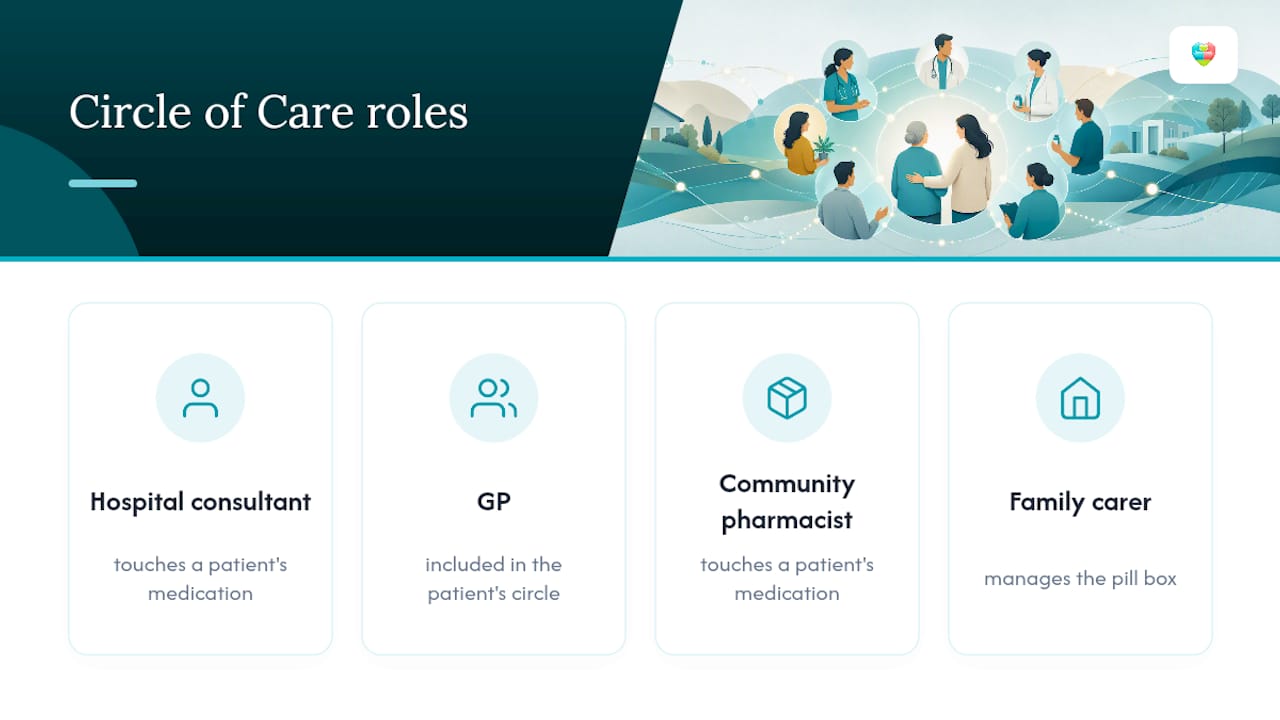
In practice, that means drawing the actual circle for a specific patient (GP, hospital pharmacist, district nurse, care home manager, daughter who manages the pill box) and marking which of them currently sees medication changes in real time. Most teams find gaps they didn't know existed.
CIHC competency domains
The Canadian Interprofessional Health Collaborative (CIHC) framework breaks collaborative practice into competency domains, and two matter most for medication safety: role clarification and collaborative leadership. Role clarification means every team member can state, without hesitation, who updates the medication list after a dose change. Collaborative leadership means someone is empowered to chase a missing piece of information rather than waiting for it to surface.
Teams that skip role clarification tend to discover the gap only when an incident happens, at which point two people assumed the other had reconciled the list.
Medication Care Coordination as an operational model
Medication Care Coordination (MCC) treats medication management as an assigned, ongoing service rather than a task bolted onto a discharge checklist. It shifts the pharmacist from a reactive dispenser to a proactive care-team member who actively engages patients and carers rather than waiting for a query to land.
Under an MCC-style split, the coordinator (often a nurse or care navigator) owns the shared list and chases updates, while the pharmacist owns clinical review: interaction checks, dose appropriateness, and the follow-up call. Splitting the roles this way stops both jobs falling to whichever clinician happens to be free.
- Map your patient's Circle of Care and identify every party who needs medication updates.
- Assign role clarity using CIHC principles: name who updates the list and who reviews it clinically.
- Adopt an MCC-style split between coordinator and pharmacist so neither task gets dropped under pressure.
Who does what: nurse champions, pharmacists, and the teach-back step
Frameworks tell you the shape of the system. Interventions tell you who actually does the work, on which day, in which order.
Nurse champions are the most consistently effective lever for changing ward-level behaviour. The Always InforMED implementation study found that a nurse champion-led bundle improved both staff medication communication and patient-reported communication scores, without requiring new technology or extra staffing. A nurse champion's job is narrow but powerful: they model the reconciliation habit on the ward, flag when a handover has skipped medication detail, and coach colleagues through the teach-back conversation until it becomes routine.
Pharmacists carry the clinical weight of the process, and their role window is fairly precise:
- Reconcile the medication list against admission, inpatient changes, and discharge orders.
- Check for interactions and duplications introduced during the admission.
- Confirm the patient has enough supply to bridge the gap until their next prescription.
- Make the follow-up call within 48 to 72 hours of discharge, the window the BMJ Open trial associates with the strongest reduction in confusion and readmission.
One friction point worth naming: a study of pharmacist communication during transitions of care found that pharmacists often go beyond their formal remit to chase up recommendations, partly because teams lack a clear contact directory. A shared, accessible list of who's responsible for what removes a lot of that informal chasing.
Teach-back is where the patient and carer stop being passive recipients of a list and start being part of the safety check. Instead of asking "do you understand your new medicines?", the clinician asks the patient to explain, in their own words, what each medicine is for and when they take it. Gaps surface immediately, and they surface before the patient goes home rather than three days later when a dose gets missed. This step fits naturally into the discharge conversation and into the pharmacist follow-up call, where it doubles as a second safety net.

Pro Tip: Run teach-back as a two-way check, not a quiz. Ask the carer to walk through the weekly pill box with you on the phone during the follow-up call; it catches transcription errors a verbal summary never would.
Care coordination research into medication safety incidents also highlights two informal strategies clinicians already use without naming them: cognitive decentering (actively imagining what the next clinician in the chain needs to know) and contingency planning for when the expected handback doesn't happen. Both are worth writing into a checklist explicitly rather than leaving them as tacit skill.

Choosing digital tools without falling into the EHR trap
The single-source-of-truth principle is simple to state and hard to enforce: there must be one medication list every clinician, carer, and the patient can see, and every other document (discharge summary, GP letter, care home file) should defer to it rather than compete with it. Research on medication management for older adults in interprofessional primary care teams confirms that technology only helps when it solves fragmentation, not when it adds another siloed record nobody checks.
Electronic health records fall short here more often than teams admit. Notes get buried in a scroll of entries nobody has time to read in full. Updates made in one setting don't propagate to another system on a different network. And documentation, by design, is asynchronous, so it is often too slow for the urgent question a nurse has right now. Research into interprofessional communication about older people's medications confirms that clinicians keep falling back on informal, real-time channels precisely because the formal system can't keep pace, and the fix isn't banning informal chat, it's defining when informal is acceptable and when it must be followed by a documented update.
A workable rule most teams can adopt immediately: informal channels (calls, messages) are fine for urgent, same-day queries, but any medication change discussed informally must be logged in the shared list within the hour, by the person who made the change.
Before adopting any tool, check it against this minimum feature list:
- A single editable medication list, not a static PDF or print-out.
- Role-based access control so carers, GPs, and hospital staff see appropriate detail.
- An audit trail showing who changed what, and when.
- Automated interaction and duplication checks.
- Carer and family access alongside clinician access, not a separate app.
- Real-time alerts when a dose, drug, or schedule changes.
A tool missing any of these six items will simply recreate the fragmentation problem in digital form, only faster.
How a digital platform maps to these workflows
The Daily Dose Tracker is built around the same single-source-of-truth logic the research above points to: one shared, editable medication list accessible to carers, patients, and professional care teams, with real-time alerts when something changes. Mapped against the minimum feature checklist, it covers drug interaction checks, household and multi-patient sharing, emergency contact integration, and refill prediction, alongside symptom and appointment logging that keeps the clinical picture attached to the medication record rather than scattered across separate notes.
A simple pilot workflow looks like this:
- Reconcile the medication list at discharge or handover using a structured reconciliation process.
- Enter the reconciled list into a shared platform so every household member and named clinician sees the same version.
- Set the pharmacist follow-up call for 48 to 72 hours out, with the platform's alerts flagging any dose missed before that call happens.
- Review medication history exports at the next GP appointment to confirm nothing drifted between settings.
The platform operates under UK GDPR standards, with accessibility controls including dark mode and adjustable font sizing, both relevant for older patients and carers managing complex regimens across multiple devices.
Pro Tip: Start the pilot with one ward or one care-home wing rather than a whole service. A contained pilot surfaces access-permission issues and role confusion before they multiply across dozens of patients.
The handover checklist your team can copy today
Most implementation failures come down to one thing: nobody wrote down who does what, by when. The fix is a short, specific checklist, not a lengthy policy document.
Role and timing assignment:
- Name the medication lead for each patient at every handover point.
- Assign reconciliation to a specific role (usually the discharging nurse or pharmacist), completed before the patient leaves the setting.
- Assign shared-list updates to whoever makes a change, logged within the hour, per the informal-to-formal rule above.
- Book the pharmacist follow-up call for 48 to 72 hours post-discharge, not "sometime next week."
Handover template fields to include on every transfer document:
- Current medicines, including dose, route, and frequency.
- Any changes made during this admission or visit, and the clinical reason.
- Indication for each medicine, so the next clinician isn't guessing why it's prescribed.
- Monitoring needs (blood tests, symptom checks, review dates).
- Supply details: how much the patient has, and when the next prescription is due.
- A named contact for medication queries, with a direct number, not a generic switchboard.
Local rules worth setting before you go live:
- Define which channel handles urgent alerts (a phone call, not a message queued in an EHR inbox).
- Set an escalation path for when the named contact is unreachable within a defined window.
- Track a small set of audit measures: reconciliation completeness, missed follow-up calls, and readmissions linked to medication confusion.
Building this into a care plan alignment process rather than a one-off form is what separates a checklist that survives contact with a busy ward from one that gets abandoned after a fortnight.
What actually stalls implementation and how to get past it
The barrier isn't usually scepticism about whether structured communication works. It's inertia. Clinicians have watched too many "new process" rollouts arrive with a training slide deck and vanish within a month, so the reasonable response is to wait and see whether this one sticks before investing effort in it.
The way past that is not a bigger launch, it's a smaller one. Pick one ward, one discharge pathway, or one care home wing. Measure three things: how many patients left with a fully reconciled list, how many pharmacist follow-up calls actually happened inside the 48 to 72 hour window, and how many carers could correctly teach back their medication changes. Report those numbers back to the team within a fortnight, not a quarter.
Trust builds faster through shared visibility than through instruction. When a nurse can see, in real time, that a pharmacist updated a dose an hour ago, the informal chasing stops on its own. That's the win worth measuring first.
— Prasant
Piloting The Daily Dose Tracker with your care team
Thedailydosetracker gives care teams something a shared spreadsheet or a hospital EHR alone cannot: one medication list that updates in real time across every device a patient, carer, or clinician uses, with alerts firing the moment something changes rather than sitting in an inbox unread.
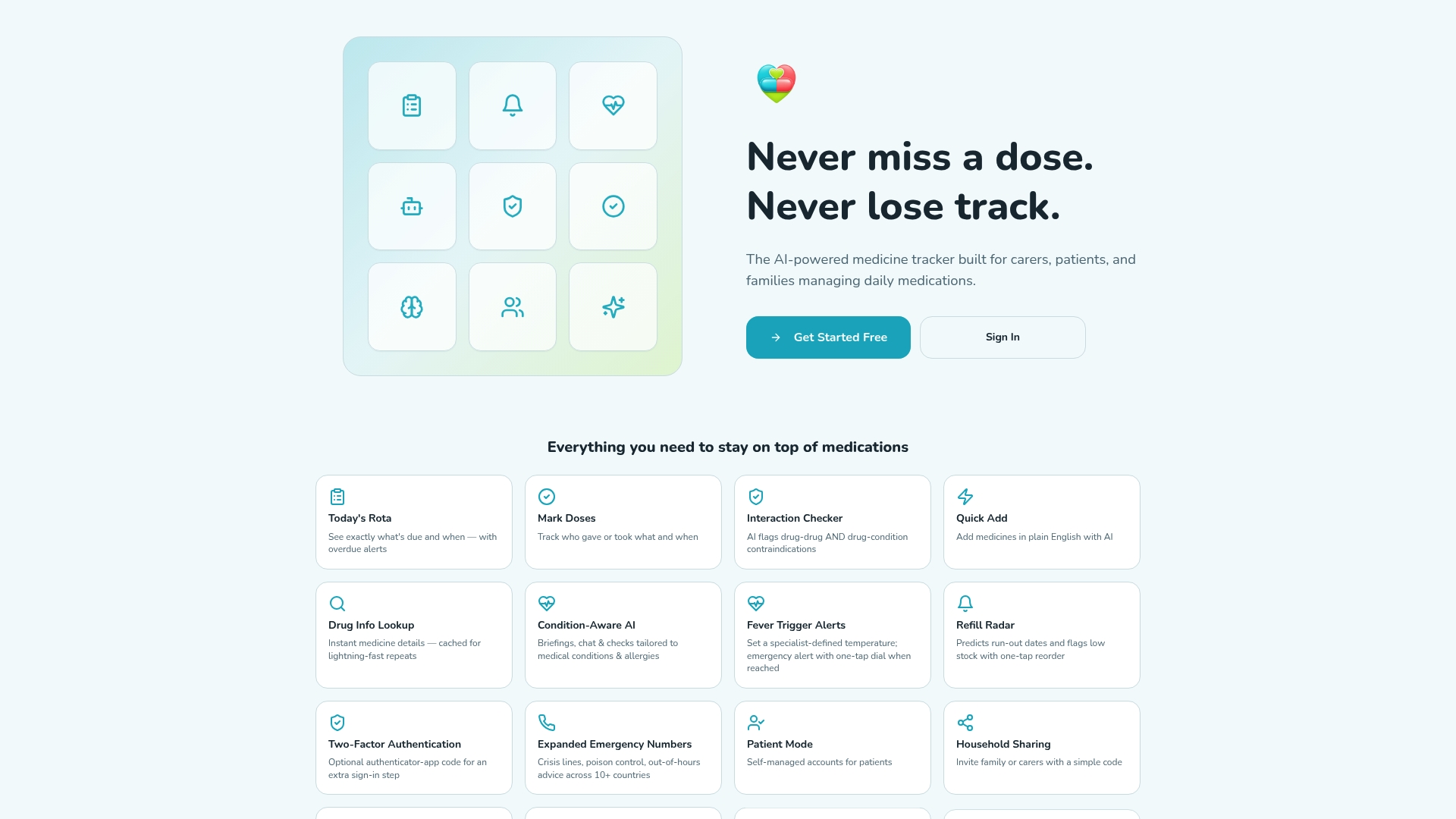
A sensible pilot runs for four to six weeks on a single ward or care pathway. Track three numbers throughout: reconciliation completeness at discharge, missed-dose incidents flagged by the alert system, and carer or patient satisfaction with how clearly changes were communicated. Three features do most of the work against the checklist built through this guide: the shared, editable list that solves the single-source-of-truth problem, drug interaction checks that catch what a rushed handover might miss, and household sharing that puts carers inside the communication loop rather than outside it.
If your team is ready to test this against a real caseload, visit the Daily Dose Tracker platform to start a trial and set up your first shared medication list.