

What is patient-centred medication planning?
Patient-centred medication planning is a collaborative, individualised process where healthcare professionals work directly with patients and caregivers to align medication regimens with personal health goals, daily routines, and clinical needs. Rather than prescribing in isolation, clinicians and pharmacists assess each person's circumstances before agreeing on a plan that the patient genuinely understands and accepts.
The core elements that define this approach:
- Appropriateness: Every medication is reviewed for clinical fit relative to the individual's conditions and other treatments.
- Effectiveness: The plan targets outcomes that matter to the patient, not just to the prescriber.
- Safety assessment: Drug interactions, dosing risks, and contraindications are checked systematically.
- Patient understanding: The person receiving care can explain why they are taking each medicine and what to expect.
- Shared agreement: No medication is added or removed without the patient's informed consent.
Caregivers are not passive observers here. They contribute context that clinicians rarely see in a ten-minute appointment, from missed doses to side effects that a patient may not think to mention.
Key principles that guide person-centred prescribing
The principles of person-centred practice for prescribing rest on a shift in clinical conversation: from "What is wrong with you?" to "What matters to you?" That single reframe changes which outcomes get prioritised and which trade-offs feel acceptable to the patient.
- Active collaboration: Decisions are made with patients, not for them, using shared decision-making at every stage.
- Whole-person consideration: Clinical, emotional, and social needs all shape the plan, not just the diagnosis.
- Caregiver involvement: Informal carers are included in discussions and treated as partners, not bystanders.
- Continuity: Plans are reviewed regularly, with clear handover between care settings.
- Transparent communication: Patients receive honest, accessible information about benefits, risks, and alternatives.
Pro Tip: Ask patients to describe their typical day before discussing medication timing. Aligning doses with existing habits, such as a morning cup of tea or a lunchtime break, dramatically reduces missed doses.
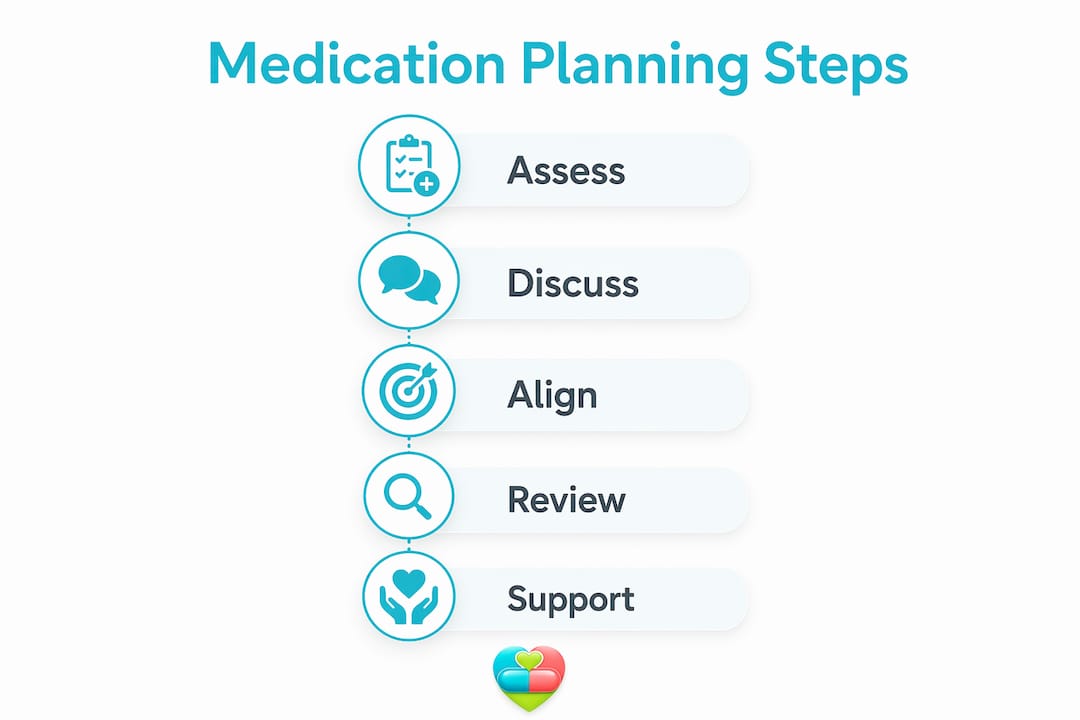
How patient-centred planning improves safety and adherence
Linking medication benefits to personal daily goals produces better adherence than clinical rationale alone. A patient who understands that their antihypertensive protects their ability to walk their grandchildren to school is far more likely to take it consistently than one who was simply told their blood pressure is high.
- Reduced prescribing errors: Systematic review of the full medication list catches duplications, interactions, and inappropriate doses before they cause harm.
- Improved adherence: When patients are involved in setting goals, they take ownership of the plan.
- Fewer hospital admissions: Ongoing monitoring and patient involvement reduce avoidable deterioration and medication-related complications.
- Lower healthcare costs: Deprescribing unnecessary medicines and preventing adverse events saves resources across the system.
- Higher satisfaction: Patients who feel heard report better experiences, which itself correlates with better self-management.
The NHS's Structured Medication Review framework reflects this evidence, embedding patient-centred goals into routine pharmacy consultations across primary care in England.
What makes implementation genuinely difficult?
The barriers to adopting patient-centred practices are structural as much as they are attitudinal. Knowing the principles is not enough if the system is not set up to support them.
- No universal definition: Without a shared understanding of what patient-centred medication planning means in practice, quality varies widely between clinicians and settings.
- Volume-based payment models: Fee-per-consultation structures reward throughput, not the time-intensive work of collaborative planning.
- Time constraints: A thorough medication review with a complex patient can take 45 minutes or more. Most GP appointments do not allow for that.
- Health literacy gaps: Patients who struggle to read or process medical information cannot participate meaningfully without additional support.
- Caregiver access: Carers who cannot attend appointments in person are often excluded from decisions that directly affect the people they support. Guidance on common caregiver access barriers highlights how systemic gaps compound this problem.
How multidisciplinary teams can collaborate more effectively
Involving patients and families authentically is a clinical strategy for reducing medication errors, not a courtesy. The evidence is clear: partnership reduces harm. The question is how to build it into everyday practice.
- Engage all relevant providers: GPs, pharmacists, nurses, and social care workers should contribute to and review the same medication plan, not maintain separate records.
- Build trust with patients: Pharmacists who take time to understand a patient's concerns, rather than simply checking compliance, create the conditions for honest disclosure.
- Use shared documentation: A single, accessible medication record reduces the risk of conflicting advice from different parts of the care team.
- Include caregivers in reviews: Where possible, invite the person's primary carer to structured medication reviews. Their observations often reveal adherence patterns that clinical data misses. The role of carers in medication management is well-documented and frequently underused.
- Agree on follow-up: Every review should end with a clear plan for when and how progress will be assessed.
Tools and technologies that support medication planning in practice
Digital platforms and structured clinical methods have made medication management more consistent and less dependent on memory or paper records.
- Brown bag medication reviews: Patients bring every medicine they take to an appointment, including supplements and over-the-counter products. This method reveals actual usage patterns and uncovers discrepancies that a prescription record alone would miss.
- Thedailydosetracker: This UK-based platform supports carers, patients, and clinical teams with real-time dose logging, drug interaction checks, refill predictions, and emergency contact integration. It complies with UK GDPR standards and works across multiple devices, making it practical for both home and clinical settings.
- Telemedicine and patient portals: Virtual consultations extend access to structured reviews for patients who cannot attend in person, particularly those with mobility limitations or complex care needs.
- AI-based personalised interventions: AI tools can analyse medication history and flag patterns, such as recurring missed doses at specific times, that prompt targeted support rather than generic reminders.
Pro Tip: Thedailydosetracker's household sharing feature lets multiple carers monitor the same patient's medication schedule simultaneously, reducing the risk of double-dosing or missed alerts during shift handovers.

Why health literacy shapes every medication plan
A medication plan is only as good as the patient's ability to act on it. Low health literacy is one of the most consistent predictors of poor adherence, yet it is routinely underestimated in clinical settings because patients rarely volunteer that they have not understood their instructions.
Effective patient education goes beyond handing over a leaflet. It means checking understanding using the teach-back method, where the patient explains the plan back in their own words, and adjusting the explanation until the information lands clearly. Written materials should use plain language, large print where needed, and visual aids for complex regimens. For patients whose first language is not English, translated resources and interpreter support are not optional extras. Addressing medication self-administration directly, including how to open packaging, store medicines correctly, and recognise side effects, closes the gap between a well-designed plan and one that actually gets followed.

Examples of patient-centred medication planning in practice
In NHS primary care, Structured Medication Reviews conducted by clinical pharmacists have demonstrated how aligning medicines to patient goals reduces polypharmacy and improves quality of life for older adults with multiple long-term conditions. A patient managing type 2 diabetes, heart failure, and arthritis might have their regimen simplified after a review that prioritises what they most want to protect: independence and pain control.
In community pharmacy, personalised care planning has shown that pharmacists who shift from telling patients what to do toward asking what matters to them generate more honest conversations about adherence difficulties. A patient who admits they skip their evening dose because it causes nausea can then be offered a timing adjustment or an alternative formulation, rather than simply being recorded as non-compliant.
Legal and ethical considerations in medication decision-making
The Mental Capacity Act 2005 sets the legal framework for medication decisions in England and Wales. Clinicians must assume a patient has capacity unless there is evidence otherwise, and any decision made on behalf of a person who lacks capacity must reflect their best interests and previously expressed wishes. Informed consent is not a signature on a form. It requires that the patient has received sufficient information, understood it, and agreed without coercion.
Shared decision-making also carries an ethical obligation of honesty. Presenting only the benefits of a medicine while downplaying risks undermines the patient's ability to make a genuine choice. The Montgomery ruling (2015) reinforced this in UK law, establishing that clinicians must disclose any risk a reasonable patient would consider significant, not just those the clinician deems material.
How to evaluate whether patient-centred medication planning is working
Measuring effectiveness requires looking beyond clinical markers. A patient whose blood pressure is controlled but who reports feeling unheard and confused about their medicines has not benefited fully from a patient-centred approach.
Useful evaluation methods include:
- Medication adherence tools: Validated instruments such as the Morisky Medication Adherence Scale provide a structured way to assess whether patients are taking medicines as planned.
- Patient-reported outcome measures (PROMs): These capture quality of life, symptom burden, and satisfaction in the patient's own terms.
- Medication error rates: Tracking adverse drug events and near-misses before and after implementing structured reviews quantifies safety improvements.
- Deprescribing rates: A reduction in inappropriate polypharmacy is a concrete indicator that reviews are identifying unnecessary medicines.
- Follow-up completion rates: Whether patients attend or engage with planned reviews reflects how well the process has been designed around their lives, not just clinical schedules.
Key takeaways
Patient-centred medication planning works when it treats the patient as the expert on their own life and the clinician as the expert on the medicine, then builds the plan at the intersection of both.
| Point | Details |
|---|---|
| Collaboration is the foundation | Effective plans require input from patients, caregivers, and multidisciplinary teams at every stage. |
| Linking goals to medicines improves adherence | Patients who understand how a medicine supports their personal priorities are more likely to take it consistently. |
| Structural barriers require systemic solutions | Volume-based payment models and time constraints undermine patient-centred practice regardless of individual clinician intent. |
| Digital tools extend reach | Platforms like Thedailydosetracker support real-time monitoring, interaction checks, and carer coordination across devices. |
| Evaluation must include patient-reported outcomes | Clinical markers alone do not capture whether a medication plan is genuinely working for the person taking it. |