

AI can lift medication adherence by a meaningful margin in controlled trials, particularly when chatbots or voice agents combine reminders with education and real-time question answering rather than just pinging a reminder alert. The gains are real but uneven: pooled effects are moderate, individual trial results vary, and much of the evidence carries a moderate-to-high risk of bias. For clinicians and researchers, the sensible next step is to look past the marketing and check the trial design, the integration model, and whether a clinician stays in the loop.
TL;DR:
- Multi-function chatbots combining reminders, education, and real-time interaction show the strongest evidence for improving medication adherence, with effects up to 32.7%.
- Reminder-only apps are easier to implement but generally yield weaker adherence improvements compared to interactive, multi-function tools.
- AI tools' helpfulness varies based on integration quality, user literacy, data quality, and transparency, with predictive risk models needing further validation.
- Validating clinical claims, ensuring interoperability, and involving clinicians in review processes are critical steps before adopting AI medication tools.
- Long-term studies and head-to-head comparisons with human-reviewed interventions are needed to solidify AI's role in medication management.
Table of Contents
- What is AI medication management, and where is it already used?
- How strong is the evidence for AI-driven adherence tools?
- How does the technology actually work under the hood?
- What does safe clinical integration actually require?
- What are the real risks, and how does AI handle patient trust?
- How should you evaluate an AI medication tool before adopting it?
- How The Daily Dose Tracker fits these evaluation criteria
- Where the evidence is strongest, and where researchers should focus next
- Try The Daily Dose Tracker as your evaluation pilot
- Sources
What is AI medication management, and where is it already used?
AI medication management refers to software that uses machine learning, natural language processing, or predictive modelling to support how patients take, and clinicians monitor, prescribed drugs. It is not a single product category. It spans everything from a chatbot that nudges a patient about a missed dose to a hospital dashboard flagging a dangerous drug interaction before a pharmacist signs off on a script. The unifying thread is automated adherence and safety support that goes beyond a static alarm clock.
Five use cases dominate current deployment, each solving a slightly different problem.
Patient-facing conversational tools. Chatbots, voice assistants and mobile apps handle reminders, answer medication questions, and deliver condition-specific education. These are the most mature category and the one with the strongest trial evidence, largely because they are cheap to deploy and easy to measure against a control group.
Adherence monitoring systems. Smart pill dispensers, ingestible sensors, and pharmacokinetic tools estimate whether a dose was actually taken, not just whether a reminder was sent. This distinction matters for research: self-reported adherence and dispenser-confirmed adherence often diverge, and reviewers treat sensor-derived data as more reliable evidence.

Predictive risk models. Machine learning models trained on prescription refill patterns, demographic data, and prior non-adherence flags can estimate which patients are likely to fall off a regimen before it happens. Predictive stratification lets care teams target scarce follow-up resources at higher-risk patients instead of treating every patient identically.
Clinical decision support for interactions and deprescribing. These systems scan a patient's full medication list against interaction databases and flag polypharmacy risks, duplicate therapies, or drugs that no longer suit an ageing patient. A narrative review on AI in older-adult medication management found machine learning models being used specifically to detect potentially inappropriate medications and support deprescribing decisions, an area where manual chart review is slow and error-prone.
EHR connectors and clinician dashboards. Rather than standalone apps, these tools sit inside the electronic health record, surfacing adherence data, interaction warnings and refill status directly in a clinician's existing workflow. This is arguably the least glamorous category and the one implementation research consistently points to as the difference between a pilot that fizzles and one that sticks.
A few patterns are worth flagging for anyone evaluating these tools:
- Reminder-only apps are the easiest to build and the weakest performers on their own.
- Voice-based interfaces show particular promise for patients with low digital literacy or visual impairment.
- Sensor-based monitoring is more accurate than self-report but adds cost and patient burden.
- Predictive models need a large, representative dataset to avoid skewed risk scores for underrepresented patient groups.
- Interaction-checking tools are only as good as the drug database behind them, so update frequency matters.
For household carers managing several people's medications, the practical entry point is usually the first category: reminders paired with basic education, delivered through a device the patient already uses. Our guide on the role of reminders in patient health covers how that foundation works before layering in anything more sophisticated.
How strong is the evidence for AI-driven adherence tools?
The honest answer: promising but patchy. A systematic review and meta-analysis published in PLOS Digital Health pooled data on AI-based chatbots used with patients managing non-communicable chronic diseases and found a pooled standardised mean difference of 0.69 (95% CI: 0.17 to 1.22) in favour of chatbot-supported adherence. That is a moderate effect by conventional statistical benchmarks, and the confidence interval is wide enough to signal real variation between the underlying studies.
The evidence in numbers: Meta-analytic pooling shows chatbots produce a moderate adherence benefit, while individual trials report improvements ranging from roughly 6.7% to 32.7% depending on the intervention and how adherence was measured.
That range is worth sitting with. A focused review in Frontiers in Digital Health gathering trial and cohort evidence on AI-based patient support tools found adherence improvements spanning from about 6.7% at the low end to 32.7% at the high end. One trial cited in that review, testing a voice-based app supporting insulin adherence, reported the 32.7% figure against standard care. That is a striking single-trial result, but reviewers are careful to flag it as exactly that: one trial, not a settled fact about voice apps generally.
The heterogeneity across this evidence base comes from several sources. Trials differ in how they define and measure "adherence" (pill counts, refill rates, self-report, sensor data), in patient population (chronic disease type, age, digital literacy), and in intervention design (single-function reminder versus multi-function chatbot). Reviewers pooling these studies consistently flag moderate-to-high risk of bias, driven by small sample sizes, short follow-up periods, and inconsistent blinding, which is difficult to achieve when the intervention is a visible app.
What does hold up across reviews is a consistent subgroup finding: multi-function tools beat single-function ones. The PLOS Digital Health meta-analysis found that chatbots combining reminders combined with patient education and real-time question-answering generally outperformed tools that only sent reminders. That is not a marginal distinction. It suggests the mechanism doing the work is not the nudge itself but the interactive support around it, which lines up with a broader point in the intervention literature: passive reminders alone tend to underperform against approaches that layer in something closer to coaching.
A few evidence gaps deserve honest acknowledgement:
- Long-term adherence data beyond six to twelve months is scarce across almost all reviewed trials.
- Predictive risk models for non-adherence are validated less rigorously than reminder or chatbot interventions.
- Most trials were conducted in high-income health systems, limiting generalisability to lower-resource settings.
- Direct comparisons between AI tools and structured non-AI interventions (like pharmacist phone calls) remain rare.
None of this means the technology doesn't work. It means the effect is real, moderate, concentrated in interactive multi-function tools, and still resting on a thinner evidence base than the marketing copy around many products would suggest.
How does the technology actually work under the hood?
Two broad architectures sit behind most tools on the market, and knowing the difference helps you interrogate a vendor's claims rather than take them on faith.
Rule-based systems operate on fixed logic: if a dose window passes without confirmation, send an alert; if drug A and drug B appear together on a medication list, flag a known interaction from a reference database. These systems are predictable, auditable, and relatively easy to validate, because their behaviour is explicit and testable line by line.
Machine learning and large language model (LLM) approaches learn patterns from data rather than following pre-written rules. A predictive adherence model might train on historical refill timing, appointment attendance, and demographic variables to estimate a patient's risk of lapsing. A conversational chatbot built on an LLM generates responses dynamically rather than pulling from a fixed script, which is what allows it to handle the messy, open-ended way patients actually ask questions about their medication.
Most production tools blend the two: rule-based logic for anything safety-critical (interaction alerts, dosage thresholds), with ML or LLM components layered on top for adherence prediction and conversational interfaces. That hybrid design is deliberate. Purely generative systems are harder to guarantee will never produce an unsafe answer, so critical safety checks tend to stay rule-based even in otherwise AI-forward products.
The data inputs feeding these systems typically include:
- Prescription and refill history pulled from pharmacy systems or self-reported logs.
- Patient-reported symptom and dose-taken data entered through an app.
- Structured drug interaction databases, updated on a regular cycle by the vendor.
- Free-text clinical notes processed with natural language processing (NLP) to extract medication mentions.
- Scanned prescription labels or packaging read via optical character recognition (OCR).
On the algorithm side, gradient-boosted models like XGBoost are common for adherence risk scoring because they handle mixed data types well and produce interpretable feature importance scores, something a clinician can actually query ("why did this patient score high risk?"). NLP models extract medication names and dosing instructions from unstructured text, while OCR handles the more mundane but genuinely useful task of reading a paper prescription or pill bottle label into structured data.
Pro Tip: When a vendor claims their system uses "AI-powered predictions", ask specifically whether that means a rule-based algorithm, a trained ML classifier, or an LLM. The answer changes how much clinical validation the claim needs before you can trust it.
The explainability challenge is real and worth taking seriously. A rule-based interaction alert can show its working: drug X plus drug Y triggers rule Z. A machine learning risk score is harder to unpack, and an LLM-generated response harder still. This is not a minor technical footnote. It is the single biggest reason clinical trust in predictive features lags behind trust in simpler reminder functions.
What does safe clinical integration actually require?
Bolting an AI tool onto existing care without a plan is how good pilots become abandoned pilots. Safe integration means treating the tool as a clinical intervention, not a consumer gadget.
-
Validate the clinical claims before rollout. Ask the vendor for published trial data, not marketing statistics, and check whether that data was peer-reviewed. Confirm any regulatory status the product claims (medical device classification, if applicable) and what that status actually covers.
-
Build in clinician-in-the-loop review. No AI-generated adherence risk score or interaction flag should trigger an automatic clinical action without a human checkpoint. Design an escalation path: who reviews high-risk flags, on what timeline, and what happens if nobody responds within that window.
-
Get data governance right from day one. Under UK GDPR, this means clear patient consent for data use, data minimisation (collecting only what the tool genuinely needs), and an audit trail showing who accessed what and when. Retrofitting governance after launch is far harder than designing it in from the start.
-
Train staff and onboard patients and carers properly. A tool that a pharmacist doesn't trust, or a patient doesn't understand, won't get used regardless of how good its underlying model is. Onboarding should cover what the tool does, what it doesn't do, and how to raise a concern.
-
Define pilot metrics before you start, not after. Adherence rate change, time-to-flag-response, false alert rate, and user drop-off are more useful pilot metrics than vague satisfaction surveys. Set a review date at three months, not "whenever it feels finished."
Pro Tip: Run your pilot alongside a matched comparison group still using standard care, even informally. Without that comparison, you cannot tell whether an adherence improvement came from the tool or from the extra attention a pilot naturally generates.
Interoperability deserves specific attention here. A tool that cannot connect to existing electronic health records forces double data entry, and double entry is where good intentions die in busy clinics. A practical guide to aligning care plans with medication records covers what that alignment looks like in day-to-day practice, which is worth reading before committing to any platform. It's also worth checking how a tool fits alongside broader primary care digital infrastructure. Services like myGPapp, which handles online GP appointment booking and digital triage, illustrate the direction general practice is already moving: patients expect their medication tools to talk to the same digital ecosystem as their appointment booking and clinical records, not sit in isolation.
Implementation research consistently points to one finding above all others: standalone apps underperform tools embedded in existing clinical workflow with a clinician genuinely involved in reviewing output. The technology is rarely the limiting factor. The workflow around it usually is.
What are the real risks, and how does AI handle patient trust?
The benefits are genuine but bounded. Multi-function chatbots reduce the routine burden on clinical staff for basic medication questions, freeing pharmacist and nurse time for cases that actually need clinical judgement. Predictive risk stratification lets care teams focus limited follow-up capacity where it's likely to matter most, rather than spreading attention evenly across a patient list regardless of risk.
But the risks sit close behind the benefits, and glossing over them does readers no favours.
- Bias in predictive models. A risk model trained predominantly on one demographic can produce skewed risk scores for patients outside that training population, systematically under- or over-flagging certain groups.
- False alerts and alert fatigue. Interaction-checking systems that flag every theoretical risk, regardless of clinical significance, train clinicians to ignore alerts altogether, which defeats the purpose.
- Reduced human contact. A chatbot that successfully handles routine adherence questions can inadvertently reduce the informal check-ins where clinicians catch problems the technology wasn't built to notice.
- Over-reliance on automated flags. Predictive scores are probabilistic estimates, not diagnoses, and treating them as certainties invites errors of a different kind than the ones they're meant to prevent.
Patient trust is conditional, not automatic: survey data on AI in medication adherence found many patients support AI-driven reminders and educational features, but support is noticeably lower for predictive functions, with privacy and technical reliability cited as the main concerns.
That gap between reminder acceptance and predictive-feature acceptance is not a marketing problem to smooth over. It reflects a genuine and reasonable patient instinct: a reminder is transparent (you can see exactly what it does), while a predictive risk score is opaque unless the system explains its reasoning. Transparency and explainability are not nice-to-haves here. They are the mechanism by which predictive features earn the trust that reminder features already have.
Practical mitigation is achievable without abandoning predictive capability. Local validation against your own patient population before trusting a vendor's stated accuracy figures, transparent explanations of how a risk score was generated (even a simplified one), and keeping a clinician as the final decision-maker on anything that affects care all reduce these risks meaningfully. Under GDPR, patients also have a right to understand how automated decisions affecting them are made, which makes explainability a compliance issue as much as a trust issue.
How should you evaluate an AI medication tool before adopting it?
Selecting a tool without a structured checklist means falling back on whichever vendor has the slickest demo. Here's a more defensible process.
-
Request the clinical evidence directly. Ask for peer-reviewed trial data specific to the product, or at minimum for the class of intervention it belongs to, and check the sample size and follow-up length before accepting any adherence improvement claim at face value.
-
Check regulatory status precisely. Confirm whether the product is classified as a medical device in your jurisdiction, and understand exactly what that classification does and doesn't guarantee about safety testing.
-
Test EHR interoperability before committing. Ask for a technical demonstration of data flowing both directions between the tool and your existing electronic health record, not just a promise that it "integrates."
-
Confirm data portability. Can medication history and adherence records be exported in a usable format if you switch tools later, or does switching mean losing historical data?
-
Assess accessibility for older adults and multi-user households. Look for adjustable font sizes, voice interfaces, and genuine support for one household managing multiple patients' medications, not just multiple logins bolted onto a single-patient design. Our elderly medication management checklist covers the specific features that matter most for this group.
-
Define pilot success metrics contractually, before signing anything. Agree in writing what "success" looks like (adherence rate change, alert response time, user retention) and at what point in the pilot you'll review those numbers.
-
Clarify pricing structure and lock-in terms. Understand what's included in any free tier versus what requires a paid upgrade, and whether contracts require long commitments before you've proven clinical value in your own setting.
Running through this list before a demo call, rather than during it, changes the entire conversation. Vendors answer specific questions about evidence and interoperability very differently than they answer "tell me about your product."
How The Daily Dose Tracker fits these evaluation criteria
Thedailydosetracker was built around exactly the checklist above, rather than retrofitted to match it after the fact. For carers and care teams managing more than one patient, several features map directly onto what clinical evaluation demands.
- Drug interaction and condition-specific checks flag risks automatically as medications are added, rather than relying on a carer to remember every combination.
- Refill prediction reduces the adherence gaps that happen simply because a prescription ran out before anyone noticed.
- Household sharing and multi-patient management let one account coordinate medications across several family members, a genuine gap in tools designed around a single patient.
- Accessibility controls, including dark mode and adjustable font sizes, support older patients and carers with visual impairment.
- UK GDPR compliance covers the data governance requirements clinical adoption checklists rightly demand.
- Medication history export supports the data portability question any serious evaluation should ask before adoption.
Three pilot scenarios suit this kind of platform particularly well. Home-care coordination, where a family carer manages medications for an elderly relative and needs real-time alerts rather than relying on memory. Multi-patient households, common in families caring for both children and elderly parents simultaneously, where separate single-patient apps become unmanageable. And pharmacist-assisted medication reviews, where exported medication history and logged adherence data give a pharmacist a clearer picture than a verbal recap at a review appointment.
For implementation, the practical notes are straightforward: exported data supports handover to a GP or pharmacist for a formal review, clinician oversight remains a manual step rather than an automated one, and expected pilot metrics should track dose logging consistency and refill alert response time over a defined period, typically four to eight weeks, before judging results.
Where the evidence is strongest, and where researchers should focus next
The strongest evidence right now sits with multi-function chatbots and voice agents that combine reminders, education and real-time interaction, not with predictive risk models or standalone reminder apps. That's a narrower claim than most vendor pitches make, and it's the one worth holding onto.
What the field genuinely needs is longer trials. Six to twelve months of follow-up, at minimum, and head-to-head comparisons between AI tools and structured human interventions like pharmacist phone calls, not just AI versus doing nothing. Predictive adherence models in particular need validation against diverse patient populations before anyone should trust a risk score applied outside the group it was trained on.
For anyone running a pilot: track adherence via objective measures where possible, not self-report alone, and hold clinician review as a fixed step rather than an occasional check. The technology augments judgement. It doesn't yet replace it, and the trial evidence doesn't support pretending otherwise.
Researchers and clinicians who want to contribute to that evidence base, rather than just consume it, should treat every pilot as a small trial worth documenting properly, and share what they learn.
— Prasant
Try The Daily Dose Tracker as your evaluation pilot
Rather than committing to a lengthy procurement process before you know whether a tool fits your household or care setting, Thedailydosetracker lets you start on the free tier and only pay once you need the advanced features a genuine pilot requires.
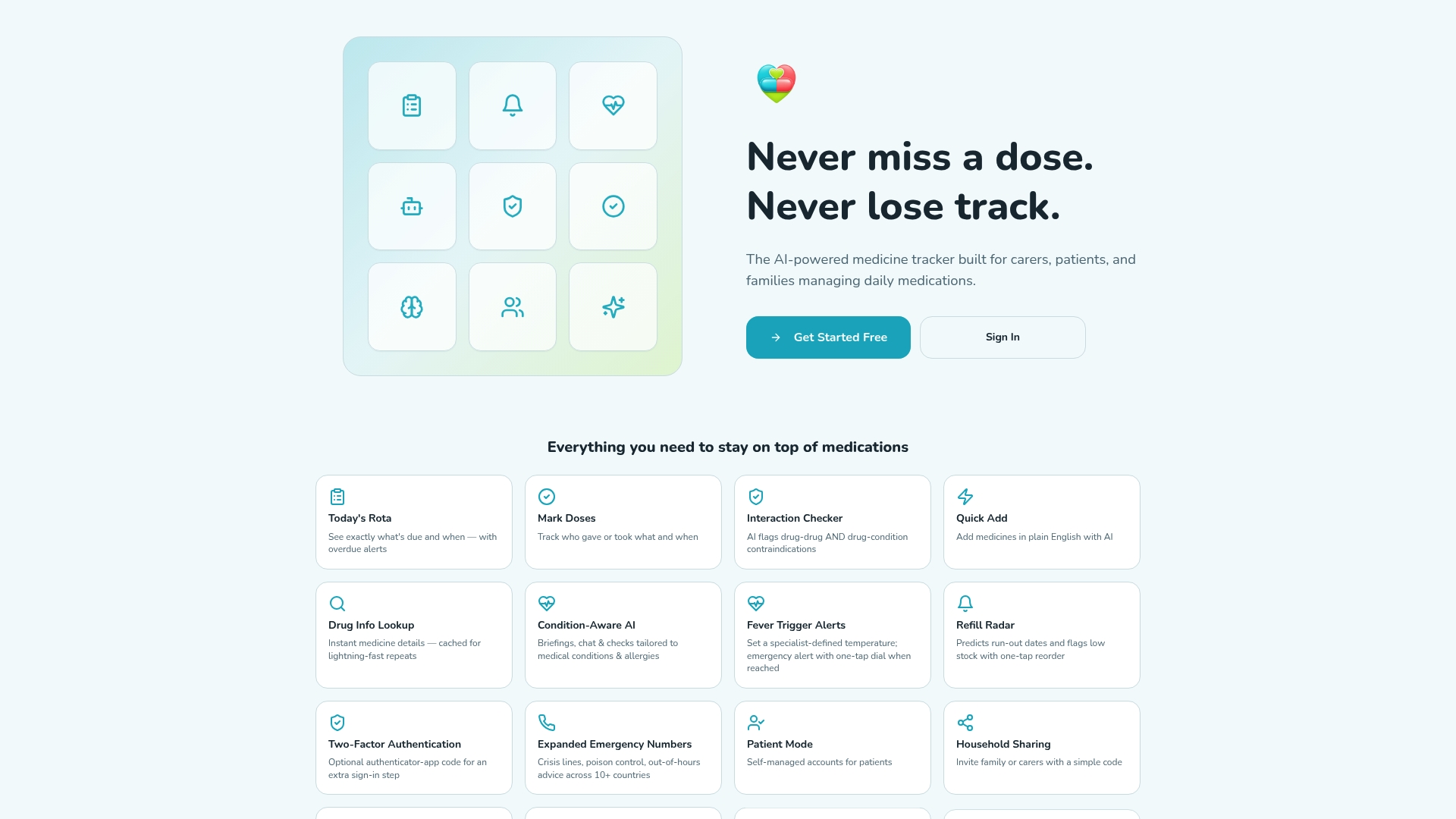
The free tier covers core scheduling, dose logging and basic reminders, enough to test whether the interface suits your patients or family members. Upgrading to the Individual or Pro subscription unlocks drug interaction checks, refill prediction, appointment scheduling, and multi-patient household management, the features most relevant to the evaluation criteria covered above. A sensible pilot runs four to six weeks: set up one patient's full medication list, track dose-logging consistency, and note how quickly refill alerts fire before a prescription actually runs out. If you're managing medications across several family members or supporting an ageing relative, the household sharing and multi-patient features are worth testing directly rather than taking on faith. For more detail on setting up reminders that actually get followed, the guide on what a daily medication reminder should do is a useful starting point before you build out a full schedule.
This article is general information, not a substitute for advice from a qualified doctor. Consult a qualified healthcare professional about your own circumstances before acting on anything here.
Sources
- Artificial intelligence–based chatbots to enhance medication adherence among patients with non-communicable chronic diseases: Systematic review and meta-analysis | PLOS Digital Health
- Artificial Intelligence in Medication Management for Older Adults in Low‑ and Middle‑Income Countries: A Narrative Review