

Adopt a five-step, team-based medicines reconciliation process — verify, clarify, reconcile, make clinical decisions, communicate — and embed it into your clinical workflow as a single shared "one source of truth." That is the core of what NICE medicines optimisation guidance (NG5) and CQC medicines governance expectations require of every UK care setting. Two things you can do right now: confirm who holds the authoritative medication list for this shift, and ask the patient or their carer to produce their medication containers or a written list before any prescribing decision is made.
The five steps at a glance:
- Verify — collect the best possible medication history (BPMH) from the patient, carer, community pharmacy, GP record and any patient-held list
- Clarify — confirm doses, formulations, routes and clinical appropriateness for each medicine
- Reconcile — compare the BPMH against current prescriptions and identify every discrepancy
- Decide — make a clinical judgement on each discrepancy: continue, stop, change or query
- Communicate — update the shared record and hand the reconciled list to the patient, carer and next care team
Table of Contents
- What does a medication reconciliation best-practice workflow look like?
- Who should do reconciliation, and when does it need to happen?
- What information belongs on the reconciled medicines list?
- How do you make reconciliation records auditable and governance-ready?
- What are the most common discrepancies and how do you fix them?
- Which digital tools genuinely reduce reconciliation errors?
- How does an integrated platform support each reconciliation step?
- Admission, transfer and discharge: a practical reconciliation checklist
- Key takeaways
- What actually changes when you implement this on a ward
- Thedailydosetracker: a practical platform for medicines reconciliation teams
- Authoritative UK sources and further reading
What does a medication reconciliation best-practice workflow look like?
A structured, numbered process removes the reliance on memory that causes most reconciliation failures; a clear Medication Side Effect Search can also help teams confirm drug interactions and warnings during reconciliation. The AHRQ MATCH toolkit is explicit on this: create one medication list, standardise roles, and embed prompts into the workflow rather than treating reconciliation as a separate administrative task.
- Collect the BPMH. Ask the patient directly, then verify with at least one independent source — community pharmacist, GP summary, discharge letter, or patient-held list. Ask specifically about OTC medicines, herbal remedies, vitamins, inhalers, eye drops and topical agents; these are the items most frequently omitted. Requesting that patients bring their medication containers to the appointment materially improves capture of these items.
- Clarify each medicine. For every item on the BPMH, confirm: generic name, strength, formulation, dose, frequency, route, indication, and when it was last taken. Flag any medicine where the dose or route differs between sources.
- Reconcile against current orders. Place the BPMH alongside the current inpatient or outpatient prescription. Document every discrepancy — omission, duplication, dose error, wrong route, or allergy mismatch — in the shared record before any prescribing decision is made.
- Make a clinical decision on each discrepancy. The prescriber (or pharmacist under a patient group direction) decides: continue unchanged, adjust, withhold, or stop. Document the rationale. For high-risk medicines — anticoagulants, insulin, opioids, antiepileptics — escalate unresolved discrepancies immediately rather than deferring to the next round.
- Communicate the reconciled list. Update the shared record in real time. Give the patient and carer a written copy. Transmit the list to the next care team at every transition: intra-hospital transfer, discharge to community, or referral.
A short example illustrates step three in practice. A patient admitted with a hip fracture lists co-codamol 30/500 as a regular home medicine. The admission prescription omits it entirely. The reconciling pharmacist catches the omission, queries whether the surgical team intends to withhold it post-operatively, and documents the decision. Without that step, the patient either receives no analgesia or receives a duplicate opioid prescribed by a different team.
Pro Tip: During a busy ward round, run the reconciliation check before the prescriber reaches the patient's bedside — not after. A pharmacist or pharmacy technician who has already compared the BPMH against the current chart can present discrepancies as a brief verbal summary at the start of the consultation, so clinical decisions are made on reconciled information from the outset.
Who should do reconciliation, and when does it need to happen?
NICE NG5 is clear that medicines reconciliation is a multidisciplinary responsibility. Pharmacists often lead, but nurses and doctors share both the tasks and the accountability. A table maps tasks to professional groups and defines escalation paths.

| Task | Primary owner | Escalation |
|---|---|---|
| Obtain BPMH on admission | Pharmacist or pharmacy technician | Nurse if pharmacy not immediately available |
| Verify BPMH against GP/pharmacy record | Pharmacist | Doctor if pharmacist unavailable |
| Identify and document discrepancies | Pharmacist or pharmacy technician | Nurse to flag; doctor to resolve |
| Make clinical decision on discrepancy | Prescriber (doctor or non-medical prescriber) | Senior clinician or on-call team |
| Update shared medication record | Any verifying clinician | Ward pharmacist to confirm |
| Communicate list at discharge | Doctor (discharge summary) + pharmacist (medication profile) | Ward manager if neither available |
| Carer/patient verification | Patient, family carer, or named carer | Social prescriber or community nurse |
Timing is where many trusts fall short. NICE quality statement 4 sets the expectation that medicines reconciliation in acute settings should be completed within a day of admission, or sooner when clinically necessary. High-risk medicines — anticoagulants, lithium, methotrexate, insulin — should be reconciled as a priority within the first hours, not left until the next pharmacy round.
Timing callout: NICE quality statement 4 advises that reconciliation in acute settings should be completed within a day of admission. For high-risk medicines, local policy should set a shorter window, typically within hours.
In primary care, reconciliation should occur at the first post-discharge consultation, ideally within one week of discharge. For intra-hospital transfers, the receiving ward should confirm the reconciled list within the first clinical contact, not assume the sending ward's list is current.
Pro Tip: When a high-risk discrepancy cannot be resolved immediately — for example, a patient on warfarin whose INR history is unavailable — document it as an open discrepancy with a named owner and a resolution deadline. An unresolved discrepancy with a named clinician responsible for it is far safer than one that disappears into a handover note.
What information belongs on the reconciled medicines list?
A reconciled list is only as useful as it is complete. The Welsh national standards for medication review specify that the history must include all medicines the patient actually takes, not only those prescribed.
Core fields for every medicine:
- Generic name (brand name in brackets where clinically relevant, e.g. modified-release formulations)
- Strength and formulation
- Dose, frequency and route
- Indication (brief, e.g. "for blood pressure")
- Date last taken and whether the patient is actually taking it as prescribed
- Source of information (patient, carer, community pharmacist, GP record, discharge summary)
- Name and role of the clinician who verified the entry
Items to prompt for explicitly:
- OTC analgesics, antihistamines and antacids
- Herbal and complementary medicines (St John's Wort is the classic interaction risk)
- Vitamins and mineral supplements
- Topical agents: creams, patches, gels
- Inhalers and nebuliser solutions
- Eye drops and ear drops
- Contraceptives (oral, patch, implant, intrauterine)
- Medicines prescribed by a specialist but not on the GP record
| Field | Why it matters |
|---|---|
| Adherence status | Prescribed ≠ taken; knowing missed doses prevents over-treatment |
| Last taken | Critical for timing of next dose, especially anticoagulants and insulin |
| Intended plan (continue/stop/change) | Prevents unintentional continuation or cessation at discharge |
| Evidence source | Medicolegal clarity; supports audit trail |
| Allergy and ADR status | Must be cross-referenced at every transition |
For patients who self-manage, asking them to bring containers or a photograph of their medication shelf is one of the most reliable ways to capture items they would not think to mention. Carers often hold this information more accurately than the patient themselves — a point the NCBI Bookshelf guidance on medication reconciliation makes explicitly: patients and carers are frequently the most reliable source for what is actually taken versus what is prescribed.

The intended plan for each home medicine — continue, stop, change, or withhold pending review — must be documented before discharge. Leaving this blank is one of the most common causes of post-discharge medication errors.
How do you make reconciliation records auditable and governance-ready?
Good records do two things: they protect the patient and they protect the team. CQC inspections of medicines governance look for evidence that reconciliation is happening systematically, not just when a pharmacist happens to be available.
Governance essentials:
- A designated organisational lead for medicines reconciliation, named in the local policy
- A written local policy that specifies who reconciles, when, using which form or EHR field, and how discrepancies are escalated
- A staff competency framework with training records showing who is authorised to perform reconciliation
- Version control on the shared medication list: every update must carry a timestamp and the name of the clinician who made it
The AHRQ MATCH toolkit recommends that if an EHR cannot enforce reconciliation as a forcing function, teams should create a clearly visible shared document — electronic or paper — that all disciplines are mandated to update. That single document is the "one source of truth."
Evidence callout: Standardised reconciliation forms and processes have been associated with large improvements in medication-list accuracy in implementation studies, as reported in NCBI Bookshelf evidence syntheses. That scale of improvement is achievable in most acute settings with a standardised form and clear role assignment.
Sample audit metrics:
| Metric | Suggested target | Measurement method |
|---|---|---|
| % patients with reconciled list within 24 hours of admission | ≥95% | EHR timestamp audit |
| % high-risk medicine discrepancies resolved within 4 hours | ≥90% | Discrepancy log review |
| % discharge summaries with complete medication list | ≥95% | Discharge summary audit |
| Discrepancy type frequency (omission, duplication, dose error) | Track monthly | Pharmacist-led discrepancy log |
| % patients given written medication list at discharge | ≥90% | Patient record audit |
Run these audits monthly at ward level and quarterly at trust level. Feed results back to the ward team within two weeks of the audit period — delayed feedback breaks the improvement loop.
What are the most common discrepancies and how do you fix them?
Most reconciliation errors fall into common categories. Awareness of these helps build processes to catch them before they reach the patient.
Frequent discrepancy types:
- Omissions — a regular home medicine not prescribed on admission (the most common type)
- Duplications — two medicines from the same class prescribed simultaneously (e.g. two ACE inhibitors under different brand names)
- Dose errors — home dose differs from admission prescription, often because the GP record is out of date
- Wrong route — oral medicine prescribed as IV, or vice versa, without clinical justification
- OTC and herbal omissions — ibuprofen, fish oil, St John's Wort not captured during history taking
- Allergy mismatches — allergy recorded in one system but absent from another
Root causes map directly to simple mitigations. Omissions often occur due to relying on a single BPMH source; verifying with an additional source reduces errors. Duplications arise from brand-name confusion; using generic names mitigates this. OTC omissions result from lack of clinician inquiry; structured prompts improve capture.
Risk prioritisation: address discrepancies in this order — (1) medicines with a narrow therapeutic index (anticoagulants, lithium, digoxin, antiepileptics, insulin), (2) medicines where omission causes acute harm (antihypertensives in stroke patients, immunosuppressants post-transplant), (3) all other discrepancies.
For managing prescriptions across multiple conditions, polypharmacy patients present the highest discrepancy burden. A patient on twelve regular medicines has twelve opportunities for an error at each transition.
Pro Tip: Before closing the history-taking conversation, ask one final open question: "Is there anything you take that you buy yourself, or that a friend or family member gives you?" This catches the ibuprofen bought over the counter, the melatonin ordered online, and the herbal remedy a relative recommended — none of which the patient considers a "medicine" worth mentioning.
Which digital tools genuinely reduce reconciliation errors?
Technology only helps if it is designed around the clinical workflow, not bolted on afterwards. The AHRQ MATCH chapter on workflow design is direct: embedding reconciliation into daily rounds and EHR workflows, rather than treating it as a separate step, is what prevents clinical decisions being made on unreconciled information.
Features that materially reduce errors:
- A single shared medication list visible to all disciplines simultaneously, with role-based editing rights
- Audit trail showing who updated each entry, when, and from which source
- Forcing functions: the system prompts the prescriber to confirm reconciliation before a discharge order can be completed
- Drug interaction checks at the point of adding a new medicine
- Community pharmacy integration or secure messaging to request and receive medication histories
- Exportable medication history in a format GPs and community pharmacists can import directly
Integration checklist for local IT teams:
- EHR API compatibility with community pharmacy systems (e.g. NHS Spine, SCR access)
- Secure messaging for GP-to-hospital and pharmacy-to-hospital communication
- Role-based access control so carers and patients can view but not edit clinical entries
- Exportable PDF or structured data file for discharge summaries
- Timestamp and author field on every record update
Patient-held records — paper or digital — are a valuable second source, not a replacement for the clinical record. A paper list carried in a patient's wallet is better than nothing, but it goes out of date silently. A digital patient-held record that the patient or carer updates in real time, and that can be shared with the receiving team at admission, is considerably more reliable. For carers maintaining household medication records, a digital platform that supports multi-patient management and exportable histories closes the gap between what the patient reports and what the clinical record shows.
Data protection: any platform used to share medication lists between care settings must comply with UK GDPR. Consent for sharing with community pharmacists and GPs should be obtained and documented at admission, not assumed.
How does an integrated platform support each reconciliation step?
A ward pharmacist leading admission reconciliation for a complex elderly patient faces a familiar problem: the patient cannot reliably recall all their medicines, the GP record is three months out of date, and the community pharmacy is closed. A platform like Thedailydosetracker addresses exactly this gap.
How the platform supports the five steps in practice:
- Verify: the patient or carer has already logged the current medication list in the platform before admission. The admitting pharmacist can view an exportable history — including OTC items and supplements the carer has added — within seconds of the patient arriving.
- Clarify: the platform's drug interaction check flags a potential interaction between a newly prescribed antibiotic and the patient's existing anticoagulant, prompting the pharmacist to clarify the dose before the prescription is confirmed.
- Reconcile: the shared list shows the carer's version of the home medicines alongside the admission prescription. Discrepancies are visible side by side, with timestamps showing when each entry was last updated.
- Decide: the pharmacist documents the clinical decision against each discrepancy directly in the platform, creating an auditable record of who decided what and when.
- Communicate: at discharge, the platform generates an exportable medication summary that the patient takes home, the GP receives electronically, and the community pharmacist can access to prepare the next dispensing cycle.
"A shared, clearly visible 'one source of truth' document in the record — that all disciplines are mandated to update — is the single most effective systems-design intervention for reducing reconciliation failures." — AHRQ MATCH toolkit
Thedailydosetracker's household sharing and multi-patient management features are particularly relevant for care teams managing frail elderly patients or those with complex needs across multiple settings. The platform complies with UK GDPR, and its role-based access model means carers can contribute to the medication record without being able to alter clinical entries.
Note: author credentials and ward-level case-study data should be inserted by the clinical team when available to strengthen the evidence base here.
Admission, transfer and discharge: a practical reconciliation checklist
Use this checklist at each care transition. Assign an owner to every item before the transition occurs.
On admission
- Ask the patient and carer to produce medication containers or a written list (owner: admitting nurse or pharmacist)
- Obtain BPMH from at least two sources: patient/carer plus community pharmacy or GP record (owner: pharmacist or pharmacy technician)
- Document all medicines including OTC, herbal and supplements in the shared record (owner: pharmacist)
- Identify and document all discrepancies against current admission prescription (owner: pharmacist)
- Escalate high-risk medicine discrepancies to the prescriber within two hours (owner: pharmacist; escalation: senior clinician)
- Confirm allergy and ADR status and cross-reference with existing records (owner: nurse or pharmacist)
- Obtain patient consent for sharing medication information with community clinicians (owner: admitting nurse)
On intra-hospital transfer
- Confirm the current reconciled list is up to date before transfer (owner: ward pharmacist)
- Brief the receiving team verbally on any unresolved discrepancies (owner: transferring nurse or doctor)
- Ensure the shared record is accessible to the receiving ward (owner: ward pharmacist or IT lead)
On discharge
- Cross-reference the discharge prescription against the reconciled inpatient list (owner: pharmacist)
- Document the intended plan for each home medicine: continue, stop, change, or withhold (owner: prescriber)
- Prepare a written medication list for the patient and carer (owner: pharmacist)
- Include complete medication information in the discharge summary for the GP (owner: doctor, with pharmacist input)
- Communicate directly with the community pharmacist for patients using dosing administration aids (owner: ward pharmacist)
- For complex or high-risk patients, recommend a post-discharge medicines review (owner: prescriber or pharmacist)
For elderly patients, add a prompt to check for medicines that are potentially inappropriate in older adults (e.g. using the STOPP/START criteria). For paediatric patients, weight-based dose verification must be completed before any reconciled list is finalised. For patients on high-risk medicines, a named clinician must sign off the reconciled list before discharge.
For a detailed elderly medication management checklist, including STOPP/START prompts and frailty-specific considerations, the linked resource provides a printable format suitable for ward use.
Key takeaways
A five-step, team-based medicines reconciliation process embedded into clinical workflow — with a single shared medication list, clear role assignment, and a 24-hour acute standard — is the most reliable way to prevent medication errors at care transitions.
| Point | Details |
|---|---|
| Five-step workflow | Verify, clarify, reconcile, decide, communicate — in that order, at every transition. |
| 24-hour acute standard | NICE quality statement 4 sets reconciliation within 24 hours of admission; high-risk medicines need a shorter local window. |
| One source of truth | Every discipline must update a single shared medication list; parallel records create dangerous discrepancies. |
| Patients and carers as partners | Carers often know what is actually taken better than the clinical record shows; always ask and always document their input. |
| Thedailydosetracker | The platform supports all five steps with shared lists, audit timestamps, interaction checks, and exportable discharge summaries aligned to UK GDPR. |
What actually changes when you implement this on a ward
The conventional view of medicines reconciliation is that it is primarily a documentation exercise. It is not. The teams that see the biggest reduction in errors are the ones that treat reconciliation as a clinical decision-making tool, not a form to fill in.
Three quick wins for ward leaders: introduce a standardised admission reconciliation form (paper or EHR template) that prompts for OTC and herbal items explicitly; make pharmacist-led admission checks a protected part of the morning routine rather than a task that gets displaced by ward rounds; and add a one-minute reconciliation prompt to the morning handover — "has the medication list been reconciled and is it current?" — so the question is asked before anyone prescribes.
The pitfalls during roll-out are predictable. Role ambiguity is the most common: if everyone is responsible, no one is. Assign a named reconciliation lead for each shift and make that assignment visible on the handover board. Duplication of documentation is the second trap — teams create a reconciliation form alongside the existing medication chart, and the two diverge within 24 hours. The fix is to make the reconciliation record the medication chart, not a separate document. Lack of IT integration is the third barrier; when the EHR cannot enforce reconciliation as a step before discharge, a paper forcing function (a physical sign-off box on the discharge checklist) achieves much the same effect.
Training effort is best focused on pharmacy technicians and nurses first. They perform the majority of BPMH collection, and a well-trained technician working to a clear protocol will catch more discrepancies than an untrained doctor working from memory. Doctors need to understand the escalation pathway and their responsibility for clinical decisions on discrepancies — that is a shorter training investment with a high return.
Thedailydosetracker: a practical platform for medicines reconciliation teams
Medicines reconciliation generates a significant documentation and communication burden. Thedailydosetracker reduces that burden by giving pharmacists, nurses, carers and patients a single shared platform where the medication list is always current, always auditable, and always exportable.
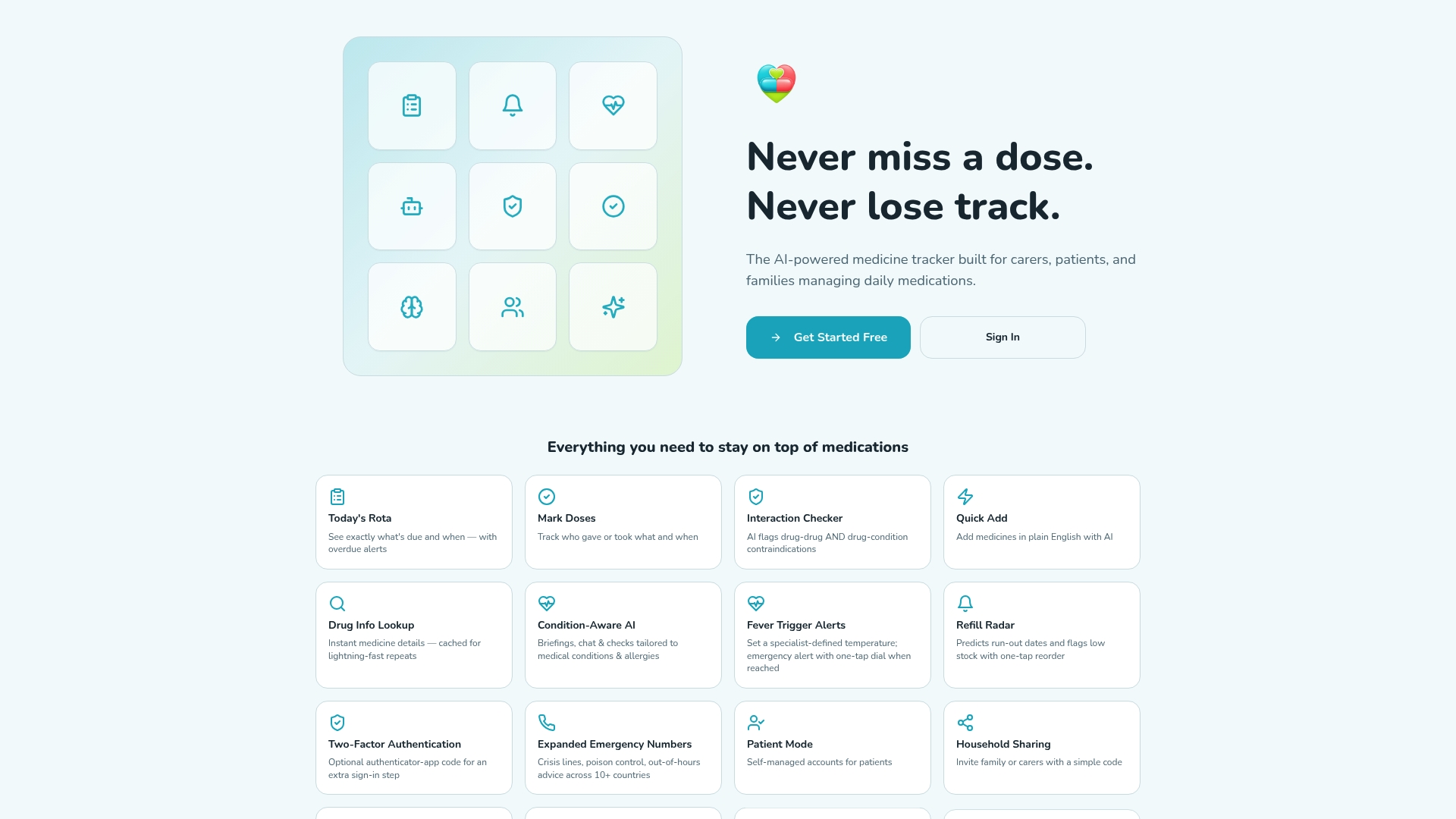
For pharmacists, the platform's audit trail and verification flags mean that every entry carries a timestamp and a named source — exactly what CQC governance inspections look for. For nurses, real-time dose alerts and interaction checks surface at the point of care, not after the fact. For carers managing complex patients at home, the household sharing and multi-patient management features mean the list the clinical team sees on admission reflects what is actually being taken, not what was prescribed six months ago.
The platform's exportable medication history is formatted for direct use in discharge summaries and community pharmacy handovers, cutting the time pharmacists spend preparing discharge documentation. It complies with UK GDPR, with role-based access ensuring carers and patients contribute to the record without compromising clinical integrity.
Teams ready to pilot the platform on a single ward can explore features and request a trial at The Daily Dose Tracker. A one-ward pilot typically covers staff onboarding, export template configuration, and a review of the reconciliation workflow against local trust policy.
Authoritative UK sources and further reading
Use these sources to validate local policy, support audit submissions, and brief governance leads.
For policy and standards (consult first):
- NICE medicines optimisation guideline NG5 — the primary UK standard for medicines reconciliation roles, timing and multidisciplinary working
- NICE quality statement 4 (medicines reconciliation in acute settings) — sets the 24-hour admission standard; access via the NICE quality standards library
- CQC guidance on medicines governance — sets inspection expectations for reconciliation processes, documentation and audit; available at cqc.org.uk
For process tools and workflow design:
- AHRQ MATCH toolkit — the most practically detailed reconciliation workflow guide available; covers forcing functions, role standardisation and EHR integration
- AHRQ MATCH chapter 3: designing the reconciliation process — specifically addresses embedding reconciliation into rounds and EHR workflows
For clinical evidence:
- NCBI Bookshelf: Medication Reconciliation — Patient Safety and Quality — evidence synthesis covering reconciliation steps, error types, and accuracy improvements from standardised processes
- Welsh national standards for medication review — detailed five-step model and patient-involvement standards applicable across UK settings
- PMC systematic review: MTM services outcomes — meta-analysis of medication therapy management outcomes including reconciliation-related interventions
For patient and carer resources:
- Patient medication history: a guide for carers and families — practical guidance on involving carers in verification
- Reviewing a complete medication history — step-by-step process for obtaining and verifying a full history
A note on local trust policy: NICE and CQC set the floor. Your local trust policy may mandate specific forms, timelines or escalation pathways that go further. Always cite local policy in governance submissions and staff training materials, and flag any conflict between local policy and national guidance to your medicines optimisation lead.
This article provides general clinical guidance and does not constitute professional medical or legal advice. Clinicians should confirm current standards with NICE, CQC, and their local trust policy, and seek specialist input for complex or high-risk cases.