

A professional medication audit trail is a secure, immutable record of every action taken during medication management, capturing who acted, what changed, when it happened, and why. For UK healthcare providers, it is the primary evidence base for demonstrating compliance with NHS England, Care Quality Commission (CQC), and local authority standards such as those published by Kirklees Council.
What does a professional medication audit trail actually record?
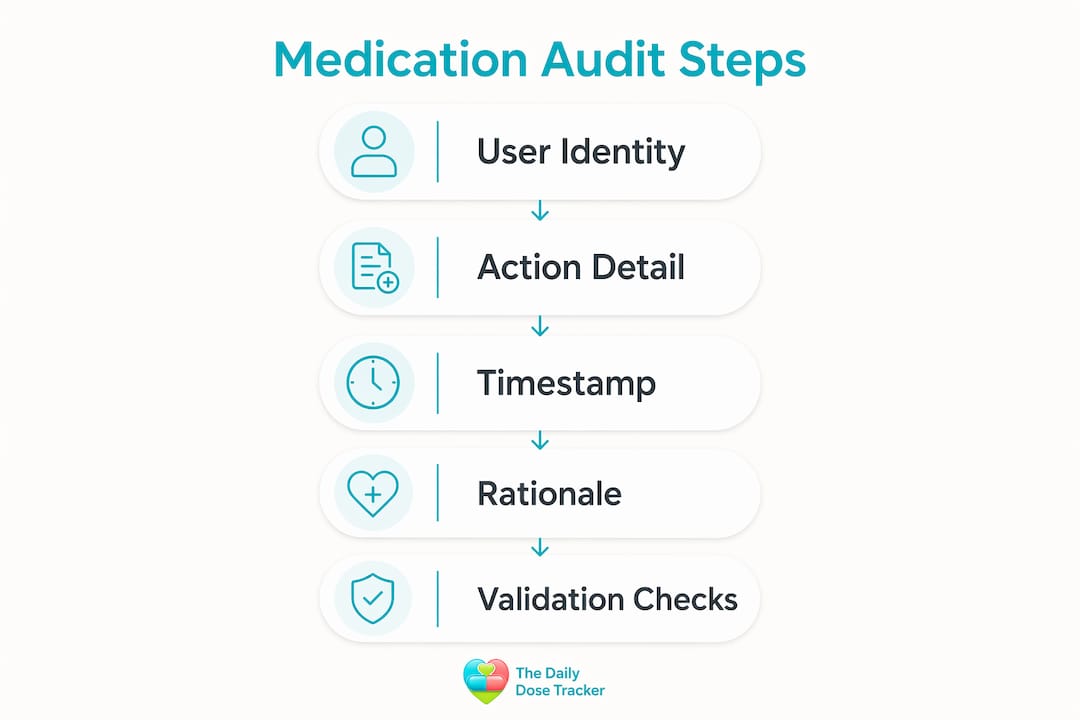
The term "audit trail" is sometimes used loosely to mean any system log, but a truly compliant record requires features like immutability, time-stamping, and identification of actions as explained in the medication side effect search. In regulated healthcare, it means something far more specific. The MHRA's GxP Data Integrity Guidance defines a compliant audit trail as a record that is immutable, time-stamped from a synchronised clock, and entirely independent from operator manipulation. It must capture four elements without exception:
- Who performed the action (named individual, not a shared login)
- What was done, including both the before and after values
- When it occurred, to the exact timestamp
- Why the change was made, documented as a formal rationale
These four elements are not optional extras. Missing any one of them produces a record that will not satisfy a CQC inspection or an MHRA audit.
Why medication audit trails are critical for patient safety and UK compliance

NHS England positions clinical audit not as a fault-finding exercise but as a quality improvement process, shifting teams from reactive error-detection towards proactive, real-time management. That framing matters practically: a well-maintained audit trail lets a ward manager spot a pattern of missed evening doses before a patient comes to harm, rather than after.

The legal weight of these records is equally significant. Medication audit trails form the definitive legal evidence in investigations of malpractice or negligence, demonstrating whether care met the required standard and whether documentation was accurate and authorised. A gap in the record is treated by regulators as a gap in care.
Key regulatory requirements for UK providers include:
- Demonstrating compliance with CQC's Key Lines of Enquiry, particularly around safe medication management
- Meeting NHS England's clinical audit standards for continuous quality improvement
- Following local authority guidance, such as Kirklees Council's MAR auditing framework for adult social care providers
- Maintaining records that would withstand MHRA inspection under GxP data integrity principles
What must a compliant audit trail contain?
The technical requirements for a compliant audit trail go beyond simply keeping records. The MHRA specifies that the system generating the trail must be independent of the person whose actions it records. An administrator cannot delete or alter their own entries.
| Element | Definition | Compliance requirement |
|---|---|---|
| Identity | Named user who performed the action | No shared logins; individual accountability |
| Action detail | Before and after values for any change | Full change history, not just current state |
| Timestamp | Date and time from a synchronised clock | Cannot be manually adjusted |
| Rationale | Documented reason for the change | Linked to incident report where applicable |
Supporting quality assurance features include version control, access logs, and regular system validation checks. For medication history records, immutability is particularly critical because retrospective alterations are one of the most common findings in MHRA inspections.
How to conduct a medication audit effectively
A medication audit is not a single event. NICE principles for clinical audit describe it as a cyclical process: audit, act, re-audit. One-off reviews do not satisfy regulators and do not produce lasting improvement.
A practical audit process follows these steps:
- Define the scope: which patients, which medications, which time period
- Select the sample, applying the 20% minimum of MARs recommended by Kirklees Council for monthly social care audits
- Review each MAR for completeness: signatures, dates, codes, and gap documentation
- Cross-reference any coded entries with the corresponding notes in daily records
- Document all findings on a dated audit sheet, naming the auditor and the records reviewed
- Assign corrective actions with named owners and deadlines
- Schedule a re-audit to confirm improvements have been sustained
Pro Tip: Apply a risk-based review approach rather than auditing every system event. Focus on clinical data that directly affects patient safety, such as missed doses, dose changes, and PRN administration. Technical system logs sit outside this scope and should be managed under IT governance, not clinical audit.
Training is inseparable from audit effectiveness. Staff who do not understand why rationale documentation matters will continue to leave fields blank. A brief, structured induction on audit trail requirements, tied to real examples from your own setting, produces more consistent records than a policy document alone.
How often should medication audits be conducted?
Kirklees Council advises adult social care providers to audit at least 20% of Medication Administration Records monthly as part of routine quality assurance. That figure sets a floor, not a ceiling.
Frequency and sampling guidance for UK providers:
- Monthly as a minimum for social care settings, covering at least 20% of MARs
- More frequently for high-risk patients, complex regimens, or following a medication incident
- GP and prescribing audits should involve all relevant team members including pharmacists and nurses, with cycles adapted to local commissioning obligations
- Re-audit within an agreed timeframe after any corrective action, as required by NICE's cyclical audit model
NHS prescribing audits stress multidisciplinary involvement. A pharmacist reviewing the same MAR that a nurse has already checked will often catch different categories of error.
Common medication audit mistakes and how to avoid them
The most damaging mistake is confusing technical system logs with a GxP-compliant audit trail. A system log records that a file was accessed. A compliant audit trail records who accessed it, what they changed, and why. Treating the former as the latter is a direct route to an inspection finding.
Other frequent errors:
- Missing rationale documentation: a dose was withheld but no reason was recorded. Auditors expect the "why" to be linked to an incident report or clinical note.
- Incomplete MAR charts: gaps in signatures or dates that are left unexplained rather than coded and cross-referenced
- Shared logins: individual accountability is lost when two staff members use the same system credentials
- Retrospective completion: filling in records after the fact without a timestamp that reflects the actual time of administration
- Treating audit as a one-off: running a single annual review and filing it, rather than following the audit-act-re-audit cycle
Each of these errors carries a consequence beyond the paperwork. A missing rationale for a withheld dose, for example, is indistinguishable from an undocumented omission during a CQC inspection.
Medication audit checklist for healthcare providers
A practical checklist for auditing a Medication Administration Record, based on Kirklees Council's published framework:
- Patient name, address, and date of birth present on the MAR
- Pharmacy and GP details recorded
- Correct medication name, strength, dose, and form documented
- Clear administration instructions (timing, route, food requirements)
- No unexplained gaps in signatures, dates, or times
- All coded entries cross-referenced with notes in daily records
- Notes checked for content quality and appropriate recording
- Audit sheet completed with auditor name, signature, date, and records reviewed
- Errors and issues listed with required actions, named responsible person, and deadline
| Checklist category | Evidence required |
|---|---|
| Patient identification | Name, DOB, address on every MAR page |
| Medication details | Name, strength, dose, form, and route |
| Administration record | Signed entries for every scheduled dose |
| Gap documentation | Coded entry plus corresponding clinical note |
| Audit documentation | Dated sheet with auditor identity and findings |
| Corrective actions | Named owner, action, and completion date |
For a deeper look at what a medication administration record should contain, the standards above apply equally to paper and electronic formats.
How long must audit trail records be retained?
Retention requirements vary by record type, but the governing principle is consistent: audit trails must be kept for at least as long as the underlying record they support. For drug batch records under EU GMP and equivalent UK standards, that means a minimum of one year beyond batch expiration. For clinical records in NHS settings, the NHS Records Management Code of Practice sets longer retention periods depending on the patient group and record type.
Practically, this means your audit trail system must not automatically purge historical entries on a rolling basis. Any deletion or archiving policy needs explicit sign-off and must not compromise the ability to reconstruct a complete medication history for any given patient or time period.
How do audit trails integrate with electronic health records?
Electronic Medication Administration Records (eMAR) generate audit trail data automatically, capturing timestamps, user identities, and dose confirmations in real time. This removes the manual transcription step that introduces most documentation errors in paper-based systems. eMAR systems also provide immediate alerts for missed doses and support pattern monitoring across patient cohorts, which simplifies CQC inspection preparation considerably.
The integration point that most providers underestimate is the link between the eMAR and the incident reporting system. When a dose is withheld or a discrepancy is flagged, the audit trail entry should carry a reference to the corresponding incident report. Without that link, the rationale documentation is incomplete even if both records exist separately. Thedailydosetracker supports this kind of joined-up logging, connecting dose events, alerts, and clinical notes within a single record that care teams and auditors can follow without switching between systems.
What to do when an audit finds problems
Acting on audit findings is where many providers stall. A finding without a corrective action plan is just a list of problems. The NICE cyclical model requires three things: document the finding clearly, assign a named corrective action with a deadline, and schedule a re-audit to confirm the improvement has held.
For serious findings, such as a pattern of unsigned doses or evidence of retrospective record completion, the response should include a formal incident report, a review of staff training records, and notification to the relevant clinical lead. Where a finding suggests a systemic failure rather than an individual error, a root cause analysis is appropriate before corrective actions are finalised. The re-audit timeline should reflect the severity: a minor documentation gap might warrant a three-month review, while a patient safety concern requires follow-up within weeks.
Thedailydosetracker gives care teams a live audit trail, not a paper trail
Most care settings still rely on paper MARs or disconnected spreadsheets, which means the audit trail only exists when someone sits down to compile it. Thedailydosetracker changes that by generating a continuous, timestamped log of every dose event, alert, and clinical note as it happens, fully compliant with UK GDPR and accessible across devices via a progressive web app.
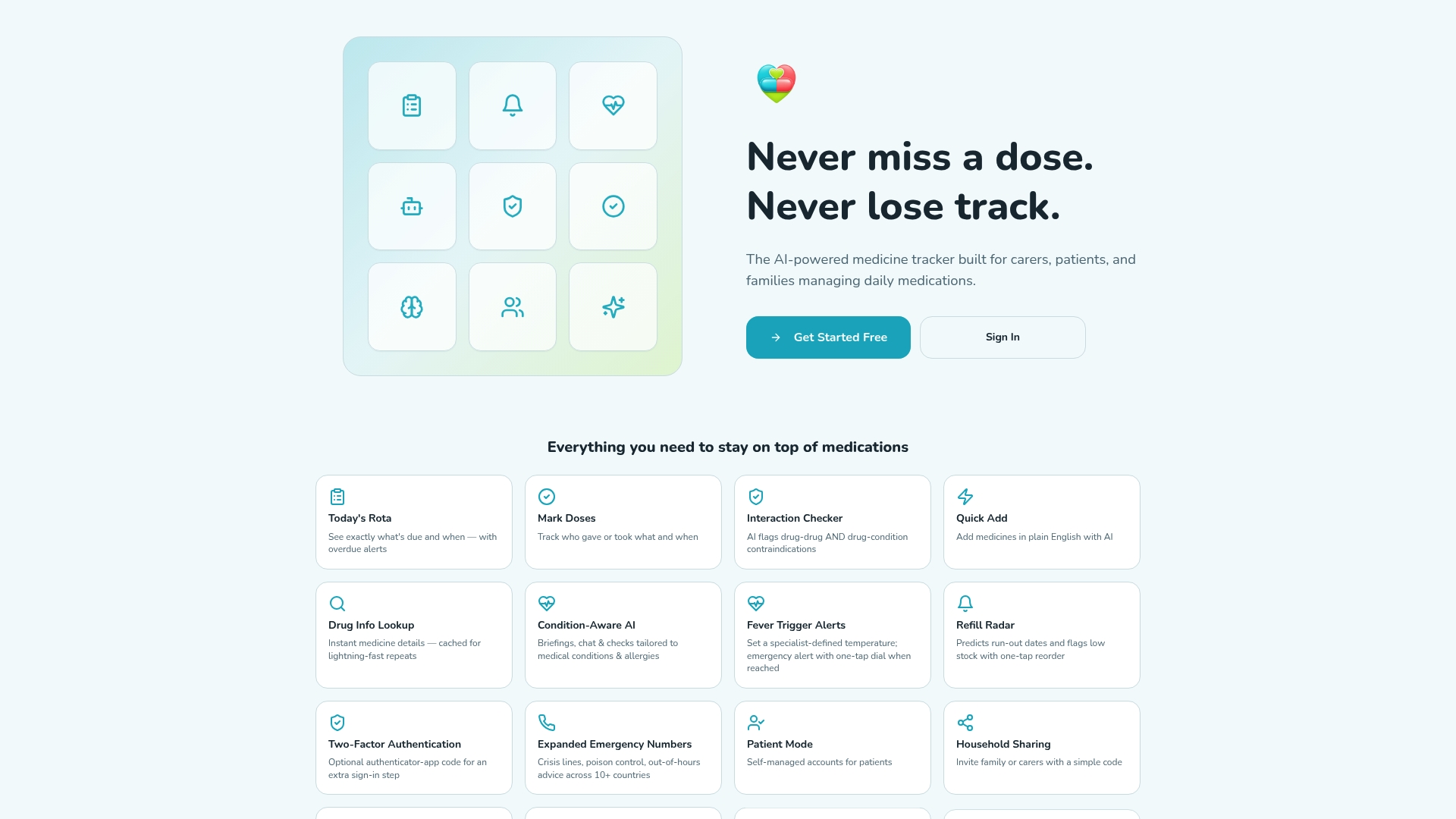
For carers managing complex or multi-patient regimens, the platform's real-time missed-dose alerts and drug interaction checks mean problems surface before they become audit findings. The AI-powered insights flag patterns that a monthly MAR review would catch only too late. For clinical teams preparing for a CQC inspection, having a complete, searchable medication record ready to export is a practical advantage that paper systems simply cannot match. See the full pricing options and start a free trial today.
Key takeaways
A compliant medication audit trail requires four documented elements: identity, action detail, timestamp, and rationale. Without all four, the record will not satisfy CQC or MHRA inspection.
| Point | Details |
|---|---|
| Four core elements | Every audit trail entry must capture who, what (before and after), when, and why. |
| Monthly sampling minimum | Kirklees Council recommends auditing at least 20% of Medication Administration Records monthly in social care settings. |
| Cyclical audit model | NICE requires audit, corrective action, and re-audit; a single annual review does not meet the standard. |
| Retention obligation | Audit trails must be kept for at least as long as the underlying record they support, per GMP and NHS standards. |
| Thedailydosetracker | Generates a continuous, timestamped medication log that supports CQC inspection readiness and real-time missed-dose alerts. |