

A centralised, patient-facing medication record delivers five concrete gains: better adherence, fewer dosing errors, clearer communication between carers and clinicians, exportable histories ready for any appointment, and faster medicine reconciliation at transitions of care. For UK family carers and small professional care teams, those five things together change the daily reality of managing complex regimens. The Daily Dose Tracker is a practical, UK-focused platform built around exactly these needs.
Carers typically notice adherence improvements within the first few days of setting up shared alerts and dose logs. Making the record genuinely routine, where everyone trusts it and updates it consistently, usually takes two to six weeks.
Key takeaways
A well-maintained centralised medication record reduces dosing errors, improves adherence, and gives carers documented evidence to use in clinical appointments, with most carers seeing adherence benefits within days and a reliable routine within two to six weeks.
| Point | Details |
|---|---|
| Adherence improves quickly | Apps roughly double self-reported adherence; set up shared alerts and dose logs on day one. |
| Exportable histories are advocacy tools | Bring a 30-day dose log to every GP or pharmacy appointment to support structured medication reviews. |
| One named record owner is critical | Assign a single person to enter changes; shared informal responsibility leads to out-of-date records. |
| Check privacy before you commit | Confirm UK GDPR compliance, data storage location, and audit trail before trusting any platform with health data. |
| Thedailydosetracker covers the full checklist | Multi-patient support, interaction checks, exportable histories, and UK GDPR compliance are all included. |
Table of Contents
- What are the real benefits of centralised patient medication data?
- What does the evidence say about medication apps and adherence?
- How does a centralised record change what carers can do in appointments?
- What safety and privacy checks should you make before trusting a platform?
- How do you set up and maintain an accurate centralised medication record?
- Where can centralised medication records fail, and what harms should you watch for?
- Which features matter most when choosing a medication platform in 2026?
- Why this matters now, and what carers should do next
- Thedailydosetracker: a practical next step for UK carers
- Sources
What are the real benefits of centralised patient medication data?
The mechanism behind each benefit is worth understanding, because it tells you which features actually matter and which are just window dressing.
Improved adherence comes from the combination of timely reminders and a dose log that closes the loop. A reminder alone tells someone a dose is due; a log confirms whether it was taken. That two-way confirmation is what digital medication reminders add over a simple alarm. NHS SPS guidance is explicit on this point: personalised, interactive tools that update with accurate prescription data outperform one-way static reminders, which can create false reassurance rather than genuine safety.
Fewer errors follow from having a single source of truth. When every carer in a household reads from the same synchronised schedule, the risk of double-dosing or a missed gap drops sharply. Interaction checks add a second layer: a flag before a new medicine is added, rather than a phone call to 111 afterwards. An audit trail means any discrepancy can be traced and corrected rather than guessed at.
Better communication is perhaps the least obvious benefit. An exportable, time-stamped medication history turns a carer from a passive bystander in a clinical conversation into someone with documented evidence. That shift matters enormously in GP and hospital appointments, where verbal accounts of complex regimens are routinely incomplete.
Key mechanisms at a glance:
- Synchronised schedules with dose-log confirmations reduce missed and duplicated doses.
- Interaction checks flag potential problems before a new medicine is started.
- Shared household access means every carer works from the same current list.
- Exportable histories give clinicians accurate data at the point of care.
- Audit trails support safer digital medication logs and enable quick error correction.
Pro Tip: Assign one named person as the record owner. Carers commonly under-record medication changes when responsibility is shared informally. A named owner with a short checklist at every prescription change keeps the record trustworthy.
What does the evidence say about medication apps and adherence?
The research base is encouraging but not without caveats, and it is worth being precise about what the studies actually show.
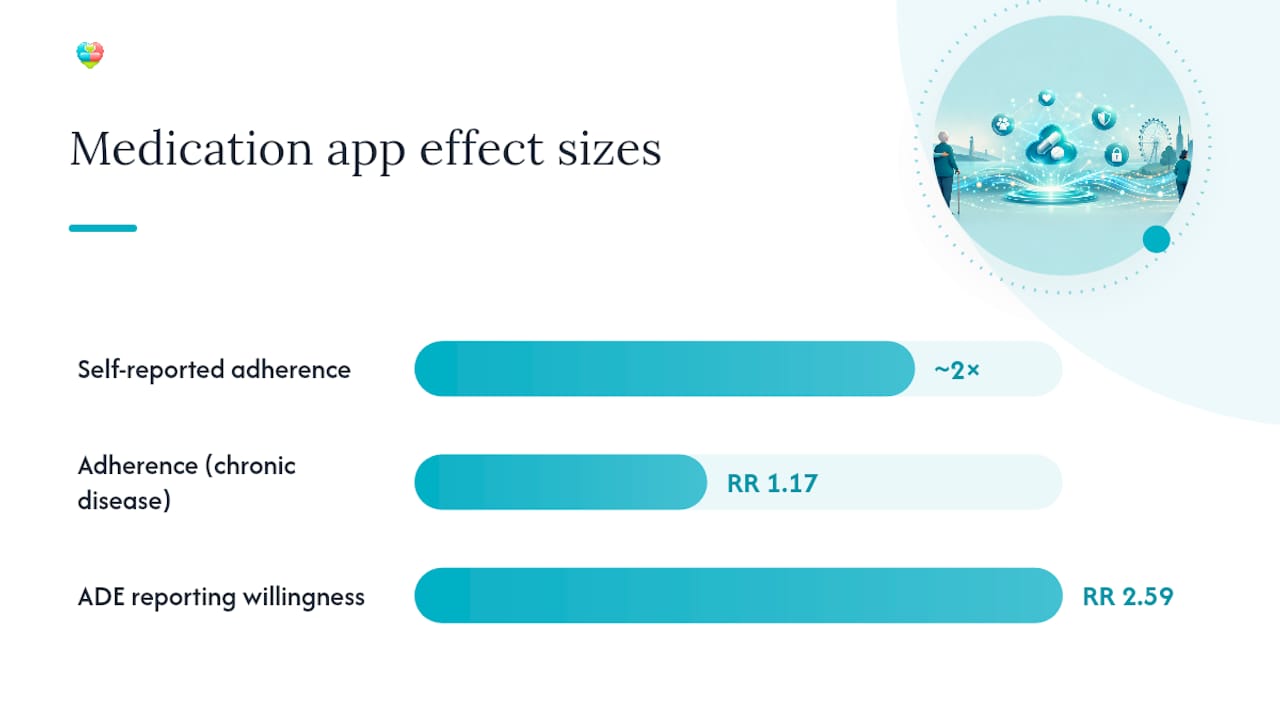
A pooled review summarised by the NIHR found that patients using medication reminder apps were more likely to self-report taking medicines as prescribed compared with non-users. The effect is real, but self-reported adherence is not the same as verified adherence, and study designs varied considerably.
A JMIR mHealth meta-analysis added more granularity: medication management apps showed a modest improvement in adherence and increased willingness to report adverse drug events in chronic disease populations. Effects on medication error reduction were inconsistent across studies, which is an important caveat for anyone expecting a straightforward safety guarantee.
| Outcome | Finding | Source |
|---|---|---|
| Self-reported adherence | Roughly twofold increase vs non-users | NIHR pooled review |
| Adherence (chronic disease) | RR 1.17 | JMIR mHealth 2022 |
| ADE reporting willingness | RR 2.59 | JMIR mHealth 2022 |
The honest summary: apps improve adherence and ADE reporting in the studies we have, but the evidence base is heterogeneous, follow-up periods are short, and direct reduction in medication errors requires broader system integration, not just an app.
The main evidence gaps are short follow-up durations, variable measurement methods, and the fact that most studies test reminder-only apps rather than the fuller centralised records this article describes. Frontiers in Pharmacology research reinforces that better outcomes occur when tools are personalised and interactive, not one-size-fits-all.
How does a centralised record change what carers can do in appointments?
Systematic reviews show that carers perform a wide range of medication tasks, from tracking intake and monitoring side effects to creating lists and chasing information from multiple sources, yet they frequently lack up-to-date information and formal involvement in clinical workflows. That gap is where a centralised record makes the biggest practical difference.
An exportable, time-stamped medication history is an advocacy tool. Carers who arrive at a GP appointment with a printed or screen-shared log of the past four weeks, including missed doses, side effects noted, and any PRN medicines used, give the clinician something concrete to work with. Research published in BMJ Open found that family caregivers are frequently not integrated into records and workflows, and that participants consistently prioritised access to an up-to-date medication list and interoperable records as their top needs.
Everyday workflow benefits for carers managing complex regimens:
- One updated list replaces handwritten notes, pillbox labels, and verbal handovers between family members.
- A shared household view means a night carer and a day carer both see the same current schedule.
- Dose logs provide evidence for medication reviews, removing the need to reconstruct history from memory.
- Refill predictions flag when a prescription is running low before a gap occurs.
Pro Tip: Before a structured medication review, export the last 30 days of dose logs and bring them to the appointment. Pharmacists and GPs can use that data to identify patterns, such as a consistently missed evening dose, that verbal accounts miss entirely. Involving your local pharmacist to verify a newly created list is also a fast way to build clinical trust in the record.
What safety and privacy checks should you make before trusting a platform?
UK GDPR applies to any platform storing personal health data about identifiable individuals. That means the platform must have a lawful basis for processing, must store data securely, and must give you the right to access, correct, and delete your data. A plain-language privacy notice is a minimum requirement; if you cannot find one or cannot understand it, that is a red flag.
Before committing to any platform, ask:
- Where is data stored? UK or EU-based servers are preferable for UK GDPR compliance.
- Can you export all data in a readable format, and delete it on request?
- Who can access shared accounts, and how is access revoked if a carer leaves?
- Is there an audit trail showing who entered or changed a record, and when?
- How does the platform handle account recovery and emergency access?
- Is data transferred over encrypted connections (look for HTTPS and a clear security statement)?
Security red flags include unencrypted data transfer, no stated data retention policy, and shared login credentials with no individual access controls. For multi-patient households, record who holds the account credentials and review access permissions whenever your care team changes. Consent for sharing a person's medication data should be documented, even informally in writing.
How do you set up and maintain an accurate centralised medication record?
Getting the record right from the start saves significant effort later. Carers managing multiple prescriptions often find that a structured setup takes under an hour and pays back that time within the first week.
- Choose the account owner. One named person is responsible for entering changes and reconciling the record. Everyone else has read or confirmation access.
- Add current medicines. Use the most recent prescription or dispensing label as the source. Photograph labels where the platform allows it.
- Record dose schedules precisely. Include dose, frequency, timing, and any special instructions (with food, at bedtime, and so on).
- Invite household members or carers. Set appropriate access levels: full edit for the account owner, confirmation-only for others.
- Reconcile at every transition of care. New prescription, hospital discharge, or pharmacist review each require a check against the current record. Suggested cadence: daily dose confirmations, weekly spot-check of the full list, monthly review against repeat prescription slips.
- Log missed doses and side effects as they happen. PRN and short-course medicines need a start date and an expected end date so they do not persist on the list indefinitely.
Pro Tip: Keep pharmacy receipts or dispensing labels for one month. When a repeat prescription arrives, compare the dispensed quantities against the record. Discrepancies, such as a dose change not reflected in the app, surface immediately rather than weeks later.
Where can centralised medication records fail, and what harms should you watch for?
No system removes human error; it just changes where errors occur. The most common failure modes with centralised records are:
- Out-of-date data. A medicine changed at a hospital discharge that never gets updated in the app. The record looks complete but reflects last month's regimen.
- Duplicated entries. The same medicine listed twice under slightly different names, leading to apparent double-dosing on the log.
- False reassurance. A carer assumes the app is correct and stops cross-checking with the prescription bag or pharmacist.
- Digital exclusion. Not every patient or carer is comfortable with a smartphone app. A centralised record that only one person can access creates a single point of failure.
Red flags requiring immediate action: a clinician's medication list that differs from your app record; an interaction flagged by a clinician that the app did not catch; a dose confirmation marked as taken when the carer knows it was not.
Practical mitigations: reconcile the record with the pharmacist at every repeat prescription collection; keep a printed copy of the current medication list accessible in the home; and never rely solely on the app during a hospital admission, where the clinical team will use their own records.
Which features matter most when choosing a medication platform in 2026?
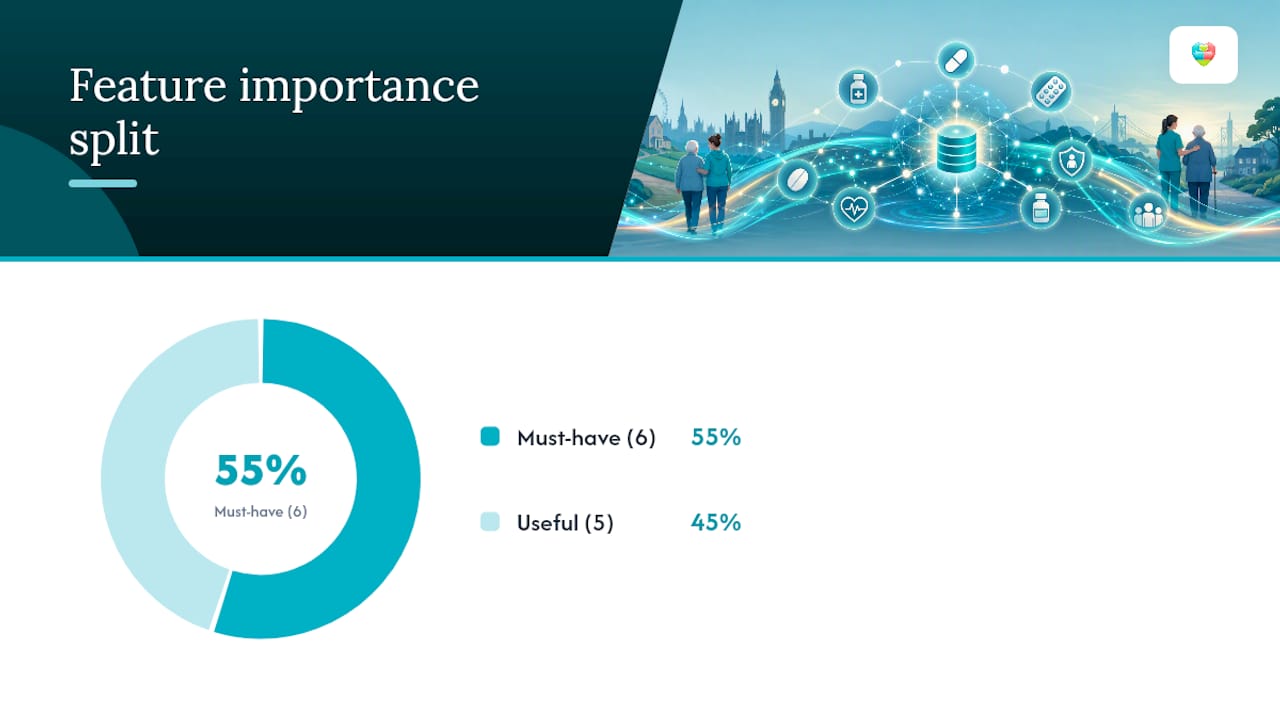
The checklist below is ranked by practical importance for carers and small professional teams.
Must-have features:
- Multi-patient support (manage more than one person from a single account)
- Exportable medication history in a readable format (PDF or similar)
- Drug interaction checks before adding a new medicine
- Audit trail showing who confirmed each dose and when
- Real-time alerts for due and overdue doses
- UK GDPR-compliant data storage and a clear privacy notice
Useful additions:
- Refill predictions and low-stock alerts
- Symptom and side-effect logging linked to the medication record
- Appointment scheduling integrated with the medication timeline
- Accessibility settings (font size, dark mode, screen-reader support)
- Offline access for areas with poor connectivity
On cost: most platforms use a freemium model. Core scheduling and reminders are typically free; exportable histories, interaction checks, multi-patient management, and AI-powered insights usually sit behind a paid tier. For a carer managing one person with a straightforward regimen, a free tier may be sufficient to start. For polypharmacy or professional care teams, a paid Individual or Pro subscription is likely necessary to access the features that matter most.
Thedailydosetracker covers every item on the must-have list above and is built specifically for UK carers, patients, and small professional teams. It is UK GDPR-compliant, supports multi-patient households, and includes drug interaction checks, exportable histories, and real-time alerts across all devices via a progressive web app.
Why this matters now, and what carers should do next
The evidence and the lived experience of carers point in the same direction: fragmented, paper-based medication management creates avoidable risk, and a well-maintained centralised record reduces that risk in ways that are measurable and immediate. What strikes me most, reading the BMJ Open research on carer roles in medication management, is not the complexity of the task but how often carers are simply excluded from the information they need to do it safely. A centralised, exportable record does not just help the carer; it gives the person being cared for a safer, more consistent experience of their own medicines. The checklist steps above are not complicated. The barrier is usually starting, not maintaining.
Thedailydosetracker: a practical next step for UK carers
Thedailydosetracker maps directly to the feature checklist above. It covers custom medication schedules, real-time dose alerts, drug interaction checks, condition-specific guidance, refill predictions, fever alerts, multi-patient management, exportable medication histories, symptom logging, and appointment scheduling, all in a device-agnostic progressive web app with accessibility controls. Data is stored in compliance with UK GDPR, and the platform supports household sharing with individual access levels.
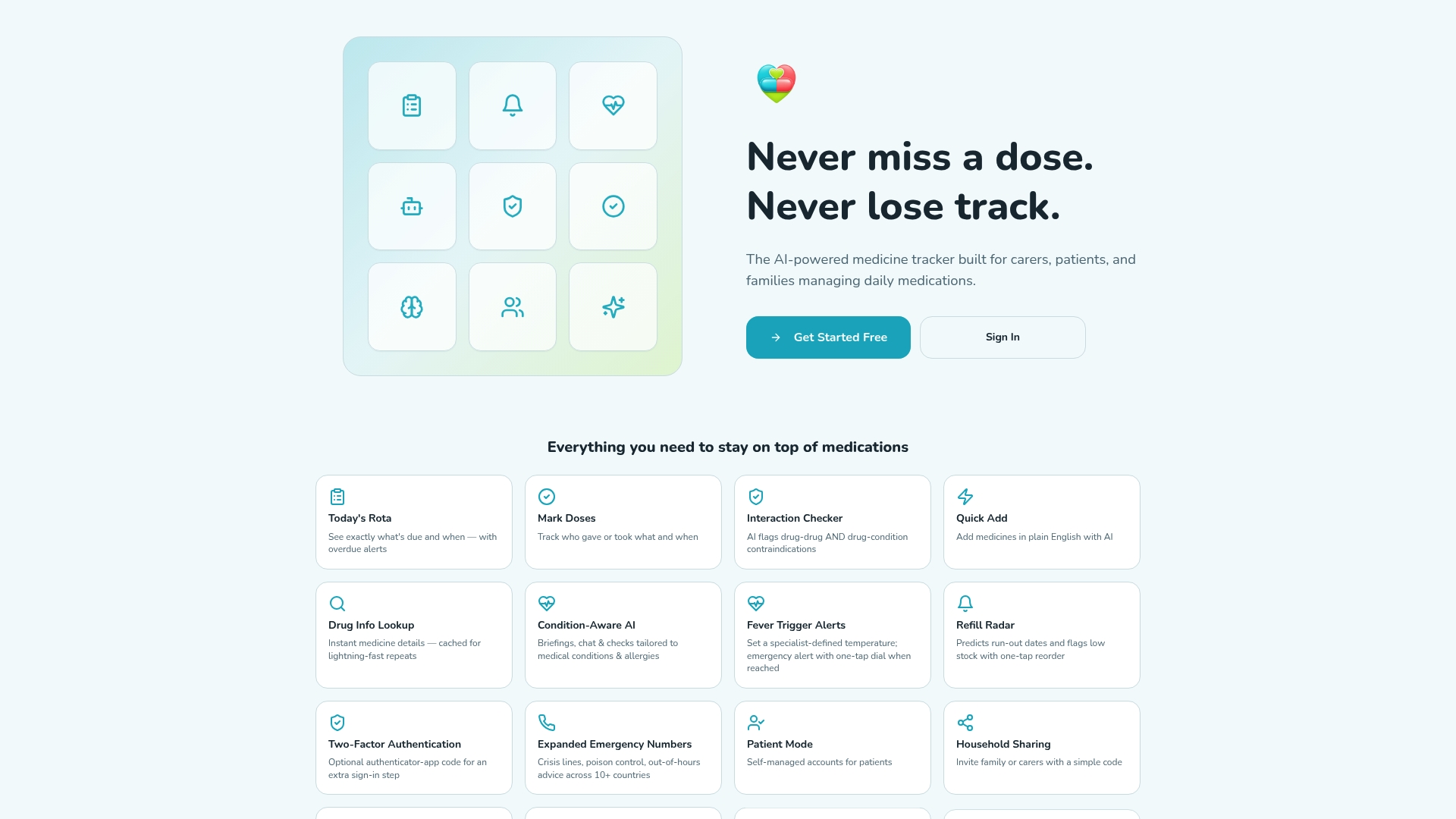
The freemium plan covers core scheduling and alerts. The Individual and Pro tiers unlock AI-powered insights, full diary and appointment management, multi-patient support, and exportable histories. For most family carers, the Pro tier is where the advocacy and reconciliation features become fully available.
Start with a free account, add your current medicines, and invite one other carer to confirm doses. You will have a working shared record within the hour. Visit The Daily Dose Tracker to get started.
Sources
- Reminding to take medicines: supporting adherence – NHS SPS - Specialist Pharmacy Service – The first stop for professional medicines advice
- Apps to help patients take medication on time need to be evaluated in a consistent way
- mmApps and medication safety: systematic review and meta‑analysis (JMIR mHealth 2022)
- Role of informal carers in medication management for people with long-term conditions: a systematic review | BMJ Open
This article is general information, not a substitute for advice from a qualified doctor. Consult a qualified healthcare professional about your own circumstances before acting on anything here.