

Use a printable 7 to 10 day grid with checkboxes, or a basic app that lets you set a course end date, to record every antibiotic dose from first pill to last. Whichever format you choose, write down the medicine name, the exact dose times, and the date the course finishes. If you want reminders that switch off automatically once the course ends, a digital option can handle that step for you.
TL;DR:
- Tracking every antibiotic dose with a printed or digital log ensures accurate record-keeping for missed or late doses and helps prevent course disruption.
- Ensure the tracker includes specific fields like medication name, strength, dose, actual intake times, and reason for missed doses to support proper stewardship.
- Completing the entire prescribed course is crucial to prevent bacteria from developing resistance, with clear documentation of the end date and side effects.
- Digital tools automate reminders and automatically switch off once the course ends, reducing the risk of unnecessary alerts or missed doses.
- Store antibiotics properly as per instructions, keep detailed records, and always communicate missed doses or adverse reactions accurately to prescribers.
Table of Contents
- Where to find a printable antibiotic course tracker
- How do you use an antibiotic tracker correctly?
- What fields does an antibiotic dosage log need?
- Why finishing the full antibiotic course matters
- Printable or digital: which antibiotic reminder tool suits you?
- What should you tell the prescriber when the course finishes?
- How private is your antibiotic tracking data?
- Tips for managing missed antibiotic doses
- How should you store antibiotics during the course?
- Author perspective: a caregiver checklist worth photocopying
- A digital alternative that handles the end date for you
- Sources
Where to find a printable antibiotic course tracker
A printable tracker is usually a grid with one row per day and one column per dose, so a twice-daily antibiotic gets two boxes a day and a three-times-daily one gets three. Most sheets run a duration matching the common prescription lengths for adults and children.
You'll find blank templates from pharmacy websites, parenting blogs, and clinic handouts, alongside more clinical infection-tracking sheets designed for long-term care settings, which show how nursing staff structure the same information for auditing purposes. Before printing anything, check it against a short list:
- Space for the medicine name, strength, and prescriber, not just tick boxes.
- Clear dose times rather than vague labels like "morning" and "night."
- Room for short notes on symptoms or side effects next to each day.
- Large, high-contrast checkboxes that still print clearly in black and white.
- Simple icons or pictograms if the tracker is for a child or a carer who prefers pictures to text.
A sheet designed for a smartphone screen often shrinks badly on paper. Print a test page first and check the boxes are still big enough to tick with a pen, especially if you're filling it in one-handed while holding a poorly toddler.
How do you use an antibiotic tracker correctly?
The tracker only works if it's filled in the same way every time. Follow these steps from the moment the prescription is dispensed:
- Write the start and end dates at the top of the sheet before the first dose, worked out from the number of days the prescriber specified.
- Log the exact time of each dose as it happens, not from memory later that evening.
- Mark each box "taken," "skipped," or "late" rather than leaving it blank, so a gap in the record is never ambiguous.
- Use one row, or one sheet, per course. Don't recycle a half-used tracker for a different prescription, even for the same person.
- Stop checking the sheet once the end date passes. If you're using an app, turn off reminders the moment the course finishes rather than leaving them running.
A single sheet covering two different antibiotics, started on different days, is how doses get muddled. An effective tracker treats each course as one discrete event with a hard stop date, and mixing courses on one page undoes that.
If a dose is missed, write it down rather than skipping the entry. Note the time you noticed and what you did next, then check the patient information leaflet or call the prescribing surgery or pharmacy for advice specific to that antibiotic, since the right response varies by drug and by how late the dose is.
Pro Tip: Keep the tracker somewhere it will actually be seen, like next to the kettle or on the fridge. A perfect log stuck in a drawer is worse than a rough one that gets used every day.
What fields does an antibiotic dosage log need?
A tracker earns its keep on a handful of fields, most of which come straight off the prescription label. Facility-level stewardship logs, of the kind used to track antibiotic courses in clinical settings, give a useful model for what's worth capturing even at home.
Treat these as non-negotiable:
- Medication name and strength (for example, amoxicillin 500mg)
- Dose amount, frequency, and route (oral, topical, and so on)
- Prescriber name and the reason the antibiotic was prescribed
- Start date and planned end date
Beyond that minimum, a few extras make the log genuinely useful rather than just tidy:
- Time each dose was actually taken, and who gave it
- Reason for any missed dose
- A short note on symptoms or side effects that day
The gap between "planned" and "actual" end date matters more than it looks. Stewardship reviews use exactly that comparison to spot courses stopped early or run on too long, and the same logic applies at home: if the course finished three days later than planned because of missed doses, that's worth mentioning to the prescriber.
Why finishing the full antibiotic course matters
Stopping early, even once symptoms ease, gives surviving bacteria a chance to adapt, which is part of why antimicrobial stewardship guidance is built around completing the prescribed course exactly as written. Your tracker's main job is making that easy to prove, both to yourself and to whoever asks later.
Some signs need a call to a clinician straight away, not a note on the tracker for later:
- A severe or spreading rash
- Difficulty breathing, swelling of the face or throat
- Persistent vomiting that stops doses staying down
- Any other sign of a serious allergic reaction
A coherent but limited body of caregiver guidance on stewardship logs consistently flags the same gap: courses interrupted without a clear record of why. That's the exact failure a printed sheet or a basic app closes, since it forces a written reason rather than a shrug.
Three habits keep the whole process safer:
- Label bottles clearly with the patient's name if more than one person in the household is on medication.
- Store the antibiotic securely, out of reach of children, and away from anywhere it could be mistaken for something else.
- Keep one single log per patient, not a shared sheet for the whole family.
Printable or digital: which antibiotic reminder tool suits you?
Neither format is universally better; it depends on the course length, the household, and how comfortable everyone is with a phone.
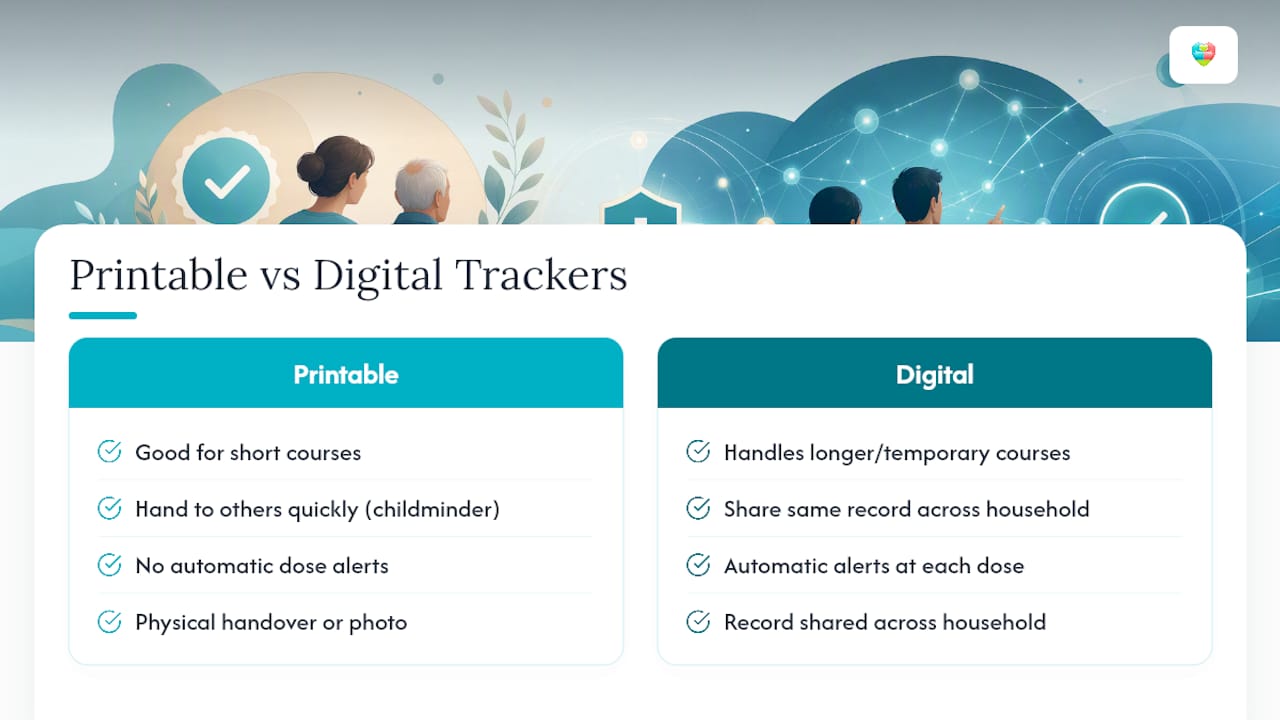
A printable sheet wins when the course is short, someone else needs to see it quickly (a childminder, a grandparent, a school nurse), or a smartphone simply isn't part of the routine. It costs nothing, needs no login, and can be handed over in seconds.
A digital antibiotic reminder tool wins on the things paper can't do: automatic alerts at each dose time, sharing the same record across a household, and a reminder that switches itself off once the course ends. Several medication-tracking apps now build that end-date behaviour in directly, so reminders for temporary medications stop automatically once the prescribed days are up, which removes the small but real risk of a reminder nagging you a week after the antibiotics are long finished.
There's a practical middle path, too: fill in a paper tracker as you go, then photograph the completed sheet, date-stamped, before a clinic visit. It's often faster than trying to reconstruct a digital export on the spot.
Pro Tip: If your household is already managing several medications across different people, a tool built for multi-patient regimens will save more hassle than a stack of printed sheets ever will.
What should you tell the prescriber when the course finishes?
Clinicians reviewing an antibiotic course generally want three things: the actual end date and total days completed, whether any doses were missed and when, and the time of the last dose taken. Bring the tracker itself, or a photo of it, rather than trying to recall the details from memory.
A combined symptom and medication timeline makes side-effect reports far easier to interpret, because it shows exactly which dose preceded which symptom rather than leaving the clinician to guess at timing. That single habit, noting symptoms next to doses rather than in a separate diary, is the difference between a vague "I think it was the antibiotic" and a clear, dated answer.
How private is your antibiotic tracking data?
A paper tracker has one obvious privacy advantage: it never leaves the house unless you take it. The trade-off is that it's also easy to lose, and it offers no protection if it ends up in the wrong hands, since anyone who picks it up can read a name, a diagnosis hint, and a course of medication at a glance.
A digital medication management system needs to earn that same trust differently. Look for a few concrete signals before entering health information into any app:
- Whether the provider states clear compliance with UK GDPR standards, not just a vague privacy policy.
- Whether household sharing is controlled, so only the people you choose can see a patient's record.
- Whether data is stored securely and whether you can export or delete your own records on request.
Health data, including something as ordinary-seeming as an antibiotic dose log, counts as sensitive personal information under UK data protection law. That doesn't mean every tracker needs bank-grade security, but it does mean checking who can see the record matters more with a shared or cloud-based tool than with a page pinned to the fridge. If a tool is vague about where data is stored or who has access, that's reason enough to look elsewhere, printable included.
Tips for managing missed antibiotic doses
Missing a dose isn't a crisis, but how you handle it depends on timing, and the tracker's job is to make that timing obvious rather than guessed at.
The general pattern most patient information leaflets follow: if you remember soon after the missed time, take it as soon as you remember. If it's nearly time for the next dose, skip the missed one and continue as scheduled rather than doubling up. Never take two doses together to "catch up" without checking the specific leaflet or asking a pharmacist first, since this varies by antibiotic.
A few habits reduce how often doses get missed in the first place:
- Tie doses to existing routines (breakfast, brushing teeth, bedtime) rather than arbitrary clock times that are easy to forget.
- Keep the antibiotic somewhere visible during the treatment window, not tucked away in a cupboard.
- If more than one person in the household administers doses, agree who's responsible for each one to avoid both a missed dose and an accidental double dose.
Whatever happens, write it down. A tracker with an honest gap in it is far more useful to a pharmacist than one that's been quietly filled in after the fact to look complete. If doses are missed repeatedly, that pattern itself is worth mentioning to the prescriber, since it may mean the timing or format of the medicine doesn't suit the household's routine.
How should you store antibiotics during the course?
Most oral antibiotics need to be kept in a cool, dry place away from direct sunlight, but a meaningful minority, certain liquid suspensions in particular, need refrigeration once mixed. The instructions on the pharmacy label always override general assumptions, so check that label every time rather than relying on what a previous prescription said.
A few storage habits matter throughout the course, not just on day one:
- Keep the antibiotic in its original container with the label intact, since that label carries the exact storage instruction, the strength, and the expiry.
- If refrigeration is specified, don't leave the bottle out "just for today." Bacteria in a liquid suspension can degrade faster at room temperature than most people expect.
- Store away from bathrooms and kitchens where humidity and heat fluctuate, even for tablets that don't need the fridge.
- Once the course ends, don't keep leftover doses "just in case." Return unused antibiotics to a pharmacy rather than storing or disposing of them at home.
Note the storage requirement on the tracker itself, next to the medicine name, if it's anything other than room temperature. It's an easy detail to forget three days in, and writing it down once removes the guesswork for whoever gives the next dose.
Author perspective: a caregiver checklist worth photocopying
Here's the one line worth pinning above the kettle: set the start and end dates first, fill in the mandatory fields as you go, and stop the reminders the moment the end date passes. That's the whole system. Everything else, the pictograms, the colour coding, the app notifications, is decoration around that core habit.
What gets missed more often than the dosing itself is the symptom note. A tracker that only records "taken" or "not taken" tells a prescriber nothing about whether the antibiotic is working. Pair it with a line or two on how the patient actually felt that day, and you've built something far more useful than a tick sheet. If you want a head start rather than a blank grid, printable templates aimed at parents are a reasonable place to begin.
— Prasant
A digital alternative that handles the end date for you
If you'd rather not manage a stack of printed sheets, digital tracking apps build the habits this article recommends directly into the software. They let you set a firm course end date so reminders stop themselves the moment the antibiotic course finishes, no manual cancelling required.
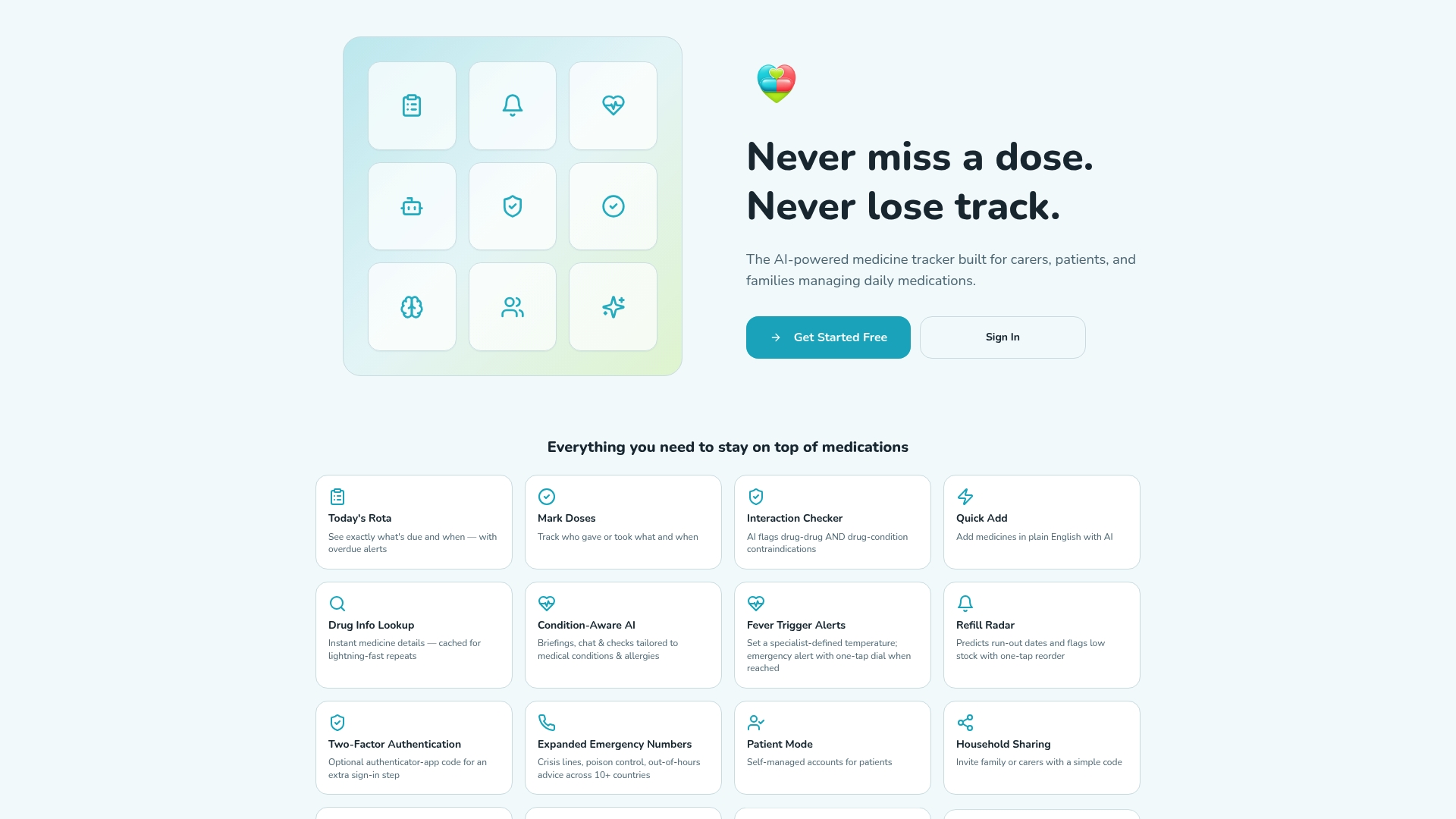
Some platforms support household sharing, so everyone caring for the same patient sees the identical, up-to-date record instead of separate paper sheets that disagree with each other. Symptom and diary logging can sit alongside the dose log itself, and some systems are built with UK GDPR compliance in mind, which matters more once health data lives on a shared device rather than a page on the fridge. You can often export a clean PDF before a clinic visit instead of photographing a handwritten sheet.
The core features are free to use. If a household is managing several medications or several people, the paid tiers unlock multi-patient management and richer reminders. Try The Daily Dose Tracker and set your first course end date today.
Sources
For a clinical-style form, see the stewardship tracking log template or a simpler antibiotic log sheet for home use.
This article is general information, not a substitute for advice from a qualified doctor. Consult a qualified healthcare professional about your own circumstances before acting on anything here.
- Antibiotic stewardship tracking log template — MangoApps
- Antibiotic use tracking sheet — Fresh-catalog