

Caregiver medication burden is the cumulative physical, emotional, and logistical strain that informal carers experience when they obtain, prepare, administer, monitor, and coordinate medicines for another person. If you are managing someone else's medications at home, you are already carrying this burden, whether you have a name for it or not. The good news is that targeted help exists, and three things you can do in the next 48 hours are: compile a single, up-to-date medication list; ask your community pharmacist about a Structured Medication Review; and set up a simple reminder system, such as Thedailydosetracker, to reduce the mental load of tracking doses.
Research published in PLOS ONE found that carers experiencing higher burden are more than twice as likely to report a medication safety incident at home (odds ratio 2.16, 95% CI: 1.03–4.50). That figure alone makes the case for taking this seriously. The NHS offers real help through its Structured Medication Review (SMR) and Discharge Medicines Service (DMS), both of which your GP or community pharmacist can refer you to. Thedailydosetracker is one practical digital tool that can sit alongside those services, helping you log doses, flag interactions, and share the workload with other household members.
- Compile one complete medication list, including over-the-counter medicines and supplements.
- Ask your pharmacist this week whether a Structured Medication Review is appropriate.
- Set up a reminder system, digital or paper, before the next dose is due.
Table of Contents
- What does caregiver medication burden actually look like day to day?
- How common is medication-related burden, and what does research show?
- What causes medication burden, and who is most at risk?
- How does medication burden affect carers?
- How is caregiver burden measured?
- Practical steps to reduce medication burden right now
- Who can help you in the UK, and what to bring to appointments
- How technology can reduce medication burden: Thedailydosetracker
- Key takeaways
- The part most guides leave out
- Thedailydosetracker: less daily stress, more confidence
- Useful sources for carers
What does caregiver medication burden actually look like day to day?
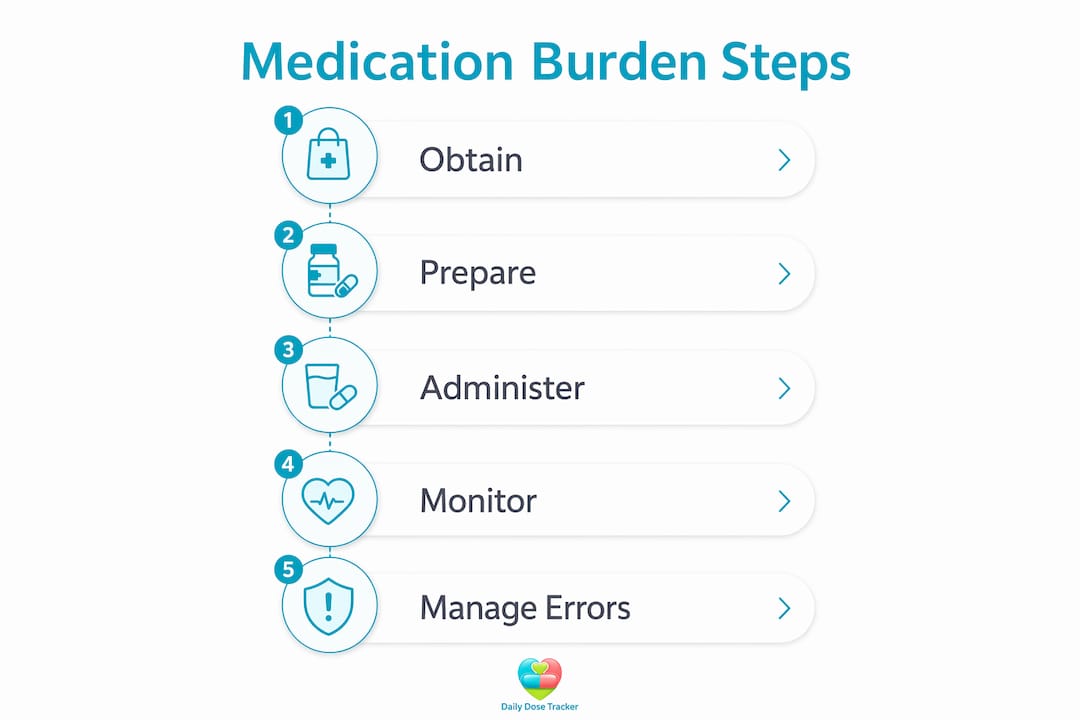
Medication burden is not one task. It is a cycle of interconnected responsibilities that rarely stops, and understanding each stage helps you identify where you most need support.
The full medication-management cycle covers:
- Obtaining prescriptions and collecting medicines from the pharmacy
- Organising medicines by dose, time, and recipient (especially when multiple people are involved)
- Preparing doses, including crushing tablets, measuring liquids, or filling pill boxes
- Administering medicines at the right time, in the right form, to someone who may resist or struggle to swallow
- Monitoring for side effects, changes in condition, or signs that a medicine is not working
- Record-keeping: noting missed doses, adverse reactions, and changes to the regimen
- Coordinating refills, repeat prescriptions, and appointments with GPs, specialists, and pharmacists
Research shows that two-thirds of informal carers report problems with at least one of these activities, and nearly half receive no formal training before taking on the role.
Complexity is what converts tasks into burden. A single daily tablet is manageable. Five medicines taken at three different times, two of which must be given with food and one of which requires a 30-minute gap before eating, is a different proposition entirely. Add a hospital discharge with new medicines, a changed dose, and a care recipient who sometimes refuses, and the cognitive load becomes genuinely exhausting. Managing polypharmacy for an ageing parent is one of the most common triggers for role overload among family carers.
How common is medication-related burden, and what does research show?
The scale is larger than most people assume. In a study of family carers supporting people with dementia, 38.9% reported burden specifically linked to medication assistance, and 56.7% reported facing concrete challenges with medication tasks. Medication refusal alone affected 36.6% of carers in that sample.
Across broader carer populations, two-thirds report problems with one or more medication-management activities. Over half of carers in some samples administer five or more different prescription medicines daily; close to 20% administer ten or more.
The safety link is stark. Carers experiencing higher burden are more than twice as likely to report a medication incident at home, with an odds ratio of 2.16 (95% CI: 1.03–4.50).
The research base draws on several types of evidence:
- Cross-sectional surveys of home carers, which capture self-reported burden and medication difficulties at a single point in time
- Home-care incident studies, which link carer burden scores to documented medication errors such as omission, duplication, wrong timing, and wrong dose
- Dementia-specific cohort studies, which track burden over time as care needs increase
Each study type has limitations, but together they consistently point in the same direction: medication work is a significant and under-recognised source of carer strain, and it carries real safety consequences for the person being cared for.
What causes medication burden, and who is most at risk?
Several factors drive burden, and some are more amenable to change than others.
Care-recipient factors include:
- Polypharmacy (five or more medicines), which affects over half of carers in some samples as they administer 5+ daily prescription medicines
- Multiple daily doses requiring administration at different times
- Cognitive impairment, which increases the likelihood of medication refusal and reduces the care recipient's ability to self-manage
- Swallowing difficulties, which require tablets to be crushed or liquids substituted
- Medication refusal, reported by 36.6% of carers in dementia samples
- Poor fit between the medication schedule and daily life, reported by 15.5% of carers in the same study
Carer risk factors include high weekly caregiving hours, lack of formal training, living with the care recipient (which means continuous exposure to medication tasks), and recent hospital discharge of the care recipient, which often brings new or changed medicines with little handover support.
| Risk factor | Evidence or prevalence |
|---|---|
| Polypharmacy (≥5 medicines) | Over half of carers in some samples administer 5+ daily prescription medicines |
| Medication refusal | 36.6% of carers of people with dementia report this as a burden factor |
| Schedule-lifestyle mismatch | 15.5% of dementia carers report disharmony between medication timing and daily life |
| No formal training | Nearly half of informal carers receive no structured instruction before taking on the role |
| High caregiving hours | Associated with greater role overload in spousal carer research |
| Recent hospital discharge | Brings new or changed medicines with limited handover, increasing process burden |

The obtaining and preparing stages of the medication cycle are often rated as high-burden process steps, even when the actual administration goes smoothly. That matters because these are also the steps where pharmacy services can most directly help.
How does medication burden affect carers?
The consequences spread across several areas of a carer's life, and they compound over time.
Emotionally, the most common experiences are persistent anxiety about making a mistake, guilt after a missed or incorrect dose, and a low-level dread that builds around complex regimens. Carers who give injections, or who manage a care recipient with dementia who regularly refuses medication, report particularly high levels of role overload.
Physically and in terms of time, repeated dosing across the day fragments sleep and limits the carer's ability to rest or pursue their own activities. Preparing doses, travelling to the pharmacy, and attending appointments all consume hours that accumulate across a week.
For safety, the consequences are measurable. The most common home medication errors are omission, duplication, wrong timing, and wrong dose, and these are often preventable with simple systems. Medication errors at home can trigger GP call-outs, A&E visits, and hospital readmissions, all of which add further strain to an already stretched carer.
Financially, the indirect costs are easy to overlook: travel to the pharmacy, paid help to cover caregiving while attending appointments, and the opportunity cost of reduced working hours. Carers UK provides guidance on financial support available to carers in the UK, including Carer's Allowance and access to benefits checks.
Understanding family medication safety in the home context is the first step towards preventing these errors before they happen.
How is caregiver burden measured?
Clinicians and researchers use validated scales to screen for burden, and knowing these tools helps you articulate what you are experiencing at a GP or pharmacy appointment.
General caregiver burden scales:
- Zarit Burden Interview (ZBI): the most widely used tool, with 22 items covering personal strain, role strain, and relationship quality. A short 12-item version (ZBI-12) is used in many clinical settings. Neither version includes medication-specific items, but high ZBI scores reliably predict medication-related difficulties.
- Caregiver Strain Index (CSI): a 13-item tool covering employment, physical, social, financial, and time dimensions of caregiving. Again, not medication-specific, but useful for capturing overall strain.
Medication-focused assessments used in research include process-burden questionnaires that ask carers to rate specific medication tasks (obtaining, preparing, administering, monitoring) by difficulty and time cost. These are not yet standard in UK primary care, but the underlying questions are ones you can raise yourself.
Pro Tip: At your next GP or pharmacy appointment, try saying: "I am finding it difficult to manage [person's name]'s medicines safely. Can we look at whether a Structured Medication Review would help?" That single sentence is enough to open the door to a formal review.
Practical steps to reduce medication burden right now
A structured approach works better than piecemeal fixes. Work through these steps in order.
- Compile one complete medication list. Include every prescribed medicine, over-the-counter product, vitamin, and supplement, with dose, frequency, and the condition each one treats. Bring this list to every appointment.
- Request a Structured Medication Review. Ask your GP or community pharmacist to refer you. An SMR is an NHS-funded clinical review that can identify medicines that are no longer needed, duplicated, or causing interactions.
- Ask about regimen simplification. Reducing the number of daily doses addresses roughly 20% of complicating factors in drug therapy. Ask whether any medicines can be switched to a once-daily formulation.
- Request a dose administration aid. Blister packs (Monitored Dosage Systems) prepared by the pharmacy reduce preparation burden significantly and lower the risk of omission or duplication errors.
- Set up a reminder system. Start with what you have: phone alarms, a printed chart on the fridge, or mealtimes as natural cues. Progress to a dedicated app or automated dispenser if the regimen is complex.
- Share the load. If other family members or paid carers are involved, use a shared system so everyone works from the same information.
For technology, the options range from low-threshold (phone alarms, printed charts) to more capable tools (automated pill dispensers, medication management apps). When choosing a digital tool, check that it complies with UK GDPR, that data is stored securely, and that you can export a medication history to share with clinicians. Thedailydosetracker covers all of these points and is accessible across devices as a progressive web app.
Pro Tip: For medication refusal, try changing the timing, the form (liquid instead of tablet), or the context (offering with a preferred food or drink). Document each refusal with the date, time, and what you tried. That record is valuable at a clinical review and can prompt a prescriber to consider alternatives.
Practical routine improvements do not need to be complicated. Small, consistent changes to how doses are prepared and tracked make a measurable difference over weeks.
Who can help you in the UK, and what to bring to appointments
You do not need to solve this alone. Several services exist specifically to support carers with medication management.
Who to contact:
- Community pharmacist: your first port of call for urgent questions, interaction checks, and access to the NHS Discharge Medicines Service (DMS) after a hospital stay. The DMS provides a structured handover for people recently discharged, covering new or changed medicines.
- GP: can refer you for a Structured Medication Review and flag you as a carer on the practice register, which unlocks additional support.
- District nurse: relevant when the care recipient needs injections, wound care, or complex clinical monitoring at home.
- Social prescriber: based in many GP practices, social prescribers can connect you with local carer support groups and practical help.
- Carers UK: provides a helpline, online forum, and detailed guidance on rights, benefits, and respite. Their advice on Carer's Allowance and the Carer's Assessment is particularly useful.
- Age UK: offers practical advice on medication management for older people, local befriending services, and signposting to NHS services.
What to bring to every appointment:
- Your complete, up-to-date medication list (including OTCs and supplements)
- Notes on timing: which doses are regularly missed and why
- A brief record of observed side effects, with dates
- Any swallowing problems or refusal episodes, with what you tried
- Hospital discharge paperwork if the care recipient has been admitted recently
Building a thorough medication history before the appointment means the clinician spends less time gathering information and more time solving problems with you.
How technology can reduce medication burden: Thedailydosetracker
Digital tools cannot replace a clinical review, but they can remove a significant amount of the daily cognitive load that makes medication management so exhausting.
Thedailydosetracker is a UK GDPR-compliant medication management platform built for carers, patients, and care teams. Its core features relevant to carers include:
- Household sharing and multi-patient management: multiple family members can view and update the same medication schedule, so no one person carries the entire mental load
- Real-time dose alerts: notifications for due and overdue doses reduce the anxiety of trying to remember across a busy day
- Drug interaction checks and condition-specific guidance: flags potential problems before they reach the care recipient
- Refill predictions: alerts you before a medicine runs out, removing a common source of last-minute stress
- Appointment scheduler and diary logging: keeps clinical appointments and symptom notes in one place, making it easier to prepare for reviews
- Medication history export: generates a shareable record for GP or pharmacist appointments
Use case one: a parent on multiple medicines. A carer managing an elderly parent on eight daily medicines across three dosing times can use the household sharing feature so that a sibling covering at weekends works from the same schedule. Refill alerts prevent the Friday-afternoon panic of a missing prescription.
Use case two: a person with dementia who sometimes refuses medication. The diary logging feature lets the carer record each refusal with the date, time, and context. Over a fortnight, a pattern emerges (refusals cluster in the late afternoon) that the carer can present at the next GP appointment as concrete evidence rather than a vague concern.

Pro Tip: Use Thedailydosetracker's medication history export before every clinical appointment. A printed or shared summary of the last month's doses, missed doses, and side-effect notes gives a clinician far more to work with than a verbal account.
The platform complies with UK GDPR, operates as a device-agnostic progressive web app, and includes accessibility options including dark mode and adjustable font sizes. It supports but does not replace professional medication review. Any changes to a medicine, dose, or regimen must be agreed with a GP or pharmacist.
Key takeaways
Caregiver medication burden is a measurable, evidence-backed strain that affects the majority of informal carers managing medicines at home, and it carries direct safety risks for the person being cared for.
| Point | Details |
|---|---|
| What it is | The cumulative strain carers experience obtaining, preparing, administering, and monitoring medicines for another person. |
| Scale of the problem | In one dementia carer study, 38.9% reported burden linked to medication assistance and 56.7% faced specific medication challenges. |
| Safety risk | Burdened carers are more than twice as likely to report a medication incident at home (odds ratio 2.16). |
| Top three actions | Compile one medication list, request a Structured Medication Review, and set up a reminder system this week. |
| Thedailydosetracker | Offers household sharing, real-time alerts, interaction checks, and medication history export to reduce daily cognitive load for carers. |
The part most guides leave out
Medication burden is treated as a background condition of caregiving, something carers are expected to absorb quietly. What the research actually shows is that it is a specific, measurable stressor with its own risk profile, and it is largely addressable with the right combination of clinical support and simple systems.
The conventional advice to "keep a medication list" is correct but insufficient on its own. The harder truth is that most carers are learning medication management by trial and error, often after a hospital discharge with minimal handover, and the errors that result are not failures of attention. They are predictable consequences of an unsupported system. The Zarit Burden Interview and similar tools exist precisely because burden is quantifiable, and quantifiable problems have quantifiable solutions.
What I find consistently overlooked is the role of the community pharmacist. GPs are the obvious first call, but pharmacists have more appointment availability, deeper medication knowledge, and direct access to the Discharge Medicines Service. A ten-minute conversation with a pharmacist can achieve more than a six-week wait for a GP appointment. If you take one thing from this, make it that: walk into your pharmacy this week, not next month.
Thedailydosetracker: less daily stress, more confidence
Managing someone else's medicines is genuinely hard work. Thedailydosetracker is built to take the sharpest edges off that work: real-time dose alerts so you stop carrying the schedule in your head, household sharing so a partner or sibling can step in without a lengthy handover, and drug interaction checks that flag problems before they reach the person you care for.
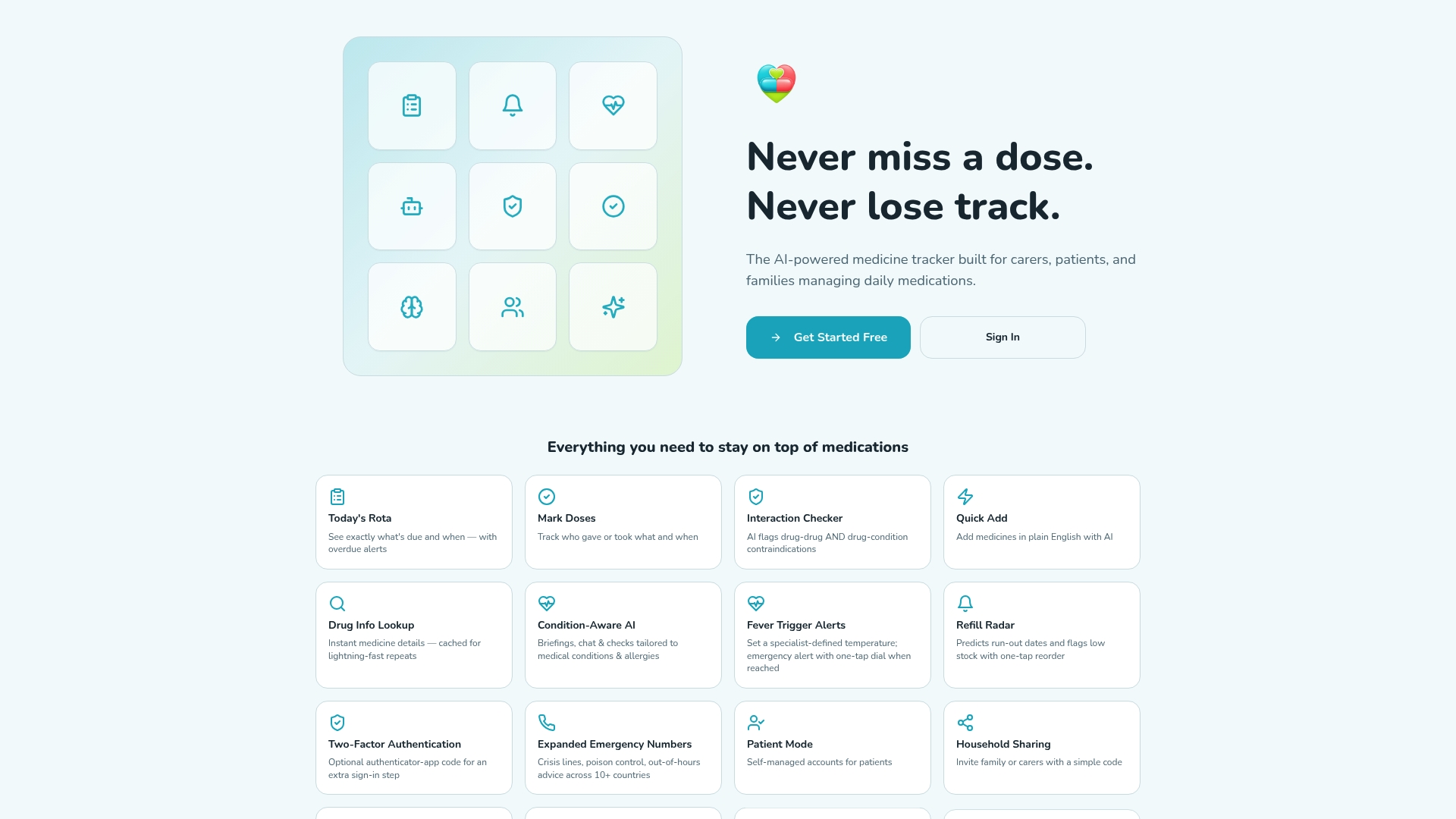
The free tier covers medication schedules, dose logging, and alerts. Paid plans unlock multi-patient management, AI-powered insights, refill predictions, and appointment scheduling, features that matter most when the care situation is complex. The platform is UK GDPR-compliant, works on any device, and takes minutes to set up.
Thedailydosetracker supports your caregiving. It does not replace your GP or pharmacist, and any changes to medicines should always go through a clinician. But for the daily work of keeping track, it removes a real and unnecessary burden. Start with the free plan and see how much lighter the routine feels.
Useful sources for carers
- NHS Structured Medication Review and Discharge Medicines Service: explains what an SMR involves, who is eligible, and how to request one through your GP or pharmacist. The DMS is specifically designed for people recently discharged from hospital.
- Carers UK: practical guidance on carer rights, Carer's Allowance, the Carer's Assessment, and a helpline for urgent queries. Their medication-management resources are written for non-clinical carers.
- Age UK: advice on medicines management for older people, local services, and signposting to NHS support. Particularly useful for carers of people aged 65 and over.
- Medication incidents and informal caregiver burden (PubMed): the cross-sectional study reporting an odds ratio of 2.16 for medication incidents among burdened carers. Useful if you want to show a clinician the evidence base for requesting a review.
- Medication management activities performed by informal caregivers (PMC): covers the full scope of medication tasks carers perform and the training gap. Relevant to anyone wanting to understand the research behind the burden concept.
- Understanding burden in dementia caregivers (BMC Geriatrics): reports the 38.9% burden prevalence and 56.7% medication challenge figures cited in this article.
- Medication process-related burden in dementia carers (PMC): focuses on specific process steps (obtaining, preparing) rated as high burden, and supports the case for pharmacy-led simplification.