

A medication compliance report is a structured clinical record showing how closely a patient has followed their prescribed medicine schedule, covering dose timing, frequency, and duration. Clinicians, carers, and patients use it to spot gaps in treatment before those gaps become clinical problems.
Typical reports contain:
- A headline adherence metric (such as the proportion of days covered or medication possession ratio)
- A visual timeline or dot chart mapping taken, missed, and late doses across a defined period
- A brief clinical or pharmaceutical interpretation noting patterns, flagged events, and suggested next steps
In practice, the report serves three immediate clinical purposes:
- Triage: quickly identifying patients whose adherence has dropped below a clinically meaningful threshold
- Barrier identification: distinguishing between patients who cannot access their medicines and those who have chosen to stop
- Documentation: creating a contemporaneous record of adherence conversations for the clinical notes
Table of Contents
- What do compliance, adherence, and persistence actually mean?
- What does a medication compliance report typically contain?
- Where does the data in a compliance report come from?
- How are MPR, PDC, and percentage adherence calculated?
- How do you read and act on a compliance report?
- What are the limitations and ethical considerations in the UK?
- Practical steps for clinicians, carers, and patients
- What does a good one-page compliance report look like?
- Key takeaways
- Reports work best when they start a conversation, not end one
- Thedailydosetracker makes compliance reporting straightforward
- Useful sources and further reading
What do compliance, adherence, and persistence actually mean?
The terms are often used interchangeably, but they carry distinct meanings that matter when reading a report.
ISPOR defines medication compliance (increasingly replaced by adherence in clinical literature) as the degree to which a patient's actual intake matches the prescribed timing, dosage, and frequency. The NHS Specialist Pharmacy Service similarly uses adherence as the preferred term, reflecting a shift away from the implied blame in "compliance." Persistence is different: it describes the duration from treatment initiation to discontinuation, regardless of how well individual doses were taken.
The distinction matters in practice. A patient who takes every dose correctly for six weeks and then stops entirely is persistent for six weeks but non-persistent thereafter. A patient who continues for a full year but regularly misses Monday doses is persistent but partially non-adherent. A high-quality patient compliance report captures both dimensions, not just one.
What does a medication compliance report typically contain?
Most reports share a common set of components, though the format varies by setting and data source.
- Patient and medication chart: name, medicine, dose, prescribed frequency, and the reporting period
- Headline adherence metric(s): a single percentage or ratio (MPR or PDC) giving an at-a-glance summary
- Visual timeline or dot chart: each day or dose occasion represented as a filled dot (taken), empty dot (missed), or coloured marker (late); dot charts and heat maps are consistently preferred by clinicians over dense numerical tables
- Flagged events: drug holidays (gaps of seven or more consecutive days), clusters of late doses, and any dose changes not reflected in the dispensing record
- Clinical or pharmaceutical interpretation: a short paragraph contextualising the numbers and recommending a next step
A few terms appear on almost every report and are worth knowing:
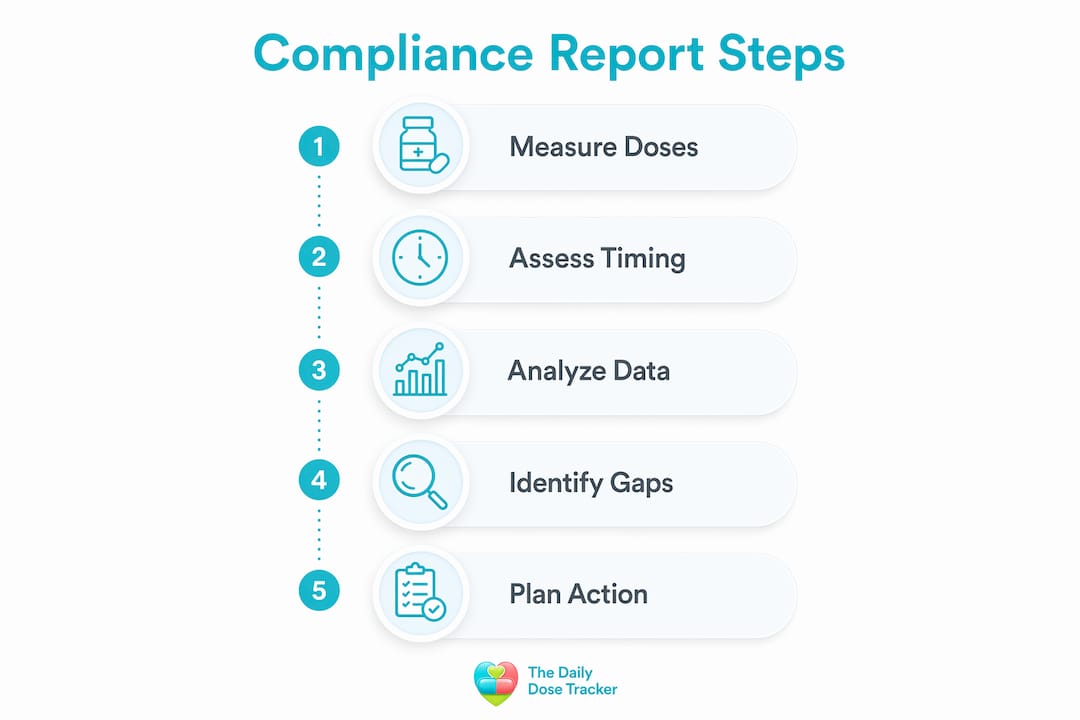
Taking adherence refers to the percentage of prescribed doses actually taken. Timing adherence measures how many of those doses fell within the prescribed time window. Correct dosing days counts days on which the right number of doses was taken at the right time. A drug holiday is a gap of several consecutive days with no recorded intake, often the most clinically significant flag in the report.
Where does the data in a compliance report come from?
The reliability of any medication adherence report depends entirely on its data source. Each source has genuine strengths and real blind spots.
| Data source | Strengths | Limitations |
|---|---|---|
| Pharmacy refill / dispensing records | Widely available; objective; covers long periods | Dispensing ≠ ingestion; filled but uncollected prescriptions inflate apparent adherence |
| Electronic health record (EHR) medication history | Integrates prescribing and dispensing; accessible to the clinical team | Relies on accurate data entry; dose changes under verbal advice may not be recorded |
| Electronic monitoring (MEMS caps, smart pillboxes) | Considered the gold standard for measuring intake timing | High cost; no contextual "why" data; device failures create false non-adherence flags |
| App or self-report (e.g. a medication tracking system) | Captures reasons for missed doses; real-time; low cost | Subject to social desirability bias; requires patient engagement |
| Pharmacy notes / carer records | Adds qualitative context | Inconsistent format; not always integrated into the report |
A refill-only report tells you a prescription was dispensed. It cannot tell you whether the patient took the medicine, adjusted the dose on a clinician's verbal advice, or stockpiled tablets. A combined report drawing on pharmacy refill data and app logs reveals both the supply picture and the day-to-day intake pattern, giving the clinician far more to work with.
How are MPR, PDC, and percentage adherence calculated?
Three metrics appear most often in UK and international reports. AHRQ documents the medication possession ratio as one of the most widely adopted measures, though standardisation across studies remains limited.

| Metric | Formula | Notes |
|---|---|---|
| Medication Possession Ratio (MPR) | Days' supply dispensed ÷ days in the observation period | Can exceed 1 if the patient collects early or stockpiles |
| Proportion of Days Covered (PDC) | Days covered by dispensed supply ÷ days in the observation period | Capped at 100%; preferred for chronic medicines |
| Taking adherence (%) | Doses taken ÷ doses prescribed × 100 | Requires electronic monitoring or app data; most granular |
Worked example (90-day period): A patient prescribed a once-daily antihypertensive collects two 30-day supplies spaced 35 days apart during a 90-day period. The proportion of days covered in this scenario is moderate but less than optimal.
There is a commonly used clinical threshold for adherence; patients at or above this level are generally classified as adherent for chronic-disease management purposes. Treat that cut-off as a starting point rather than a verdict. A patient at 79% who has been managing a complex regimen alone deserves a different conversation from one at 79% who has simply stopped collecting prescriptions.
How do you read and act on a compliance report?
Start with the headline metric, then move to the timeline before drawing any conclusions.
PDC or MPR below 80%: Check the refill history first. Is the gap a single missed collection or a sustained pattern? Then ask open questions about side effects, cost, and practical barriers before assuming intentional non-adherence. A care plan medication alignment review is often the most productive next step.
A drug holiday flag: A gap of seven or more consecutive days warrants a direct conversation. Useful opening questions: "Has anything changed with how you're feeling on this medicine?" and "Have you had any difficulty getting to the pharmacy?" Avoid framing the conversation as an accusation.
Late-dose clustering: Doses consistently taken several hours outside the prescribed window may indicate a practical barrier (shift work, caring responsibilities) rather than disengagement. Regimen simplification, such as switching to a once-daily formulation, often resolves this without any change in the patient's motivation.
Reports that combine intake logs with symptom diary entries reveal the reasons behind missed doses far more reliably than refill numbers alone, which is why qualitative logging alongside quantitative metrics matters.
What are the limitations and ethical considerations in the UK?
No report is a complete picture, and several common errors can lead to misinterpretation.
- Primary non-adherence: a prescription issued but never dispensed leaves no trace in refill-based reports; the patient appears absent from the data rather than non-adherent
- Stockpiling: patients who collect prescriptions but take them irregularly will show high MPR/PDC while their actual intake is poor
- Unrecorded dose changes: verbal advice to halve a dose or take a medicine only on certain days creates a mismatch between the prescribed and expected supply
- Device failures: smart pillbox malfunctions or app non-use generate false non-adherence flags
- Social desirability bias: patients and carers completing self-report tools tend to over-report adherence, particularly when they sense the report will be reviewed by a clinician
On the legal side, UK GDPR applies to any personal health data used to generate a compliance report. Patients must give informed consent for their data to be shared with named carers or a multidisciplinary team. Data should be minimised to what is clinically necessary, and retention periods must be documented. When recording adherence findings in the clinical notes, note the metric, the data source, and the conversation held, but avoid language that could be read as blaming the patient. The Information Commissioner's Office publishes guidance on health data processing that is worth reviewing before setting up any shared reporting workflow.
Practical steps for clinicians, carers, and patients
Clinicians:
- Confirm dispensing records against the patient's own account before acting on a low metric
- Integrate the report finding into the care plan with a documented action and review date
- Consider regimen simplification (fewer daily doses, combination tablets) when timing adherence is consistently low
- Refer to a clinical pharmacist or medicines optimisation team for complex cases
Carers:
- Check physical medicine supplies against the expected count at each visit; a medication routine review can help structure this
- Use a shared pill organiser or a digital app to log doses in real time rather than relying on memory
- Record missed doses with a brief note on the reason (patient refused, supply ran out, side effect reported)
- Escalate to the prescriber promptly if a drug holiday is identified or the patient reports new symptoms
Patients:
- Bring your blister packs, prescription slips, and any symptom diary to the appointment
- Note any doses you have adjusted or skipped, and the reason, before the consultation
- Ask your GP or pharmacist to explain what the headline metric means for your specific medicine
Pro Tip: When preparing for a medicines review, photograph your current blister packs on your phone. A visual record of remaining tablets gives your clinician an instant pill count without requiring you to carry the boxes.
What does a good one-page compliance report look like?
Consensus research with clinicians and pharmacists found that compact, one-page reports combining calculated adherence values with dot charts and a pharmaceutical interpretation were preferred for clinical use and reduced cognitive load at the point of decision.
A well-structured one-page report includes:
- Patient name, date of birth, medicine name, dose, and prescribed frequency
- Reporting period (typically 90 days for chronic medicines)
- One or two headline metrics (PDC and/or taking adherence percentage)
- A dot chart or daily calendar showing taken, missed, and late doses
- Flagged events: drug holidays, early refills, dose changes
- A short pharmacist or clinical interpretation (two to three sentences)
- Recommended actions with a named responsible clinician and review date
Anonymised example: A 68-year-old patient with type 2 diabetes showed a PDC of 64% over 90 days for their metformin, with a 12-day drug holiday in the third month. The dot chart revealed late-dose clustering on weekends. The pharmacist's interpretation noted a likely practical barrier rather than intentional non-adherence. The agreed action was a switch to a modified-release once-daily formulation and a follow-up call at four weeks. At review, the patient reported no further missed doses.
Thedailydosetracker supports this workflow directly. The platform logs each dose in real time, generates a visual timeline, and exports a one-page summary that carers or clinicians can share with the wider team. All data is stored and processed in line with UK GDPR, and household sharing means multiple carers can contribute to the same patient record without duplicating effort.
Key takeaways
A medication compliance report is only as useful as the action it prompts: the metric identifies the problem, but the clinical conversation and care plan change determines the outcome.
| Point | Details |
|---|---|
| Core definition | A compliance report records how closely a patient follows prescribed dose timing, frequency, and duration. |
| Key metrics | PDC and MPR are the most common measures; an 80% threshold is widely used but should not be applied rigidly. |
| Data source matters | Refill-only reports miss primary non-adherence and stockpiling; combined app and dispensing data gives a fuller picture. |
| UK legal obligations | UK GDPR requires patient consent before sharing report data with carers or multidisciplinary teams. |
| Thedailydosetracker | The platform logs doses in real time, generates exportable one-page summaries, and supports GDPR-compliant sharing for carers and clinical teams. |
AHRQ has documented substantial gaps between prescribed and taken medicines across multiple datasets, underscoring why structured adherence reporting matters for patient safety.
Reports work best when they start a conversation, not end one
The most common misuse of a medication adherence report is treating it as a verdict. A PDC of 64% is not evidence that a patient is careless; it is a prompt to ask why. In my experience reviewing how these tools are used in practice, the reports that actually change outcomes are the ones where the clinician or carer approaches the finding with curiosity rather than correction.
Carers, in particular, carry enormous cognitive load when managing medicines for someone else. A report that surfaces a missed-dose pattern is genuinely useful to them, but only if it is framed as shared information rather than an audit. The same applies to patients managing their own complex regimens: seeing a dot chart of their own adherence is often the first time they have had a visual representation of something they already knew was difficult.
The shift from "compliance" to "adherence" in clinical language was not just semantic. It reflected a recognition that the patient is a partner in the process, not a subject of it. Reports built on that principle, combining quantitative metrics with qualitative diary data and presented in a format that the patient can also read, tend to produce better conversations and, ultimately, better outcomes.
Thedailydosetracker makes compliance reporting straightforward
Most families and care teams do not have access to a clinical pharmacist who can pull together a one-page adherence summary on demand. Thedailydosetracker fills that gap without requiring any clinical infrastructure.
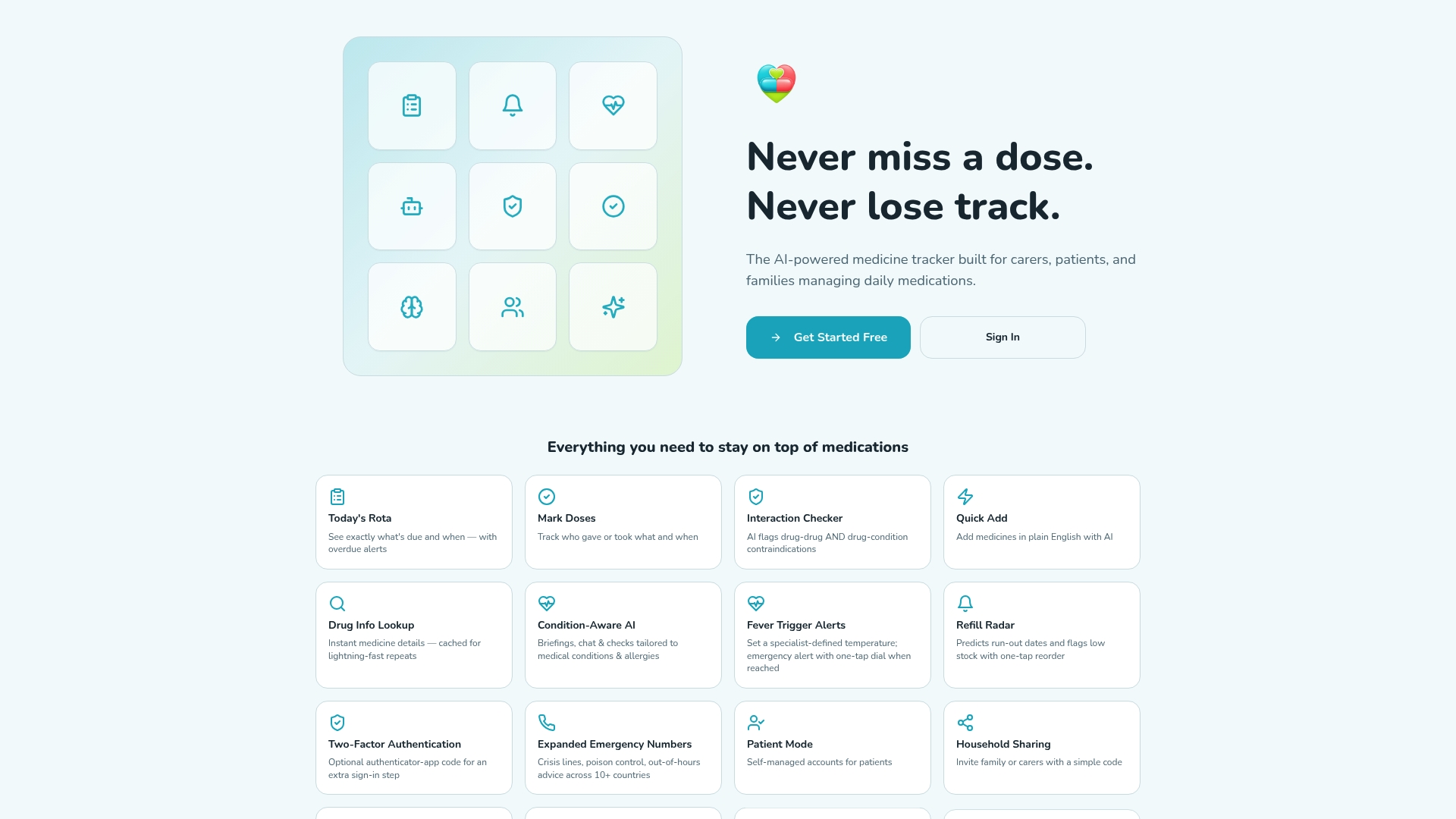
Log each dose as it is taken, and the platform builds a visual timeline automatically. When a medicines review is due, export a one-page summary showing the headline PDC, the dose chart, and any flagged events, ready to share with a GP, pharmacist, or specialist. Household sharing means a family carer and a professional care worker can both contribute to the same record, with no duplication. Drug interaction checks and refill predictions run in the background, so the report reflects the full picture of a patient's regimen.
Three steps to get started: create a free account, add the patient's medicines and prescribed schedule, then log doses as they happen. The exportable summary is available from day one. All data is processed under UK GDPR, and you control exactly who can view or download the report.
Start your free account and have a shareable compliance summary ready before your next medicines review.
Useful sources and further reading
- NHS Specialist Pharmacy Service: Defining and understanding medication adherence — the NHS's own terminology guidance; useful for clinicians wanting a UK-grounded definition of adherence and its distinction from compliance.
- ISPOR: Medication Compliance and Persistence — Terminology and Definitions — the formal international reference for distinguishing compliance, adherence, and persistence; cited in most clinical measurement papers.
- AHRQ: Using Health IT to Determine Medication Adherence — covers MPR, PDC, and the practical challenges of integrating adherence data into electronic health records.
- PMC: Communicating electronic adherence data to physicians (consensus development) — the consensus study underpinning the one-page report format recommendation; directly relevant to anyone designing or commissioning a report template.
- PMC: The Medication Adherence Report Scale (MARS-5) — a validated self-report tool widely used in UK primary care; useful background for clinicians considering self-report as a data source.
- ICO: UK GDPR guidance for health organisations — the primary reference for consent, data minimisation, and retention requirements when processing patient adherence data in the UK.