
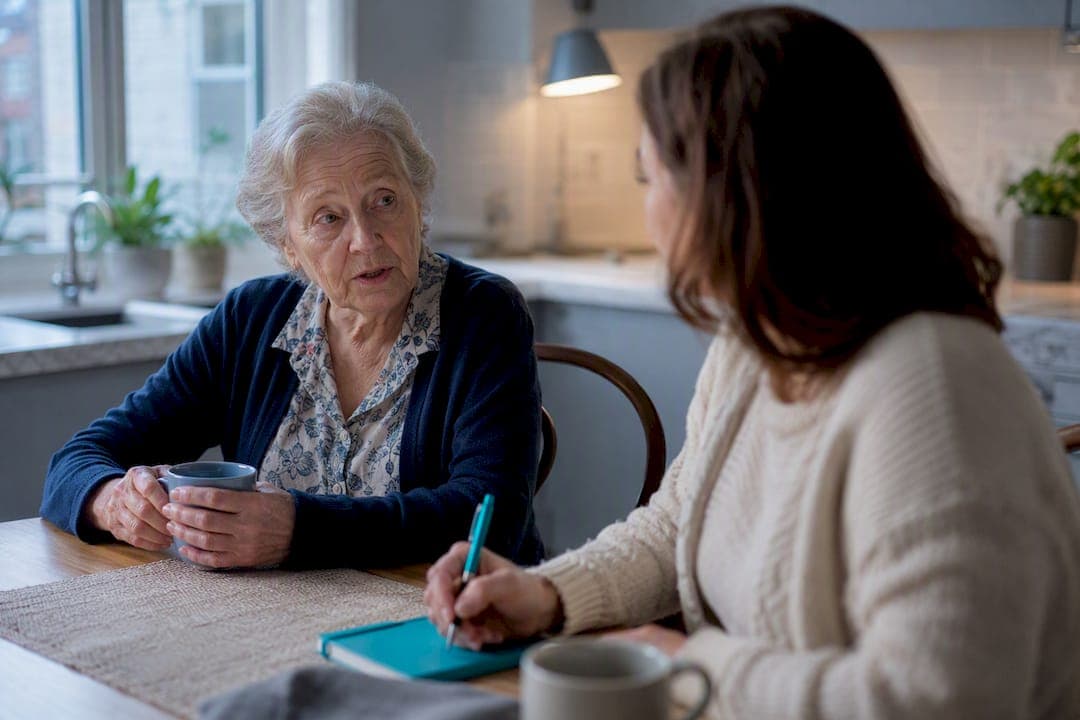
Start by collecting the essentials: who has had which condition, at what age, and how family members feel about sharing that with others. Get clear consent before you send anything. Then pick a secure route: the NHS App's proxy access for eligible carers, Apple Health's family sharing, or a dedicated family-history app. Make this a priority soon rather than an indefinite, vague plan.
TL;DR:
- Sharing detailed family health history helps improve clinical decisions and early screening, but reach depends on communication patterns within families.
- Using family history apps or NHS proxy access requires matching GP surgeries and explicit consent, with revocation and privacy controls being crucial.
- Digital sharing options vary: Apple Health allows selective data sharing with easy revocation, while exported documents are difficult to control once sent.
- Involving relatives in ongoing conversations and building incremental, consistent records over time yields better accuracy than one-time efforts.
- For medication safety, household sharing tools provide real-time, shared schedules and interaction checks, reducing risks through continuous, collaborative updates.
Table of Contents
- Why sharing family health information actually matters
- What to collect: the family health history checklist
- How to share: conversation strategies and practical templates
- Digital options: platform types and how to choose one
- NHS App and proxy access: what UK carers can actually do
- Apple Health, family-history apps, and exported documents: what to expect from each
- Privacy, consent, and how to limit or stop sharing
- A practical checklist: gather, secure, and share
- Practical lessons from carer-focused platform design
- Extending sharing beyond immediate family: what changes
- How clinicians actually interpret shared family history
- When family members disagree about the facts
- Keeping shared data secure once it leaves the platform
- Where conventional advice on this gets it wrong
- An option worth trying: household sharing built for medication safety
- Further reading and primary sources
- Sources
Why sharing family health information actually matters
Family history is one of the few pieces of clinical information a patient can supply that no blood test replicates. When a GP knows your mother had breast cancer at 44 or your father developed type 2 diabetes at 50, they can adjust screening schedules and flag risks years before symptoms appear. Patient and family involvement in sharing health data improves clinical decision-making and supports preventive care, though privacy concerns and practical barriers still limit how widely families actually do it.
For carers, the payoff is more immediate when they use a care app that helps share a parent’s care plan. Knowing a relative's full medication list and diagnosis history prevents dangerous overlaps, avoids repeating tests, and gives every clinician in the loop the same starting point. A carer juggling appointments for an elderly parent with three specialists benefits enormously from one accurate, current record rather than three partial ones scattered across different systems.
The evidence on reach is more mixed than the marketing usually admits. Research into family health information sharing among older adults found that reach depends heavily on communication patterns within a family. Some relatives naturally become information hubs; others are left out entirely, often not through malice but because nobody thought to loop them in.
Sharing has clear boundaries worth respecting from the outset:
- A teenage niece rarely needs the same clinical detail as a sibling managing the same hereditary condition.
- Distant relatives may only need a summary flag ("heart disease runs in the family") rather than full diagnosis dates.
- Some conditions, particularly mental health diagnoses, carry stigma that means broader sharing needs explicit permission every time, not assumed consent.
- Partial information still has value. Even an incomplete family history helps clinicians guide screening decisions, so don't let missing details stop you from sharing what you do know.
Pro Tip: If a relative is hesitant, offer to share only a summary line rather than the full history. A partial "yes" beats a full "no" every time.
The barriers are real, not just theoretical. Families avoid sharing because they worry about who else might see the data, whether it could affect insurance, or simply because nobody has ever asked them the right questions in the right order. That last one is fixable, and it's where a proper checklist earns its keep.
What to collect: the family health history checklist
Get the scope right before you start asking questions, or you'll end up chasing people twice. A useful family history covers multiple categories of relatives and captures key data points on each.
1. Who to include
Cover your parents, siblings, and children first. Then work outward to grandparents, aunts, uncles, nieces and nephews. This scope of eight relative categories comes directly from NHS guidance on family and carer access, and it's the right level of breadth for spotting hereditary patterns without turning the project into a genealogy dig.
2. The five essential data points per person
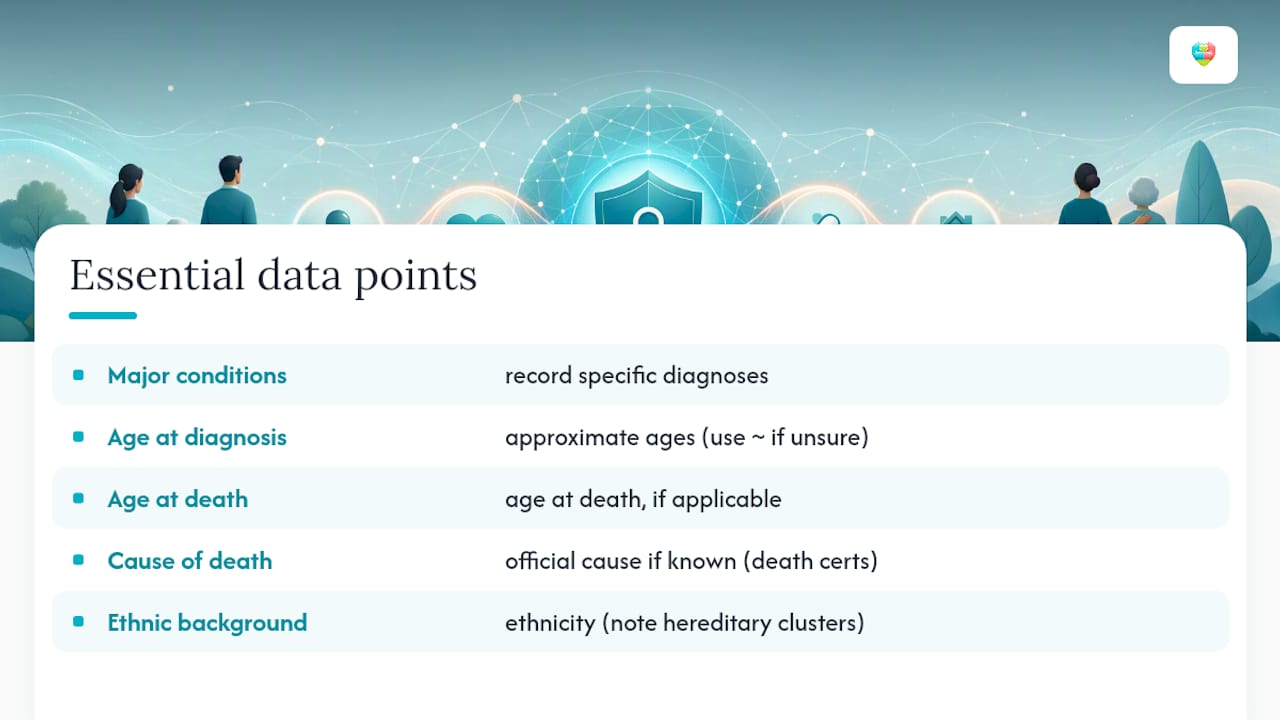
For each relative, aim to record major medical conditions with as much specificity as possible, approximate ages at diagnosis and death if applicable, cause of death if known, and ethnic background, recognizing hereditary condition clusters.
3. Handling uncertainty honestly
Families rarely have perfect records, and that's fine. Mark approximate ages with a tilde or "circa" rather than guessing a precise figure and presenting it as fact. Write "cancer, type unknown" rather than inventing a diagnosis nobody actually confirmed. Clinicians would rather see an honest "unsure, believed to be around 60" than a confident but wrong number.
4. Where to find the paper trail
Death certificates list official cause of death and are usually the most reliable single document a family holds. GP referral letters and hospital discharge summaries often name conditions precisely, including the exact terminology a specialist used. Old vaccination cards and health visitor records can confirm childhood illnesses and rule out mistaken assumptions about what a relative actually had. If a relative kept a diary or letters mentioning hospital stays, even informal notes can jog memory and help date events.

5. Building the record incrementally
Don't try to complete the whole tree in one sitting. Start with immediate family, since that's where clinical relevance is highest, then add extended relatives as conversations happen naturally, at gatherings, phone calls, or when someone mentions a health scare. A family history built over three conversations across a month is more accurate than one rushed phone call trying to cover four generations at once.
Keep the format consistent from day one, whether that's a shared spreadsheet, a notes app, or a dedicated family-history tool. Consistency matters more than the specific format you choose, because it's what makes the record usable by a GP later, not just readable by you now.
How to share: conversation strategies and practical templates
The hardest part of family health data sharing usually isn't the technology. It's asking your uncle about his heart attack without it feeling like an interrogation. Getting the conversation right matters more than picking the right app.
Scripts that lower the temperature
Open with the benefit, not the request. Something like: "I'm putting together a family health record so we've got the full picture for doctors, mine and yours. Would you mind if I asked a few quick questions about your health history?" That framing signals the request serves them too, not just you.
For a phone call to a relative you don't see often, try: "I know this might feel like an odd question out of nowhere, but I'm trying to understand our family's health background properly, for screening and just being prepared. Do you know if anyone on your side had diabetes or heart disease?"
For a text message, keep it short and low-pressure: "Quick one, when you get a chance: do you know what age Grandad was diagnosed with his heart condition? Building a family health record and want to get it right."
Documenting consent properly
A verbal "yes, that's fine" is enough for most family sharing, but write it down anyway. A simple consent log works well: date, relative's name, what they agreed to share, and with whom. If you're using a digital platform that stores health data, send a short message confirming what you've entered and why, so there's a written trail if a relative later asks what happened to their information.
For anything going into a shared digital record rather than a private notebook, get explicit confirmation in writing, even if it's just a text reply saying "yes, fine to add that to the family record." That single message protects everyone if a dispute arises later.
Sensitive cases need a different approach
- For children, always ask a parent or guardian rather than the child directly, and keep detail proportionate to age and clinical relevance.
- For elderly relatives with cognitive decline, involve whoever holds power of attorney or is their primary carer, and be patient with repeated explanations.
- For estranged relatives, a brief, low-obligation message often works better than a phone call: "No pressure at all, but if you're ever willing to share any family health history, even just a quick note, it would help. Totally understand if not."
- If someone refuses outright, respect that fully and don't push. Note the gap in your record rather than guessing, and revisit only if they raise it themselves later.
Research into how older adults share health information within families found that social dynamics, not the technology used, determined who actually received updates. The families who did this well treated it as an ongoing relationship, not a one-off data collection task.
Digital options: platform types and how to choose one
Once you've got the conversations done, you need somewhere to put the information that isn't a photo of a napkin. Five broad categories cover most of what's available.
Family-history apps focus specifically on capturing pedigree-style records, often letting you build a visual family tree with conditions attached to each person. Tools in this category, such as HealthKin, typically offer document capture and per-profile sharing controls, though the depth of GDPR compliance and export policy varies by provider, so check before committing sensitive data.
Household medication apps solve a narrower but urgent problem: keeping track of what everyone in a household is actually taking right now, rather than historical family conditions. These matter most for active caregiving situations rather than long-term hereditary risk tracking.
Patient portals and electronic health record (EHR) systems connect directly to clinical records, but interoperability between systems remains patchy. Health information exchange between providers improves clinical completeness in principle but organisational uptake is uneven, meaning your patient-held data often still needs manual reconciliation with what your GP's system actually holds.
Device ecosystems, chiefly Apple Health, let you share specific health metrics with named people through your phone's existing infrastructure, no separate app or account needed.
Shared or exported documents (a spreadsheet, a PDF, an emailed summary) are the lowest-tech option and sometimes the most practical for a small family, but they come with the weakest privacy controls of any option here.
When choosing between these, run through a short decision checklist:
- Can you grant and revoke access to specific people, or is it all-or-nothing?
- Does the platform support multiple users updating the same record, or does one person become the permanent bottleneck?
- Can you export your data if you switch platforms later, and does it import cleanly elsewhere?
- Does the provider state clear UK GDPR compliance, and can you find their data retention policy without digging?
Pro Tip: Before entrusting a platform with sensitive family health data, actually test the revoke function on a dummy entry. Some apps make granting access easy and revoking it deliberately harder to find.
No single category wins outright. A family managing three generations of hereditary heart disease probably needs a proper family-history tool with pedigree mapping. A household caring for one elderly parent with a complex medication list needs something built around daily schedules and dose tracking far more than genealogy. Match the tool to the actual job, not the one with the most features.
NHS App and proxy access: what UK carers can actually do
The NHS App offers formal proxy access, letting a carer view and manage certain health information for someone else, but eligibility hinges on one detail people often miss.
The registration requirement that trips people up
Both the patient and the carer must be registered at the same GP surgery for formal proxy access to work. This single surgery-matching requirement catches out a lot of families, especially adult children who've moved away and registered with a different practice from their ageing parents.
What proxy access typically covers
Once set up, proxy access generally lets a carer book and manage appointments on the patient's behalf, order repeat prescriptions, and view certain parts of the patient's medical record depending on what the GP practice has enabled. It doesn't automatically grant full access to every note a GP has ever written. Access levels are set by the practice, and some information (particularly sensitive entries) may stay restricted even with proxy access active.
Setting it up, step by step
- Confirm both patient and carer are registered at the same GP surgery. If not, this is the first thing to resolve.
- Contact the GP surgery directly, since proxy access isn't something you can self-activate purely within the app.
- The patient will usually need to provide consent, either in writing or verbally with the practice recording it, unless they lack capacity, in which case different rules on legal authority apply.
- Once approved, the carer logs into their own NHS App and switches to the linked profile to manage the patient's appointments and prescriptions.
- Check periodically that access still reflects the current situation, particularly if the patient moves surgeries or the caring arrangement changes.
If proxy access isn't available
Not every family qualifies straight away, especially where the patient and carer use different surgeries. In that situation, a shared summary document covering medications, conditions and key contacts, updated manually after each appointment, is a workable interim step until proxy access can be formally arranged.
Apple Health, family-history apps, and exported documents: what to expect from each
Different tools handle sharing in genuinely different ways, and knowing the mechanics before you commit data matters.
Apple Health's family sharing
Apple's Health app lets you share specific categories of health data with named people, and critically, you choose exactly which categories to share rather than exposing an entire record. Apple provides stepwise controls including the ability to stop sharing at any point, which puts it ahead of most exported-document approaches on revocability. The limitation is scope: it covers data your phone or connected devices actually capture, such as activity and some logged conditions, not a full clinical history a GP holds.
Family-history apps and what to check before trusting one
Dedicated family-history tools generally offer pedigree-style visual trees and document capture, sometimes with AI-assisted extraction from uploaded letters or certificates. Before entering sensitive data, verify the provider's stated GDPR compliance and, just as importantly, what happens to your data if you delete your account. A polished interface says nothing about whether your data actually gets deleted on request.
The exported document problem nobody warns you about
Once a health document leaves a platform as an exported PDF or an emailed attachment, the sender cannot reliably revoke access to copies that have already been downloaded or forwarded. There's no technical mechanism to claw back an email attachment sitting in someone's inbox. If you must share via export, minimise what's included, watermark or date the document, and treat it as a one-time snapshot rather than a living record you can update remotely later.
Privacy, consent, and how to limit or stop sharing
Most platforms give you real control over sharing, and using it properly matters as much as setting access up correctly in the first place.
Adjusting or revoking access
- Check the platform's settings for a dedicated sharing or permissions menu, usually found under account or privacy settings rather than buried in a general menu.
- Revoke access for specific people rather than resetting everything, if the platform allows selective revocation.
- Confirm the change actually took effect, some apps show a pending state for a short period before revocation completes.
- If you're correcting an error in an official NHS record rather than just your own shared notes, contact your GP surgery directly, since patients can't usually edit clinical entries themselves.
If a document has already gone further than intended
Request deletion from whoever received it, and note when and how it was shared, in case you need that trail later. If the exposed information carries a genuine safety risk, such as an incorrect allergy or medication entry circulating, tell the patient's clinician promptly so it doesn't influence a treatment decision.
Your rights over the underlying record
You have a right to ask for corrections to inaccurate health information held about you or, with appropriate authority, a relative. The most direct route for NHS-held records is asking your GP practice what their specific correction process involves, since procedures vary slightly by practice and by what system they use.
Pro Tip: Set a calendar reminder every six months to review who has access to your shared health data. Circumstances change, carers move on, relationships shift, and stale access is the most common privacy gap in family sharing setups.
A practical checklist: gather, secure, and share
Breaking the whole process into three phases keeps it manageable rather than overwhelming.
Prepare
- List every relative you plan to include, using the eight-category scope covering parents through to nieces and nephews.
- Gather available documents: death certificates, GP letters, old vaccination records.
- Set a realistic timeline, aiming to complete initial data collection within two to four weeks rather than rushing it in one weekend.
Collect
- Log each entry using the five standard fields: condition, age at diagnosis, age at death, cause of death, ethnic background.
- Tag uncertain entries clearly rather than presenting guesses as confirmed fact.
- Fill gaps as conversations happen naturally, don't force every relative into one sitting.
Share
- Choose your sharing method based on the decision criteria covered earlier, matched to your family's actual size and complexity.
- Document consent for each person, even briefly, before adding their information to a shared platform.
- Share the completed or updated record with the relevant clinician and revisit it after major health events, not just once a year.
| Phase | Core action | Typical timeframe |
|---|---|---|
| Prepare | List relatives, gather documents | 1 week |
| Collect | Log entries with standard fields | 2 to 3 weeks |
| Share | Choose platform, document consent, notify clinician | Ongoing |
The record isn't a one-off project you finish and file away. New diagnoses, deaths, and even corrected memories mean it needs revisiting, ideally whenever a significant health event happens in the family, not on some arbitrary annual schedule.
Practical lessons from carer-focused platform design
Working closely with how carers actually manage medication reveals a consistent pattern: the families who cope best treat health data sharing as a habit, not a project. They update records the week something changes, not months later when a new specialist asks and nobody remembers the details.
Medication safety failures rarely come from a lack of care. They come from information sitting in the wrong place at the wrong moment, a dosage change mentioned to one sibling but never passed to the carer actually administering the medicine that evening. Household sharing tools exist precisely to close that gap, letting everyone involved see the same current schedule instead of relying on memory or a scrap of paper on the fridge.
Household sharing and multi-patient management features map fairly directly onto the checklist covered earlier: one shared schedule visible to every carer in the household, refill predictions that flag a running-low prescription before it becomes a missed dose, and drug interaction checks that catch a dangerous combination before it reaches the patient. For a family managing an elderly relative across two or three specialists, that kind of continuous, shared view of medication does more for day-to-day safety than a static family-history document ever could, though the two serve genuinely different purposes and both matter.
The single most useful habit isn't a tool at all. It's a five-minute conversation after every appointment: what changed, who needs to know, and who's updating the record. Get that right and the right medication reminder system becomes far more effective, because it's working from accurate, current information rather than last month's guess.
Extending sharing beyond immediate family: what changes
Sharing with a wider circle, aunts, cousins, long-term carers who aren't blood relatives, brings real benefits but shifts the risk calculation noticeably.
The upside is genuine: extended family members with the same hereditary risk get earlier warning, and a professional carer who knows the full medication picture makes fewer dangerous assumptions. A cousin who learns early that a hereditary heart condition runs in the family can raise it with their own GP years before symptoms appear.
The risk grows with the circle, though, and not just in an abstract privacy sense. More people holding a copy of sensitive health data means more chances for it to end up somewhere it shouldn't, forwarded, stored on an unsecured device, or simply remembered inaccurately and passed on wrong. Extended relatives also don't share the same assumed confidentiality that close family often defaults to.
The practical fix is proportionality, not exclusion. Give extended family and non-family carers summary-level information relevant to their situation ("heart disease is common on this side of the family, worth mentioning to your GP") rather than full clinical detail with exact dates and diagnoses. Full access should stay reserved for those directly involved in day-to-day care or decision-making, where the operational need for detail is obvious and ongoing.
How clinicians actually interpret shared family history
A GP reading a family history you've compiled isn't treating it as a diagnosis. They're using it to adjust probability, deciding whether a screening test happens five years earlier than standard guidelines suggest, or whether a symptom that might otherwise get dismissed deserves a closer look.
This matters for how you present information. Rather than writing "Dad had a heart attack," specify age, whether it was a first event, and any known contributing factors like smoking or diabetes if you know them. Clinicians weigh a heart attack at 45 very differently from one at 75, and vague entries force them to either guess or ask you to go back and find out.
Incomplete entries still carry weight, so don't withhold a rough answer while waiting for a perfect one. Guidance on family health history from public health sources confirms that even partial information helps guide screening decisions, so "cancer, type unknown, sometime in her 60s" is genuinely more useful to a GP than nothing at all.
One caution worth flagging directly to your clinician: family history is a risk indicator, not a certainty. A strong family history raises the probability of a condition; it doesn't confirm it, and clinicians read it that way. Presenting it as definite ("I will definitely get this") rather than as elevated risk can lead to unnecessary anxiety or, in rare cases, requests for tests that aren't actually clinically indicated at that point.
When family members disagree about the facts
Family memory is unreliable in entirely predictable ways, and disagreements about who had what, or at what age, are common rather than exceptional.
When two relatives give conflicting accounts, record both versions rather than picking the one that sounds more confident. Write something like "condition reported as either kidney disease or kidney stones, accounts differ" rather than silently choosing one and losing the discrepancy entirely. A clinician can work with acknowledged uncertainty far more easily than with false precision that later turns out to be wrong.
Documentary evidence should generally settle a dispute over memory. A death certificate naming a specific cause of death outranks a relative's recollection from thirty years ago, however confidently that recollection is delivered. Where documents don't exist, the account from whoever was closest to the event, a spouse rather than a distant cousin, usually carries more weight, though it's still worth noting the source alongside the claim.
Some disagreements aren't really about facts at all. They're about who gets to control the family narrative, particularly around a condition carrying stigma or blame. In those cases, keep the record focused on clinical relevance rather than trying to adjudicate a family dispute, and don't let an unresolved argument stop you recording what multiple people do agree on.
Keeping shared data secure once it leaves the platform
Platform-level privacy controls only cover the data while it sits inside that platform. The moment it moves, by message, email, or a printed sheet handed to a relative, different rules apply.
Avoid sending sensitive health data over standard SMS or unencrypted email where possible; a secure messaging app or a platform's built-in sharing function offers far better protection than a plain text message sitting on a phone company's servers indefinitely. If email is genuinely the only option, consider password-protecting the document and sharing the password through a separate channel, a phone call rather than the same email thread.
For storage, avoid keeping the only copy of a family health record on a single personal device with no backup, since a lost or broken phone shouldn't mean losing years of collected history. A password-protected cloud backup or an encrypted drive gives you resilience without leaving the data exposed on an easily lost device.
Physical printouts deserve the same caution as digital files. A paper copy left on a kitchen table or in an unlocked car is just as much a privacy lapse as an unsecured spreadsheet, and it's the one people tend to forget about entirely.
Where conventional advice on this gets it wrong
Most guidance on this topic treats family health data sharing as a technical problem: pick the right app, tick the right settings, done. The research doesn't support that framing. The genuine barrier is social, deciding who needs to know, in what detail, and getting consent without it feeling like an audit.
The checklist-first approach earns its place here because most families fail at the collection stage, not the sharing stage. They pick a lovely app and then have nothing accurate to put in it. Get the conversations right first.
The one thing worth prioritising above all else: proportionate, revocable sharing beats comprehensive, permanent sharing every time. A summary shared with fifteen relatives that can be corrected or withdrawn is worth more than a perfect record locked in an email attachment nobody can ever pull back. Platforms like the NHS App and Apple Health get this right by design. Exported PDFs never will.
— Prasant
An option worth trying: household sharing built for medication safety
If your family has got the health history sorted and the next problem is keeping everyone's daily medication straight, that's a genuinely different job, and it's the one Thedailydosetracker was built to solve. Rather than a family-history document you update occasionally, it's a live, shared schedule that every carer in the household can see and act on in real time.
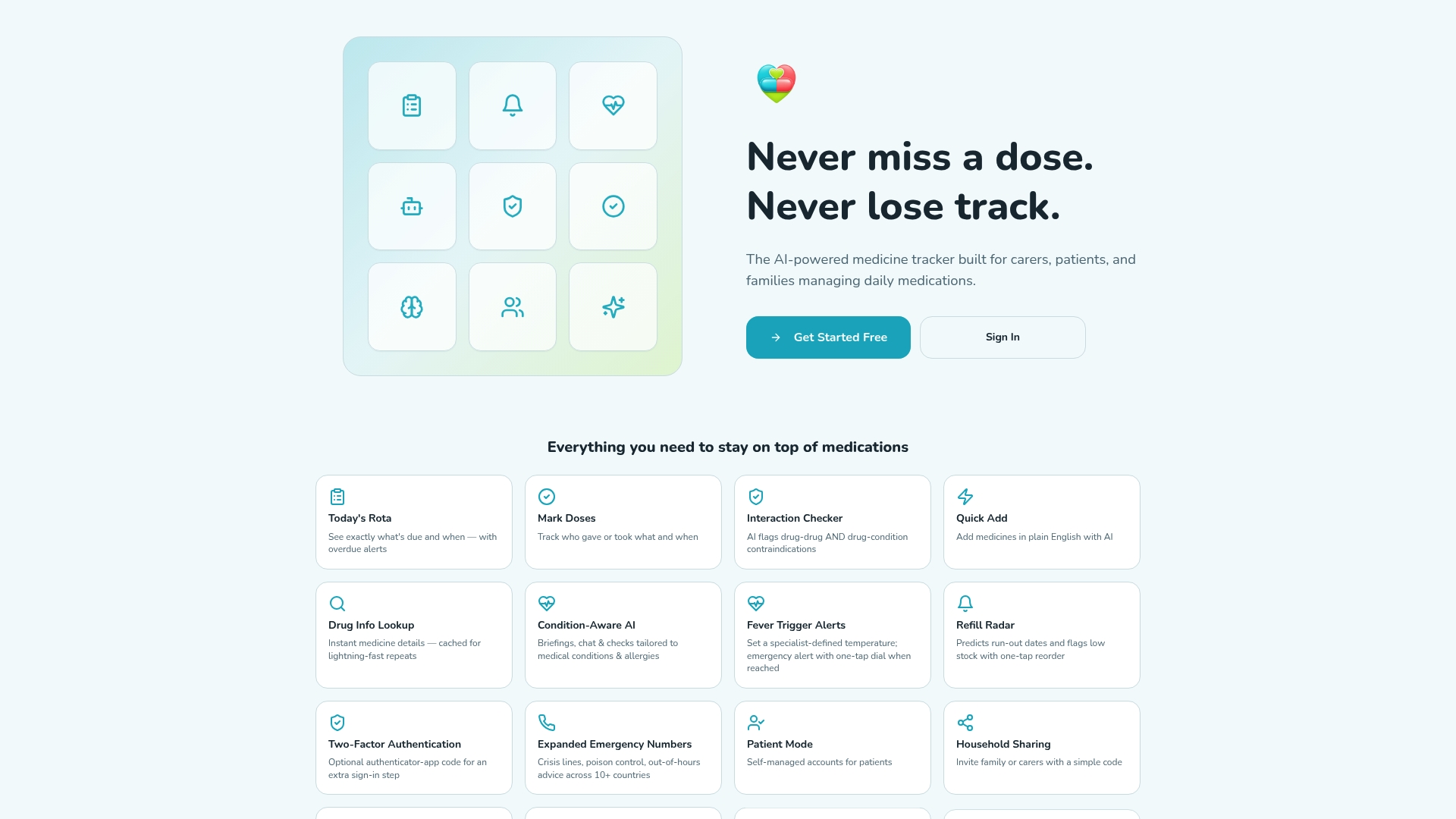
Shared medication schedules across multiple patients allow one household account to track dosing for an elderly parent and a partner without juggling separate logins. Refill predictions flag a running-low prescription before it becomes a missed dose, and built-in drug interaction checks catch a risky combination before it reaches the person taking it. Data handling follows UK GDPR standards, with encryption details set out on the security page, so sensitive information stays where it should.
Core scheduling and dose logging are free to use. If your household needs the fuller set of tools, appointment management, diary logging, multi-patient support, the Individual and Pro plans unlock those on the product page. Start with the free tier, add a relative's schedule, and see whether it fits before deciding on anything more.
Further reading and primary sources
For readers who want to verify the guidance above or dig deeper into specific systems:
- NHS App: family and carer access help, covering who qualifies for proxy access and what it enables.
- NHS App toolkit: step-by-step setup guide, with practical detail on granting and revoking access.
- Health data sharing to support better outcomes (NCBI Bookshelf), the patient and family leader statement on benefits and barriers.
- Family health information sharing among older adults (PMC), the peer-reviewed study on communication patterns within families.
- Apple's guide to sharing Health app data, for device-level sharing controls.
This article is general information, not a substitute for advice from a qualified doctor. Consult a qualified healthcare professional about your own circumstances before acting on anything here.
Sources
- Using family and carer access – NHS App help
- Health data sharing to support better outcomes: Patient and family leader statement (NCBI Bookshelf)
- Family health information sharing among older adults: reaching more family members