

Medication tracking for children is defined by dynamic, weight-based dose calculations rather than the fixed amounts used in adult medication management. This single distinction drives nearly every child and adult medication tracking difference you will encounter as a carer. Children's bodies process drugs differently at every developmental stage, meaning a dose that is safe for a four-year-old may be dangerous for a seven-year-old of different weight. Regulatory bodies including the FDA and the American Academy of Pediatrics (AAP) mandate age- and weight-specific dosing standards precisely because paediatric pharmacology is not simply a scaled-down version of adult medicine.
1. Why child and adult medication tracking differences start with dosing
Paediatric dosing is weight-based, calculated in milligrams per kilogram (mg/kg) or milligrams per square metre (mg/m²), while adult doses are fixed standard amounts. That difference alone makes tracking a child's medication far more complex than managing an adult's regimen. Every time a child gains weight, the correct dose may change. A tracker that does not account for this will become inaccurate within weeks.
Children's organ maturation directly affects how drugs are metabolised and excreted. Renal and hepatic function in infants and young children differs significantly from adults, altering a drug's half-life and toxicity profile. This means the monitoring interval for a child's medication often needs to be shorter and more responsive than for an adult taking the same drug class.

Pro Tip: Record your child's weight in your tracking app every time you visit the GP. An updated weight ensures any dose calculation stays accurate and reflects your child's current size.
2. How pharmacokinetics make paediatric monitoring uniquely complex
Adult medication management assumes a relatively stable physiology. Paediatric pharmacokinetics change continuously as organs mature from birth through adolescence. A newborn's liver enzymes operate at a fraction of adult capacity, meaning drugs clear more slowly and accumulate more readily.
This developmental variability means a single fixed-dose reminder, which works perfectly for an adult taking a daily statin, is insufficient for a child on an anticonvulsant. The dose may need recalculating every few months. Tracking systems for children must therefore log developmental milestones alongside medication history, not just dose times.
The FDA PREA and AAP Red Book mandate specialised paediatric drug safety testing and dosing guidelines for exactly this reason. These frameworks exist because adult clinical trial data cannot reliably predict how a child's body will respond.
3. Medication errors in children versus adults
Weight-based miscalculations are the leading cause of paediatric medication errors. A known case involved a 300% ibuprofen overdose caused by unit confusion between pounds and kilograms. That type of error is virtually impossible in adult fixed-dose regimens, where the dose does not change based on body weight.
Specialised paediatric trackers reduce errors compared to generic adult systems by 38%. That figure reflects the real safety gap between a general reminder app and a purpose-built paediatric tool. The difference lies in features like unit validation, which forces carers to confirm whether they are entering weight in kilograms or pounds before any dose is calculated.
Off-label prescribing adds another layer of risk. Approximately 50% of paediatric oral medications are authorised after adult approval, meaning children frequently receive drugs that were never formally tested in their age group. Tracking these medications requires notes on compounding instructions, dilution ratios, and preparation steps that adult apps simply do not accommodate.
Common error types unique to paediatric tracking include:
- Entering weight in pounds instead of kilograms, producing a dose roughly 2.2 times too high
- Failing to update the weight field after a growth spurt
- Logging a compounded liquid dose in milligrams when the prescription is written in millilitres
- Multiple carers each administering a dose without checking a shared log
4. Caregiver-managed adherence versus adult self-management
Medication adherence in children depends entirely on caregivers, unlike adults who self-manage their routines. This is not simply a matter of reminding a child to take a tablet. Factors including taste, texture, swallowing ability, and a child's emotional state all affect whether a dose is actually taken. An adult who dislikes a tablet can swallow it anyway. A toddler cannot.
The practical implications for tracking are significant. A child's medication record needs to capture not just whether a dose was given, but how it was given, whether it was accepted, and whether any of it was spat out or vomited. None of these fields appear in a standard adult medication management app.
Multiple caregivers often manage a child's medication, including parents, grandparents, childminders, and school staff. Without real-time synchronised tracking, double-dosing becomes a genuine risk. A parent who gives a morning dose and then a grandparent who gives the same dose an hour later, each unaware of the other, is a scenario that plays out in households without shared digital logs.
Effective caregiver coordination requires:
- A shared medication log that updates in real time across all carers' devices
- Clear confirmation prompts before any dose is logged as given
- Alerts that notify all carers when a dose has already been administered
- Notes fields for recording how a dose was received, particularly for liquid medications
Pro Tip: Set up a household group in your medication tracking app and add every regular carer, including grandparents and childminders. A shared log prevents double-dosing without requiring a phone call every time.
5. What paediatric tracking tools offer that adult apps do not
Adult medication tracking apps typically lack weight-based dose calculators, developmental milestone logs, and multi-carer coordination features. Adult apps focus on fixed-dose reminders. They are built for a single patient who manages their own care. That model does not transfer to paediatric use.
Purpose-built paediatric tracking tools include features that address the specific risks outlined above:
- Weight and unit input validation to prevent pound-kilogram confusion
- Dose calculators that update automatically when a child's weight is revised
- Off-label and compounded medication notes fields
- Developmental milestone logs linked to medication history
- Multi-carer access with real-time synchronisation
The table below shows how paediatric-focused features compare to what standard adult tracking tools typically provide.
| Feature | Paediatric-focused tracker | Standard adult tracker |
|---|---|---|
| Dose calculation | Weight-based (mg/kg, mg/m²) | Fixed dose reminders |
| Unit validation | Enforced kg/lb confirmation | Not applicable |
| Multi-carer access | Real-time shared log | Single-user focus |
| Off-label medication notes | Supported | Rarely included |
| Developmental milestone log | Included | Not included |
| Compounding instructions | Supported | Not supported |
Digital adherence tools with reminders and tracking raised adherence from 30% to 84% in paediatric asthma trials. That improvement shows what purpose-built technology can achieve when it addresses the actual barriers to paediatric adherence rather than simply copying adult app design.
6. Practical advice for households managing both child and adult medications
Many carers manage medications for a child and an adult simultaneously, whether that is a parent caring for both a young child and an elderly parent, or a household where multiple family members are on regular prescriptions. The risks of confusion multiply when two very different medication regimens share the same physical or digital space.
Medication schedule best practices for carers consistently recommend separating child and adult medication records within the same app rather than using separate tools. Separation reduces the risk of a carer accidentally logging an adult dose against a child's profile, while keeping everything visible in one place.
Key practices for managing both regimens safely:
- Use a multi-patient app that clearly labels each profile with the patient's name and age
- Store child and adult medications in separate, clearly labelled physical locations
- Set distinct alert tones or colours for child versus adult dose reminders
- Review both medication schedules weekly to spot any timing conflicts or overlaps
- Log every dose immediately, not from memory at the end of the day
Adult adherence patterns also differ from children's in ways that affect tracking. Adults managing medication adherence in later life often face polypharmacy, where multiple drugs interact, rather than the single-drug weight-based challenges typical in paediatrics. A tracking system that handles both needs to flag drug interactions for adults while simultaneously managing dose calculations for children.
Key takeaways
Child and adult medication tracking differ fundamentally because children require dynamic, weight-based dose management and caregiver coordination, while adults use fixed doses and self-managed schedules.
| Point | Details |
|---|---|
| Weight-based dosing | Children's doses are calculated in mg/kg and must be updated as weight changes. |
| Higher error risk in paediatrics | Unit confusion between pounds and kilograms is a leading cause of child medication overdose. |
| Caregiver coordination is critical | Multiple carers sharing a real-time log prevents double-dosing in paediatric care. |
| Adult apps are insufficient for children | Standard adult trackers lack dose calculators, unit validation, and multi-carer access. |
| Digital tools improve adherence | Purpose-built paediatric tracking tools have raised adherence rates significantly in clinical trials. |
Why I think most carers underestimate the tracking gap
Most carers assume that any medication reminder app will do the job for both a child and an adult. I have seen this assumption cause real problems. The moment a child's weight changes and no one updates the app, every subsequent dose calculation is wrong. That is not a minor inconvenience. It is a safety issue.
What surprises me most is how often the error is not in the dose itself but in the unit. A carer who enters a child's weight in pounds instead of kilograms will generate a dose that is more than double what it should be. The app will not flag this unless it has been specifically built to validate units. Most general reminder apps have not been built with this in mind.
The other thing I have observed is that carers managing both a child and an elderly parent often feel that the child's medication is the simpler of the two. In reality, the opposite is true. An elderly patient on five fixed-dose tablets is complex, but the doses do not change week to week. A child on a weight-based antibiotic or anticonvulsant requires recalculation every time they grow. That is a fundamentally different kind of vigilance.
My honest recommendation is to use a platform that was built with both profiles in mind. Not one that was designed for adults and then had a child profile bolted on. The difference shows up in the details: unit validation, weight fields, multi-carer access, and developmental notes. Those features are not extras. They are the core of safe paediatric tracking.
— Prasant
Thedailydosetracker: built for the full family medicine cabinet
Managing a child's weight-based antibiotic alongside an adult's daily prescriptions is exactly the kind of complexity that Thedailydosetracker was designed for.
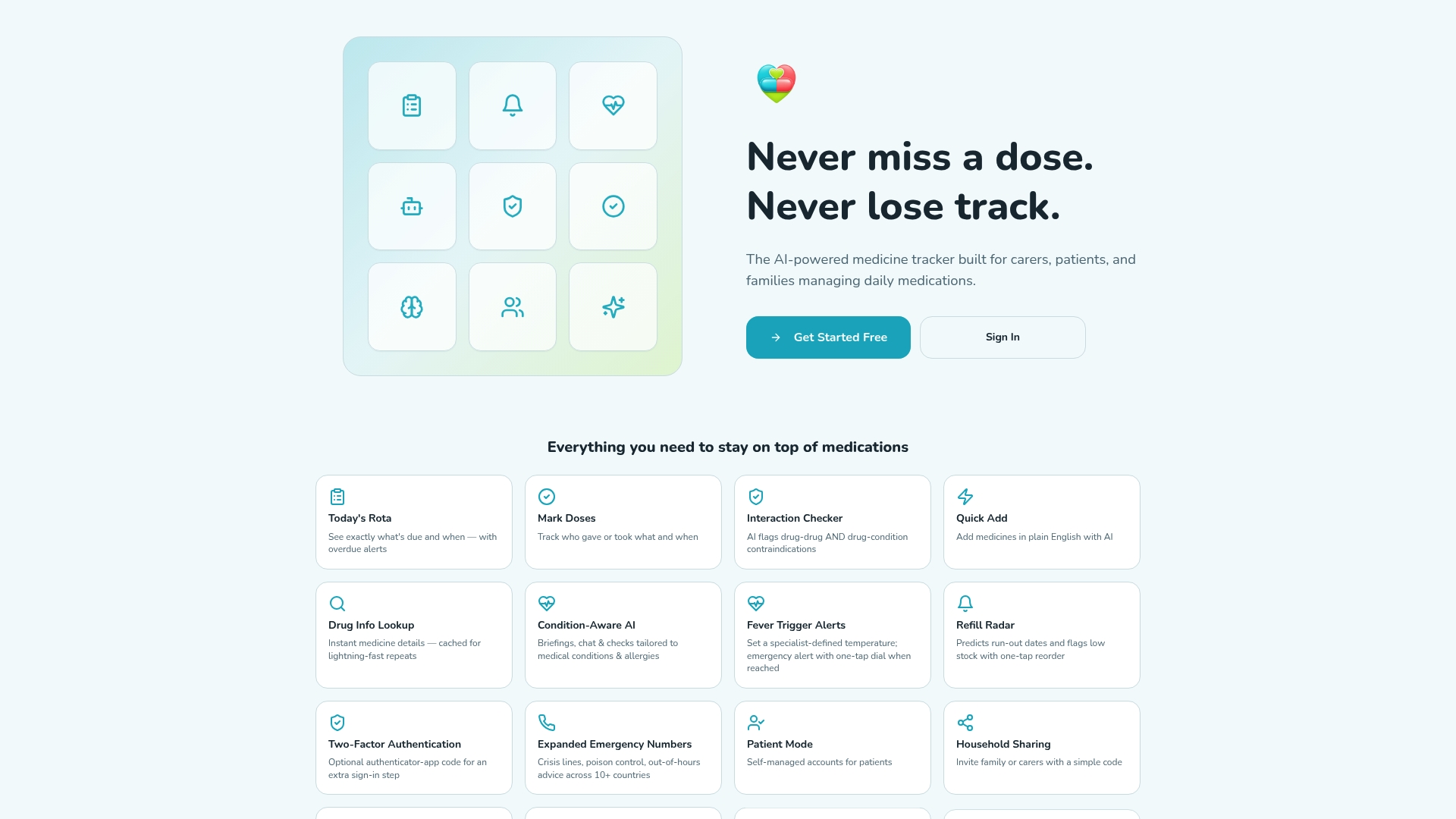
Thedailydosetracker supports multi-patient profiles, real-time dose logging, and alerts for both paediatric and adult medications within a single household account. The platform includes drug interaction checks, fever alerts, and emergency contact integration, making it practical for carers who need to act quickly. Every profile is managed separately, so a child's dose record never crosses with an adult's. You can explore the full feature set and get started with a free account today. For carers managing complex schedules across multiple family members, see the available plans to find the right fit.
FAQ
Why does medication tracking differ for children and adults?
Children require weight-based dose calculations that change as they grow, while adults use fixed doses. This makes paediatric tracking more complex and error-prone without specialised tools.
What is the biggest medication error risk in paediatric tracking?
Confusing pounds and kilograms when entering a child's weight is a leading cause of overdose. Purpose-built paediatric apps enforce unit validation to prevent this error.
Can one app track both child and adult medications safely?
Yes, provided the app supports separate patient profiles, weight-based dose calculators for children, and multi-carer access. Standard adult reminder apps do not include these features.
How do multiple caregivers avoid double-dosing a child?
A shared real-time medication log that updates across all carers' devices is the most reliable method. Every carer can see whether a dose has already been given before administering another.
Why do children need different medication adherence strategies?
Paediatric adherence depends on caregivers and is affected by taste, swallowing ability, and a child's developmental stage. These factors require tracking approaches that are caregiver-centred rather than patient-centred.