

For UK clinicians and family carers managing complex medication regimens, Thedailydosetracker is the recommended choice. It combines AI-assisted interaction review, multi-patient management, and GDPR-aligned data controls in a single platform built for both professional care teams and household carers.
Three features set it apart from generic online checkers:
- Multi-patient tracking and household sharing — manage several patients or family members from one dashboard, with exportable medication histories for safe care transitions.
- Renal/liver-adjusted, condition-specific checks — interaction assessments that account for the patient context that generic checkers miss, including age, comorbidities, and organ function.
- Clinician-reviewed, regularly updated knowledgebase with audit logs — documented update cadence and a full multi-patient audit trail for clinical governance.
Pro Tip: When you first log in, go straight to the alert-prioritisation settings. Set the threshold to show only "serious" and "contraindicated" flags for your first session. You will see the signal-to-noise ratio drop immediately, and you can expand the filter once you understand the baseline for your patient list.
Safety note: Never stop or change a patient's medication based solely on a tool's output. Always confirm with the patient's GP or pharmacist before acting on any interaction flag.
Table of Contents
- Why do drug interaction review tools matter in UK care settings?
- What core features should you prioritise in a drug interaction checker tool?
- How does Thedailydosetracker map to what clinicians and carers actually need?
- How should you evaluate and implement a tool safely in UK clinical practice?
- What are the safety limits of interaction-check tools?
- Quick setup: get meaningful checks running in 15–30 minutes
- Key takeaways
- Why clinical-grade interaction checks shaped how we built this
- Try Thedailydosetracker: start your free trial today
- Useful UK-relevant sources and further reading
Why do drug interaction review tools matter in UK care settings?
The core clinical case is straightforward: patient-specific interaction review reduces avoidable harm when it is integrated into workflow rather than treated as an afterthought. The problem is that most UK care settings still rely on fragmented records.
Fragmented medication records across multiple prescribers and pharmacies are a principal source of medication harm. When a patient sees their GP, a hospital specialist, and a community pharmacist independently, no single clinician holds the complete picture. Prescribing cascades — where a new drug is added to treat the side effect of an existing one — are a direct consequence. The best tools consolidate prescriptions, over-the-counter products, and supplements into one shared view.
Alert fatigue compounds the problem. Systems that flag every theoretical interaction, including minor ones, train clinicians and carers to ignore warnings. Higher-quality tools distinguish critical, actionable warnings from low-priority flags. That distinction is what keeps safety alerts meaningful rather than background noise.
For family carers, the stakes are just as high. Carers managing elderly relatives with polypharmacy often lack access to the full prescription history. Household sharing features and exportable medication summaries let carers bring a complete, accurate list to every GP or pharmacist appointment, which is exactly what patient-facing guidance recommends.
What core features should you prioritise in a drug interaction checker tool?
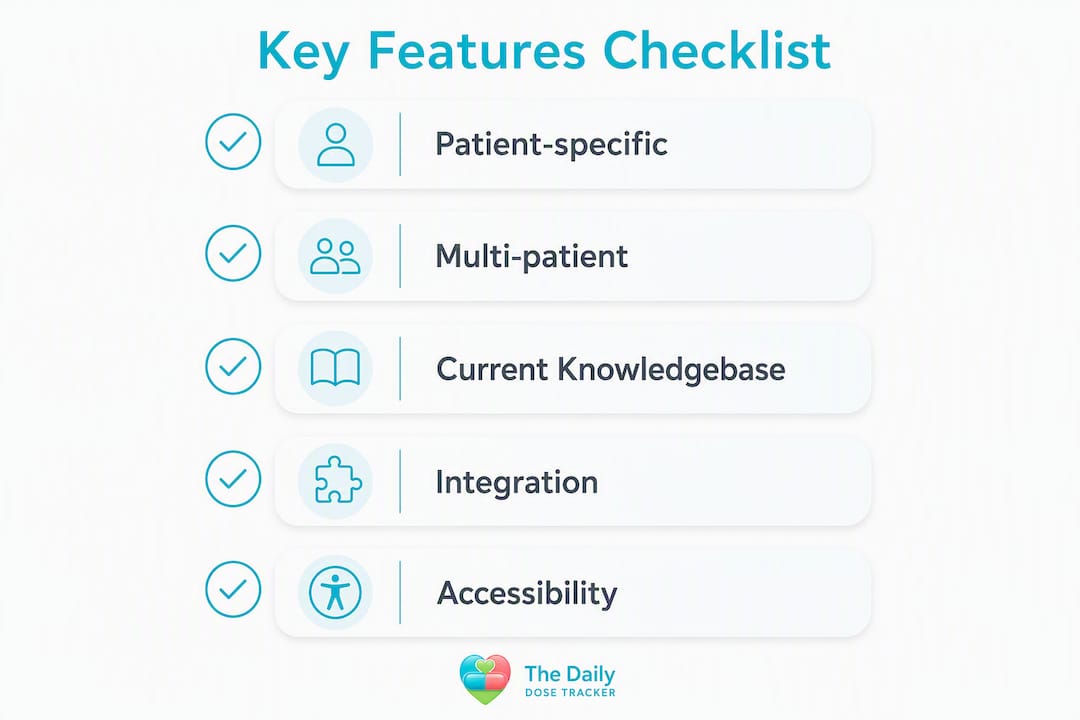
Start with patient-specific checks, multi-patient management, and a knowledgebase that is demonstrably current. Everything else is secondary.
| Category | Feature | Why it matters |
|---|---|---|
| Safety | Renal/liver and age adjustments | Generic checks without patient context produce false positives and miss real risks |
| Safety | Severity tiers with actionable guidance | Clinicians need contraindicated/serious/monitor tiers, not a flat list |
| Safety | OTC, herbal, and supplement coverage | Full medication lists must include non-prescription items for complete screening |
| Usability | Multi-patient/household dashboards | Carers and care teams manage more than one person |
| Usability | Alert prioritisation | Reduces fatigue; keeps critical flags visible |
| Integration | API and EHR connectivity | Practitioners favour tools integrated into existing workflows |
| Integration | Exportable medication history | Supports safe handovers and GP/pharmacist consultations |
| Governance | Audit logs and multi-patient trail | Required for clinical governance and accountability |
| Governance | UK GDPR compliance | Non-negotiable for any UK clinical or care deployment |
| Governance | Documented knowledgebase update cadence | New interaction research is published continuously; stale data is a safety risk |
Pro Tip: During any trial, deliberately enter a known serious interaction pair — for example, warfarin and aspirin — and check whether the tool flags it at the correct severity tier with a clear recommended action. If it does not, the knowledgebase quality is insufficient for clinical use.
How does Thedailydosetracker map to what clinicians and carers actually need?
Thedailydosetracker meets the essential checklist above. Here is how its features align with each clinical requirement.
The platform's AI-assisted interaction checks incorporate condition-specific and renal/liver context, moving beyond the flat drug-pair lookups that generic online checkers rely on. Multi-patient household dashboards let a carer or care team monitor several patients simultaneously, with medication history exports available for GP appointments and care transitions. Audit logs record multi-patient changes, supporting the clinical governance requirements that NHS-adjacent settings demand.

On integration, Thedailydosetracker offers API and EHR integration capabilities, which matters for clinics that need interaction checks embedded in existing prescribing workflows rather than as a separate step. GDPR-aligned privacy controls and data security are built into the platform, not bolted on.
For carers specifically, accessibility features including dark mode and adjustable font sizes make the platform usable across a wider range of users, including older carers who may find standard clinical interfaces difficult.
Pricing shape: the platform operates on a freemium model. Core features are available without charge; advanced AI tools, multi-patient management, appointment scheduling, and diary functions are gated behind Individual and Pro monthly subscriptions. Most clinicians and carers will want a paid tier to access the full interaction-check and multi-patient workflow. Onboarding is designed to be achievable within a short time for a single patient setup.
Pro Tip: Use the medication history export feature before any GP or specialist appointment. A printed or PDF summary of the full medication list, including OTCs and supplements, gives the clinician the complete picture that shared medication lists are designed to provide.
How should you evaluate and implement a tool safely in UK clinical practice?
Choose a GDPR-compliant, clinician-reviewed tool with API/EHR capability and a clear knowledgebase update cadence. Then follow these evaluation steps.
Vendor questions to ask during procurement:
- How frequently is the knowledgebase updated, and is that cadence documented?
- Who reviews the clinical content — are qualified clinicians or pharmacists involved?
- What integration options exist for existing EHR or prescribing systems?
- What export formats are supported for medication histories?
- Are audit logs available, and can they be exported for governance review?
- What are the trial or pilot terms, and what support is included?
- How are multi-patient limits structured across pricing tiers?
| Vendor question | Why it matters | Acceptable answer |
|---|---|---|
| Knowledgebase update frequency | Stale data creates safety risk | Monthly or more frequent, with documented dates |
| Clinician review process | Ensures clinical accuracy | Named clinical/pharmacist oversight |
| Integration options | Reduces workflow friction | REST API or HL7 FHIR support |
| Audit log availability | Required for governance | Exportable, timestamped logs |
| Multi-patient limits | Affects care team usability | Clearly tiered, not hidden |
Go/no-go criteria for a pilot: the tool must flag known serious interactions correctly, provide severity tiers with recommended actions, support at least five patients in the trial cohort, and produce an exportable medication summary. If any criterion fails, escalate to the GP or pharmacist before proceeding.
For polypharmacy management in particular, confirm the tool handles patients on five or more concurrent medicines before sign-off.
What are the safety limits of interaction-check tools?
Interaction tools are decision-support aids. They do not replace clinical judgement, and misusing them as a substitute is a governance failure, not just a clinical one.
- Never stop or change a medication without GP or pharmacist authorisation, regardless of what a tool flags.
- Always validate tool output against patient-specific data: renal and liver function, age, pregnancy status, and current comorbidities.
- Include OTC products, vitamins, herbal remedies, and supplements in every check — omitting them is one of the most common errors.
- Use audit logs to document every multi-patient change for accountability.
- Local clinical governance must approve any tool deployment in a formal care setting.
Pro Tip: Before consulting a clinician about a flagged interaction, export or screenshot the tool's output, including the severity tier and recommended action. This gives the GP or pharmacist the exact context they need and avoids miscommunication.
This article is general information, not professional medical advice. Confirm all medication decisions with your GP, pharmacist, or a qualified clinician.
Quick setup: get meaningful checks running in 15–30 minutes
You can run a meaningful first interaction check within half an hour by following these steps.
- Create your clinician or carer account and complete the profile.
- Add a single patient and enter the full medication list, including OTCs, vitamins, and herbal supplements.
- Enter patient context: age, weight if relevant, known renal or liver impairment, and key conditions.
- Run the interaction check and apply alert-prioritisation to filter to serious and contraindicated flags first.
- Export or share the medication summary with the patient's GP or pharmacist.
- Set up emergency contacts and, if managing multiple household members, activate household sharing.
Common first-day pitfalls to avoid:
- Omitting OTC products and supplements from the medication list — this is the single most frequent gap and the one most likely to produce a missed interaction.
- Leaving alert-prioritisation on default settings, which often surfaces too many low-priority flags.
- Skipping the export step before a clinical appointment.
- Adding a second patient before completing the first profile fully.
For carers new to the platform, the care home medication management guide covers household sharing and emergency contact setup in practical detail.
Key takeaways
The most effective drug interaction review tool for UK clinicians and carers is one that combines patient-specific AI checks, multi-patient management, GDPR compliance, and a clinician-reviewed knowledgebase with a documented update cadence.
| Point | Details |
|---|---|
| Patient-specific checks are non-optional | Renal/liver function, age, and comorbidities change every risk assessment; generic checkers without this context miss real risks. |
| Alert prioritisation protects safety | Tools that surface only serious and contraindicated flags prevent the fatigue that causes clinicians and carers to ignore warnings. |
| Governance requires audit logs and GDPR controls | UK clinical and care settings need exportable, timestamped audit trails and documented data protection compliance. |
| Setup takes 15–30 minutes | Enter the full medication list including OTCs, apply alert filters, and export a summary before the first clinical appointment. |
| Thedailydosetracker covers the full checklist | AI-assisted, patient-specific checks, multi-patient dashboards, GDPR-aligned controls, and medication history export in one platform. |
Why clinical-grade interaction checks shaped how we built this
The gap that prompted Thedailydosetracker was not a lack of interaction checkers. There were plenty. The gap was that none of them were built for the people who actually manage medications day to day: family carers juggling multiple household members, care teams without a shared view, and patients who arrive at a GP appointment with an incomplete list.
Clinical-grade means patient-specific. It means the check accounts for renal function, not just the drug pair. It means the audit trail exists so a clinician can see what was reviewed and when. And it means the knowledgebase is reviewed by qualified clinicians on a documented schedule, not updated whenever someone gets around to it.
The platform is built for UK carers and clinicians, and we actively seek feedback from professional care teams to improve clinical accuracy and workflow fit. If you work in an NHS-adjacent or social-care setting and want to discuss a formal evaluation or partnership, we want to hear from you.
Try Thedailydosetracker: start your free trial today
Thedailydosetracker gives UK clinicians and carers something the standard online checkers do not: patient-specific AI interaction checks, multi-patient dashboards, and exportable medication histories, all within a GDPR-compliant platform designed for real care workflows.
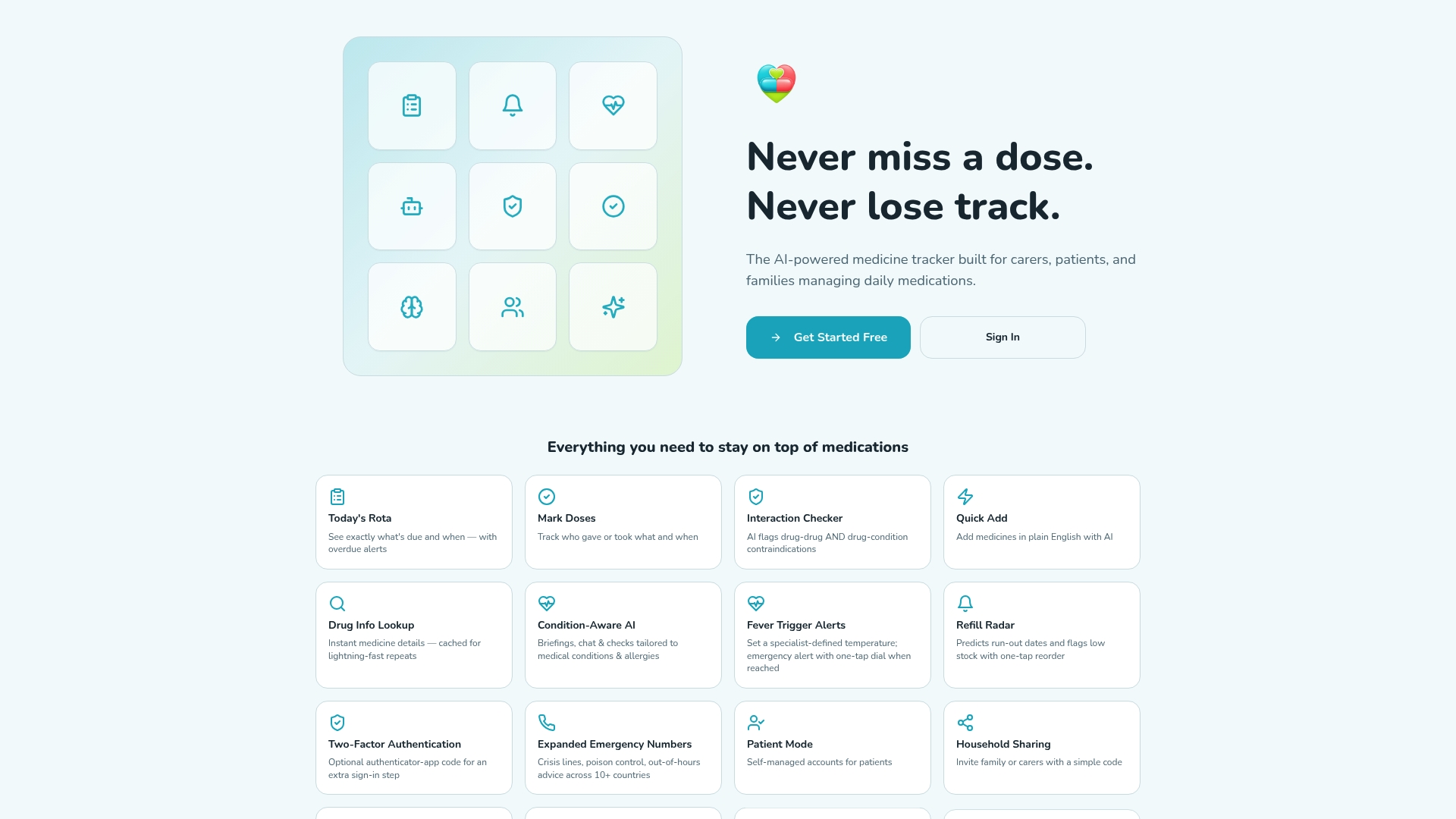
During a free trial, test the features that matter most for your setting:
- Knowledgebase recency: enter a recently updated drug pair and check the guidance matches current clinical standards.
- Alert prioritisation: confirm the tool separates serious flags from minor ones clearly.
- Multi-patient workflows: add two or three patients and test the household sharing and dashboard views.
- GDPR controls: review the data protection settings and confirm they meet your governance requirements.
- Export formats: generate a medication history export and check it is usable at a GP or pharmacist appointment.
Core features are free. Advanced AI tools, multi-patient management, and full notification controls are available on Individual and Pro monthly subscriptions. Start your free trial and run your first interaction check within 30 minutes.
Useful UK-relevant sources and further reading
The sources below back the clinical claims in this article. For individual medication decisions, always consult your GP or pharmacist.
- Drugs.com interaction checker — patient and clinician-facing checker with severity tiers; useful for verifying specific drug pairs and understanding the safety rules around stopping medications.
- WebMD interaction checker — emphasises sharing complete medication lists with clinicians; good for understanding why consolidated records matter.
- Medscape drug interaction checker — clinician-focused resource covering mechanism, effect, level of concern, and recommended action; the standard reference for severity classification.
- Drug interaction screening in nursing: 2026 guide — practical guidance on API integration and real-time medication safety in healthcare IT systems.
- How digital drug interaction checks boost medication safety — clinical rationale and evidence base for digital interaction checks; useful background for clinicians evaluating outcomes.