

Three things keep a steroid taper safe: follow the exact schedule your clinician set and update every reminder the moment a dose changes, carry a steroid alert card and make sure whoever cares for you knows the emergency plan, and know your sick-day rules so you never guess whether to pause, increase, or call for help. Get those three right and the rest of this guide is detail.
TL;DR:
- Following your clinician’s exact taper schedule and updating reminders immediately after dose changes is crucial to prevent adrenal suppression or crisis.
- Maintaining a steroid alert card, sharing emergency contacts, and knowing sick-day rules ensures swift action during illness or adverse symptoms.
- A typical taper involves faster reductions from high doses to around 5–7.5mg, then very slow decreases near physiological levels, with careful symptom monitoring.
- Logging symptoms, missed doses, and adverse reactions helps clinicians adjust the taper safely and detect signs of adrenal insufficiency early.
- Digital tools that enable shared, editable schedules and dose histories improve adherence and safety, especially when multiple caregivers are involved.
Table of Contents
- Why steroid taper reminders matter more than willpower
- A short, printable daily checklist for taper reminders
- What does a safe steroid tapering pattern actually look like?
- What withdrawal and adrenal insufficiency actually feel like
- Sick-day rules and your emergency plan while tapering
- When and how cortisol testing guides your taper
- How to set reliable reminders and dose logs
- Practical tips for carers: administering, recording, communicating
- A note on how digital tools fit into steroid taper safety
- What tapering steroids actually feels like, and why the wait is worth it
- Ready to build your clinician-approved taper plan into daily reminders?
- Sources
Why steroid taper reminders matter more than willpower
Missing a dose or drifting off schedule during a steroid taper isn't a minor slip. Your adrenal glands have effectively been on standby while synthetic steroids did their job, and bringing them back online takes time, sometimes months to a year for people who have been on long-term therapy. A steroid dosage schedule that looks simple on paper (reduce by this much, every so many days) becomes hard to track in real life once you factor in illness, travel, or a carer handover between family members.
This is where the standard advice falls short. Most guidance tells you what a safe taper looks like clinically but says little about the mechanics of remembering it. "Steroid taper reminders" isn't yet a term you'll find in a textbook. Clinicians talk about "glucocorticoid withdrawal protocols" or "steroid weaning schedules." What patients actually need is the same clinical logic translated into something they can act on daily: a checklist, a calendar, an alarm, a card in their wallet. That's the gap this guide fills.
A short, printable daily checklist for taper reminders
Print this, stick it on the fridge, or copy it into a shared notes app. It works whether you're managing your own steroid dosage schedule or supporting someone else through theirs.
- Dose record: time taken, exact dose, and who gave or took it (useful in shared-care households).
- Symptom check: any new fatigue, joint pain, nausea, dizziness, or mood change since yesterday?
- Illness flag: fever, vomiting, diarrhoea, or infection today? If yes, move straight to your sick-day rules.
- Missed dose log: note the time you realised, what you did about it, and whether you contacted a clinician.
- Weekly emergency check: steroid alert card in your bag or wallet, up-to-date medication list, and emergency contact numbers saved somewhere a carer could find quickly.
The point of this checklist isn't box-ticking for its own sake. A missed morning dose that goes unnoticed for two days looks very different from one caught within hours, and your log is what lets a GP or endocrinologist tell the difference at a glance rather than reconstructing events from memory during a rushed appointment.
Pro Tip: Take your steroid dose in the morning wherever possible. It mirrors the body's natural cortisol rhythm, and NHS guidance notes that evening dosing can disrupt sleep and may work against your adrenal glands' recovery. Set your reminder for the same morning window every day, not "sometime before lunch."
If you're a carer managing this for someone else, a preventive medication management routine built around consistent timing removes a lot of the daily guesswork.
What does a safe steroid tapering pattern actually look like?
There's no universal steroid dosage schedule that fits every patient, and any numbers below are illustrative only. Your clinician sets the real plan based on your starting dose, how long you've been on treatment, and how your body responds. But understanding the shape of a typical taper helps you spot whether your own schedule looks reasonable and gives you sensible questions to bring to your next review.
The core principle clinicians follow is a two-phase taper: reduce relatively quickly down to a near-physiological dose (roughly the amount your body would produce naturally, around 5 to 7.5mg prednisolone equivalent per day), then slow right down for the final stretch. The first phase is forgiving. The second phase is where adrenal function is most fragile, and where most withdrawal symptoms show up.
Here's how that generally breaks down by starting dose, always subject to your clinician's actual instructions:
Typical tapering involves faster reductions from high doses, gradually slowing down as the dose approaches physiological levels. Exact amounts and intervals vary widely based on individual response and clinician guidance.
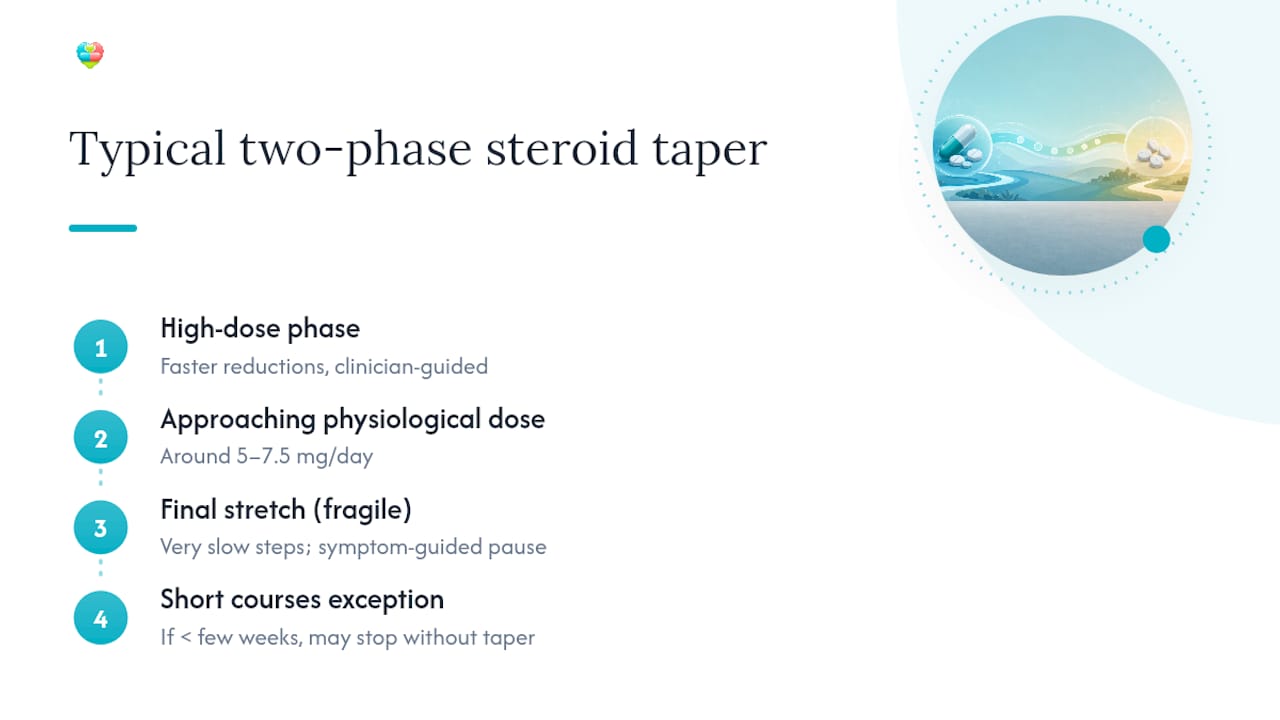
That final stretch deserves extra respect. Even a small step, dropping from 2mg to 1mg for instance, can trigger noticeable symptoms in some patients because it's the point where your own adrenal glands are being asked to properly restart. Monitoring how you feel often matters more than sticking rigidly to a calendar date, and a symptom-guided approach, where a taper step gets paused or slowed if you're clearly struggling, tends to work better than forcing through a fixed timetable regardless of how you feel.
Not everyone needs this staged approach. If you've only been on glucocorticoids for a short course, for short courses generally under a few weeks, guidance often allows stopping without tapering (https://australianprescriber.tg.org.au/articles/practical-guidance-for-stopping-glucocorticoids.html), because your adrenal glands haven't had time to downregulate significantly. The complexity kicks in once treatment stretches beyond that window. Someone on prednisolone for eight months faces a genuinely different withdrawal risk than someone who took a two-week course for a chest infection, and tapering steroids for the former group needs the structured approach outlined above.
Every one of these numbers is a template, not a prescription. Your actual steroid dosage schedule depends on your diagnosis, your response to previous dose changes, and sometimes blood test results covered further down. Never adjust your own taper speed based on generic figures you've read online, including these ones. Bring them to your clinician instead and ask how your specific plan compares.
What withdrawal and adrenal insufficiency actually feel like
Withdrawal symptoms happen because your adrenal glands haven't caught up with the drop in synthetic steroid, so your body is temporarily short of the cortisol it needs for normal function. MedlinePlus lists fatigue, mood changes, joint and muscle pain, and nausea among the common signs, and most of these are unpleasant rather than dangerous on their own.
Common withdrawal symptoms worth logging include:
- Persistent tiredness that doesn't improve with rest
- Joint or muscle aches, sometimes mistaken for flu
- Low mood, irritability, or unexplained anxiety
- Nausea or loss of appetite
- Low blood pressure or dizziness on standing
- Headaches or difficulty concentrating
Most of these settle as your body adjusts to a new dose. The concern is when symptoms tip into something more serious. Adrenal crisis is the red-flag scenario, and it can develop quickly, particularly during illness, infection, or physical stress when the body's cortisol demand spikes and your glands can't meet it.
Watch for these signs, which need urgent medical attention rather than a wait-and-see approach: severe vomiting or diarrhoea that prevents you keeping tablets down, confusion or extreme drowsiness, very low blood pressure, severe abdominal pain, or collapse. Right Decisions' NHS Scotland guidance treats abrupt cessation after long-term therapy as a genuine adrenal crisis risk, which is exactly why sick-day rules and steroid alert cards exist as a safety net.
When you log a symptom, note three things: when it started, how severe it felt on a simple scale of mild, moderate, or severe, and what might have triggered it (a missed dose, an infection, unusual stress). That structure turns a vague "I've been feeling rough" into something a clinician can actually act on.
Sick-day rules and your emergency plan while tapering
Sick-day rules exist because illness increases your body's cortisol demand at exactly the moment your adrenal glands are the least able to supply it. Right Decisions' guidance for adrenal insufficiency and long-term steroid use sets out pragmatic stress-dosing principles that most tapering plans mirror to some degree.
The general shape looks like this, though your clinician's exact figures may differ:
- Mild illness (a cold, a mild fever) on a dose already above 10mg prednisolone equivalent daily: usually no extra stress dose needed, but monitor closely.
- Physiologically dosed patients with a mild illness: often advised to increase to around 10mg per day for the duration of the illness.
- More significant stress (higher fever, vomiting, injury, surgery): may call for tripling the normal physiological dose, temporarily.
- Unable to keep oral medication down: this is the point where parenteral hydrocortisone, given by injection, and emergency care become necessary rather than optional. Don't wait to see if things settle.
Write your specific version of these rules down, agreed with your clinician, and keep a copy where a carer or family member can find it without hunting. Share it with whoever is likely to be present in an emergency: a partner, an adult child, a school if the patient is young, or a professional carer. An emergency contact plan built into your medication records means nobody has to search for a phone number while someone is unwell.
When and how cortisol testing guides your taper
Testing usually enters the picture in three situations: you've been on long-term steroid therapy and need to know whether your adrenal glands have recovered, you're struggling to get below a certain dose without symptoms returning, or you're facing surgery and clinicians need to know if you'll need extra steroid cover.
The most common approach is a morning cortisol blood test, timed to catch your natural cortisol peak, alongside a short synacthen (ACTH stimulation) test in less clear cases. Right Decisions' guidance sets out clear thresholds for interpreting the morning cortisol result:
| Morning cortisol result | What it generally suggests | Typical next step |
|---|---|---|
| Above physiological cortisol levels | Adrenal function has likely recovered | Stopping steroids is often appropriate |
| Between low and physiological cortisol levels | Adrenal function is borderline | Continue a slow taper and retest later |
| Below physiological cortisol levels | Adrenal function hasn't recovered | Delay further tapering and repeat testing |
Preparation matters for an accurate result. You'll typically be asked to omit your morning steroid dose before the blood draw and have the sample taken early, since cortisol naturally peaks shortly after waking and synthetic steroids in your system can distort the reading. Follow your clinic's exact instructions on timing, because getting this wrong risks a misleading result and an unnecessary delay to your taper, or worse, a premature stop.
How to set reliable reminders and dose logs
Paper diaries, phone alarms, shared calendars, and dedicated medication apps all work to some degree, but they don't all cope well with the thing that makes steroid tapering different from most medication schedules: the dose changes regularly, sometimes every one to two weeks, and every reminder needs updating in step.
A basic phone alarm handles fixed daily timing well but does nothing for dose changes. You have to remember to edit it, and if a carer or partner shares dosing duties, they need to know the new number too, not just see a generic alert. A shared paper chart on the fridge solves the visibility problem for a household but falls apart the moment two people are travelling, or when a hospital admission means someone else needs the history fast.
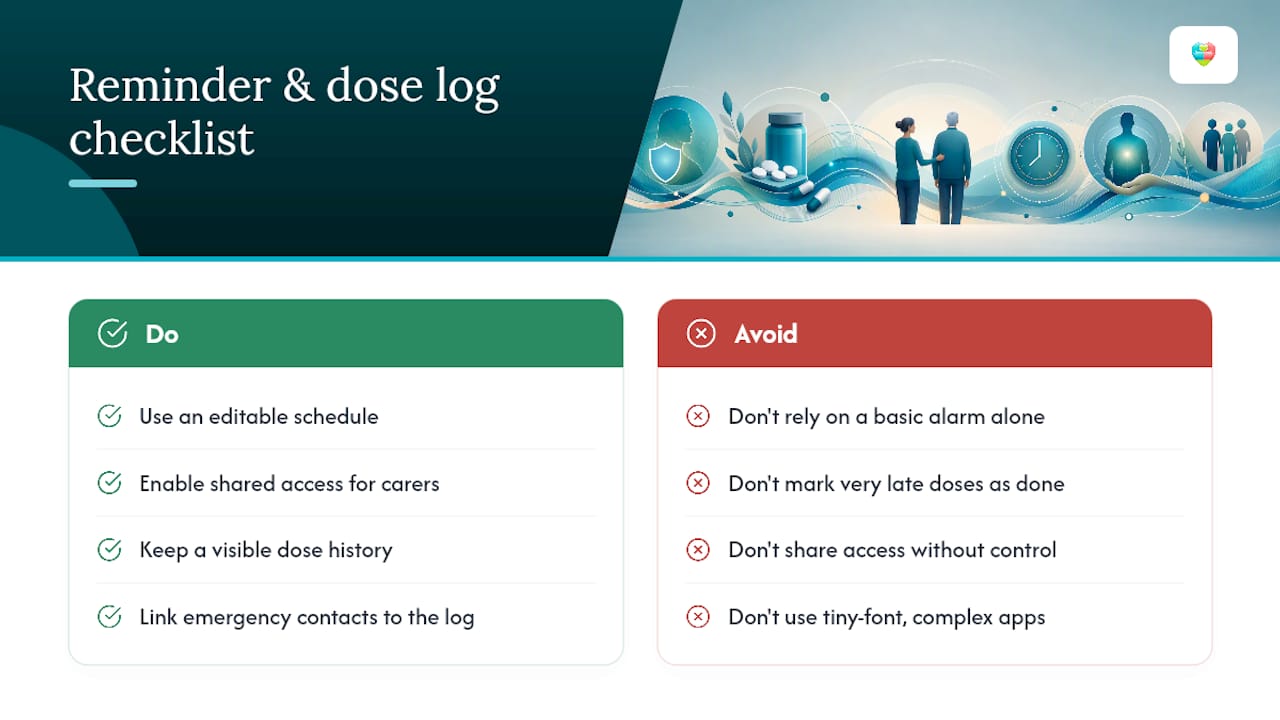
Whatever method you choose, look for three things: an editable schedule that's simple to update every time your clinician changes the dose, shared access so a carer isn't relying on you to remember to tell them, and a visible dose history that shows what was actually taken, not just what was planned. Emergency contact details linked to the same place you log doses save critical minutes if something goes wrong.
Pro Tip: Set your reminder to alert again if a dose is confirmed as taken more than two hours late, rather than just marking it done. A very late dose during a fine taper phase can matter clinically, and a log that treats "on time" and "three hours late" identically hides useful information from your next clinician review.
Privacy and accessibility deserve a check too. If a carer, family member, or professional care team has access to your dose log, know exactly who can see it and whether that access can be switched off. If you or the person you're caring for struggles with small text or complex apps, look for adjustable font sizes and a simple interface rather than one built for tech-confident users. Tools that sync across a phone and a tablet mean the person administering the dose and the person reviewing it later aren't working from two different pictures. A medication management checklist template is a reasonable starting point if you'd rather build your own system from scratch than adopt an app outright.
Practical tips for carers: administering, recording, communicating
Carers carry a lot of the operational weight in a steroid taper, often more than the patient realises day to day. A repeatable routine removes the risk of relying on memory alone.
- Check the current dose against the written schedule before administering it, not from memory, especially in the first week after any change.
- Give the dose at the same time each day, ideally morning, and log it immediately rather than waiting until the end of the day.
- Ask the daily symptom-check questions from the checklist above and note anything unusual, even if it seems minor.
- Flag missed or late doses the moment they happen, including what caused the miss, so patterns become visible over time.
- Review the log weekly against the prescribed schedule to catch drift before it becomes a real gap.
For clinician appointments, bring the full dose history, a list of any missed or delayed doses, and your symptom log rather than trying to summarise from memory under time pressure. If withdrawal symptoms escalate to anything on the red-flag list, particularly severe vomiting, confusion, or collapse, call emergency services rather than waiting for the next scheduled appointment. Reducing errors during shared care usually comes down to consistency of process rather than any single clever trick, something covered in more depth in guidance on reducing medication errors in elderly home care.
A note on how digital tools fit into steroid taper safety
This guide draws on NHS Scotland's Right Decisions protocols, peer-reviewed tapering guidance, and patient-facing NHS material, translated into steps a patient or carer can actually act on day to day. None of it replaces your prescribing clinician's instructions.
Digital reminder tools solve a specific problem in this picture: keeping a shared, accurate dose history when a schedule changes frequently and more than one person is involved in care. A system that lets a household share a schedule, store dose history, flag emergency contacts, and stay compliant with UK GDPR standards reduces the chance that a taper step gets missed or duplicated between carers. That's a genuine gap in most paper-based systems, where the person who wrote the chart is often the only one who fully understands it.
Always agree any digital reminder plan, and any change to it, with the clinician managing your taper. The tool supports the plan. It doesn't set it.
What tapering steroids actually feels like, and why the wait is worth it
The hardest part of tapering isn't usually the physical symptoms. It's the uncertainty: not knowing whether today's tiredness is normal adjustment or something that needs a phone call. That fear is reasonable, and it doesn't mean you're doing anything wrong.
What tends to get lost in clinical explanations is how much psychological relief a simple, reliable reminder system gives someone in this position. Knowing your dose is logged, your card is in your bag, and your sick-day rules are written down somewhere you can find them removes a layer of low-grade anxiety that otherwise sits underneath every day of a long taper. Recovery of adrenal function is rarely linear, and a good week followed by a rough one doesn't mean the taper has failed.
Keep talking to your clinician when something feels off rather than waiting for the next scheduled review. Tapers get adjusted all the time, and asking a question is never the wrong move.
— Prasant
Ready to build your clinician-approved taper plan into daily reminders?
Once your clinician has set the actual numbers, the daily challenge is keeping every reminder, dose log, and emergency contact in sync, especially when a taper step changes every week or two and more than one person is involved in care. A digital medication tracking platform can address exactly that problem: a shared record that updates once and stays consistent for everyone administering or checking a dose.
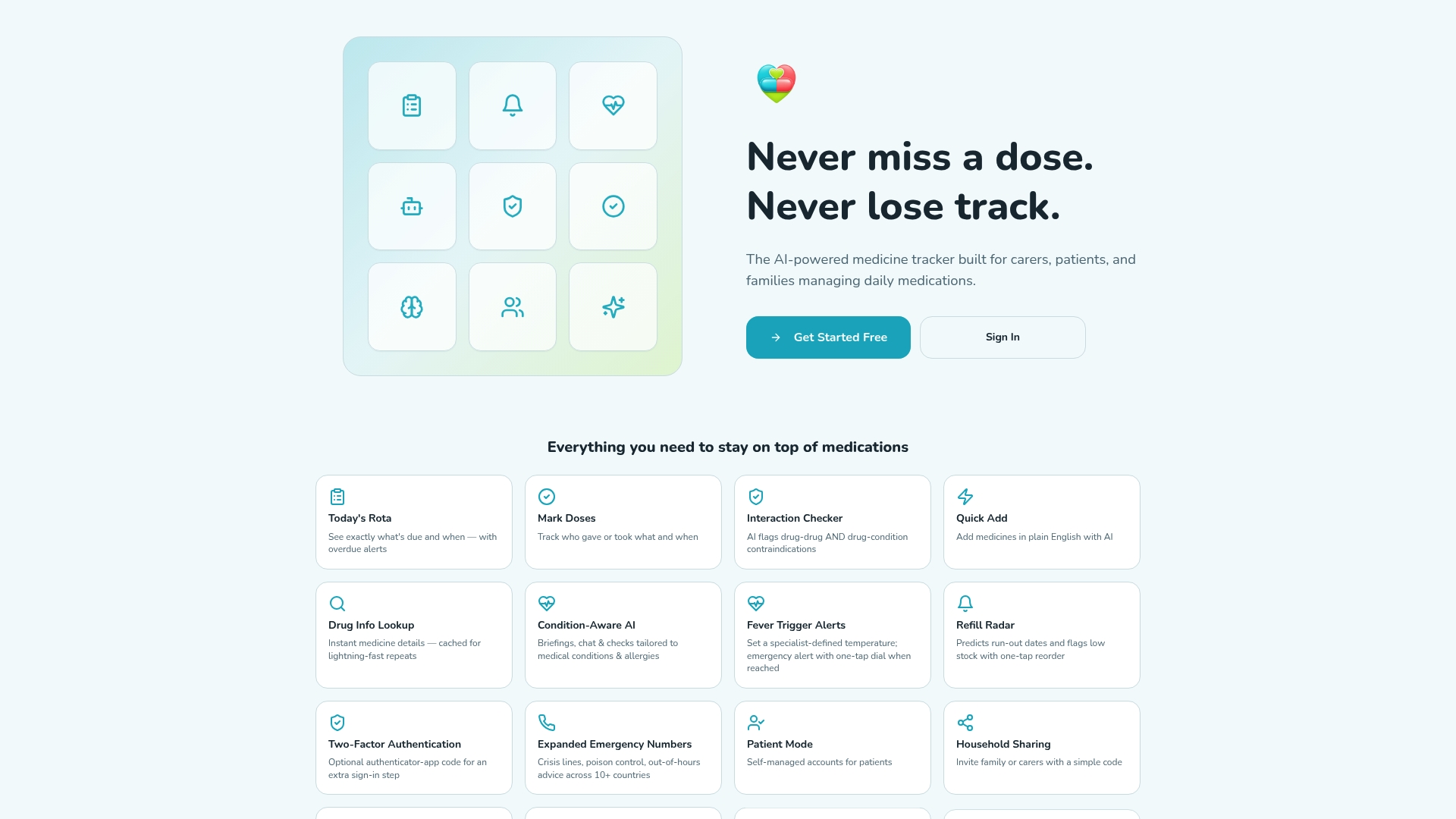
Such platforms support needs a steroid taper creates, including:
- Custom schedules editable immediately when doses change
- Household sharing so carers or family members see the same up-to-date record
- Emergency contact integration linked directly to the medication plan
- Accessibility controls like adjustable font sizes
- Dose history and symptom logging consolidated for clinician review
If you're managing a steroid dosage schedule for yourself or someone in your care, take a look at The Daily Dose Tracker and set up a shared schedule that matches your clinician's plan. Confirm any reminder settings and emergency details with your prescribing clinician before relying on them.
Sources
Print or save these before your next appointment. They're the same guidance this article is built on, and having them in hand makes it easier to compare your own plan against standard practice.
- Prednisolone therapy safe withdrawal in patients with non-endocrine disease (Right Decisions, NHS Scotland)
- The glucocorticoid taper: a primer for the clinicians (PMC, 2024)
- Prednisone: patient information (MedlinePlus)
This article is general information, not a substitute for advice from a qualified doctor. Consult a qualified healthcare professional about your own circumstances before acting on anything here.