

If you work shifts, the single best fix for missed doses is to stop anchoring reminders to clock times and start anchoring them to events: your wake time, your shift start, your last meal. Keep the interval between doses consistent even when the clock time moves, and run every reminder through a primary channel with a backup that can't be silenced by do-not-disturb settings.
Two things to set up right now:
- A wake-time anchor reminder: instead of "8am", set "15 minutes after I wake up" for your morning medication.
- A weekly reset reminder: a five-minute Sunday check to realign every dose time to next week's rotation.
A platform such as The Daily Dose Tracker supports this kind of event-based scheduling alongside standard clock-time alerts, which matters once your pattern gets complicated.
Key takeaways
Consistent dosing intervals anchored to wake time or shift start, backed by a persistent reminder channel and a weekly reset ritual, are what actually protect shift workers from missed doses.
| Point | Details |
|---|---|
| Anchor to events, not clocks | Set reminders relative to wake time, shift start, or meals rather than fixed hours. |
| Know your pattern first | Map fixed, rotating, or on-call status before choosing any reminder tactic. |
| Treat transition days separately | Double up reminders on rotation-change days, the highest-risk point for missed doses. |
| Flag timing-critical medicines | Insulin, antiepileptics, antiretrovirals, and thyroid medication need clinician-specific missed-dose rules. |
| The Daily Dose Tracker supports the setup | Its rescheduling, household sharing, and interaction checks fit a shift-adaptive routine. |
Table of Contents
- Understanding your shift pattern before you fix your medication reminders
- Why anchoring to wake or shift start beats fixed clock times
- Practical routines for every shift pattern
- Which medicines can't wait, and what to do about a missed dose
- Choosing reminder tools that survive irregular hours
- The five-minute weekly reset that keeps everything aligned
- How The Daily Dose Tracker fits a shift-adaptive routine
- What most advice on shift work and medication gets wrong
- Get a medication reminder system that moves with your rota
- Sources
Understanding your shift pattern before you fix your medication reminders
Shift worker medication reminders only work if they're built around your actual pattern, not a generic 9-to-5 assumption. There are three broad types, and each breaks medication timing differently.
- Fixed non-standard: the same hours every week, but not daytime. Permanent nights or permanent evenings. Your body eventually adapts to one rhythm, so the main risks are dosing drift around meals and sleep, not constant change.
- Rotating: your start time changes on a schedule, weekly or every few days. This is the hardest pattern for adherence because your circadian rhythm never fully settles, and every rotation resets your reminder logic.
- On-call/irregular: no fixed pattern at all. You might work a night, then a day, then nothing, with little notice.
The physiology matters here. Shift work displaces sleep and disrupts your circadian rhythm, and the World Health Organization's material on shift work documents the downstream health effects of that disruption, including how it degrades routine behaviours like medication taking. A Korean cohort study found shift workers had significantly worse medication adherence than fixed-day workers (adjusted odds ratio 1.16), and forgetting was the main driver.
Before doing anything else, spend ten minutes writing down your wake time on a work day, your wake time on a rest day, and which days involve a rotation change. That map is what every tactic below depends on.
Why anchoring to wake or shift start beats fixed clock times
An anchor event is something that happens reliably in your day regardless of what the clock says: waking up, starting your shift, eating your main meal. Fixed clock times ignore the fact that "morning" for a night-shift worker might be 3pm.
Not every medicine can move, though. Three categories need different rules:
- Fixed-time medicines (some hormonal treatments, certain heart medications) genuinely need to stay close to a set clock time regardless of your shift. Check the patient information leaflet or ask your pharmacist which category yours falls into.
- Interval-based medicines (many antibiotics, some pain relief) care about the gap since the last dose, not the time of day. These are the easiest to anchor to wake or sleep.
- Mealtime medicines (many diabetes and gut medications) should move with your meals, which themselves move with your shift.
Simple formulas make this concrete: "15 minutes after wake" for a morning dose, "every 24 hours from last dose" for an interval drug, "90 minutes before shift start" for something that needs to be active before you're on the floor. Write the formula, not the time, into your reminder app where the app allows a rule rather than a fixed clock entry.
When a medicine must stay on a strict clock time even though your shift moves, combine both approaches: keep that one dose on its clock alarm, and anchor everything else to wake or shift start around it. Mixing systems is fine as long as you know which medicine belongs to which rule.
Pro Tip: Write your anchor rule on the medicine's box in marker, not just in the app. If your phone dies or you switch devices mid rotation, the box still tells you the rule.

Practical routines for every shift pattern
Copy whichever of these matches your rota. Each is built to survive a bad night or a last-minute schedule swap.
Permanent night shift
- Anchor your main dose to wake time, not to "morning".
- Keep the medication and a glass of water by your bed so the reminder and the action are in the same place.
- Use a persistent alert channel (SMS rather than a silent push notification) since day-sleepers often run phones on do-not-disturb.
- Limit caffeine within about six hours of your intended sleep window; the Harvard T.H. Chan School of Public Health's guidance on caffeine and sleep is a useful reference for timing your last cup relative to bedtime, which indirectly protects the sleep you need to remember doses at all.
Rotating shifts
- Run the weekly reset ritual every time your rota changes (more on this below).
- On transition days, set a double reminder: one at the old anchor time, one at the new one, until you're sure which applies.
- Where clinically appropriate, ask about shifting dose timing gradually across two or three days rather than jumping the full gap overnight.
Fixed non-standard shifts Plan interval-based doses around your actual meal pattern once it's stable. If you eat your main meal at 4pm before a 6pm start, a mealtime medicine anchors to 4pm every working day, full stop.
On-call and irregular work
- Pre-pack doses into a portable organiser so you're never caught without medication when a call comes in unexpectedly.
- If your phone is restricted on shift, keep a physical reminder (a note on your bag, an alarm on a smartwatch) as the backup channel.
- Log doses as you take them rather than relying on memory at the end of an unpredictable day.
Our guide to organising medication schedules covers organiser setups in more depth if packing is your weak point.
Which medicines can't wait, and what to do about a missed dose
Some medicines are genuinely timing-critical, and shift work makes the risk of getting them wrong higher, not lower. Insulin, some antiepileptic drugs, antiretrovirals, and thyroid replacement medication all fall into this category because their effect depends heavily on consistent spacing or blood level stability.
Shift workers had significantly poorer medication adherence than fixed-day workers, and forgetting doses stood out as a major reason.
That figure, from the Scientific Reports study on shift work and adherence, is exactly why a generic "take it when you remember" instruction isn't good enough for high-risk drugs.
General missed-dose guidance looks like this, though it is never a substitute for your own patient information leaflet:
- If you remember soon after the missed time, most medicines can be taken as soon as you notice.
- If you're close to the next scheduled dose, many medicines say skip the missed one rather than doubling up.
- Never double a dose to "catch up" unless a clinician has specifically told you that's safe for your medicine.
- For insulin, antiepileptics, and similarly timing-sensitive drugs, don't guess. Contact your pharmacist or prescriber for a personalised missed-dose protocol before it happens, not after.
Ask specifically whether your medicine has any flexibility in dosing window. Clinicians can sometimes preserve efficacy with a longer half-life formulation or a once-daily option that's more forgiving of a shift worker's variable schedule, according to the same Scientific Reports research.
Choosing reminder tools that survive irregular hours
A reminder system built for a 9-to-5 worker fails a shift worker in predictable ways: it assumes fixed clock times, it relies on push notifications that get muted overnight, and it can't handle a rota change without you rebuilding every alert by hand.
Look for these features instead:
- Easy rescheduling, ideally natural-language entry ("remind me 20 minutes after I wake") rather than manually resetting a clock time every rotation.
- Calendar or schedule import, so your rota feeds directly into your reminder pattern.
- SMS or carrier-level delivery as a backup channel. Tech-focused care practitioners point to data-centric alerts that cut the burden of constant rescheduling as a meaningful defence against missed doses, and SMS in particular can land even when a phone is set to silent for daytime sleep.
- Persistent alerts that repeat until dismissed, not a single notification that vanishes into a notification tray.
- Household sharing, useful if a partner or carer sometimes needs to check whether a dose was taken.
A workable setup: set your wake-anchor reminder first, add per-shift reminders for anything that varies with start time, then create one-off transition-day reminders manually for the specific week your rota changes. Pair the app with a physical pill organiser as a visual backup. Our primer on digital medication reminders walks through the feature set in more detail.
Pro Tip: If your app only supports fixed clock times, set the reminder time to your average anchor point and adjust it weekly during your reset ritual rather than trying to rebuild it daily.
The five-minute weekly reset that keeps everything aligned
Rotations drift, and a reminder system set once and forgotten drifts with them. A short weekly ritual keeps things honest.
- Check next week's rota and update every anchor-based reminder to match.
- Refill your pill organiser for the week ahead.
- Mark any transition days in your calendar and set a manual backup reminder for those specific dates.
- Note anything that felt close to a missed dose this week, and adjust the anchor rule if it kept happening.
When you next see your prescriber or pharmacist, describe your actual rotation pattern rather than saying "I work shifts". Ask directly whether a once-daily or longer half-life version exists for your medicine, and ask for a specific missed-dose protocol in writing. It's also worth asking a pharmacist about blister packs or compliance packaging sorted by day and time slot, particularly if you're managing several medicines at once. Booking that conversation is easier with services like myGPapp's guidance on booking appointments, especially for out-of-hours access that fits around a rota.
How The Daily Dose Tracker fits a shift-adaptive routine
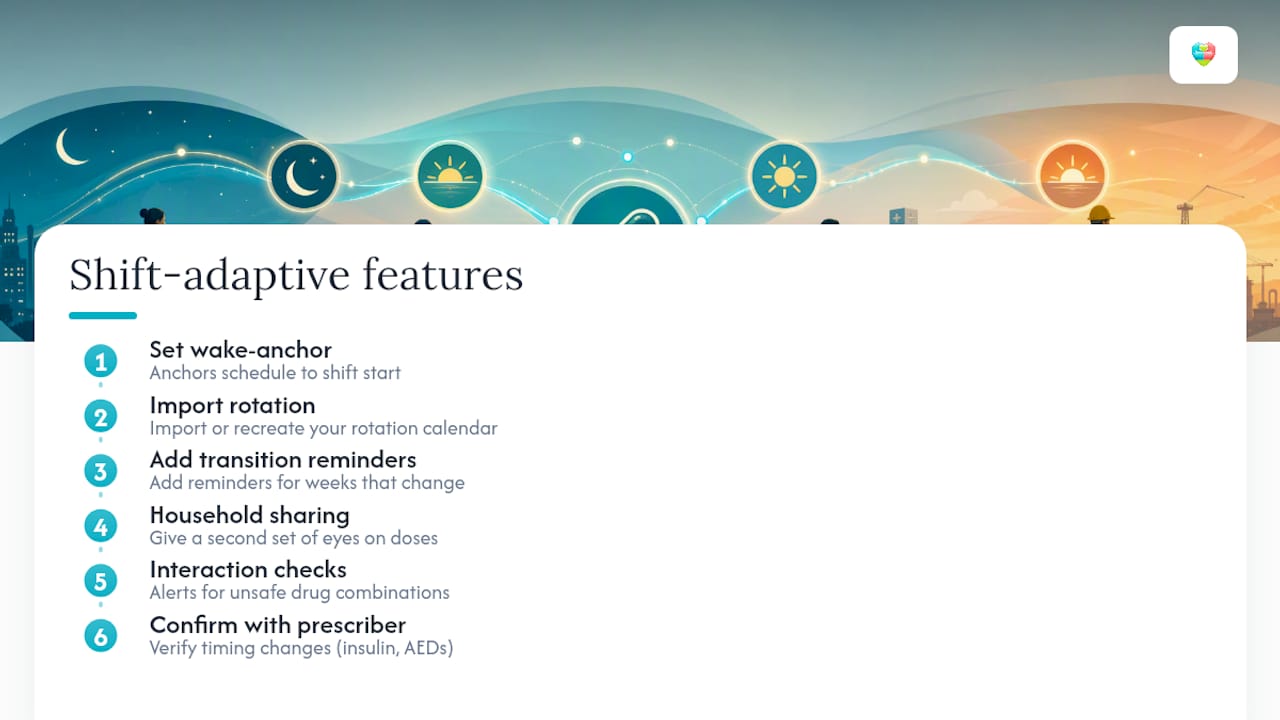
The Daily Dose Tracker's real-time dose alerts, household sharing, and drug interaction checks map directly onto the problems above: rescheduling without rebuilding, a second set of eyes on doses, and a safety check when a clinician adjusts your regimen. A practical start: set your wake-anchor reminder, import or recreate your rotation, then add transition-day reminders for the specific week it changes. Confirm any timing change with your prescriber first, particularly for insulin or antiepileptic medication.
What most advice on shift work and medication gets wrong
Most guidance on this topic treats shift work as a discipline problem, something you fix by trying harder to remember. The research doesn't support that framing. A person forgetting a dose after a rotation change hasn't failed; their schedule has changed faster than their reminder system did. That distinction should drive every decision you make about apps, alarms, and pill organisers.
The overrated advice is the blanket instruction to "take your medication at the same time every day." For a fixed-time drug that's fine. For a rotating-shift worker on an interval-based medicine, it's actively unworkable advice dressed up as caution.
What I'd prioritise first isn't the app at all. It's the weekly reset ritual. Every tactic in this article, from wake-anchoring to transition-day backups, depends on you actually knowing next week's rota before Monday hits. Get that five-minute habit right and the rest becomes far easier to automate.
— Prasant
Get a medication reminder system that moves with your rota
Fixed-time apps and paper charts both assume your day starts at the same hour every time, which is exactly the assumption that causes missed doses on shift work. The Daily Dose Tracker is built around event-based scheduling instead of clock-only alerts, so a wake-anchor reminder and a transition-day backup take minutes to set up rather than a full manual rebuild every rotation.
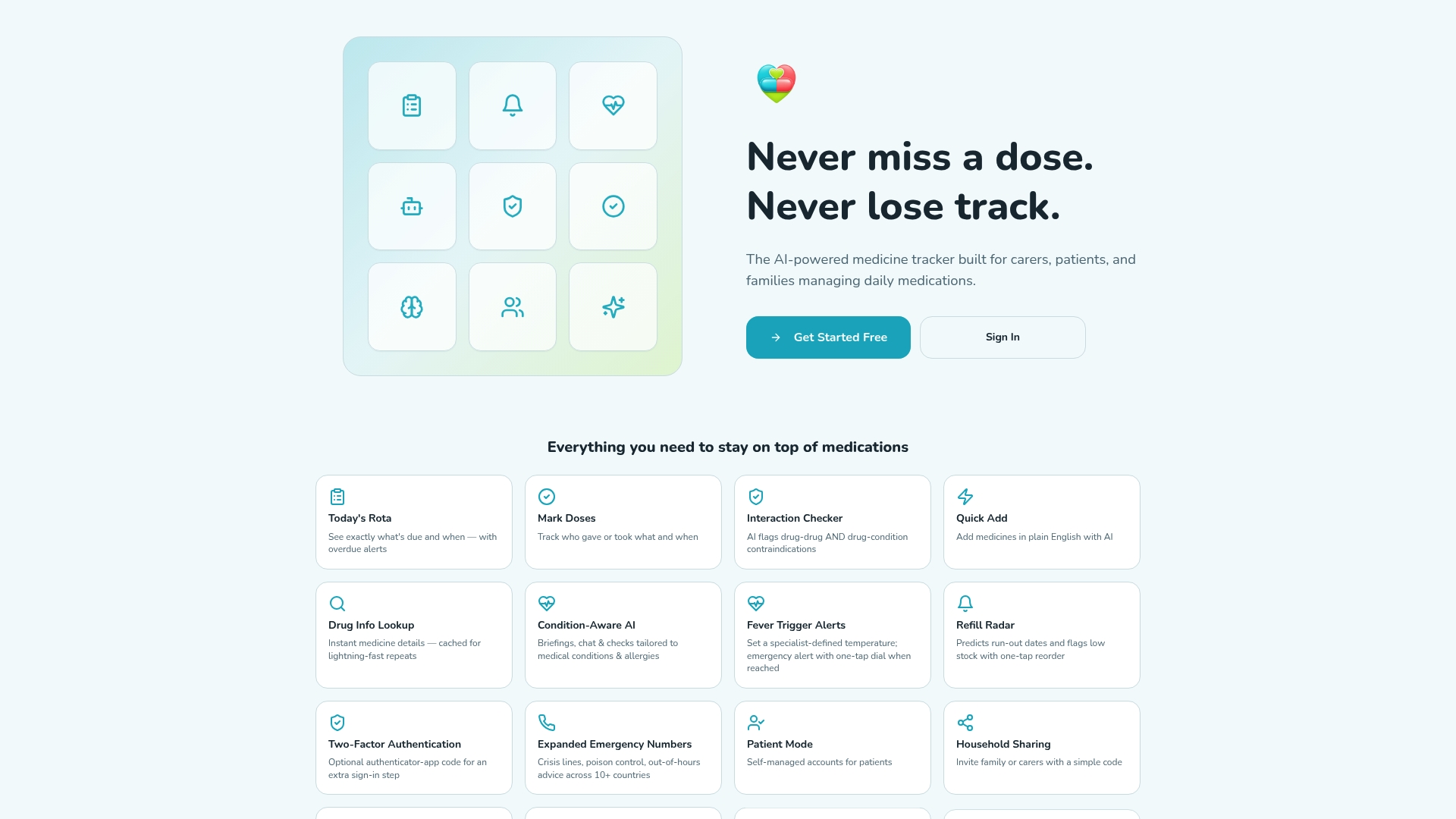
Its household sharing feature also means a partner or carer can see whether a dose was logged, which matters on the nights your own memory is running on four hours' sleep. Drug interaction checks flag risks before a prescriber changes your regimen for shift work, and refill predictions stop you running out mid-rotation when a pharmacy visit is hard to schedule.
Start by setting up your own wake-anchor reminder and rotation calendar on the free plan at The Daily Dose Tracker, then add a transition-day backup for your next rota change.
This article is general information, not a substitute for advice from a qualified doctor. Consult a qualified healthcare professional about your own circumstances before acting on anything here.
Sources
- Association between medication adherence to chronic diseases and shift-work schedules in the Korean working population | Scientific Reports
- Smart reminders: improving medication adherence through data-centric alerts (MGH IHP opinion)
- WHO material on shift work and health (IRIS collection)
- Caffeine and sleep guidance (Harvard T.H. Chan School of Public Health)