

Effective medication schedule organisation is defined as the systematic process of listing, timing, and tracking every medicine you take to prevent errors and maintain consistent adherence. For anyone managing multiple prescriptions, supplements, or over-the-counter products, the difference between a safe routine and a dangerous one often comes down to three things: a complete master medication list, the right physical or digital organiser, and reliable reminders. This article covers the most practical, evidence-based tips for building a system that actually holds up under the pressure of daily life, prescription changes, and complex regimens.
1. Medication schedule organisation tips: build your master list first
A master medication list is the single most important document in any medication management system. An up-to-date list covering every prescription drug, over-the-counter product, vitamin, and supplement prevents errors and gives every clinician you see a complete picture of your regimen. Without it, interactions go unnoticed and doses get duplicated.
Your list should record the medication name, dose, timing, the reason you take it, and any past reactions. These five details are the minimum. Keep a copy on your phone, carry a printed version in your wallet, and share it at every appointment, including dental visits and A&E attendances.
- Record the exact dose and frequency as written on the prescription label
- Note the prescribing clinician's name alongside each medicine
- Flag any medicines that require food, fasting, or specific timing
- Update the list within 24 hours of any prescription change
Pro Tip: Take a photo of your list and save it as your phone's lock screen wallpaper. In an emergency, any clinician can read it without needing to unlock your device.
2. Choosing the right pill organiser for your regimen
Pill organisers, also called dosette boxes or multi-compartment compliance aids (MCAs), reduce confusion by separating doses visually. Compartment schemes such as AM/PM or morning, afternoon, evening, and bedtime slots let you confirm at a glance whether a dose has been taken. This single feature eliminates the most common cause of accidental double-dosing.
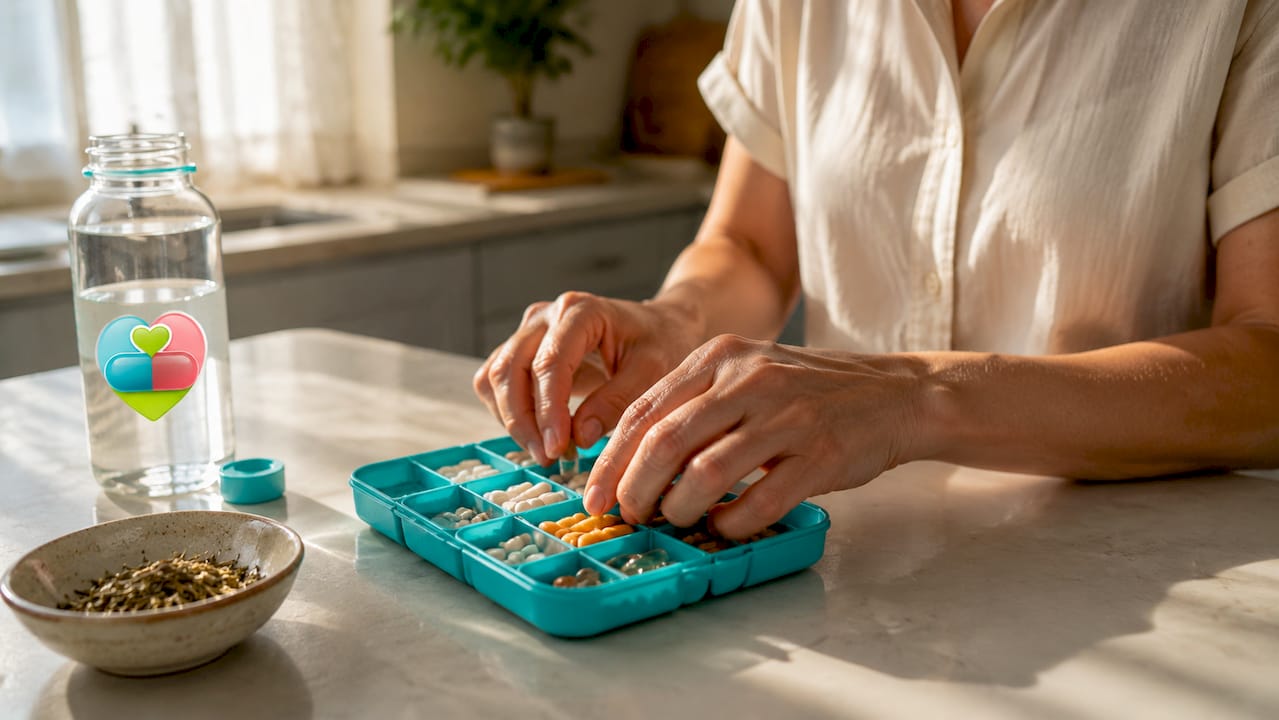
Not every medicine belongs in a pill organiser, however. NHS Specialist Pharmacy Service guidance states that pharmacist review is required before transferring medicines into an MCA, because some tablets degrade when removed from their original blister packaging, and others require light or moisture protection. Your pharmacist will also assess whether your eyesight, dexterity, and memory make a particular organiser suitable for you.
| Organiser type | Best suited for | Limitation |
|---|---|---|
| Daily AM/PM box | Simple two-dose-per-day regimens | Not suitable for four-times-daily medicines |
| Weekly seven-day box | Stable weekly regimens | Requires weekly filling discipline |
| Four-slot daily box | Complex morning to bedtime schedules | Larger and less portable |
| Pharmacy blister pack | High-risk or complex polypharmacy | Requires pharmacy preparation |
Pro Tip: Ask your pharmacist to use the NHS SPS Medicines Compliance Aid Stability Tool before filling your organiser. It flags which of your medicines are unsuitable for MCA transfer, which prevents silent degradation errors.
3. Structuring your schedule around exact dosing instructions
Building your schedule from clinician instructions and packaging labels, rather than personal convenience, is the foundation of safe medication management. Labels and packaging design are specifically engineered to reduce error risk, and your schedule should reflect them precisely rather than relying on memory or habit.
Timing matters more than most people realise. Some medicines must be taken on an empty stomach, others with food, and some must be separated from each other by at least two hours. Calcium supplements and thyroid medicines, for example, compete for absorption and must not be taken together. Structuring your schedule around these rules protects both safety and effectiveness.
- Write each medicine's timing rule directly onto your master list
- Create named time blocks such as "breakfast," "midday," "evening meal," and "bedtime" rather than vague clock times
- Store medicines that require refrigeration separately and note this on your schedule
- When a prescription changes, rebuild the affected time block from scratch rather than patching the old one
Understanding prescription label instructions in full is a skill worth developing. Many dosing errors trace back to misreading frequency abbreviations or missing food interaction notes printed in small type.
4. Using digital reminders to improve adherence
Combined digital and behavioural interventions produce adherence rates above 90%, outperforming single strategies such as alarms alone. This means pairing a reminder app with a physical habit, such as taking your morning medicines at the same time as breakfast, produces significantly better results than either approach on its own.
Smartphone apps designed for medication tracking go beyond simple alarms. Thedailydosetracker, for instance, provides real-time alerts for due and overdue doses, logs each dose taken, and flags potential drug interactions. These features answer the most anxiety-inducing question in medication management: "Did I take that already?" Consistent logging through digital dose tracking removes the guesswork entirely.
- Set reminders five minutes before each scheduled dose time, not at the exact moment
- Anchor each reminder to a fixed daily activity such as a meal, tooth brushing, or a morning coffee
- Involve a carer or family member as a secondary alert recipient for high-risk medicines
- Review your app's dose log weekly to spot any patterns of missed doses
Digital adherence tools work best when combined with behavioural supports and the involvement of family or carers. Technology alone does not change habits. The combination does.
5. Coordinating with your pharmacist for safer management
Your pharmacist is the most underused resource in medication management. Pharmacists can prepare multi-dose blister cards and synchronise your refills to reduce sorting errors and the organisational burden of managing multiple prescription cycles. For anyone taking five or more medicines, this service alone can prevent a significant number of errors each month.
Pharmacist-led medication reviews are particularly valuable when your regimen changes. Missed-dose plans must be medication-specific; generic advice found online carries real risk because the correct action after a missed dose varies widely between medicines. Your pharmacist can document the right response for each medicine on your list and update it every time a prescription changes.
- Book a medication review with your pharmacist at least once a year, or after any significant prescription change
- Ask specifically about refill synchronisation so all your medicines run out on the same date
- Request written missed-dose instructions for each medicine and attach them to your master list
- Confirm which medicines must stay in their original packaging rather than being transferred to an organiser
Pro Tip: If you manage medicines for an elderly relative, ask the pharmacy whether they offer a monitored dosage service. Many NHS-contracted pharmacies fill weekly blister packs at no charge for eligible patients, removing the filling burden from carers entirely.
6. Managing prescription changes without losing track
Prescription changes are the most common trigger for medication errors in complex regimens. Multi-compartment compliance aids must be reviewed and updated with every prescription change to avoid silent dosing errors where an old dose continues to be taken from a pre-filled organiser. The risk is highest in the first week after a change.
Treat every prescription change as a reason to rebuild your system from the relevant point. Update your master list the same day. Empty and refill any affected organiser compartments immediately. Notify any carer or family member who helps manage your medicines. Medication-taking works best as a shared team workflow where up-to-date lists are shared with emergency contacts and every provider involved in your care.
When multiple carers are involved, assign one person as the single point of responsibility for filling and verifying the organiser each week. Shared responsibility without clear ownership is the fastest route to a missed or duplicated dose.
7. Logging doses to prevent double-dosing and omissions
Visual and digital dose logging reduces the risk of accidental double-dosing and omission by making the answer to "Did I take it?" immediately available. A pillbox with a visible empty compartment is a form of logging. An app with a timestamped dose record is a more reliable one.
The goal of any logging system is to make the missed-dose question answerable within seconds, without relying on memory. Design your system so that the answer is always visible. If you use a physical organiser, check the compartment before taking a dose, not after. If you use an app, log the dose at the moment of taking it, not later in the day when memory becomes unreliable.
Combining both methods, a physical organiser for visual confirmation and an app for timestamped records, provides the strongest protection against both omission and double-dosing. This dual approach is particularly valuable for medicines with narrow therapeutic windows, such as warfarin or lithium, where dosing errors carry serious clinical consequences.
Key takeaways
Effective medication schedule organisation requires a complete master list, a pharmacist-reviewed organiser, and combined digital and behavioural reminders to achieve consistent, safe adherence.
| Point | Details |
|---|---|
| Master list is non-negotiable | Record every medicine, dose, timing, and purpose; update within 24 hours of any change. |
| Pharmacist review before using an organiser | Not all medicines are safe to transfer into a dosette box; always get professional sign-off first. |
| Build schedules from labels, not memory | Use packaging instructions and clinician directions as the source of truth for timing and food rules. |
| Combine digital reminders with habits | Adherence above 90% requires pairing app reminders with fixed daily anchors such as meals. |
| Assign clear ownership in care teams | One person must be responsible for filling, verifying, and updating the organiser each week. |
Why I think most people are managing their medicines backwards
Most people I speak with start by buying a pill organiser and then try to fit their medicines into it. That is the wrong order. The organiser is the last step, not the first. The first step is building a complete, accurate list. The second is understanding the timing and food rules for each medicine. Only then does the right organiser become obvious.
The other mistake I see constantly is treating a filled organiser as a finished job. It is not. It is the start of a managed workflow that requires weekly verification, prompt updates after prescription changes, and a clear record of who filled it and when. A pre-filled organiser that has not been updated after a dose change is more dangerous than no organiser at all, because it creates false confidence.
Technology helps, but only when it is layered on top of a solid manual system. I have seen people rely entirely on a reminder app and then miss doses for three days because their phone battery died. The app should confirm what your physical system already shows. Neither should be the only safeguard.
The pharmacist relationship is the most undervalued part of this whole process. A 20-minute medication review once a year, where your pharmacist checks every medicine on your list for interactions, duplications, and outdated doses, is worth more than any organiser or app. Book one. It is free on the NHS and it will almost certainly surface something you did not know.
— Prasant
Take control of your medication routine with Thedailydosetracker
Managing a complex medication schedule is demanding enough without the added stress of missed doses, refill confusion, or uncertainty about interactions.
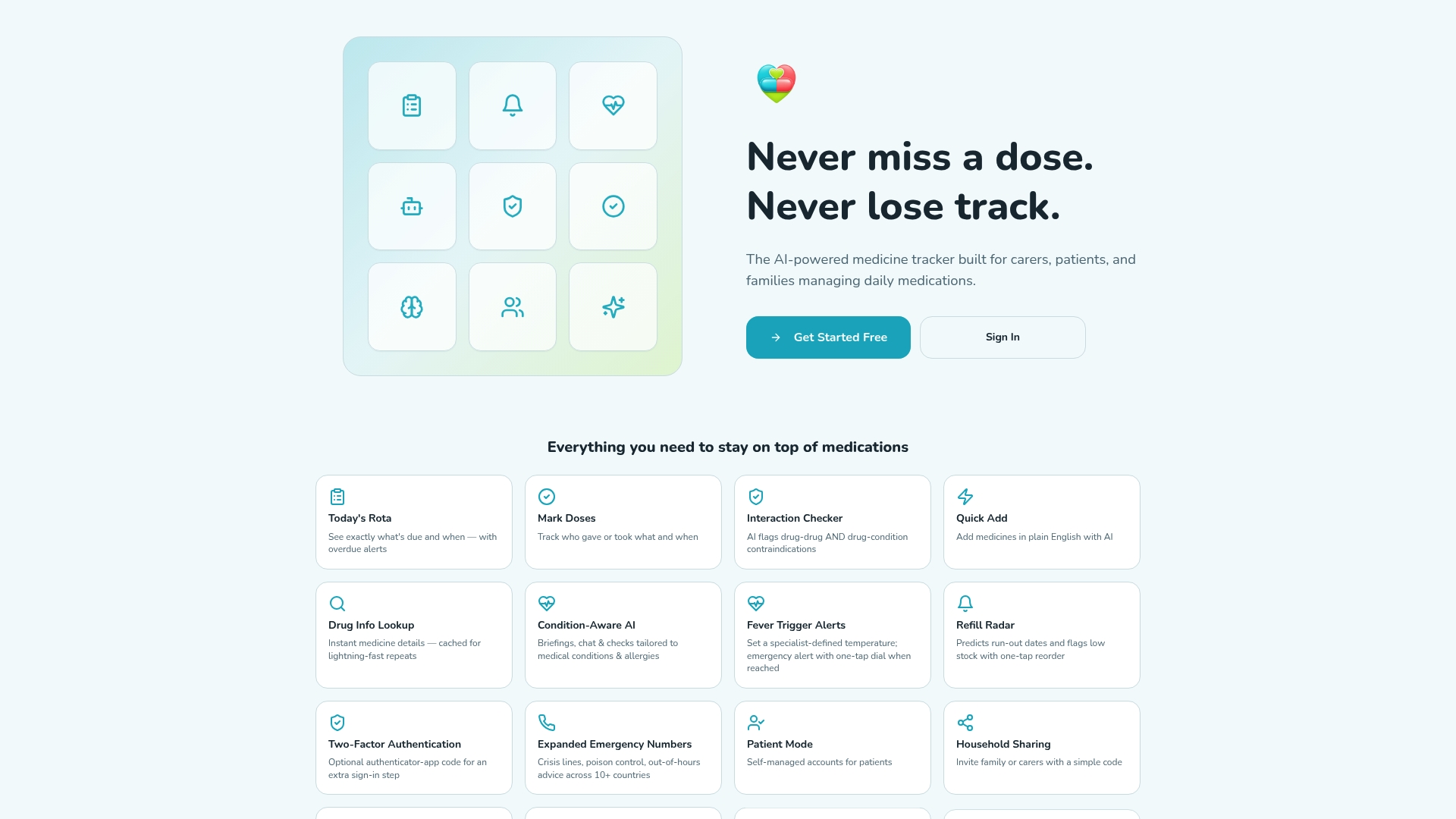
Thedailydosetracker is a free medicine management app built for carers, patients, and families who need more than a basic alarm. It logs every dose with a timestamp, sends real-time alerts for due and overdue medicines, checks for drug interactions, and supports multi-patient management across a single household. For families caring for elderly relatives or anyone managing five or more medicines, it removes the guesswork from daily medication routines. Start using Thedailydosetracker today and bring the same level of structure to your medication routine that this article recommends.
FAQ
What should a master medication list include?
A master medication list should include every prescription drug, over-the-counter product, vitamin, and supplement, along with the dose, timing, reason for taking it, and any past reactions. Keep a copy on your phone and share it at every clinical appointment.
Are all medicines safe to put in a pill organiser?
No. Some medicines degrade when removed from their original blister packaging, and others require specific storage conditions. NHS Specialist Pharmacy Service guidance requires a pharmacist review before transferring any medicine into a multi-compartment compliance aid.
How do digital reminders improve medication adherence?
Combined digital and behavioural interventions produce adherence rates above 90%, according to a systematic review published in the Journal of Clinical Medicine. Pairing a reminder app with a fixed daily habit, such as a meal, produces better results than either approach alone.
What should I do when a prescription changes?
Update your master medication list on the same day, empty and refill any affected organiser compartments immediately, and notify any carer involved in your routine. Ask your pharmacist for updated missed-dose instructions specific to the new medicine.
How often should I have a medication review with my pharmacist?
At minimum, once a year or after any significant prescription change. A pharmacist-led review checks for interactions, outdated doses, and whether your current organiser system remains appropriate for your regimen.