

Contraindication screening tools are instruments used to identify whether a medication, vaccine, or treatment is safe for a specific patient before administration. The best examples of contraindication screening tools include CDC vaccine checklists, tPA exclusion criteria forms, Alberta Health Services' "Fit to Immunize" assessment, and digital platforms like Thedailydosetracker. These tools sit at the centre of medication safety, giving healthcare professionals and carers a structured way to catch risks before they become harm. Without them, adverse reactions, inappropriate deferrals, and clinical errors increase significantly.
1. What are examples of contraindication screening tools?
Contraindication screening tools fall into three broad categories: paper checklists, structured clinical criteria, and digital applications. Each category serves a different setting, from a busy vaccination clinic to a stroke unit operating under time pressure. The industry term for this practice is contraindication assessment, and the tools used are sometimes called screening tools for contraindications or risk assessment tools in clinical governance documents.
The core function is the same across all formats. A clinician or carer works through a set of questions or criteria to determine whether a patient has a condition, allergy, or medication history that makes a treatment unsafe. The output is either a clear green light, a flag for further assessment, or an absolute stop.

2. CDC vaccine screening checklists
The CDC vaccine screening checklist is one of the most widely used contraindication assessment tools in the world. Separate versions exist for children and teenagers and for adults, each structured as a series of yes/no questions covering allergies, immune status, pregnancy, and recent illness. The checklist is administered no earlier than the day of vaccination, which is a deliberate design choice to capture acute changes in health status.
The questions are intentionally brief. A typical item reads: "Has the patient ever had a severe allergic reaction to any component of this vaccine?" A "yes" answer triggers a clinical review rather than an automatic refusal. This matters because distinguishing contraindications from precautions reduces unnecessary deferrals and keeps vaccination rates where they need to be.
Common contraindications captured by vaccine screening tools include:
- Anaphylaxis to a previous dose of the same vaccine
- Known severe allergy to a vaccine component such as polyethylene glycol
- Confirmed immunodeficiency for live virus vaccines
- Pregnancy, for certain live attenuated vaccines
- Moderate or severe acute illness at the time of the appointment
The Merck Manual confirms that anaphylaxis is a firm contraindication for vaccines including RSV, shingles, and COVID-19 products, while moderate illness is classified as a precaution requiring clinical judgement rather than an outright stop.
Pro Tip: Administer the screening checklist on the day of the appointment, not at booking. A patient's health status can change overnight, and a checklist completed a week earlier misses acute contraindications entirely.
Vaccine screening is also part of a wider safety system. The CDC links checklist completion to post-vaccination observation periods and the distribution of vaccine information sheets, making the tool one step in an end-to-end vaccination clinic safety process rather than a standalone form.
3. tPA contraindication checklists for emergency medications
Intravenous alteplase (tPA) for ischaemic stroke is one of the clearest examples of risk assessment tools under genuine time pressure. The tPA contraindication checklist separates exclusions into two tiers: absolute and relative. This structure is the defining feature of emergency medication screening tools.
Absolute contraindications are non-negotiable. They include:
- Intracranial haemorrhage on imaging
- Surgery within the last three months
- Active internal bleeding within the last 21 days
- Severe uncontrolled hypertension above defined thresholds
- Ischaemic stroke or serious head trauma within three months
Relative contraindications require expert consultation before proceeding. Examples include blood pressure readings at borderline thresholds, use of direct oral anticoagulants (DOACs) within the preceding 48 hours, and minor or rapidly improving neurological deficits.
| Contraindication type | Definition | Clinical action |
|---|---|---|
| Absolute | Risk of harm clearly outweighs benefit | Do not administer |
| Relative | Risk is uncertain; benefit may still apply | Consult senior clinician |
| Precaution (vaccines) | Temporary or manageable risk factor | Defer or assess individually |
Screening tools with numeric cut-offs and time anchors reduce errors in high-pressure decisions. A clinician working a stroke call at 3am benefits from a checklist that states "bleeding within 21 days" rather than asking them to recall the exact threshold from memory. Decision support calculators such as MDCalc's tPA tool embed these criteria directly into a digital form, reducing cognitive load at the moment of highest risk.
Pro Tip: Print laminated tPA contraindication checklists and mount them in resuscitation bays and stroke assessment areas. Digital calculators are faster, but a physical backup prevents delays when systems are slow or unavailable.
The time-anchored design of emergency screening tools is a lesson that transfers to other high-risk medications. Any drug with a narrow therapeutic window or serious bleeding risk benefits from a structured checklist that specifies exact timeframes and laboratory thresholds.
4. Digital and app-based contraindication screening tools
Digital tools for evaluating contraindications go beyond static checklists by integrating patient history, allergy records, and real-time medication logs. This makes them particularly effective for complex cases involving polypharmacy, which is common in elderly patients managing four or more concurrent medications.
Digital medication management apps support carers and healthcare professionals by tracking medication timing, flagging drug interactions, and alerting teams to doses that may conflict with a patient's recorded conditions. Thedailydosetracker, for example, offers drug interaction checks, condition-specific guidance, and real-time alerts for due or overdue doses. For a carer managing an elderly patient on warfarin, a diuretic, and an antibiotic, this kind of dynamic screening catches risks that a paper checklist cannot.
Key advantages of digital contraindication assessment tools include:
- Automatic cross-referencing of new prescriptions against existing medication lists
- Allergy flagging at the point of medication logging
- Integration across multiple devices, supporting handovers between care team members
- Audit trails that document screening decisions for clinical governance purposes
The management of complex medication regimens is where digital tools show their greatest advantage over paper. A paper checklist cannot update itself when a new prescription is added mid-week. A digital platform can flag the conflict within seconds of the new medication being logged.
Pro Tip: When selecting a digital contraindication screening tool, check whether it supports multi-patient management. Carers often oversee more than one person, and a platform that handles both an elderly parent and a child with a chronic condition saves significant time.
5. Comparing checklists and digital screening tools
Paper checklists and digital screening tools each have a clear role. Neither replaces the other entirely. The choice depends on the clinical setting, the complexity of the patient, and the resources available.
| Feature | Paper checklist | Digital screening tool |
|---|---|---|
| Speed of use | Fast for simple cases | Fast for complex cases |
| Update frequency | Requires manual reprint | Updated automatically |
| Integration with records | None without manual entry | Direct integration possible |
| Training required | Minimal | Moderate initial setup |
| Best use case | Vaccination clinics, point-of-care | Polypharmacy, chronic care, homecare |
| Audit trail | Paper-based, variable | Digital, consistent |
Paper checklists work best in high-volume, low-complexity settings such as vaccination clinics. The CDC design for vaccine screening reflects this: short questions, same-day administration, and immediate clinical review if a flag is raised. Digital tools work best where patient complexity is high and medication histories are long.
The Alberta Health Services "Fit to Immunize" tool sits between these two categories. It is a structured paper assessment that captures nuanced contraindication versus precaution status, rather than applying a binary yes/no exclusion. That nuance is what reduces inappropriate vaccine deferrals and supports better clinical reasoning.
For carers working in home settings, a digital tool that logs doses and checks interactions offers a level of safety that no printed form can match. The digital drug interaction checks available through platforms like Thedailydosetracker bring clinical-grade screening into the home environment.
Key takeaways
Effective contraindication screening requires the right tool for the setting: structured checklists for vaccination clinics, tiered criteria forms for emergency medications, and digital platforms for complex or ongoing medication management.
| Point | Details |
|---|---|
| Checklists for vaccines | CDC and AHS checklists use yes/no questions and must be completed on the day of vaccination. |
| Absolute vs relative criteria | tPA screening separates non-negotiable exclusions from cases requiring expert review. |
| Digital tools for complexity | Apps like Thedailydosetracker flag interactions and contraindications in real time for polypharmacy patients. |
| Contraindications vs precautions | Distinguishing the two reduces inappropriate deferrals and supports accurate clinical decisions. |
| Timing is built into the tool | Effective screening tools embed specific time windows and lab thresholds, not just general categories. |
Why the contraindication/precaution distinction is the most underused clinical skill
Most clinicians know what a contraindication is. Far fewer apply the contraindication versus precaution distinction consistently under pressure. I have seen vaccination clinics defer patients with mild colds because a nurse read "acute illness" as an absolute stop, when the guidance clearly classifies it as a precaution requiring individual assessment. That is not a knowledge failure. It is a tool design failure.
The best screening tools do not just list exclusions. They tell the clinician what to do next. A checklist that flags a relative contraindication and then says "consult senior clinician" is more useful than one that simply marks the patient as unsuitable. The tPA checklist structure gets this right. The absolute column means stop. The relative column means call someone. That clarity saves lives.
Digital tools add another layer that paper cannot. When a carer logs a new antibiotic for an elderly patient already on warfarin, the interaction flag appears before the dose is given, not after. That is the difference between a near miss and a hospital admission. The medication timing considerations for elderly patients are exactly where digital screening earns its place.
My practical advice: use the simplest tool that matches the complexity of the case. A vaccination clinic does not need an app. A carer managing a patient on eight medications does not need a paper form.
— Prasant
Thedailydosetracker and medication safety for carers
Carers managing complex medication regimens need more than a printed checklist.
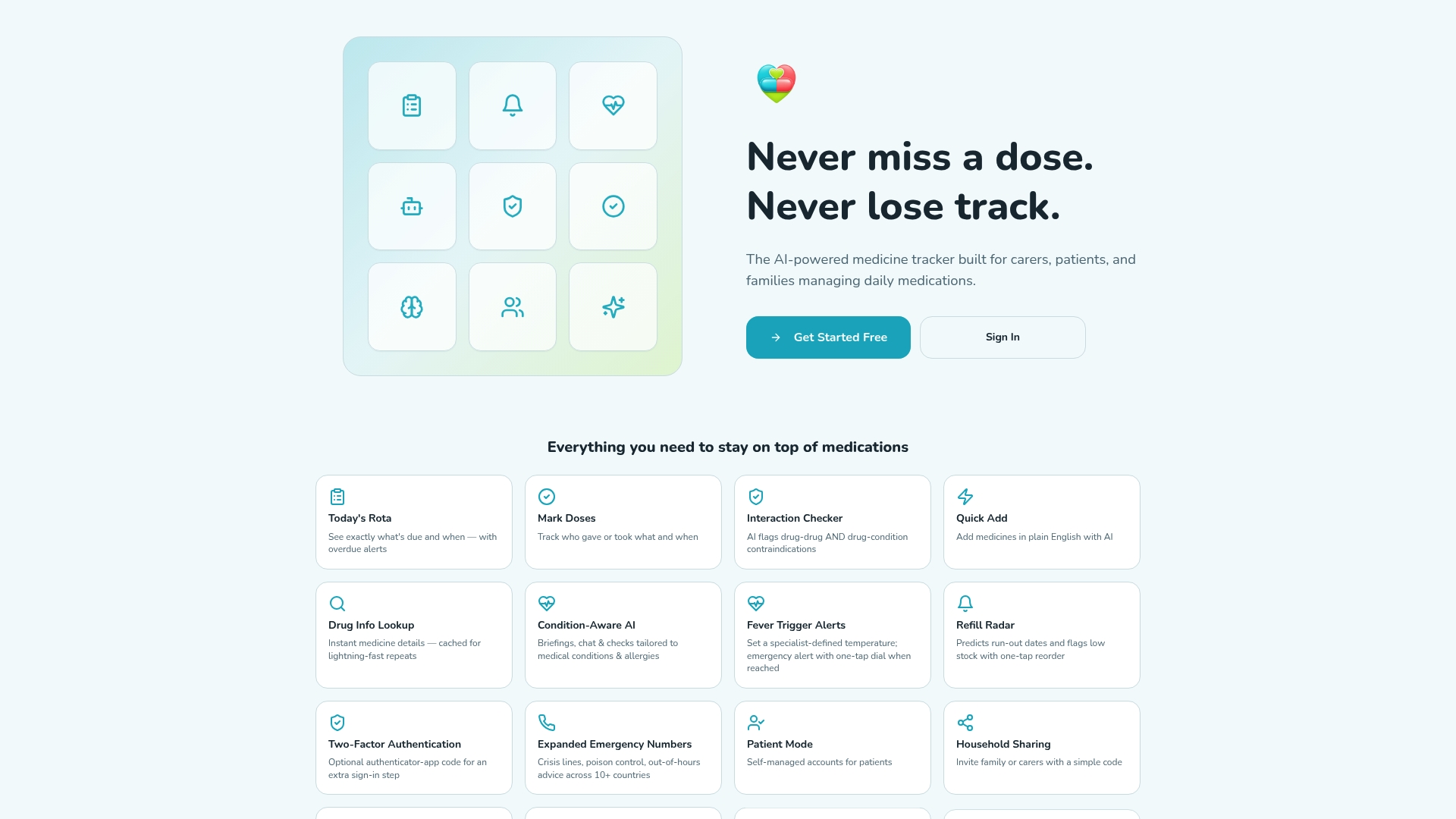
Thedailydosetracker is a digital medication management platform built for carers, patients, and healthcare professionals. It offers drug interaction checks, real-time dose alerts, condition-specific guidance, and multi-patient management across devices. For households where one carer oversees an elderly parent and a child with a chronic condition, the platform provides a free medicine management app that brings contraindication screening, dose logging, and interaction alerts into a single place. It complies with UK GDPR standards and works across devices without requiring installation.
FAQ
What are the main examples of contraindication screening tools?
The main examples include CDC vaccine screening checklists, the Alberta Health Services "Fit to Immunize" assessment, tPA exclusion criteria forms for stroke thrombolysis, and digital medication management apps. Each tool is designed for a specific clinical context and level of patient complexity.
How do checklists screen for contraindications in vaccination?
CDC vaccine checklists use brief yes/no questions covering allergies, immune status, and acute illness, administered on the day of vaccination. A positive answer triggers clinical review rather than automatic refusal, allowing clinicians to distinguish contraindications from precautions.
What is the difference between a contraindication and a precaution?
A contraindication means the risk of harm clearly outweighs the benefit, and the treatment should not proceed. A precaution means the risk requires individual assessment, and the treatment may still be appropriate after a risk-benefit review.
When should a digital tool replace a paper checklist?
Digital tools are most effective when a patient is on multiple medications, has complex allergies, or requires ongoing monitoring across a care team. Paper checklists remain appropriate for high-volume, low-complexity settings such as vaccination clinics.
Can carers use contraindication screening tools at home?
Yes. Digital platforms like Thedailydosetracker give carers access to drug interaction checks and real-time alerts that flag contraindications before a dose is administered, making clinical-grade screening accessible outside formal healthcare settings.