
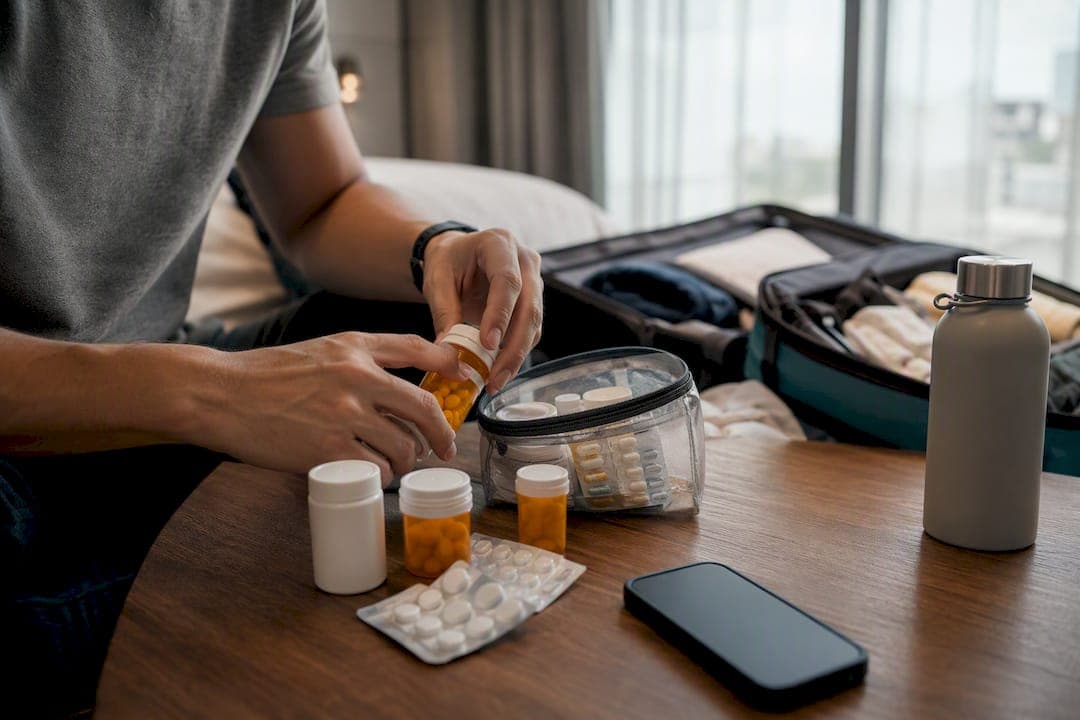
A travel medication list is a portable, shareable record of everything a person takes, with names, doses, schedules and emergency contacts, written so a clinician anywhere can act on it in seconds. Start compiling yours now, and book a medication review with a GP or pharmacist 4 to 6 weeks before departure, as recommended in The smarter ways to book a doctor's appointment. A tool like The Daily Dose Tracker can hold that record securely and export it as a PDF when you need to hand it over.
TL;DR:
- A verified medication list should include generic names, doses, timing, and prescriber contact information, and be laminated and photographed for safety.
- Booking a medication review 4 to 6 weeks before travel ensures proper reconciliation, updated dosing instructions, and customs documentation for controlled drugs.
- Carry medicines in original pharmacy containers with prescriptions, and obtain a signed letter for controlled or injectable medicines to prevent delays at borders.
- Adjust medication timing based on intervals since the last dose when crossing time zones, especially for high-risk medicines like insulin and anticoagulants.
- Use a digital tool to keep an up-to-date record, export PDFs for sharing, and perform drug interaction checks to minimize risks during trips.
Table of Contents
- Free travel medication list template and printable checklist
- How do you compile a clinician-verified medication list?
- Do you need a doctor's letter to travel with medication?
- How do you adjust medication timing across time zones?
- How should you pack medicines for a flight?
- How do you share a medication list safely while travelling?
- Why do so many travel medication lists fail in practice?
- Create, export and share your travel medication list with The Daily Dose Tracker
- Where to check official travel medicine rules
- Sources
Free travel medication list template and printable checklist
Think of this less as a packing list and more as a document a stranger in a foreign A&E department could use to save someone's life. That's the standard the NIHR's medication passport sets, and it's worth building your own version around the same fields.
A single sheet works better than a folder of loose prescriptions. Print one, laminate it if you can, and photograph it too.
- Full name, date of birth and NHS or patient number
- Known allergies and existing medical conditions
- Each medicine: generic name, brand name, strength, dose, timing and reason for use
- When the last dose was taken and when the next is due
- Prescriber name and contact details
People routinely forget the medicines that don't come in a blister pack: inhalers, eye drops, topical steroid creams, insulin pens, and supplements that interact with prescription drugs. Devices like glucose monitors or nebulisers belong on the list too, alongside their power or battery requirements.
| Field | Example entry |
|---|---|
| Medicine (generic/brand) | Metformin / Glucophage |
| Strength and dose | twice daily |
| Timing | With breakfast and evening meal |
| Reason | Type 2 diabetes |
| Prescriber contact | Dr J. Malik |
Keep one printed copy in your carry-on and a digital duplicate on your phone. If one gets lost, the other still works.
How do you compile a clinician-verified medication list?
Building the list is the easy part. Getting it verified is what actually protects the patient.
- Gather every medicine from its original packaging, current prescriptions and any electronic patient record you can access, rather than relying on memory.
- Write the generic (INN) name for each drug first, then the brand name beside it. Overseas clinicians often won't recognise a UK brand name, but generic drug names are internationally standardised and cut reconciliation time dramatically in an emergency.
- Book a medication review with the GP or pharmacist 4 to 6 weeks before travel, the window travel medicine specialists advise for anyone on regular prescriptions or with a chronic condition.
- Ask specifically for written travel-day dosing instructions if the trip crosses time zones or the medicine has a narrow safety margin.
- Request a letter on headed paper for any controlled or injectable medicine, plus copies of the relevant prescriptions to carry alongside it.
This process is essentially a formal medication reconciliation, the same check hospitals run when a patient moves between care settings, applied to a holiday instead of a ward transfer.
Pro Tip: Bring the pharmacy's printed medication summary to the review appointment. It's usually more accurate than what's in the GP's system, especially after a recent dose change.
Do you need a doctor's letter to travel with medication?
For most repeat prescriptions, no. For controlled drugs, injectables, or anything a customs officer might mistake for something illicit, yes, and skipping this step is the single most common reason travellers get delayed at borders.
Keep medicines in their original pharmacy-labelled containers and carry prescriptions with you at all times, rather than checking them into hold luggage, since Gov is explicit that decanted or unlabelled medicines can be seized or questioned.
- Check the destination's controlled-drug rules well before booking, because possession limits vary enormously between countries.
- Apply for an export licence early if the medicine is controlled and the quantity or destination requires one.
- Consult embassy and INCB guidance for country-specific restrictions, since some medicines legal in the UK are banned outright elsewhere, and this is confirmed as necessary because enforcement can happen at transit airports too, not just the final destination.
- Keep photographed or scanned copies of all documentation in your carry-on, and leave a duplicate set with a trusted contact at home.
None of this is bureaucratic box-ticking. A prescriber letter on headed paper, dated recently, is often the only thing standing between a traveller and a confiscated three-month insulin supply.
How do you adjust medication timing across time zones?
The safest rule is simple: dose by hours since the last dose, not by the clock on the wall. Landing in a new time zone doesn't change how long a drug's effect lasts in the body, and the NHS's travel health advice points travellers towards calculating intervals rather than guessing based on local time.
- Ask the clinician for a written travel-day dosing plan for any high-risk medicine before you fly.
- Simplify multi-dose regimens where it's clinically safe to do so, since fewer daily dosing points mean fewer chances to miss one.
- Set phone alarms to the destination time zone as soon as you land, adjusted according to the interval plan rather than the old schedule.
Insulin, anticoagulants and anti-seizure medicines deserve particular care. Clinicians typically provide a day-by-day travel plan for exactly these drug classes, because a missed or doubled dose carries real consequences within hours, not days.
Pro Tip: Anchoring reminders to a fixed interval rather than a fixed clock time works well for shift workers too, and the same reminder logic applies whether the disruption is a night shift or a nine-hour flight.
How should you pack medicines for a flight?
Keep every essential medicine in carry-on luggage, in its original packaging, and pack extra doses to cover unexpected delays. Checked bags get lost. Carry-on doesn't.
- Check the airline's specific rules on liquids, syringes and medical devices before you travel, since allowances differ by carrier.
- Plan ahead for anything that needs refrigeration. Insulin needs a validated cool bag, and pharmacists can advise on temperature-stable transport options.
- Notify the airline in advance if you're travelling with oxygen equipment or injectable medicines, so ground staff know what to expect at security.
- Split supplies between two travellers where possible, and photograph every label in case original packaging gets damaged or lost.
How do you share a medication list safely while travelling?
Keep both a printed copy and a digital one. A PDF on your phone works when you've lost the paper version; the paper version works when your phone's dead.
- Save the list as an offline PDF or photo so it's accessible without signal or Wi-Fi.
- Share it with the prescribing clinician, a travel companion and, where possible, the destination's care team before you leave, a practice clinical travel guidance actively recommends.
- Protect the file with a passcode or app-level security rather than leaving it as an unprotected attachment in an email thread.
This is where a dedicated tool earns its place over a scanned document. The Daily Dose Tracker lets you export a complete list to PDF, share it by secure link, and run interaction checks across everything on it, useful if a destination doctor prescribes something new. Multi-patient management matters if you're travelling as the carer for more than one person, and UK GDPR compliance means the data doesn't sit somewhere unaccountable.
Why do so many travel medication lists fail in practice?
The failures I see repeated aren't dramatic. They're small omissions that become large problems at exactly the wrong moment.
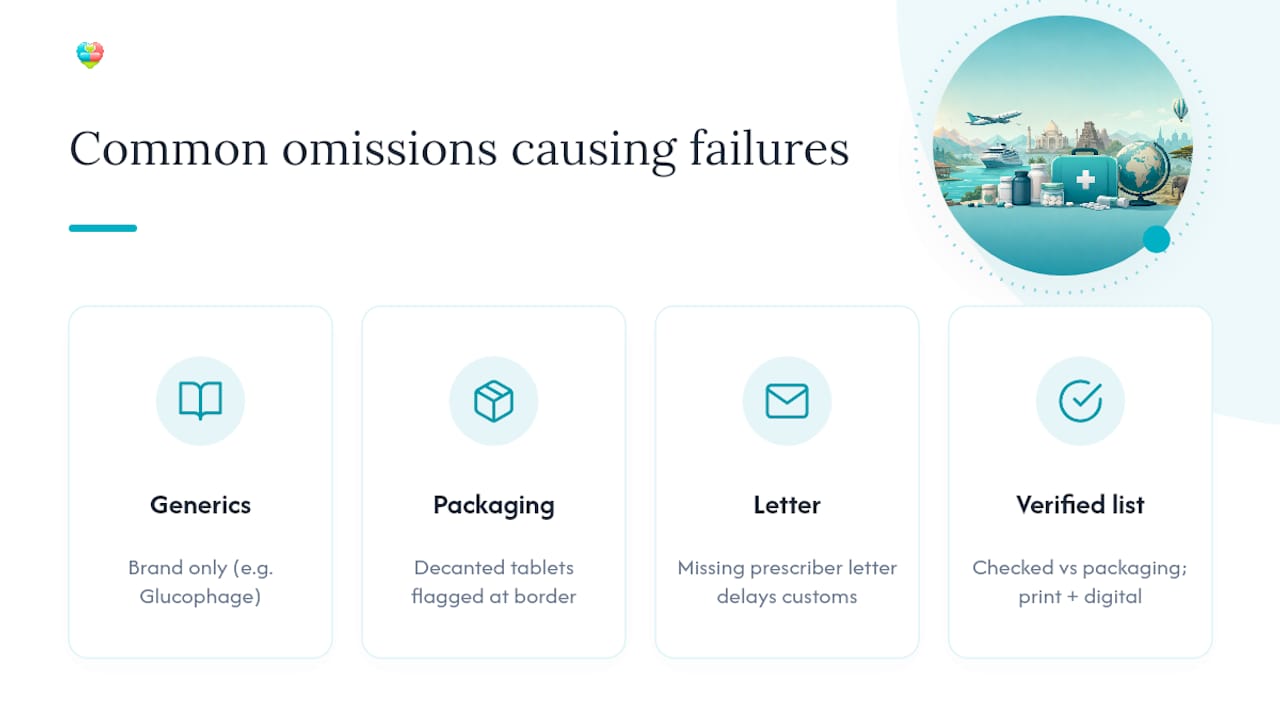
Missing generic names top the list. A list that says "Glucophage" but not "metformin" slows down a foreign clinician who's never encountered the brand. Decanted medicines, tablets tipped into a weekly organiser for convenience, are the second recurring issue, and they're exactly what border officials are trained to question. The third is the absent prescriber letter, which turns a routine customs check into a delayed flight.
A verified list, checked against original packaging and signed off by whoever prescribed it, fixes all three in one sitting. Combine that printed, clinician-reviewed sheet with a digital backup you can update on the move, and most of the risk disappears before it ever becomes a problem.
— Prasant
Create, export and share your travel medication list with The Daily Dose Tracker
Building a travel-ready medication list by hand works, but keeping it accurate across every trip, every dose change and every new prescription is where a paper system starts to slip. The Daily Dose Tracker gives you one live record instead of a folder of outdated printouts.
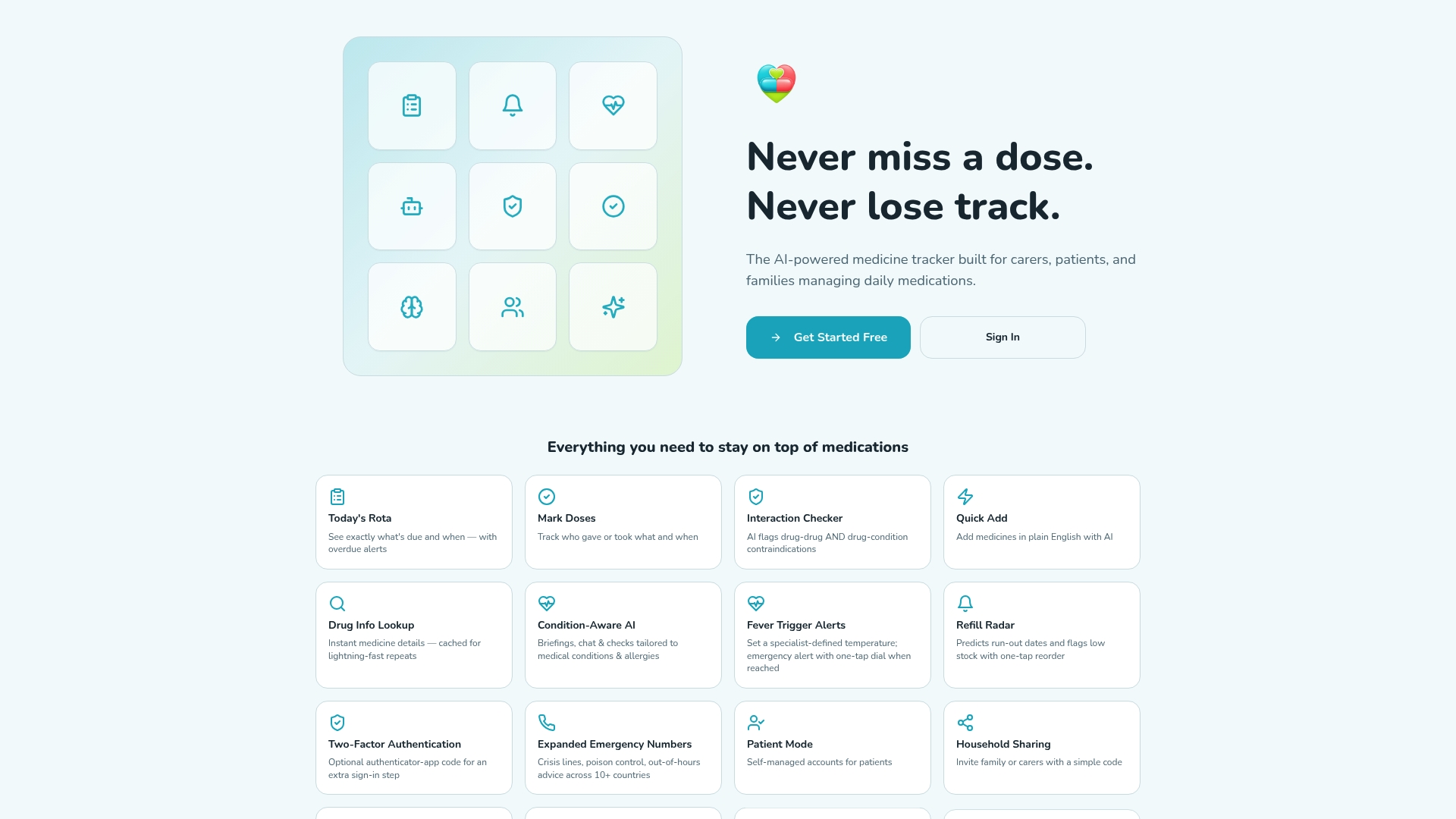
Set up a free master list for yourself or the person you care for, and the platform runs drug interaction checks automatically as you add new medicines. When travel comes round, export the full list to PDF in seconds, share it by secure link with your GP before the appointment, and hand a copy to your travel companion or destination care team. Multi-patient support means one account can hold lists for an entire household, which matters if you're the one coordinating medicines for elderly parents as well as your own prescriptions. Set up your free medication list before your next trip and have it ready to export the moment your clinician review is booked.
Where to check official travel medicine rules
- Gov for UK-specific rules on taking medicine abroad and controlled-drug licences
- CDC travel health advice for destination-specific restrictions and documentation
- TravelHealthPro for UK clinical guidance on medicines abroad
- Your embassy or the INCB for country-specific controlled-substance rules before booking an export licence
This article is general information, not a substitute for advice from a qualified doctor. Consult a qualified healthcare professional about your own circumstances before acting on anything here.