

Remote medication monitoring uses apps, smart dispensers, sensors, and video check-ins to confirm whether patients take their medicines as prescribed, and to flag missed or incorrect doses before they cause harm. The main clinical payoff is earlier intervention: teams catch non-adherence in hours rather than at the next appointment, weeks later.
TL;DR:
- Connectivity issues in rural areas and with elderly patients often cause silent gaps that can be mistaken for missed doses.
- User engagement relies heavily on personalized prompts and involving carers early to prevent device abandonment after initial use.
- Alert fatigue can undermine safety if thresholds are not carefully calibrated, especially given England's high prescription volume.
- Remote monitoring adds workload in triaging alerts and training staff, requiring dedicated effort beyond initial setup.
- Starting with small cohorts and thorough alert design improves scaling success more than expanding device choices or caseloads prematurely.
Table of Contents
- What does remote medication monitoring actually cover?
- How do the different monitoring technologies actually work?
- How do you build remote monitoring into clinical workflow?
- How do you keep remote monitoring clinically safe?
- What does it cost, and how do you start a pilot?
- Where does The Daily Dose Tracker fit into this?
- What actually goes wrong with remote medication monitoring?
- How do you keep patients actually engaged with monitoring?
- What regulatory requirements go beyond GDPR?
- How much extra work does this create for staff?
- What I've learned from watching these pilots succeed and fail
- Start your own pilot with The Daily Dose Tracker
- Sources
What does remote medication monitoring actually cover?
The term spans four overlapping activities: tracking whether a dose was taken, confirming administration visually or electronically, watching refill patterns for gaps in supply, and screening new prescriptions against existing medicines for dangerous interactions. Some programmes run all four; many start with just adherence tracking and refill alerts, then add observed administration for higher-risk patients.
In practice, the people running these programmes aren't limited to hospital pharmacists. Community nurses use it to keep tabs on patients between visits. Family carers use it to manage an elderly parent's seven-drug regimen without ringing them three times a day. Domiciliary care providers use it across a caseload where staff can't physically be in every home every morning.
The clinical contexts where it earns its place tend to cluster around a few patterns:
- Post-discharge follow-up, where medication changes made in hospital are most likely to go wrong at home
- Polypharmacy cases, typically five or more regular medicines, where timing errors and interactions compound
- High-risk patients, including those with heart failure, epilepsy, or mental health conditions where a missed dose has fast, visible consequences
- Cognitive impairment or frailty, where the patient can't reliably self-report whether they've taken anything
Given the volume of prescribing involved, even small adherence gains matter at scale. NHS Business Services Authority mental health medicines data for England alone shows the scale of prescribing that adherence tools are working against.
How do the different monitoring technologies actually work?
Four tool categories dominate the market, and each confirms a dose differently.
- Medication reminder apps send scheduled prompts and log a tap or swipe as confirmation. They're the cheapest option and the easiest to deploy, but they rely entirely on the patient (or a carer) engaging with a screen.
- Smart pillboxes and bottle caps detect when a compartment opens or a cap is removed, which is a stronger adherence signal than an app tap because it requires physical interaction with the medicine itself.
- Video check-ins let a carer or clinician watch a patient take medication in real time or via a recorded clip, useful for high-risk regimens like directly observed therapy for tuberculosis or certain mental health medicines.
- Sensor-based confirmation, including ingestible sensors and connected inhalers, gives the strongest confirmation of actual ingestion but remains expensive and used selectively.
The choice between bring-your-own-device (BYOD) and supplied hardware shapes everything downstream. BYOD keeps set-up costs down and lets patients start immediately using a phone they already own, though it introduces variability: older handsets, patchy data plans, and wildly different comfort levels with technology. Supplied devices standardise the experience and reduce the training burden, but they cost more per patient and need a logistics chain to distribute, replace, and eventually collect them. Vendors in this space, including MedM's remote monitoring platform, document this trade-off clearly: BYOD accelerates enrolment but increases support variability.
Connectivity is the quiet failure point most pilots underestimate. Rural addresses, thick-walled Victorian houses, and elderly patients who switch their router off at night all create gaps. Better platforms handle this with edge buffering and store-and-forward logic, holding dose events locally and syncing once a connection returns, so a two-hour outage doesn't look like a missed dose on the dashboard. Onix Health's work on remote patient monitoring describes exactly this kind of resilience as a baseline requirement, not a nice extra.
Pro Tip: Before choosing a device model, test it with your actual patient cohort for a week, not your team. A pillbox that's intuitive to a 35-year-old clinician can be baffling to an 84-year-old with early-stage dementia, and you'll only find that out by watching them try.
How do you build remote monitoring into clinical workflow?
Bolting a monitoring app onto an existing caseload without changing how staff work is the fastest way to make a pilot fail. Workflow has to absorb the new information, not just receive it.
Onboarding needs a fixed checklist so nothing gets skipped under time pressure:
- Documented consent, including what data is collected and who sees it
- Device set-up completed with the patient or carer present, not left as a leaflet
- A short competency check confirming the patient (or carer) can operate the device unaided
- A test dose or dry run logged before going live, so the first real alert isn't also the first real test of the system
Alert handling is where most of the operational risk sits, and partnering with experts in medical billing and care-coordination services can help ensure streamlined documentation and time-on-task tracking for reimbursement workflows. Every alert needs a destination: a triage queue that someone actually monitors, clear escalation rules for what counts as urgent versus routine, and a documented record of what action followed each alert. An alert that fires into an inbox nobody checks is worse than no monitoring at all, because it creates a false sense of oversight.
Pilots work best kept deliberately small at first. A cohort of around 10 to 15 patients is enough to surface workflow problems without overwhelming a team still learning the system, a pattern several remote monitoring vendors, including MedM, design their onboarding around. Track adherence rate, missed-dose events, time-to-response for alerts, and staff time-on-task, then review at four and eight weeks before deciding whether to scale.
How do you keep remote monitoring clinically safe?
Monitoring only improves safety if the data feeding it is accurate and the alerts it generates are trustworthy. Two things underpin that: interaction screening and disciplined alert management.
Interaction checks need to run against a current, reconciled medication list, not whatever was prescribed at the last review. A monitoring platform that flags dose timing but misses a new interaction from a GP-added prescription is solving half the problem.
Data governance under UK GDPR means being explicit about what's collected (dose events, timestamps, sometimes video), who can access it, and how long it's retained. Consent has to cover remote observation specifically, not just general care.
Alert fatigue is the single biggest reason remote monitoring programmes quietly get abandoned by staff. The fixes that actually work:
- Per-clinician alert budgets, so no one individual is drowning in notifications
- Configurable thresholds set against each patient's own baseline, not a generic default
- Snooze states for known, explained deviations rather than repeat pings for the same issue
With over a billion prescription items dispensed annually in England, even a small percentage generating unnecessary alerts would swamp any care team. Alert design has to assume scale from day one.
What does it cost, and how do you start a pilot?
Two pricing models dominate: per-patient-per-month subscription fees, which scale predictably with caseload, and upfront device supply costs, which front-load spend but reduce ongoing fees. Most services blend both, a pattern documented across remote monitoring vendors like MedM.
A realistic timeline runs four to twelve weeks for the pilot itself, following initial set-up and staff training. That's enough time to see genuine adherence patterns rather than a novelty effect from week one.
Before switching anything on, work through this checklist:
- Get governance sign-off, covering data protection impact assessment and information governance review
- Set inclusion criteria (which patients, which conditions, which risk tier qualifies)
- Assign staff roles explicitly, including who triages alerts and who has escalation authority
- Confirm consent processes are documented and repeatable, not improvised per patient
- Agree evaluation metrics in advance, so success or failure is judged against numbers, not impressions
HSJ's reporting on remote medication monitoring in home settings documents programmes that followed roughly this shape and saw measurable reductions in missed doses.
Where does The Daily Dose Tracker fit into this?
Some medication management platforms map closely onto the workflow described above, providing features like drug interaction checks against a household's full medication list, refill prediction to reduce gaps caused by running out unnoticed, and multi-patient management to assist carers or small care teams managing a caseload. These often run as progressive web apps with accessibility options such as dark mode and adjustable font size, and are designed to comply with UK GDPR standards. For elderly home care and family carers juggling complex regimens, such platforms can function as practical entry points into structured monitoring without requiring hospital-grade infrastructure.
What actually goes wrong with remote medication monitoring?
The technology rarely fails outright. It's the surrounding assumptions that trip programmes up.
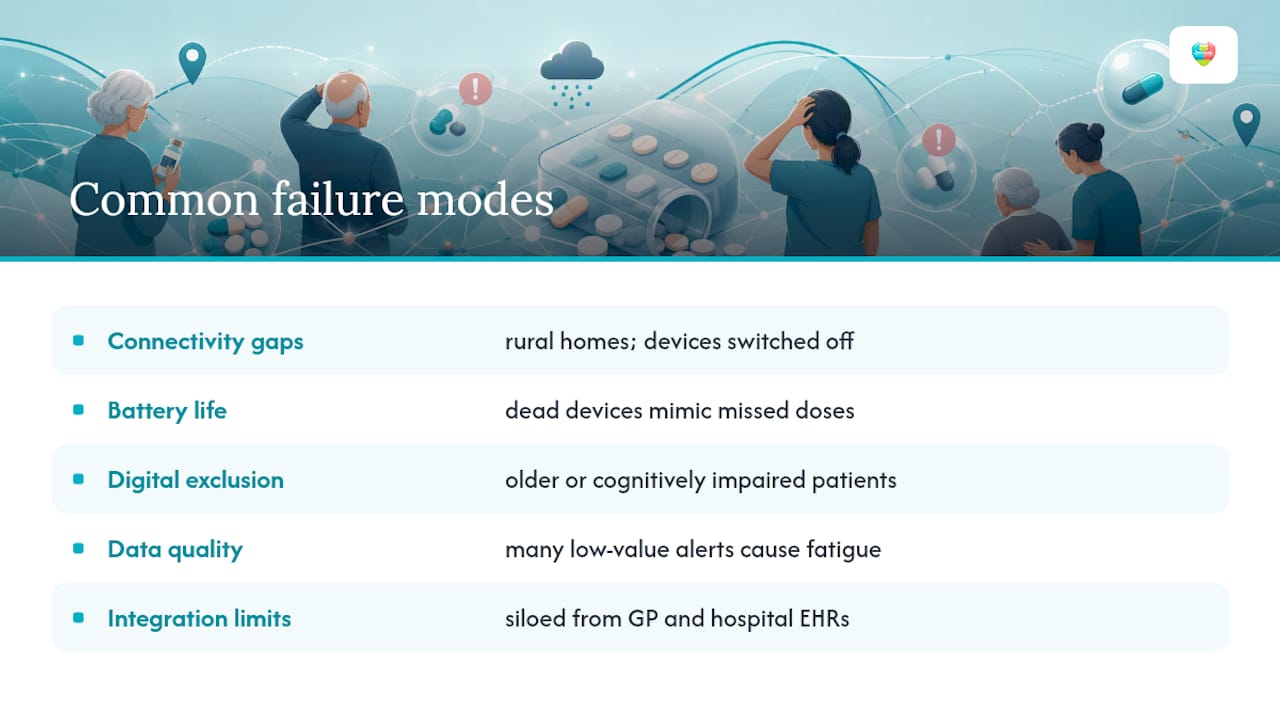
Connectivity gaps are the most common operational headache, particularly in rural areas or homes with elderly residents who switch devices off or forget to charge them overnight. Battery life on wearables and sensors is a genuine limitation, not a footnote; a dead device generates a silent gap that can look identical to a genuine missed dose unless the system distinguishes between the two.
Digital exclusion is a harder problem. Some patients, particularly older or cognitively impaired individuals, simply can't operate an app reliably regardless of how well it's designed, and BYOD models expose that gap fastest. Monitoring that assumes smartphone fluency will quietly exclude exactly the patients who need it most.
There's also a data quality trap: more data doesn't automatically mean better oversight. A system generating hundreds of low-value events a day trains staff to ignore alerts altogether, which defeats the point. And no remote system fully replaces clinical judgement. A dose confirmed as "taken" tells you nothing about whether it was taken correctly, at the right time relative to food, or whether the patient is experiencing side effects they haven't reported. Monitoring narrows the information gap; it doesn't close it.
Finally, integration limits remain real. Many platforms still don't talk cleanly to GP systems or hospital electronic health records, which means monitoring data sits in a separate silo unless someone manually cross-references it during reviews.
How do you keep patients actually engaged with monitoring?
Engagement, not the technology itself, decides whether a programme succeeds. A perfectly designed pillbox that a patient stops using after three weeks has delivered nothing.
Static reminders that fire at the same time every day lose effectiveness fast, because patients start treating them as background noise. Just-In-Time-Interventions, or JITI, take a different approach: prompts adapt based on the patient's actual behaviour patterns, timing, and context, rather than firing on a fixed schedule regardless of relevance. That personalisation tends to sustain adherence longer than a one-size reminder ever does.
User experience design matters more with older patients than younger ones, not less. Large, high-contrast text, minimal steps to confirm a dose, and forgiving error handling (a missed tap shouldn't trigger a panic alert) all reduce drop-off. Involving the patient's actual carer or family member in the initial set-up, rather than expecting the patient to configure things alone, consistently improves early engagement.
Framing also matters. A system presented as "checking up on you" breeds resentment and disengagement. One presented as "helping you stay on top of a complicated regimen" gets used voluntarily. That's not a cosmetic distinction. It shapes whether a patient sees the device as surveillance or support, and that perception decides whether they keep the routine going once the novelty fades. Small adjustments to reminder timing and message tone, tailored to how a specific patient actually behaves, tend to outperform generic defaults over time.
What regulatory requirements go beyond GDPR?
Data protection is necessary but not sufficient. Several other regulatory layers apply depending on what the monitoring tool actually does.
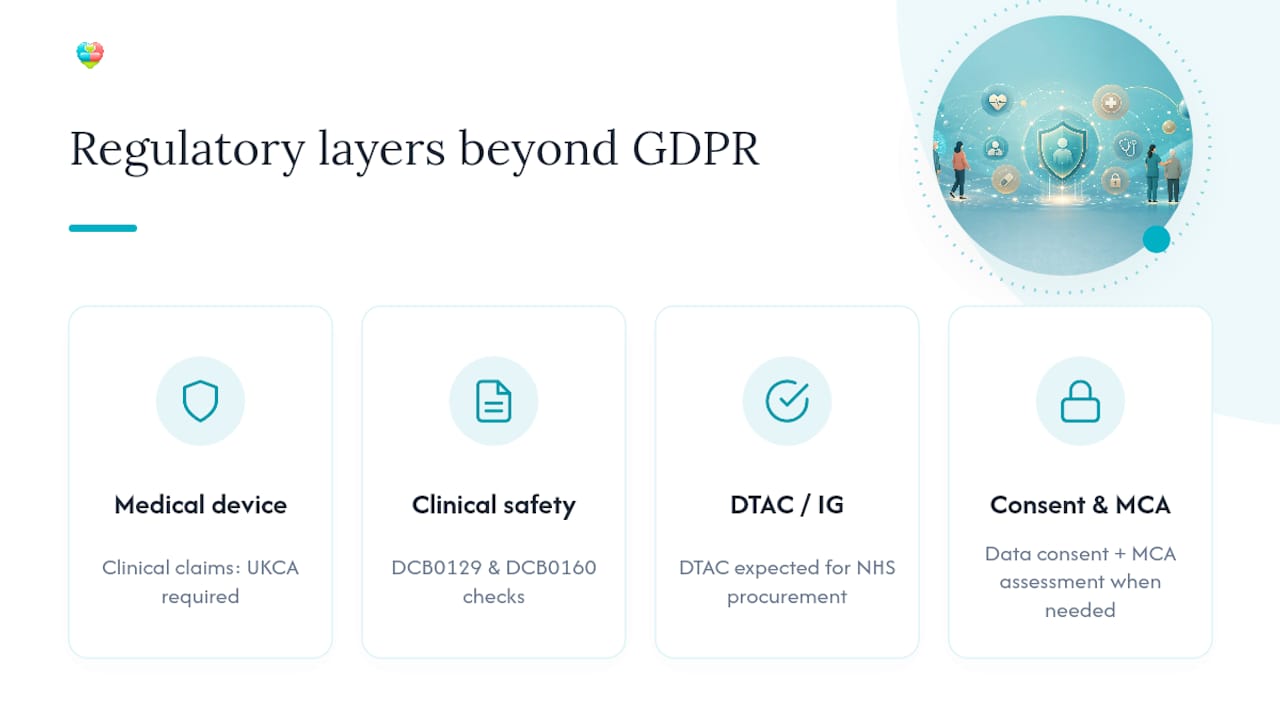
If a device or app makes a clinical claim, such as detecting a missed dose with diagnostic confidence rather than simply logging an interaction, it may fall under medical device regulation and require UKCA marking. Most simple reminder and logging tools sit outside that scope, but video observation, sensor-based confirmation, and anything offering clinical decision support sit closer to the boundary and need a proper regulatory assessment before deployment.
Clinical safety standards, including DCB0129 and DCB0160 for health IT systems used in NHS settings, apply to software that influences clinical decisions. Any monitoring platform feeding data into a clinical workflow, rather than just a carer's phone, should be assessed against these before go-live, not retrofitted afterwards.
Information governance requirements sit alongside GDPR rather than replacing it: NHS Digital Technology Assessment Criteria (DTAC) compliance is increasingly expected for tools procured into NHS or commissioned care pathways. Procurement teams should ask directly whether a vendor has been through a DTAC assessment, because retrofitting compliance after deployment is far costlier than building it in from the start.
Consent frameworks for observed administration, particularly video-based check-ins, need to satisfy both data protection consent and, in some cases, mental capacity considerations if the patient's ability to consent is in question. That's a conversation for a Mental Capacity Act assessment, not a tickbox in an app.
How much extra work does this create for staff?
Remote monitoring changes workload; it doesn't simply reduce it, and pretending otherwise sets teams up for disappointment.
The upfront cost is real: onboarding takes time, training takes time, and the first few weeks of any pilot generate more staff hours per patient than steady-state care, not fewer. Teams that budget for this transition period cope far better than those expecting instant efficiency gains.
Once a programme is running, the workload shifts rather than disappears. Staff spend less time on routine check-in calls and home visits for stable patients, but more time triaging alerts and following up on flagged deviations. Whether that's a net saving depends entirely on alert design; a poorly tuned system generates so much noise that triage time exceeds the time saved on visits.
Training needs go beyond "how to use the app". Staff need to understand what a false negative looks like (a device fault masquerading as a missed dose), how to escalate appropriately, and how to document interventions in a way that stands up to audit. This is closer to a new clinical skill than a software tutorial, and treating it as the latter is a common reason pilots underperform. Building in dedicated training time, rather than a single onboarding session, pays back quickly once a programme scales past its pilot cohort.
What I've learned from watching these pilots succeed and fail
Start smaller than feels comfortable. The programmes that scale well begin with a tight cohort and obsess over alert design before adding patients, not after. The ones that stall almost always over-invested in device choice and under-invested in who actually reads the alerts. Build for the person receiving the notification, not just the one wearing the sensor.
— Prasant
Start your own pilot with The Daily Dose Tracker
If you're weighing up whether to run a small monitoring pilot before committing to bigger infrastructure, The Daily Dose Tracker gives carers and small care teams a free entry point rather than a procurement process. The core scheduling, dose logging, and interaction checks are free to use, which suits a family carer managing one relative's regimen or a small team testing the workflow before scaling.
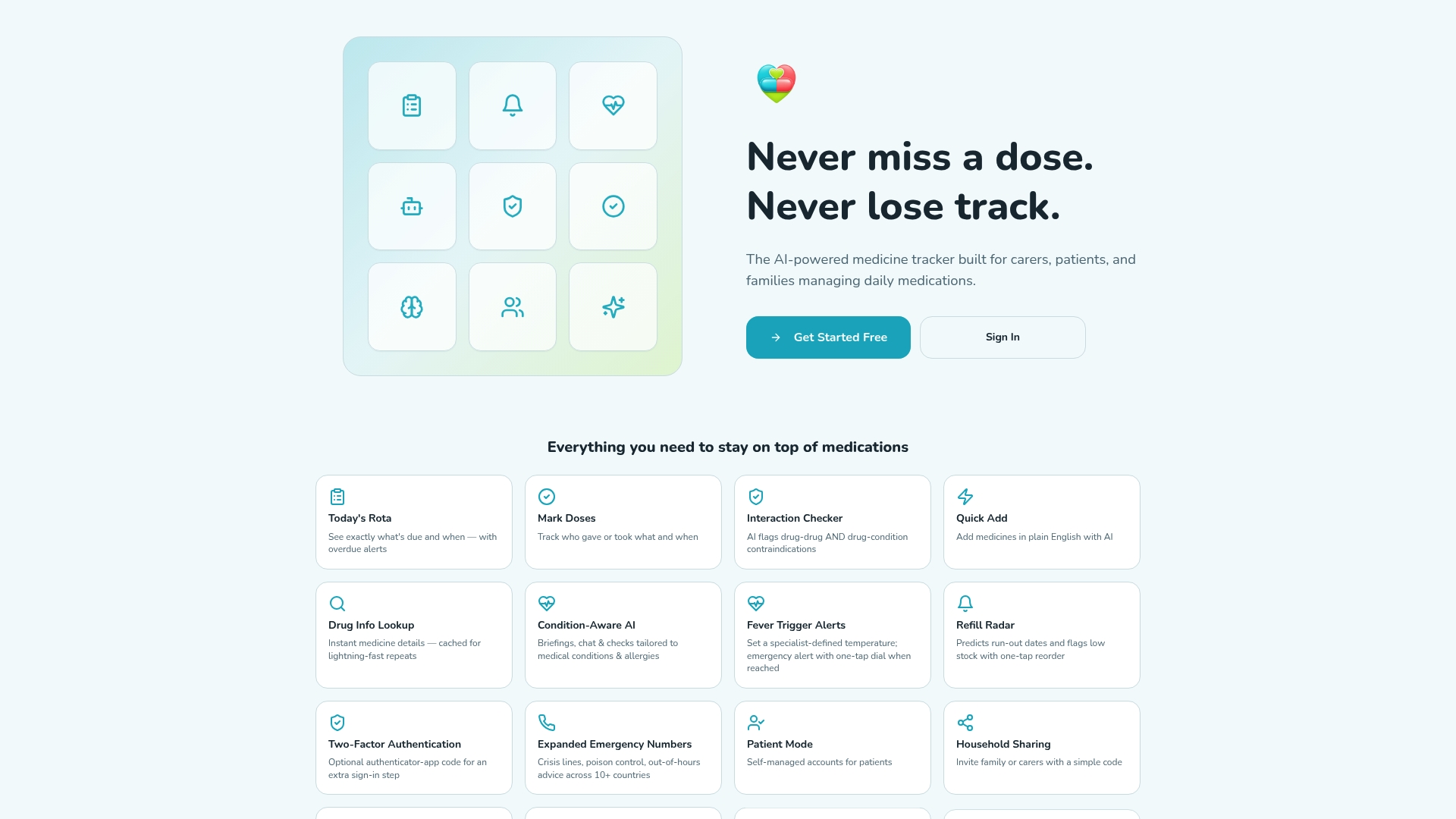
Advanced tools, including multi-patient management, refill prediction, and household sharing, sit behind the paid Individual and Pro tiers for teams that need to coordinate across several patients at once. Before running anything with real patients, get consent and any necessary governance sign-off in place first, exactly as outlined earlier in this guide. To begin, visit The Daily Dose Tracker's sign-up page and start with a single patient before deciding whether to scale.
Sources
For policy context and case studies, see NHSBSA's mental health medicines data, HSJ's reporting, and the Patient Safety Congress resource library.
This article is general information, not a substitute for advice from a qualified doctor. Consult a qualified healthcare professional about your own circumstances before acting on anything here.
- NHSBSA press release: mental health medicines statistics for England (2023–24)
- Statista: prescription items dispensed in England
- Home alone: Remote medication monitoring improves adherence and patient safety